Competitive intelligence in advertising used to mean hiring researchers, running focus groups, or simply guessing what was working for your rivals. Today, the Meta Ad Library puts every active ad from every advertiser directly in front of you, for free. The challenge is no longer access to competitive data. It is knowing how to act on it quickly enough to matter.
That is exactly the problem a Meta ads creative cloning tool solves. Instead of spending days briefing designers, waiting on revision cycles, and debating internally whether a concept will resonate, you start from something the market has already validated. You study the structure of ads that are actively spending, identify what makes them work, and rebuild those patterns with your own brand assets. The result is a dramatically shorter path from competitive insight to live campaign.
This article breaks down what creative cloning actually means in the context of Meta advertising, how the underlying technology works, and how to build it into a repeatable workflow that keeps your creative pipeline ahead of the competition. Importantly, it also clarifies the line between legitimate structural inspiration and the kind of direct copying that creates legal and platform risk.
The Logic Behind Cloning Winning Ad Creatives
Let's get the definition right first, because "cloning" sounds more controversial than it actually is. In the context of Meta advertising, creative cloning does not mean copying someone's images, video footage, or written copy. It means studying the structural blueprint of a successful ad and rebuilding that blueprint with entirely original assets.
Think of it like architecture. If you see a building layout that works exceptionally well, nothing stops you from designing your own building using similar structural principles. The materials, the facade, the interior details are all yours. The logic of the layout is the inspiration. Creative cloning in advertising works the same way.
The elements worth analyzing include visual composition and layout, headline structure and length, offer framing (whether the ad leads with a discount, a benefit, or urgency), CTA style and placement, video hook structure in the first few seconds, text overlay patterns, and format choice. None of these elements are proprietary. They are observable patterns, and studying them is a widely practiced and entirely legitimate competitive research technique.
What makes this approach strategically sound is the signal embedded in ad longevity. When an advertiser keeps a creative running for weeks or months on Meta, they are almost certainly doing it because the ad is generating returns. Advertisers rarely sustain spend on unprofitable creatives. A long-running ad has already survived the market's attention filter. It has proven itself against real audiences with real money behind it.
This is fundamentally different from brainstorming internally and hoping a concept lands. Internal creative decisions are often shaped by personal preference, brand committee opinions, and aesthetic choices that have no connection to what actually drives clicks and conversions. Starting from a proven market signal removes a significant layer of guesswork from the creative process.
The distinction between legitimate structural inspiration and copyright infringement is important to understand clearly. Copying the actual visual assets, video footage, or written copy from a competitor's ad is a legal and platform violation. A proper creative cloning tool never does this. It works from publicly available ad data, analyzes structural and compositional patterns, and generates entirely new assets. The output is original. The intelligence informing it is competitive.
This is why the Meta Ad Library is the foundation of the entire approach. It provides transparent, publicly accessible data on active ads across Facebook and Instagram, and it is the raw material that makes systematic creative intelligence possible at scale.
How the Meta Ad Library Powers Creative Intelligence
The Meta Ad Library was introduced as a transparency measure, giving the public visibility into the ads running across Meta's platforms. What started as an accountability tool has become one of the most valuable free competitive intelligence resources available to digital marketers.
Every active ad across Facebook, Instagram, Messenger, and Audience Network is included. You can search by advertiser name, keyword, or category. The library shows you the creative itself, the format being used, the platforms it is running on, and in many cases, how long the ad has been active. That last data point is the one experienced media buyers pay closest attention to.
An ad that has been running continuously for several weeks or months is a strong signal of profitability. Advertisers operating at scale do not leave underperforming ads live. The budget would be reallocated. So when you see a competitor's ad with a long run duration, you are looking at something that has likely been generating positive returns throughout that period. That is meaningful competitive intelligence before you have spent a single dollar of your own budget.
Manually scrolling through the Meta Ad Library is useful but time-consuming. A Meta ads creative cloning tool connects to this library programmatically, allowing you to pull ad data, filter for relevant competitors, and identify the creatives worth studying without spending hours in manual research. The efficiency difference is significant, especially for agencies managing multiple clients across different verticals.
Here is where the intelligence layer becomes interesting. A basic screenshot of a competitor's ad tells you what it looks like. A proper cloning tool goes deeper, analyzing visual composition to understand how elements are arranged and weighted, text overlay patterns to understand how much copy appears on screen and where, video structure to identify how the hook is constructed in the opening seconds, offer framing to understand whether the ad leads with price, outcome, or emotional benefit, and CTA placement and style to understand how the ad closes the loop.
This structural analysis is what separates a creative cloning tool from a simple ad spy tool. Ad spy tools show you what your competitors are running. A creative cloning tool extracts the underlying framework so you can rebuild it. The difference between seeing an ad and understanding why it works is the intelligence layer that makes cloning actionable rather than just informative.
UGC-style ads deserve specific mention here because they have become a dominant format in Meta advertising. These ads are designed to look and feel like organic content rather than polished brand advertising, which reduces the banner blindness that causes audiences to scroll past traditional ad formats. Identifying when a competitor is successfully using UGC-style creative, and understanding the structural patterns behind it, is a particularly valuable competitive signal.
From Competitor Ad to Your Own Creative: The Generation Process
Understanding the theory is one thing. Seeing the actual workflow makes the value concrete. Here is how the generation process works inside a tool like AdStellar.
The process starts with input. You can paste a competitor ad URL directly into the platform, or you can browse through the integrated Meta Ad Library connection to find ads worth studying. Once you have identified a creative that looks promising based on its format, run duration, or structural approach, you select it as the reference point for your new creative.
The AI then does something more sophisticated than a simple copy. It analyzes the structural blueprint of the reference ad: the visual hierarchy, the headline approach, the offer framing, the CTA style, the pacing if it is a video. It identifies the underlying creative framework rather than the surface-level aesthetic. Is this an urgency-led headline paired with a lifestyle visual? A benefit-forward hook with social proof in the middle? A problem-solution structure with a single strong CTA at the end? The framework is what gets extracted.
Once the framework is identified, the AI generates a brand-new creative using your own inputs: your product images or URL, your brand colors, your messaging and offer. The output is entirely original. Nothing from the competitor's actual ad appears in your creative. What carries over is the structural logic that made the reference ad effective.
This is where chat-based refinement becomes valuable. If the generated creative has the right structure but the tone feels off, or the visual emphasis is not quite where you want it, you can adjust through conversation rather than going back to a designer brief. Want the headline to feel more urgent? Shift the visual to lead with the product rather than a lifestyle shot? Adjust the CTA to be more direct? These refinements happen in the platform without breaking the workflow.
Format flexibility is another significant advantage. Once a strong creative framework is identified from a competitor ad, that same framework can be applied to generate multiple formats from a single competitive insight. The structural logic of a winning image ad can inform a video creative with the same hook approach. A UGC-style script can be generated using the same offer framing. AdStellar's AI handles image ads, video ads, and UGC-style avatar creatives, which means one competitive insight can seed an entire creative set rather than a single ad.
This matters for a practical reason. Running only one version of a concept, even a well-researched one, limits what you can learn. Generating multiple format variations from the same proven framework gives you a richer creative testing surface while keeping the creative investment manageable. You are not starting from scratch with each format. You are applying a validated structural blueprint across different executions and letting performance data tell you which combination resonates most with your specific audience.
The generation process also benefits from AdStellar's ability to clone competitor ads directly from the Meta Ad Library, which means the competitive research and the creative generation happen inside the same workflow rather than requiring you to switch between tools, take screenshots, and brief someone separately on what you found.
Scaling Cloned Concepts with Bulk Ad Variations
Identifying a strong creative framework and generating your first ad from it is a meaningful step forward. But one ad, even a well-structured one, is not a testing strategy. This is where bulk launching transforms a single competitive insight into a systematic advantage.
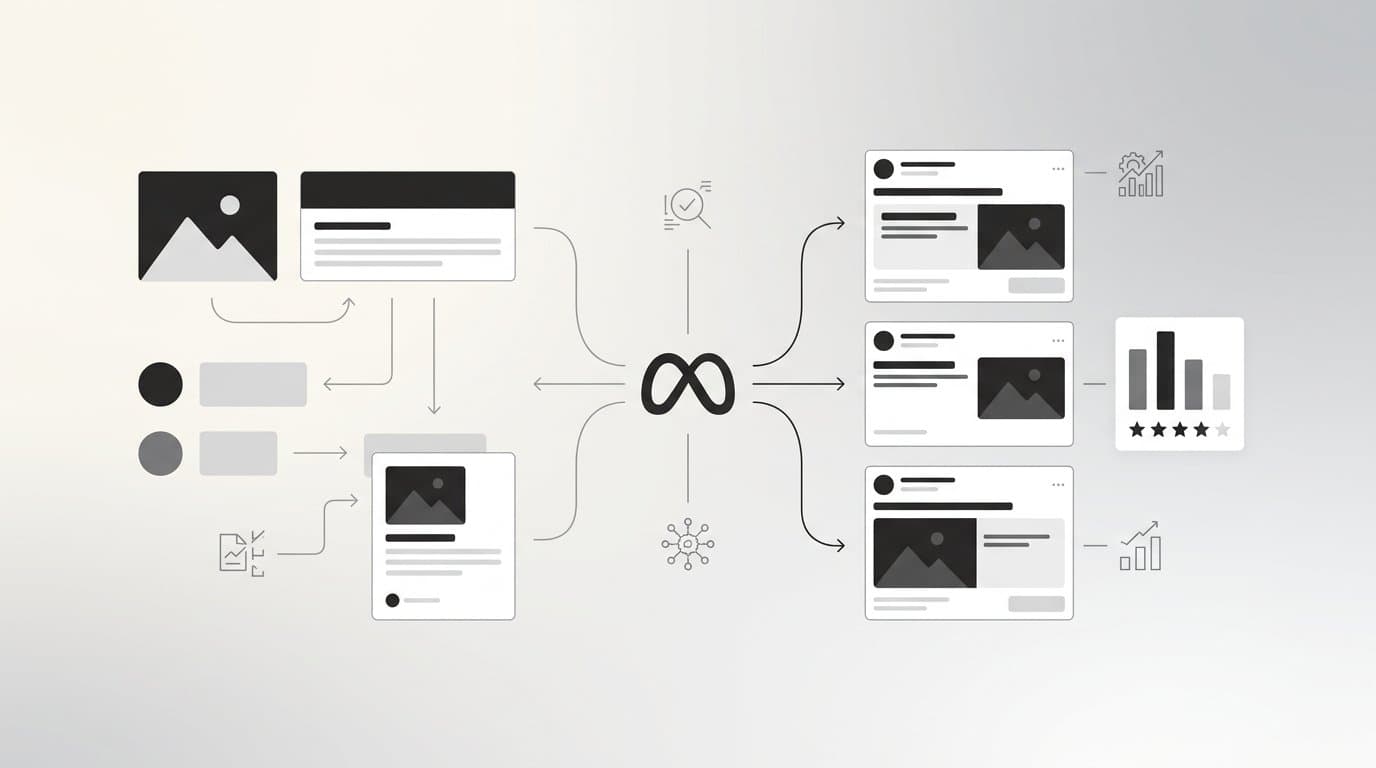
Once you have a cloned creative framework and an initial ad generated, bulk ad launching lets you multiply that concept across hundreds of variations automatically. You mix different headlines, different copy angles, different audience segments, and different visual treatments, and AdStellar generates every combination and prepares them for launch. What would take a team days of manual setup happens in minutes.
The strategic logic here connects directly to how Meta's algorithm works. The platform rewards advertisers who give it enough creative variation to optimize against. A single ad gives the algorithm limited signal. A broad set of variations built on a proven creative framework gives the algorithm meaningful material to work with while keeping your creative investment anchored to something that has already demonstrated market effectiveness.
This approach also directly addresses one of the most persistent challenges in Meta advertising: creative fatigue. Audiences who see the same ad repeatedly show declining engagement and rising CPMs over time. Having a pipeline of fresh variations built on proven structural frameworks is a practical solution. You are not reinventing your Meta ads campaign automation strategy every few weeks. You are systematically refreshing execution while maintaining the structural logic that has proven effective.
Here is where AI insights and leaderboard rankings close the loop. Once your bulk variations are live and accumulating performance data, AdStellar's AI surfaces which version of the cloned concept is actually winning. Leaderboards rank your creatives, headlines, copy, and audiences by real metrics: ROAS, CPA, and CTR. You set your target goals, and the AI scores everything against those benchmarks.
This means you are not left interpreting raw data and guessing which creative direction to scale. The platform tells you which variation of your cloned framework is performing, which headline angle is resonating with which audience, and which format is driving the best cost-per-acquisition. The competitive insight that started the process gets refined through real performance data until you have a clear picture of what is actually working for your brand and your specific audience.
The compound effect of this approach is significant. Each round of bulk testing produces more signal. That signal informs the next round of creative generation. The creative framework that started as a competitive observation becomes a validated, performance-backed asset that gets stronger with each iteration.
Building a Repeatable Competitive Research Workflow
The most effective use of a Meta ads creative cloning tool is not as a one-time tactic but as an ongoing competitive intelligence habit. The teams that benefit most are the ones who build regular competitive research into their creative workflow rather than treating it as something they do when they run out of ideas.
A practical rhythm looks something like this. Set a regular cadence, whether weekly or biweekly, for monitoring the Meta Ad Library in your niche. You are looking specifically for ads with extended run durations, since those are the ones most likely to be generating returns. When you spot a format or structural approach that looks worth adapting, flag it and feed it into your creative pipeline. Over time, you build a running library of competitive signals organized by format type, offer approach, and audience context.
AdStellar's Winners Hub plays a critical role in making this sustainable. As your cloned and adapted creatives prove themselves in your own campaigns, they get stored alongside their performance data. Future campaigns can be built on a winning creative library of validated creative frameworks rather than starting from scratch each time. The competitive intelligence you gathered three months ago, refined through your own testing, becomes institutional knowledge that compounds over time.
There are common mistakes worth avoiding in this process. The first is cloning ads that have not proven themselves. A competitor ad that launched last week has no track record. You have no signal that it is working. Focus your attention on creatives with meaningful run duration, not on whatever is newest in the feed.
The second mistake is failing to adapt the cloned framework to your own brand voice. A structural blueprint is a starting point, not a finished product. If your brand communicates with warmth and humor and you clone a framework from a direct-response advertiser who leads with aggressive urgency, the mismatch between structure and brand voice will undermine the execution. The framework should serve your brand, not override it.
The third mistake is disconnecting creative performance from actual conversion data. Platform-reported metrics like CTR and click volume are useful signals, but they are not the full picture. A creative that drives clicks but fails to convert is not a winner, regardless of what the Meta dashboard shows. Connecting creative performance to actual attribution data, through an integration like Cometly, gives you the full picture of whether a cloned creative concept is genuinely driving business outcomes or just generating activity.
Building this attribution layer into your workflow from the start ensures that the competitive intelligence you gather and the creative frameworks you validate are connected to real business results rather than vanity metrics.
Putting It All Together: Creative Cloning as a Growth Lever
The core value of a Meta ads creative cloning tool comes down to one thing: compressing the creative learning curve. Instead of starting every campaign from internal brainstorming and hoping your instincts are right, you start from what the market has already validated. The structural logic of ads that are actively generating returns becomes the foundation of your own creative strategy.
This is not about imitation. It is about intelligence. The market has already run the experiment. Long-running competitor ads are the results. A creative cloning tool lets you read those results and apply the lessons to your own brand rather than running the same expensive trial-and-error process from scratch.
AdStellar connects the entire loop inside one platform. You identify a competitor ad worth studying through the integrated Meta Ad Library connection. The AI analyzes its structural blueprint and generates a brand-new creative using your own product assets and brand identity. Bulk launching multiplies that concept across hundreds of variations. AI insights and leaderboard rankings surface which variation is actually winning by ROAS, CPA, and CTR. The Winners Hub stores your proven frameworks for future campaigns. And attribution integration ensures your creative performance connects back to real business outcomes.
Every step of that workflow, from competitive research to creative generation to campaign launch to performance analysis, happens inside one platform. No switching between tools. No briefing designers separately. No waiting on revision cycles. The time between spotting a competitive opportunity and having a live campaign built on that insight shrinks dramatically.
For performance marketers and agencies managing Meta campaigns at scale, that speed and systematic approach is a meaningful competitive advantage. The teams moving fastest from insight to execution are the ones consistently finding and scaling winners while others are still in the briefing room.
If you want to experience this workflow firsthand, AdStellar offers a 7-day free trial across all plan tiers, starting at $49 per month for the Hobby plan. Start Free Trial With AdStellar and see how quickly you can move from a competitor insight to a live campaign built on proven creative frameworks, without a designer, a video editor, or a single round of internal guesswork.