If you've been running Meta ads for any length of time, you already know the feeling. You're planning a new campaign and you're almost certain you tested a similar angle six months ago. You remember it performed well. But finding it means digging through dozens of ad sets, cross-referencing campaign names that made sense at the time, and eventually giving up and just rebuilding the creative from scratch.
This is creative chaos. And it's one of the most underestimated performance killers in Meta advertising.
As ad accounts grow, the volume of creative assets compounds fast. A single campaign might generate ten to twenty variations. Run multiple campaigns per month across different products, audiences, and objectives, and you're quickly managing hundreds of assets with no clear system to track what worked, what flopped, or what's worth reusing. The problem isn't creativity. It's organization.
A meta ads creative library organizer solves this by creating a centralized, searchable, performance-linked system for every creative asset you produce. Instead of hunting through Ads Manager or digging through shared drives, you have a single source of truth that tells you exactly which creatives performed, why they worked, and how to deploy them again. In 2026, with creative testing velocity continuing to accelerate and AI-powered ad generation making it easier than ever to produce high volumes of assets, having an organizational system isn't optional. It's the foundation of scalable Meta advertising.
Why Creative Chaos Kills Meta Ad Performance
The lifecycle of a Meta ad creative is surprisingly short and surprisingly messy. You brief a designer or generate an asset, upload it to Ads Manager, run it against an audience, and move on to the next test. If the ad performs, great. If it doesn't, it gets paused and buried. Over time, you accumulate a graveyard of untested, partially tested, and proven assets spread across campaigns with no connective tissue between them.
The first cost of this disorganization is duplicated effort. Teams regularly recreate concepts that have already been tested because there's no accessible record of what was tried. A new team member, an agency handoff, or even just a few months of distance from a campaign can mean starting from zero instead of building on existing knowledge.
The second cost is wasted ad spend. When you can't track which creative angles have already been exhausted, you end up spending budget testing ideas that have already been proven to underperform. That spend isn't just wasted on the test itself. It delays finding the next winner. Understanding your budget allocation strategies becomes nearly impossible when your creative data is scattered.
The third and most compounding cost is the inability to identify patterns. The real value in a large creative library isn't any single winning ad. It's the patterns across winners. Maybe your direct-response hooks consistently outperform lifestyle imagery. Maybe video ads under fifteen seconds drive lower CPA than longer formats for your specific audience. Maybe a particular value proposition resonates across multiple audience segments. These insights are sitting in your data, but they're invisible when your assets are scattered and untagged.
There's also a scaling problem that's specific to Meta. As you increase budget and expand campaigns, the pressure to produce more creative volume increases. Teams respond by generating more assets faster, which compounds the organizational problem. Without a system in place before you scale, the chaos grows proportionally with your spend.
The pattern is consistent across ad accounts of every size. The teams that scale most efficiently aren't necessarily the ones producing the most creative. They're the ones who know exactly what they have, what it did, and how to use it again. That's what a creative library organizer enables.
What a Creative Library Organizer Actually Does
It's worth being clear about what a creative library organizer is, because the term gets used loosely. A shared Google Drive folder is not a creative library organizer. Neither is a Dropbox archive or a Notion database with thumbnail screenshots. These are file storage systems. They can hold your assets, but they can't tell you how those assets performed.
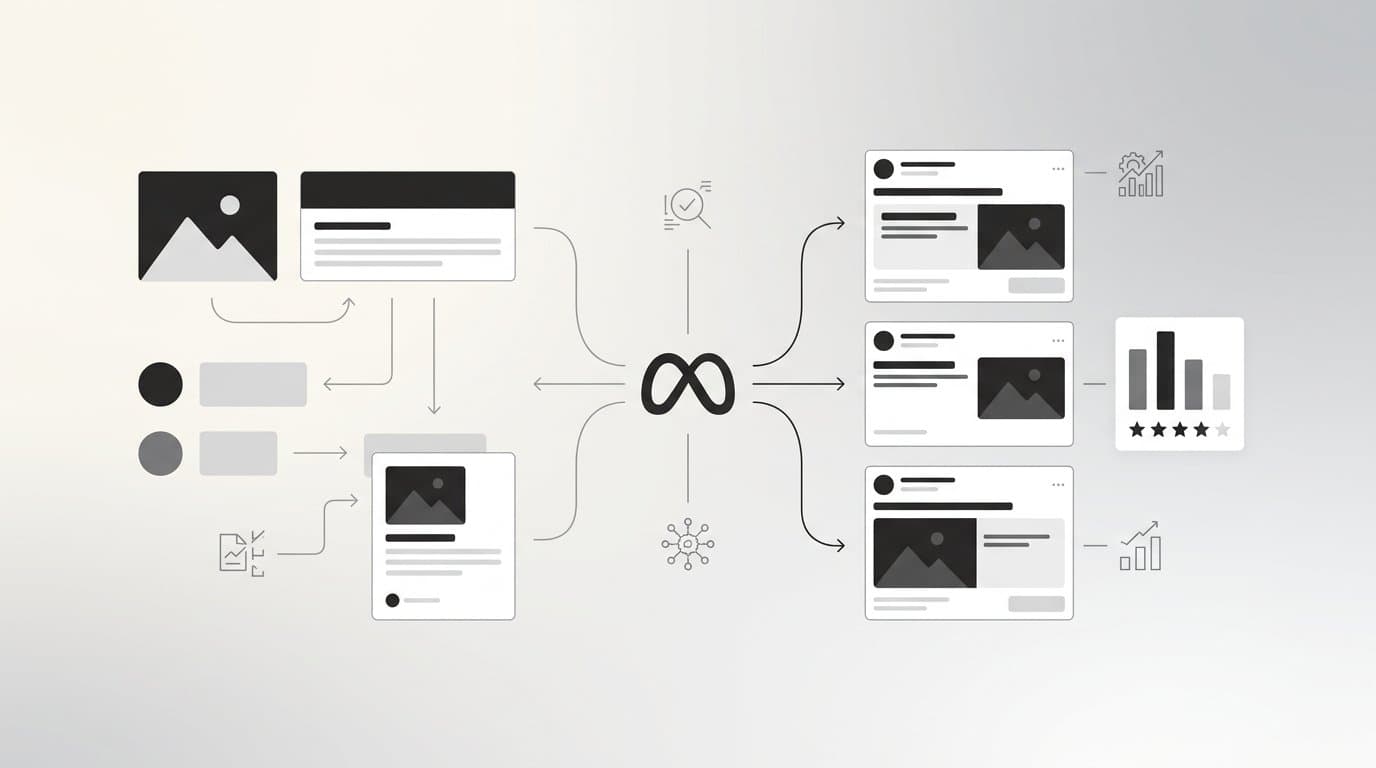
A true meta ads creative library organizer does something fundamentally different: it ties your creative assets to live performance data from Meta. That connection is what transforms a folder of images and videos into an actionable intelligence system. A dedicated creative management platform is purpose-built for this kind of workflow.
The core functions of a proper creative library organizer include several key capabilities. The first is centralized storage with performance linkage. Every asset lives in one place, and every asset has performance metrics attached to it: ROAS, CPA, CTR, spend, conversions. You can look at any creative and immediately see its performance history.
The second function is searchability and filtering. You need to be able to find creatives by more than just file name. Filtering by format (image, video, UGC), by performance metric, by campaign objective, by audience segment, or by creative angle is what makes the library actually useful at scale.
The third function is tagging and taxonomy. This is how you add context that raw performance data doesn't capture. A creative might have a strong CTR but you also need to know it was a product demo video targeting cold audiences at the top of funnel. Tags encode that context so you can find and compare like assets intelligently.
The fourth function is surfacing winners. A creative library organizer should make it easy to identify your top performers across any dimension you care about, whether that's best ROAS in the last thirty days, lowest CPA by creative format, or highest CTR by audience segment. The goal is to turn your historical data into forward-looking creative strategy.
It's also worth clarifying one common point of confusion: a meta ads creative library organizer is entirely different from Meta's Ad Library. Meta's Ad Library is a public transparency tool that lets you browse active ads running across Facebook and Instagram from any advertiser. It's a research and competitive intelligence resource, and you can learn more about how to use it in our guide to the Meta Ads Library. Your creative library organizer is a private, internal system for managing your own assets. The two serve completely different purposes, though some platforms let you pull inspiration from Meta's Ad Library and feed it directly into your own creative workflow.
Building Your Organizational Framework: Tags, Naming, and Taxonomy
The foundation of any creative library is a consistent naming convention. When you're managing dozens of assets, inconsistent file names feel like a minor annoyance. When you're managing hundreds, they become a serious operational problem. Establishing a naming system from the start, and applying it retroactively to existing assets, is one of the highest-leverage organizational investments you can make.
A practical naming convention for Meta ad creatives typically follows a structure that captures the most important context at a glance. A format like [Date]_[Creative Angle]_[Format]_[Audience Segment] works well for most accounts. For example: 2026-05_SocialProof_VideoShort_ColdLookalikeUS. Anyone on the team can read that file name and immediately understand when it was created, what angle it uses, what format it is, and who it was targeting.
The naming convention should be simple enough that it gets used consistently, which means avoiding overly granular structures that create friction. Four to five components is usually the right balance between context and usability. This kind of discipline also pays dividends when you're building out your creative testing strategy, since well-named assets make test results far easier to interpret.
Beyond naming, your tagging taxonomy is where the real organizational depth lives. Tags should map directly to your testing strategy and the dimensions you actually want to analyze. Consider building your taxonomy around these categories:
Creative Hook Type: How does the ad open? Question hooks, bold statements, social proof, problem-agitation, and curiosity gaps are all distinct angles that perform differently across audiences and objectives.
Value Proposition: What primary benefit does the creative communicate? Price, speed, quality, social proof, exclusivity, and ease of use are common value propositions worth tracking separately.
Visual Style: Is it lifestyle imagery, product-focused, user-generated content style, animation, or talking-head video? Visual style often has a stronger impact on performance than the copy alone.
Funnel Stage: Top of funnel, middle of funnel, and retargeting creatives serve different purposes and should be compared within their own category, not against each other.
CTA Type: Shop Now, Learn More, Get Offer, Sign Up. Tracking which CTAs perform by objective and audience adds another layer of actionable insight.
If you're retroactively organizing an existing library, don't try to tag everything at once. Start with your top spenders and top performers from the past six to twelve months. These are the assets most likely to be reused or iterated on, and they'll give you the highest return on your organizational effort. Work backward from there as time allows.
Surfacing Winners: Using Performance Data to Rank and Reuse Creatives
Organization is only valuable if it leads to better decisions. The payoff of a well-structured creative library comes when you can quickly identify your best-performing assets and put them back to work.
A performance-linked creative library lets you rank every asset by the metrics that matter most to your specific goals. If you're optimizing for ROAS, you can sort your entire library by ROAS and immediately see which creatives have delivered the strongest return. If you're running a lead generation campaign where CPA is the primary metric, you can filter by CPA and find your most efficient assets in seconds. Understanding which performance metrics to prioritize is essential for making this ranking meaningful.
The concept of a winners hub takes this a step further. Rather than searching through your full library every time you need to build a campaign, a winners hub is a curated collection of your proven top performers. Think of it as the highlight reel of your creative library. Your best-performing images, videos, headlines, and copy variants all live together with their real performance data attached, ready to be deployed into new campaigns without rebuilding from scratch. For a deeper dive into building this system, explore our guide to a winning creative library.
The practical workflow looks like this: you're launching a new campaign targeting a fresh audience segment. Instead of briefing new creative, you open your winners hub, filter by relevant format and funnel stage, and pull the three to five assets that have performed best in comparable contexts. You launch those proven creatives against the new audience alongside a smaller set of new test variations. Your baseline performance is immediately higher because you're leading with proven winners rather than untested concepts.
This approach also changes how you think about creative iteration. When a winner is clearly identified and tagged with its performance context, you can make informed decisions about what to iterate on. If a video ad with a social proof hook is consistently driving low CPA, you don't just reuse it. You create variations that test different social proof formats, different lengths, and different CTAs while keeping the core winning angle. The library becomes a map for systematic creative development rather than a collection of one-off experiments.
Over time, this compounds. Teams that consistently surface and build on winners develop a creative knowledge base that gets more valuable with every campaign. The library doesn't just store history. It actively improves future performance.
Scaling Creative Testing Without Losing Control
One of the most common challenges in scaling Meta ad campaigns is maintaining testing discipline as creative volume increases. It's easy to run structured tests when you have ten creatives. When you have two hundred, the complexity can quickly become unmanageable without a system to support it.
A well-organized creative library is the prerequisite for effective bulk ad creation. When your assets are tagged, named consistently, and linked to performance data, mixing and matching proven elements becomes straightforward. You can pull your top three video creatives, combine them with your five best-performing headlines, and pair them with two different copy variants to generate thirty unique ad combinations in minutes. The ability to launch multiple Meta ads at once depends entirely on having this organizational foundation in place. Without it, bulk launching creates a different kind of chaos: lots of ads with no clear way to track what combination drove which result.
Multivariate testing also depends on organizational discipline. When you're testing multiple creative variables simultaneously, you need to be able to isolate the impact of each variable after the fact. That requires consistent tagging before the test runs, not after. If your assets are tagged by hook type, visual style, and CTA, you can analyze results across those dimensions and draw conclusions that inform future creative strategy rather than just identifying a single winner.
The feedback loop is where organized libraries create compounding returns. Every test you run generates data. That data should flow back into your library as updated performance tags, new winners added to your hub, and retired assets clearly marked so they don't get retested. Learning how to scale Meta ads efficiently requires exactly this kind of systematic approach. Over time, your library becomes a living record of your creative knowledge: what works for which audience, at which funnel stage, for which objective. Each campaign makes the next one smarter.
Teams that build this feedback loop into their workflow consistently outperform those that treat each campaign as a standalone effort. The creative library becomes the institutional memory of your advertising program, and that memory is a genuine competitive advantage.
How AI Transforms Creative Library Management
Manual tagging, naming conventions, and spreadsheet-based tracking systems work. But they require consistent human effort to maintain, and they tend to break down as team size and creative volume increase. This is where creative automation powered by AI is changing the game for Meta advertisers.
AI can automate the most labor-intensive parts of creative library management. Rather than manually reviewing performance data and tagging assets, an AI system can continuously monitor your campaigns, score every creative against your defined performance benchmarks, and automatically surface top performers. This removes the organizational bottleneck that causes most manual systems to fall apart at scale.
More importantly, AI can identify patterns that human review would miss. When an AI analyzes hundreds of creatives across thousands of data points, it can recognize that a specific combination of visual style, hook type, and audience segment consistently drives stronger ROAS. It can flag creatives that are showing early signs of fatigue before performance drops significantly. It can recommend which proven winners to iterate on and which underperformers to retire, based on actual performance trajectories rather than gut feel.
The connection between AI-powered creative analysis and new creative generation is particularly powerful. When your AI system knows which creative patterns are working, it can apply those patterns to generate new variations that are grounded in proven performance data rather than starting from a blank slate. Platforms built for AI-driven Meta ads campaigns close the loop between your creative library and your creative production pipeline.
AdStellar is built around exactly this kind of integrated, intelligent creative management. The Winners Hub centralizes your top-performing creatives, headlines, audiences, and landing pages with real performance data attached, so your best assets are always one click away from your next campaign. The AI Insights feature goes further by using leaderboard rankings to score every ad element against your specific goals, whether that's ROAS, CPA, or CTR. You set your benchmarks, and the AI continuously evaluates every creative in your library against them.
The AI Campaign Builder takes this intelligence and applies it forward. It analyzes your historical campaign data, ranks your creative and audience performance, and builds complete Meta ad campaigns with full transparency into every decision it makes. You're not just getting a recommended campaign. You're getting an explanation of why each element was selected, grounded in your own performance history.
For teams managing high creative volume, AdStellar's Bulk Ad Launch feature lets you take proven winners from your library and create hundreds of ad variations in minutes by mixing creatives, headlines, audiences, and copy at both the ad set and ad level. The organizational work you've done in your creative library directly enables faster, smarter scaling. And for generating new creatives to add to that library, AdStellar's AI Creative Hub can build image ads, video ads, and UGC-style content from a product URL, or clone competitor ads directly from Meta's Ad Library to inspire new angles.
The result is a single platform that handles the full creative lifecycle: generate, organize, test, analyze, and redeploy. That's what a truly intelligent meta ads creative library organizer looks like in practice.
Your Next Steps Toward Creative Clarity
A meta ads creative library organizer is not a productivity tool for the overly organized. It's a performance tool for anyone serious about scaling Meta ads efficiently. As creative volume increases and testing velocity accelerates, the gap between teams with organized systems and those without grows wider with every campaign.
The key pillars are straightforward: centralized storage tied to live performance data, a consistent naming and tagging taxonomy, a clear system for surfacing and redeploying winners, and ideally an AI-powered layer that automates the scoring, ranking, and pattern recognition that manual systems struggle to sustain at scale.
Start where you are. If you have an existing library in chaos, begin by tagging your top performers from the past six to twelve months. Build a naming convention and apply it going forward. Create a simple winners hub, even if it's just a dedicated folder or spreadsheet at first, and commit to keeping it current. The discipline you build now will compound as your account grows.
If you want to skip the manual infrastructure and go straight to an AI-powered system that handles creative generation, organization, performance scoring, and campaign building in one place, AdStellar is built for exactly that. The Winners Hub and AI Insights features bring intelligent creative organization into your workflow from day one, and the 7-day free trial means you can see what your organized creative library could look like before committing.
Start Free Trial With AdStellar and be among the first to launch and scale your ad campaigns faster with an intelligent platform that automatically builds, tests, and surfaces winning ads based on real performance data.