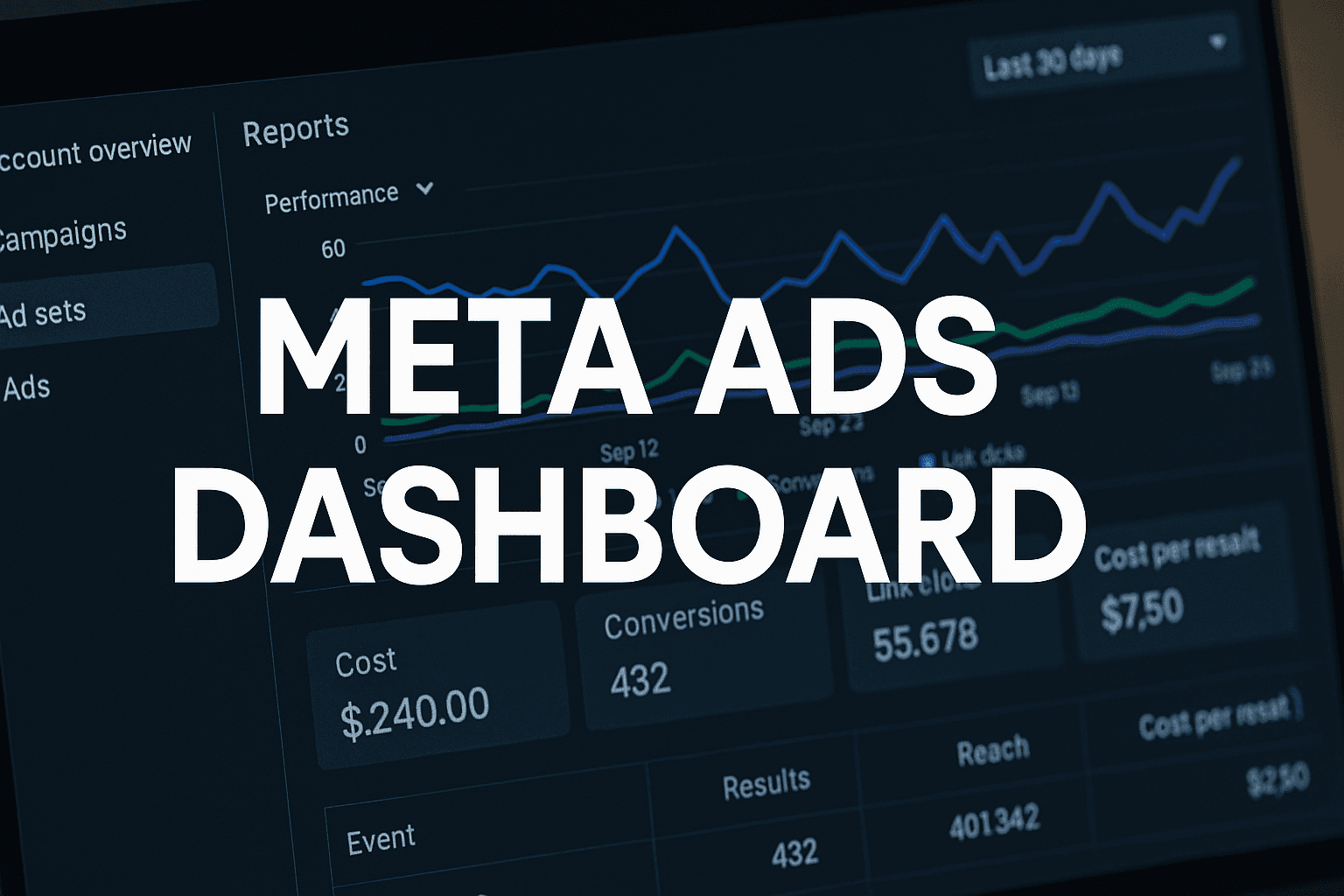
It's 9:47 AM on a Monday. Your coffee's gone cold. You've been staring at your Meta ads dashboard for twenty minutes, and somehow you're more confused now than when you started.
The numbers are all there—impressions climbing, clicks happening, money flowing out of your budget. But what story are they telling? Is that 2.3% CTR good or terrible? Should you be celebrating that $4.50 CPC or panicking? And why does your ROAS look completely different today than it did yesterday afternoon?
You're not alone in this dashboard paralysis. Thousands of advertisers open their Meta ads dashboard every morning with the same sinking feeling—drowning in data but starving for actual insights.
Here's the thing most people miss: your dashboard isn't just a reporting tool. It's a strategic intelligence hub that's constantly broadcasting signals about what's working, what's failing, and where your next breakthrough opportunity is hiding. The problem isn't the dashboard—it's that nobody taught you how to read it like a detective reads clues at a crime scene.
Think about it. Every metric on that screen represents real human behavior. Someone saw your ad and decided to scroll past it. Someone else stopped, clicked, and maybe even bought something. Your dashboard is recording these micro-decisions thousands of times per day, creating patterns that predict your campaign's future—if you know how to spot them.
But instead of pattern recognition, most advertisers fall into reactive mode. They see a red number and panic. They spot a green arrow and relax. They make optimization decisions based on gut feelings dressed up as data analysis. And their campaigns suffer for it.
This guide transforms you from a dashboard checker into a dashboard detective. You'll learn how Meta structures information to guide your attention, which metrics actually matter for decision-making, and how to read the interconnected story your data is telling—not just isolated numbers in boxes.
By the end, you'll understand why your dashboard shows what it shows, when to act on what you're seeing, and how to avoid the costly mistakes that sabotage even experienced advertisers. More importantly, you'll develop the dashboard literacy that separates professionals who scale campaigns confidently from those who throw money at problems and hope for the best.
Let's decode your command center.
Let's decode your command center.
Decoding Your Meta Ads Command Center
Think of your Meta ads dashboard as mission control for a spacecraft. You wouldn't launch a rocket by randomly pushing buttons and hoping for the best. Yet that's exactly how most advertisers approach their dashboard—clicking around, checking numbers, making gut-feel decisions without understanding what they're actually looking at.
Your dashboard isn't just a collection of charts and numbers. It's a real-time intelligence system that's constantly processing millions of data points about human behavior, competitive dynamics, and market conditions. Every metric on that screen represents actual people making split-second decisions about your ads—and those decisions create patterns that predict your campaign's future.
The difference between advertisers who scale profitably and those who burn through budgets comes down to one thing: understanding what their command center is actually telling them.
Your Digital Mission Control
At its core, the Meta ads dashboard serves as your centralized command center for every advertising operation you're running. It's not just showing you what happened yesterday—it's broadcasting real-time signals about what's working right now, which audiences are responding, and where your next breakthrough opportunity is hiding.
The dashboard aggregates data from multiple campaigns, ad sets, and individual ads into a unified view. But here's what most people miss: it's not designed to give you answers. It's designed to help you ask better questions. When you see your CTR dropping, the dashboard isn't telling you to panic—it's asking you to investigate whether your creative is fatiguing, your audience is saturating, or your competitors just launched an aggressive campaign.
Professional advertisers use their dashboard as a pattern recognition tool. They're not checking individual numbers in isolation—they're looking for relationships between metrics that reveal the underlying story. When CTR stays strong but conversion rate drops, that's not two separate problems. That's one story about audience quality or landing page friction.
Understanding these patterns becomes exponentially more valuable when integrated into a systematic meta ads workflow that transforms insights into repeatable optimization actions.
Beyond Basic Metrics: Strategic Intelligence
The real power of your dashboard emerges when you stop treating it as a report card and start using it as strategic intelligence. Every data point is a clue about human behavior at scale. Your audience isn't just clicking or not clicking—they're telling you which messages resonate, which visuals stop the scroll, and which offers trigger action.
Consider what your dashboard reveals about creative performance. When one ad variation generates 3x the engagement of another, that's not random luck. It's your audience broadcasting their preferences. Maybe they respond better to lifestyle imagery than product shots. Maybe questions in headlines outperform statements. Maybe shorter copy beats longer explanations for your specific market.
These insights compound over time. The dashboard doesn't just show you what's working today—it builds a knowledge base about your audience's psychology that informs every future campaign. Advertisers who treat their dashboard as a learning system rather than a scorecard develop an unfair advantage: they know their audience better than competitors who just chase yesterday's winning numbers.
The strategic intelligence goes deeper than creative performance. Your dashboard reveals audience expansion opportunities through demographic breakdowns that show unexpected high-performers. It exposes placement preferences that guide budget allocation. It identifies time-of-day patterns that optimize delivery scheduling. All of this
Decoding Your Meta Ads Command Center
Stop thinking of your Meta ads dashboard as a spreadsheet with pretty graphs. That's like calling NASA's mission control "a room with some screens."
Your dashboard is a real-time intelligence hub that's monitoring thousands of micro-decisions happening across your campaigns right now. Someone in Chicago just scrolled past your ad. Someone in Austin clicked it. Someone in Seattle bought something because of it. Every one of these actions is being recorded, categorized, and translated into the metrics you're looking at.
But here's what separates professionals from amateurs: pros don't just check numbers. They read patterns.
Your Digital Mission Control
Think about how air traffic controllers work. They're not watching individual planes—they're monitoring flight patterns, identifying potential conflicts, and making strategic decisions based on how everything moves together. That's exactly what your dashboard enables when you know how to read it properly.
The dashboard centralizes every signal from your advertising operations into one command center. Campaign performance across multiple ad sets. Audience behavior patterns that reveal who's actually engaging. Creative elements that are winning or dying. Budget pacing that tells you if you'll hit your targets or run out of money by Tuesday.
Marketing agencies live in this space differently than solo advertisers. They're juggling dozens of client accounts, each with different objectives, budgets, and performance standards. Their dashboard mastery isn't about checking if one campaign is working—it's about pattern recognition across their entire portfolio. They spot a winning audience segment in one account and test it across three others before lunch. They identify creative fatigue patterns and proactively refresh assets before performance drops.
This is the mindset shift that changes everything: you're not checking numbers. You're gathering intelligence that predicts what happens next.
Beyond Basic Metrics: Strategic Intelligence
Here's where most advertisers get stuck. They see CTR going up and think "good." They see CPC going down and think "better." But they're reading individual data points instead of the story those points are telling together.
Your dashboard reveals campaign narratives through data patterns. A rising CTR combined with stable CPC means your audience targeting is getting sharper—you're reaching people who actually care about your offer. But rising CTR with rising CPC? That's competitive pressure. Someone else is bidding on your audience, and you need to either improve your creative or find new segments.
These patterns predict future outcomes before they show up in your conversion data. Declining engagement rates on your top-performing creative? That's creative fatigue broadcasting a warning three days before your ROAS tanks. Audience overlap increasing between ad sets? That's auction competition you're creating against yourself, driving up costs before you even notice the budget impact.
The dashboard also reveals audience behavior insights that most advertisers completely miss. Device performance variations tell you when your mobile experience needs work. Time-of-day patterns show you when your audience is actually ready to buy versus just browsing. Geographic performance differences highlight expansion opportunities or problem markets that need creative adjustments.
And creative performance patterns? This is where scaling decisions get made. When you identify that
Beyond Basic Metrics: Strategic Intelligence
Your dashboard isn't showing you numbers. It's showing you human behavior translated into data patterns—and those patterns are trying to tell you something.
Think about it this way: when your CTR drops 0.8% on Tuesday afternoons, that's not random noise. That's your audience signaling that their attention shifts at that specific time. When one ad creative consistently outperforms others with 18-24 year olds but underperforms with 35-44 year olds, that's not just a metric—that's a roadmap for audience segmentation and creative customization.
The difference between dashboard checkers and dashboard detectives comes down to pattern recognition. Checkers see isolated numbers. Detectives see interconnected stories that predict what happens next.
Performance Trends as Future Predictors: Your dashboard's historical data contains leading indicators that forecast campaign trajectory. A gradual CTR decline over five days, even while ROAS remains stable, signals creative fatigue before it impacts your bottom line. Catching this pattern early means you can refresh creative proactively rather than reactively scrambling when conversions tank.
Audience Behavior Insights for Targeting Refinement: The demographic and placement breakdowns in your dashboard reveal expansion opportunities hiding in plain sight. When you notice that Instagram Stories consistently delivers 40% lower CPC than Feed placements for your 25-34 female audience, you've discovered a scaling pathway. When desktop conversions cost 3x more than mobile despite similar CTRs, you've identified a targeting inefficiency worth investigating.
Creative Performance Patterns for Scaling Decisions: Your dashboard tracks which headlines, images, and video hooks drive engagement across different audience segments. When you spot that user-generated content styles outperform polished studio shots by 60% in engagement rate, you've uncovered a creative direction worth doubling down on. When carousel ads consistently generate higher conversion rates than single-image ads despite lower CTR, you've learned something valuable about your audience's decision-making process.
Here's where dashboard literacy transforms into competitive advantage: most advertisers make optimization decisions based on yesterday's performance. Dashboard detectives make decisions based on pattern trajectories that predict tomorrow's performance. They see the creative fatigue signal before ROAS drops. They identify the winning audience segment before competitors saturate it. They catch the placement inefficiency before it drains budget.
The dashboard isn't hiding its intelligence from you. It's broadcasting signals constantly. The question is whether you're listening for isolated data points or tuning into the complete performance symphony playing out across your campaigns.
The Hidden Psychology Behind Dashboard Design
Ever notice how your eyes always land on that big performance number at the top of your dashboard first? That's not an accident. Meta's interface designers spent thousands of hours studying how advertisers process information under pressure, and they built the dashboard to guide your attention in very specific ways.
Understanding this hidden psychology doesn't just make you a better dashboard reader—it makes you a better decision maker. Because once you see how the interface is designed to influence your thinking, you can step back and analyze data more objectively instead of reacting to whatever catches your eye first.
Information Architecture That Guides Decisions
The dashboard follows a deliberate visual hierarchy that mirrors how most people make advertising decisions. Performance metrics appear at the top because they trigger immediate emotional responses—green numbers create relief, red numbers create urgency. This placement isn't about convenience; it's about leveraging psychological triggers that drive action.
But here's what most advertisers miss: that top-line performance summary is designed for quick health checks, not deep analysis. It's the dashboard equivalent of checking your pulse—useful for knowing if something's seriously wrong, but terrible for diagnosing complex problems.
The real strategic intelligence lives in the sections below—audience breakdowns, placement performance, creative comparisons. These areas require slower, more deliberate analysis, which is exactly why they're positioned lower in the visual hierarchy. The interface assumes you'll spend 80% of your time on that top performance section and 20% on everything else. Professional advertisers flip that ratio.
Color coding creates another psychological layer. Red and green indicators trigger instant emotional responses that bypass rational analysis. You see red, your stress response activates. You see green, you relax. This emotional reaction happens before your analytical brain even processes what the numbers actually mean.
Smart advertisers train themselves to look at the numbers first, then the colors. What looks like a "bad" red indicator might actually be a 5% variance that's completely normal for your campaign type. What looks like a "good" green trend might be masking a fundamental problem in your conversion funnel.
Data Flow: From Click to Dashboard
Here's something that confuses even experienced advertisers: your dashboard is telling you three different stories depending on when you look at it. Morning data tells a different story than evening data, which tells a different story than week-old data. Understanding this timing dynamic prevents countless premature optimizations.
When someone clicks your ad, that action doesn't instantly appear as a neat data point on your dashboard. It travels through Meta's attribution system, gets matched to user profiles, waits for conversion windows to close, and finally gets aggregated into the metrics you see. This process can take anywhere from minutes to days depending on your attribution settings.
Real-time metrics like impressions and clicks update quickly because they're simple to track—someone saw your ad, someone clicked it, done. But conversion-based metrics like ROAS require Meta to wait and see if that click eventually led to a purchase. If you're using a 7-day click attribution window, your ROAS from Monday's traffic won't be complete until the following Monday.
This is why your dashboard numbers change throughout the day even when you haven't touched your campaigns. Meta isn't recalculating your performance—it's receiving delayed conversion data and updating your metrics accordingly. That "declining" ROAS you panic about at 9 AM might look
Your Dashboard Mastery Roadmap
You started this guide staring at a confusing grid of numbers. You're finishing it with a completely different lens—one that sees patterns instead of chaos, stories instead of statistics, and opportunities instead of overwhelming data.
That transformation matters because your Meta ads dashboard isn't just reporting what happened. It's broadcasting signals about what's about to happen next. The declining CTR that predicts tomorrow's rising costs. The audience segment that's quietly outperforming everything else. The creative pattern that's begging to be scaled. These insights were always there—you just needed the detective skills to spot them.
Remember the core principles: Your dashboard is a strategic intelligence hub, not a scoreboard. Metrics tell interconnected stories, not isolated facts. Timing and context determine whether you're optimizing or sabotaging. And professional dashboard setup isn't about checking more often—it's about seeing more clearly when you do check.
But here's the thing about mastery: it reveals the limits of manual analysis. You can read patterns brilliantly, but you can't monitor them 24/7. You can identify winning combinations, but you can't test hundreds of variations simultaneously. You can make smart optimization decisions, but you can't execute them at machine speed across dozens of campaigns.
This is where dashboard literacy becomes the foundation for something more powerful. Start Free Trial With AdStellar AI and watch as your hard-won dashboard insights transform into automated action. Our AI agents monitor the exact patterns you've learned to recognize—then automatically launch optimized campaigns based on what your data reveals. You get the strategic intelligence you've mastered, amplified by AI that never sleeps, never second-guesses, and never misses an opportunity hiding in your dashboard.
Your dashboard detective skills aren't being replaced—they're being multiplied. Welcome to effortless campaign growth.
From Dashboard Detective to Campaign Master
You've just gained something most advertisers never develop: the ability to read your Meta ads dashboard like a strategic intelligence document instead of a confusing spreadsheet. You understand that every metric represents human behavior, that patterns predict future performance, and that the interface itself is designed to guide your attention in specific ways.
This knowledge changes everything. You're no longer reacting to red and green arrows. You're spotting creative fatigue before it tanks your ROAS. You're identifying winning audience segments before they saturate. You're making optimization decisions based on pattern trajectories, not yesterday's numbers. That's the difference between advertisers who scale confidently and those who burn budgets hoping for breakthroughs.
But here's the reality: even with masterful dashboard literacy, you're still limited by human constraints. You can't monitor performance patterns 24/7. You can't simultaneously test hundreds of creative variations. You can't execute optimizations at machine speed across multiple campaigns. Your insights are brilliant—but manual execution will always cap your growth potential.
That's exactly why the most sophisticated advertisers are moving beyond manual dashboard analysis. They're using their pattern recognition skills to set strategic direction, then letting AI handle the relentless execution, testing, and optimization that compounds results. Ready to transform your advertising strategy? Start Free Trial With AdStellar AI and be among the first to launch and scale your ad campaigns 10× faster with our intelligent platform that automatically builds and tests winning ads based on real performance data.