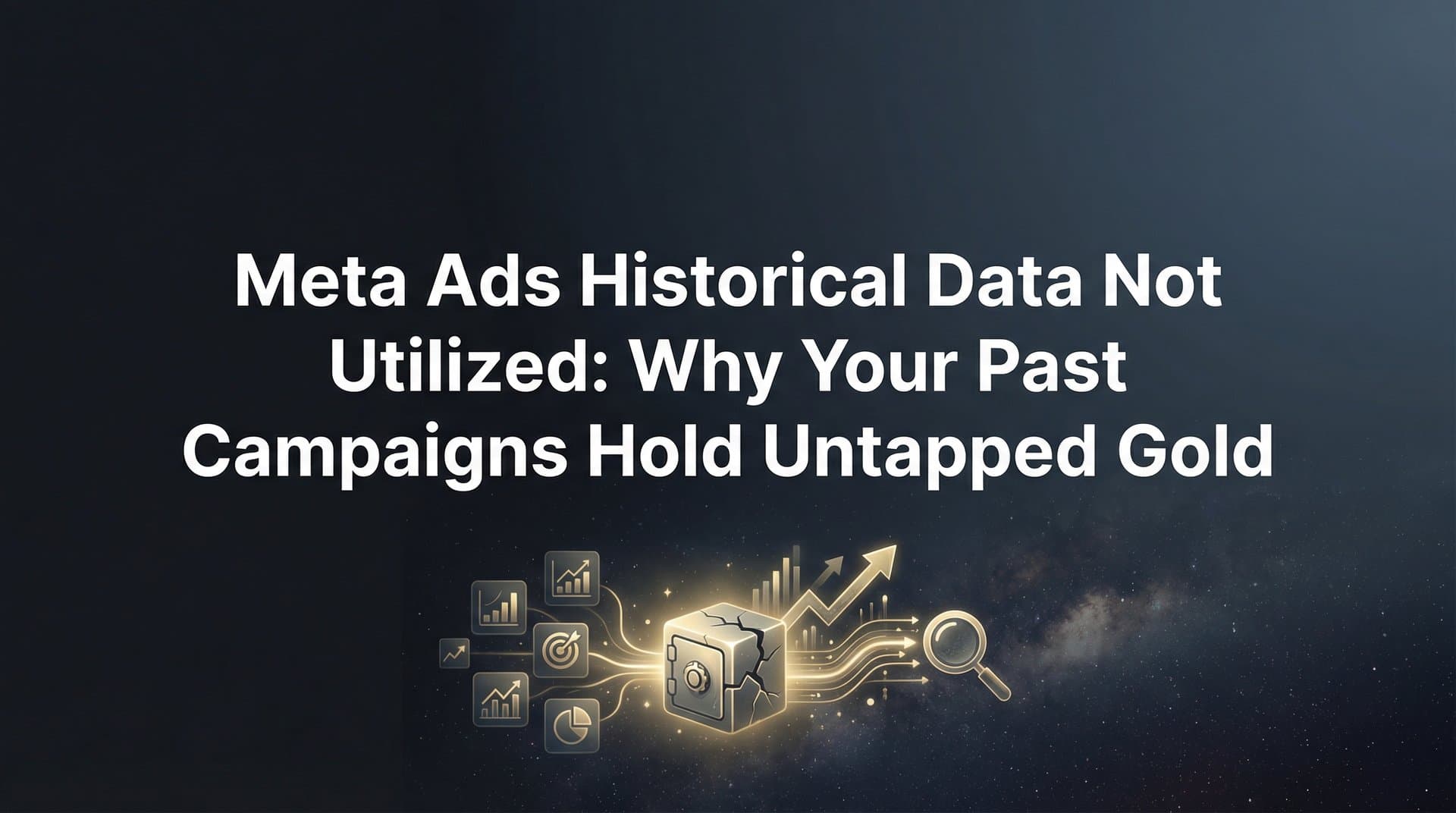
Most Meta advertisers are sitting on a goldmine they've never opened. Months of campaign data, thousands of ad variations, millions in ad spend, all meticulously tracked and stored. Yet when it comes time to launch the next campaign, they start from a blank slate, guessing at what might work instead of building on what already has.
The irony is painful. You've paid to learn which creatives convert, which audiences engage, which headlines drive clicks. That knowledge exists in your account right now. But without a systematic way to extract and apply those insights, you're essentially paying the same tuition twice, testing variations that already flopped, missing opportunities to scale what worked, and treating every campaign like your first.
Your historical data isn't just a performance record. It's a strategic asset that reveals patterns about your audience, validates creative approaches, and provides benchmarks that separate winners from time-wasters. The question isn't whether your past campaigns hold valuable insights. It's whether you have a system to unlock them before your competitors do.
The Hidden Cost of Ignoring Your Campaign History
Every time you launch a new campaign without consulting your historical performance data, you're essentially agreeing to pay for the same education twice. That audience segment that tanked your ROAS three months ago? You just allocated 30% of your budget to test it again. That creative style that consistently underperforms? It's back in rotation because nobody systematically flagged it as a loser.
The waste compounds over time. Advertisers often run campaigns in cycles: Q4 holiday push, spring product launch, summer sale. Each cycle brings fresh creative briefs and new campaign structures, but rarely does anyone ask "What worked last time we did this?" The result is redundant learning at scale.
Consider what happens when winning elements get buried. You run a campaign with 50 ad variations. Three of them absolutely crush it with 4x ROAS while the rest hover around breakeven. The campaign ends, you download a performance report, maybe screenshot the winners for your records, then move on. Six months later, you're building a new campaign and can't remember which specific headline combination drove those results. Was it the urgency-focused CTA or the benefit-driven one? Which product image angle resonated? The knowledge exists somewhere in your exported CSVs, but reconstructing it requires archaeological work through spreadsheets.
Meanwhile, your best-performing audiences face a similar fate. You discover that women aged 35-44 interested in sustainable living convert at twice the rate of your broader targeting. That insight should become a foundational element of every future campaign. Instead, it lives in a forgotten report while you test broad audiences again, relearning the same lesson at the same cost.
The strategic cost goes beyond wasted budget. Without historical context, you can't establish meaningful benchmarks. Is a 2.5% CTR good for your business? You have no idea because you're not comparing it to your historical average. Should you kill an ad set at $50 CPA or let it run? Without knowing that your typical CPA is $75, you might pause a winner prematurely.
Every campaign that ignores historical data starts from zero, treating your advertising account like it has no memory. You're not building on a foundation of proven insights. You're guessing with slightly more data than a complete beginner, which means you're leaving performance, budget efficiency, and competitive advantage on the table every single time you click "Create Campaign."
Why Most Marketers Struggle to Leverage Historical Data
The problem isn't that marketers don't understand the value of historical data. Most would love to systematically apply past learnings to new campaigns. The problem is that Meta's tools aren't designed for historical data analysis across campaigns.
Meta Ads Manager excels at real-time reporting. You can see today's CTR, yesterday's spend, this week's conversions. But try to answer "Which creative styles have consistently outperformed across my last 10 campaigns?" and you're suddenly exporting CSVs, building pivot tables, and spending hours on analysis that still won't capture the full picture. The platform shows you the trees brilliantly but provides no view of the forest.
The scale problem makes manual analysis nearly impossible for active advertisers. A single campaign might test 30 ad variations across 5 audience segments. Run one campaign per month and you're analyzing 1,800 ad variations per year. Each variation has dozens of data points: creative elements, copy variations, audience characteristics, performance metrics. Finding meaningful patterns in that volume of data without dedicated tools is like looking for specific grains of sand on a beach.
Then there's the data fragmentation issue. Your creative files live in a design folder. Performance metrics live in Ads Manager. Audience insights exist in separate reports. Notes about why certain ads worked live in someone's head or a Slack thread from four months ago. There's no central system connecting creative decisions to performance outcomes to strategic insights. Everything exists in isolation, making pattern recognition across campaigns virtually impossible.
Time constraints finish off most good intentions. Marketing teams are perpetually in execution mode, launching the next campaign while the current one runs and reporting on the last one's results. The idea of spending 10 hours analyzing historical data to inform a campaign that needs to launch this week feels like a luxury nobody can afford. So the analysis gets skipped, the new campaign launches based on intuition and recent memory, and the cycle continues.
Even when teams do invest in historical analysis, they often lack the framework to make it actionable. You might discover that video ads outperform static images by 40% on average. Great insight. But which specific video elements drove that performance? Was it the hook, the pacing, the product demonstration style, the length? Without granular analysis, you know video works but not why, which makes replicating success inconsistent.
What Your Historical Data Actually Reveals
Your campaign history contains three categories of intelligence that directly translate to better future performance: creative patterns, audience insights, and messaging frameworks. Each category answers critical questions that guesswork can't solve.
Creative patterns show you what actually stops the scroll for your specific audience. Not what worked for a competitor, not what a case study claimed, but what drove results with your products and your customers. Maybe you discover that product-in-use images consistently outperform studio shots by 60%. Or that UGC-style content drives 2x engagement compared to polished brand content. Or that certain color schemes correlate with higher conversion rates across multiple campaigns.
These patterns go deeper than surface-level observations. Historical data can reveal that your winning creatives share specific structural elements: they lead with a problem statement, show the product solving it within three seconds, and end with social proof. That's a replicable formula, not a lucky guess. Or you might discover that ads featuring specific product angles (like showing scale or demonstrating portability) consistently outperform other approaches, giving your creative team clear direction for future assets.
Audience intelligence transforms targeting from educated guessing to strategic deployment. Your data shows which demographic segments actually convert versus which ones just engage. You might find that while 25-34 year-olds drive the most clicks, 35-44 year-olds convert at twice the rate with 40% lower CPA. That insight alone could reshape your entire targeting strategy and budget allocation.
Interest-based targeting patterns become visible across campaigns. Perhaps "fitness enthusiasts" seemed like an obvious audience for your wellness product, but your data shows that "meditation" and "stress management" interests actually drive better results. Or you discover that layering certain interests creates audience combinations that significantly outperform broader targeting, giving you proven segments to prioritize in new campaigns.
Geographic and temporal patterns emerge from historical analysis. Maybe certain regions consistently deliver better ROAS, or specific days of the week show higher conversion rates. Your data might reveal that campaigns launched on Tuesday perform 30% better than those launched on Friday, or that certain products resonate differently across regions in ways that should inform both targeting and creative strategy.
Copy and messaging insights show you the exact language that resonates with your audience. Historical data reveals which headlines drove the highest CTR, which value propositions generated conversions, and which calls-to-action prompted clicks. You might discover that benefit-focused headlines ("Get clearer skin in 30 days") outperform feature-focused ones ("Clinically-tested formula with retinol"), or that urgency-based CTAs work better than curiosity-driven ones for your specific products.
These insights compound when combined. Imagine knowing that video creatives featuring customer testimonials, targeted to 35-44 year-old women interested in sustainable living, using benefit-focused headlines, consistently deliver 3.5x ROAS. That's not guesswork. That's a proven formula extracted from your actual campaign history, ready to be deployed and scaled in your next campaign with confidence that it will perform.
Turning Past Performance Into Future Wins
Knowing your historical data holds value is different from having a system to extract and apply that value. The gap between insight and action is where most optimization opportunities die. Building a systematic process for leveraging historical performance requires three components: documentation, organization, and application.
Start by creating a post-campaign review ritual that goes beyond surface metrics. When a campaign ends, don't just note the overall ROAS and move on. Identify the top three performing ad variations and document exactly what made them work: the creative style, the specific headline, the audience segment, the offer structure. Equally important, flag the bottom performers and note why they failed. This creates a knowledge base that grows with every campaign.
The documentation should be granular enough to be actionable. Instead of "video ads performed well," record "15-second product demonstration videos with customer testimonial overlay and benefit-focused headlines drove 4.2x ROAS with 35-44 female audience interested in home organization." That level of detail makes the insight reusable. You're not just noting that something worked, you're capturing the recipe to recreate it.
Organization transforms scattered insights into strategic assets. Build a winners library that catalogs your top-performing elements by category: best creatives, highest-converting headlines, most profitable audiences, effective ad copy variations. This isn't a spreadsheet graveyard where data goes to be forgotten. It's an active resource that your team consults before every campaign launch, ensuring that proven winners get prioritized over untested experiments.
The winners library should include performance context. A creative that drove great results in Q4 might not work in Q2. An audience that converted well for a specific product might not be relevant for another. Attach metadata to each winning element: when it performed, which product it promoted, what campaign objective it served, what budget it required to succeed. This context prevents misapplication while preserving the core insights.
Application is where documentation and organization pay off. Before launching a new campaign, start with your winners library. Which proven creatives can be adapted for this product? Which audiences have shown affinity for similar offers? Which headlines have historically driven clicks in this category? Your new campaign should build on this foundation, using 60-70% proven winners and 20-30% new tests to continue learning.
Create performance benchmarks from your historical data that inform real-time decision making. Calculate your average CTR, CPA, and ROAS across successful campaigns. These become your baseline metrics. When a new campaign launches, you can immediately identify underperformers (anything significantly below benchmark) and outperformers (anything significantly above). This speeds up optimization decisions and prevents you from killing winners prematurely or letting losers run too long.
The compounding effect of this system becomes powerful over time. Each campaign adds to your winners library. Your benchmarks become more refined. Your understanding of what works deepens. Instead of starting from scratch every time, you're building on an increasingly sophisticated foundation of proven insights, which means every new campaign has a higher probability of success than the last.
How AI Changes the Historical Data Game
Manual historical analysis hits a ceiling fast. You can review your last three campaigns and extract insights. Maybe even your last five. But analyzing patterns across 20 campaigns with 1,000 ad variations each? That's where human analysis breaks down and AI for Meta ads campaigns becomes transformative.
AI excels at exactly what humans struggle with: processing massive volumes of data to identify patterns that aren't immediately obvious. An AI system can analyze every ad variation you've ever run, compare performance across dozens of variables simultaneously, and surface correlations that would take weeks of manual analysis to uncover. It might reveal that ads featuring specific color palettes consistently outperform others, or that certain word combinations in headlines correlate with higher conversion rates across multiple campaigns and products.
The pattern recognition goes beyond simple correlations. Advanced AI can identify contextual patterns: which creative styles work best for which audience segments, how performance varies by time of day or day of week, which combinations of elements create synergistic effects. It might discover that video ads work exceptionally well for one audience segment but underperform for another, or that certain headline styles drive clicks but not conversions, revealing quality issues that surface-level metrics miss.
Automated ranking systems transform raw data into actionable intelligence. Instead of manually comparing hundreds of ads to find your winners, AI can score every creative, headline, audience, and copy variation against your actual performance goals. Want to know your top 10 creatives by ROAS? Instant answer. Need to see which audiences deliver the lowest CPA? Ranked list ready. This ranking isn't based on gut feeling or recent memory. It's based on comprehensive analysis of real performance data across your entire campaign history.
The transparency of AI-powered analysis matters as much as the insights themselves. When AI identifies a winning pattern, it should explain why: "This creative style ranks #1 for ROAS because it averaged 4.2x return across 8 campaigns, outperforming your account average of 2.8x by 50%." That explanation builds trust in the recommendation and helps your team understand the underlying strategy, not just follow blind suggestions.
Continuous learning loops create compounding intelligence. Each campaign you run feeds more data into the AI system, which refines its understanding of what works for your specific business. The AI doesn't just analyze historical data once. It continuously updates its recommendations as new performance data comes in, meaning the insights get more accurate and relevant over time. Your advertising strategy becomes a self-improving system rather than a series of disconnected experiments.
This is where platforms like AdStellar fundamentally change how historical data gets utilized. The AI Campaign Builder doesn't just store your past performance. It actively analyzes every campaign, ranks every element by real metrics, and uses those insights to inform new campaign construction. When you're building a new campaign, the AI can recommend proven winners from your history, explain why they're likely to succeed based on past performance, and help you avoid elements that have consistently underperformed.
Putting Your Data to Work Today
You don't need to wait for perfect systems or complete historical analysis to start leveraging your campaign data. Immediate improvements come from asking better questions about what you've already run.
Start with a focused audit of your last five campaigns. Pull performance data and identify clear winners and losers. Which three ads drove the highest ROAS? What did they have in common? Which audiences converted at the lowest CPA? Are there patterns in the demographics or interests? This 30-minute exercise often surfaces insights you can apply to your next campaign immediately.
Ask the scaling question: what worked well enough that you should have spent more on it? Many advertisers find winners but never scale them aggressively. Your historical data might reveal that certain ad sets consistently delivered 5x ROAS but only received 10% of your budget. That's an immediate optimization opportunity. The next campaign should allocate more budget to proven performers and less to untested experiments.
Identify what to retire permanently. Some creative styles, audience segments, or messaging approaches fail consistently across multiple campaigns. Stop testing them. Your historical data has already proven they don't work for your business. Retiring consistent losers frees up budget and attention for more promising approaches.
Look for reusability opportunities. Which winning creatives could be adapted for new products or offers? Which successful audiences might be relevant for upcoming campaigns? The goal isn't to run identical ads forever, but to build new campaigns on proven foundations rather than starting from scratch.
For teams ready to move beyond manual analysis, platforms like AdStellar automate the entire process. The Winners Hub organizes your top-performing creatives, headlines, audiences, and copy in one place with real performance data attached. Instead of digging through spreadsheets, you see your proven winners ranked by actual metrics like ROAS, CPA, and CTR. When building a new campaign, you can instantly pull winning elements from past campaigns, knowing they're backed by real performance data.
The AI Insights feature takes this further by setting performance analytics benchmarks based on your goals and scoring every element against those standards. You define what success looks like (target ROAS, acceptable CPA, minimum CTR), and the system automatically identifies which creatives, audiences, and campaigns meet or exceed those thresholds. This transforms historical analysis from a periodic manual task into an always-on intelligence layer that informs every decision.
The AI Campaign Builder completes the loop by using historical insights to construct new campaigns. It analyzes your past performance, identifies patterns in what worked, and builds complete campaign structures that leverage those learnings. Every recommendation comes with transparent rationale explaining why the AI selected specific creatives, audiences, or targeting based on your actual historical data. You're not blindly following AI suggestions. You're making informed decisions backed by comprehensive analysis of what's worked before.
The Compounding Value of Campaign Intelligence
Your historical campaign data represents more than past spending. It's accumulated market research, validated creative insights, and proven audience intelligence that cost real money to acquire. Every dollar you've spent on Meta ads has generated not just immediate results but also knowledge about what works for your specific business. The question is whether that knowledge compounds or evaporates.
Most advertisers let it evaporate. They run campaigns, review surface metrics, then start fresh with the next launch. The insights exist but never get systematically extracted, organized, or applied. It's like paying for an expensive education then throwing away your notes before the exam. The cost isn't just wasted budget on redundant testing. It's the opportunity cost of not building on proven foundations, not scaling what works, not getting smarter with every campaign.
The alternative is treating historical data as a strategic asset that grows in value over time. Each campaign adds to your knowledge base. Your understanding of what resonates with your audience deepens. Your ability to predict performance improves. Your benchmarks become more refined. Instead of starting from zero with every new campaign, you're building on an increasingly sophisticated foundation of proven insights. That compounding intelligence is what separates advertisers who consistently improve performance from those who stay stuck in a cycle of guessing and testing.
The gap between having data and using it strategically is closing fast. AI-powered platforms are making comprehensive historical analysis accessible to teams of any size, automating the pattern recognition and insight extraction that used to require dedicated analysts and weeks of work. The competitive advantage increasingly belongs to advertisers who leverage their campaign history systematically, not those with the biggest budgets or the fanciest creative teams.
Ready to transform your advertising strategy? Start Free Trial With AdStellar and be among the first to launch and scale your ad campaigns 10× faster with our intelligent platform that automatically builds and tests winning ads based on real performance data. Stop guessing. Start building on what you've already proven works.