There's a particular kind of frustration that comes with watching a well-prepared campaign go nowhere. You've set your budgets, uploaded your creatives, configured your pixel, and hit publish. Then the waiting begins. Days pass, spend accumulates, and instead of seeing results stabilize, you're staring at a "Learning Limited" status or watching cost-per-result numbers bounce around with no sign of settling. The campaign never finds its rhythm, and by the time you realize something is structurally wrong, you've already burned through budget that should have been generating returns.
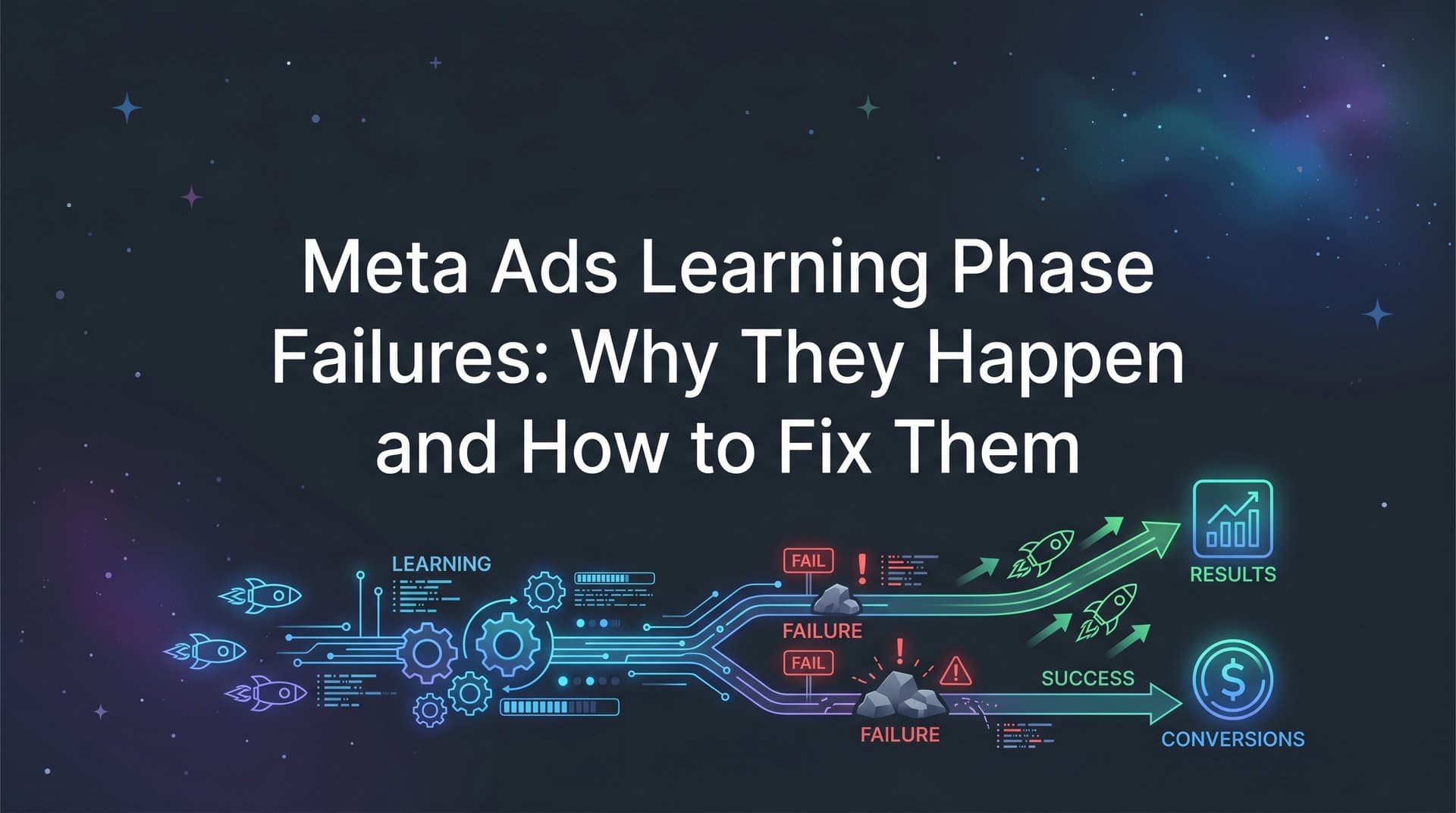
This is the reality of meta ads learning phase failures, and it's more common than most advertisers want to admit. The learning phase isn't a passive waiting period. It's the window during which Meta's algorithm builds its delivery model for your ad set, and what happens in those first seven days shapes everything that follows. A failed or limited learning phase doesn't just delay results. It can permanently skew how an ad set delivers, meaning the campaign never performs the way it should even if you let it run longer.
The good news is that most learning phase failures are structural, not random. They follow predictable patterns, show early warning signs, and respond to specific fixes. This article breaks down exactly how the learning phase works, what causes it to fail, how to spot trouble before it becomes expensive, and what a properly structured campaign looks like before it ever goes live. If you've been treating the learning phase as something that just happens to your campaigns, this will change how you approach every launch going forward.
How Meta's Learning Phase Actually Works
Before you can fix learning phase failures, you need a clear picture of what the algorithm is actually doing during this period. The learning phase is the window in which Meta's delivery system explores the best combinations of people, placements, and times to show your ads. It's not evaluating your creative in isolation. It's building a probabilistic model of who is most likely to complete your optimization event, and it needs real data to do that.
According to Meta's Business Help Center, an ad set needs approximately 50 optimization events within a 7-day window to exit the learning phase successfully. Those events must be the specific action you've chosen as your optimization goal, whether that's a purchase, a lead form submission, an add to cart, or another conversion. Until that threshold is reached, the algorithm is still testing and adjusting delivery, which means performance will appear inconsistent.
Advertisers encounter three distinct statuses in Ads Manager, and each one tells you something different about campaign health. Learning means the ad set is actively gathering data and hasn't yet reached the 50-event threshold. Performance will be variable during this period, and that's expected. Learning Limited is a flag that Meta applies when it determines the ad set is unlikely to reach the threshold needed to exit learning. This is not a temporary state you can wait out. It signals a structural problem that requires intervention. Active status, sometimes displayed as "Active" post-learning, means the ad set has graduated from the learning phase and delivery has stabilized. This is where consistent, predictable performance begins.
What makes this window especially consequential is how the algorithm uses early signals. The conversion data, engagement patterns, and delivery feedback collected in the first few days become the foundation of the algorithm's delivery model for that ad set. If your creative generates poor engagement early, if your landing page produces high bounce rates, or if your audience is too narrow to deliver efficiently, those signals get baked into the model. The algorithm learns from what it sees, which means a weak start doesn't just slow learning. It can actively teach the algorithm the wrong patterns, leading to poor targeting decisions even after the learning phase technically completes.
This is why the quality of inputs during the learning phase matters so much. The algorithm isn't just counting events. It's building a picture of your ideal converter based on who actually converts during this window. Give it high-quality signals from the start, and the post-learning delivery model will reflect that. Give it noisy, inconsistent, or insufficient data, and you'll be fighting the algorithm's assumptions for the life of the campaign.
The Most Common Reasons Learning Phases Fail
Understanding the mechanics is one thing. Knowing what actually breaks the process in practice is where most advertisers need the most help. Learning phase failures cluster around three core problems, and they often appear together.
Budget set too low relative to CPA: This is the most common cause of "Learning Limited" status, and it's also the most straightforward to fix. If your target cost per acquisition is high and your daily budget can't support enough conversions within a 7-day window, the ad set will never accumulate the 50 optimization events it needs. Think about the math: if your target CPA is $50 and your daily budget is $30, you're mathematically incapable of generating the conversion volume required to exit learning, regardless of how good your creative or targeting is. Meta recommends a daily budget of at least 5 times your target cost per result as a baseline for giving the algorithm room to operate. For many advertisers running lower-funnel optimization events, the budget required is higher than they've allocated.
Audience fragmentation from over-segmentation: This is a structural trap that experienced advertisers fall into more often than beginners. The instinct to create highly specific ad sets for each audience segment feels like precision, but it works against the algorithm. When you split a campaign into five or six small ad sets targeting narrow audience slices, you divide both budget and signal volume. None of the individual ad sets generates enough conversion events to exit learning, so all of them stay stuck. The audience fragmentation problem compounds with budget constraints, because each fragmented ad set is now working with a smaller slice of an already insufficient budget.
Frequent edits that reset the learning counter: Every significant change made to an ad set during the learning phase resets the clock entirely. Meta defines significant edits broadly: changes to budget above roughly 20 to 25 percent of the current daily budget, changes to bid strategy, audience modifications, new creatives, placement adjustments, or switching the optimization event all trigger a reset. The result is that advertisers who are trying to fix a struggling campaign by making adjustments are often making the problem worse. Each edit wipes out whatever signal has been accumulated and restarts the 7-day window from zero. Campaigns that go through multiple edit cycles during learning can spend weeks in the learning phase, burning budget without ever stabilizing.
These three failure modes are interconnected. An advertiser with a low budget who fragments their campaign across multiple ad sets and then makes frequent edits to try to improve performance is stacking all three problems simultaneously. The learning phase never completes, the algorithm never builds a reliable delivery model, and the campaign never reaches the consistent performance that makes scaling possible.
Warning Signs Your Campaign Is Headed for a Learning Failure
The "Learning Limited" flag in Ads Manager is the clearest signal that something has gone wrong, but by the time it appears, you've already spent time and budget heading in the wrong direction. There are earlier indicators worth watching for in the first 48 to 72 hours of a campaign.
Erratic CPMs and unstable delivery: Some volatility in the first day or two is normal as the algorithm explores delivery. But if CPMs are swinging dramatically without any pattern, or if reach is extremely low while frequency is climbing in the first 48 hours, that's a signal the algorithm is struggling to find a scalable audience. High frequency with low reach early in a campaign often indicates an audience that's too small or too restrictive to support the delivery volume needed for learning.
Cost-per-result that doesn't stabilize after day 3: During learning, cost-per-result will vary. That's expected. What you should start to see by day 3 to 4 is a gradual trend toward stabilization as the algorithm narrows its delivery model. If costs are still swinging wildly after day 3 with no sign of convergence, the algorithm is likely not receiving clean enough signals to build a reliable model. This is often a precursor to the "Learning Limited" flag appearing. Understanding your Meta ads performance metrics during this window is essential for catching these warning signs early.
Pixel and conversion event mismatches: One of the most damaging and easily overlooked causes of learning failure is a misconfigured pixel or a mismatched optimization event. If the pixel is firing on the wrong page, firing multiple times per conversion, or not firing at all, the algorithm receives corrupted or absent conversion signals. It cannot build a delivery model around events it can't see. Similarly, if you're optimizing for purchases on a cold audience with a small daily budget, the optimization event may simply happen too rarely to generate the 50 events needed. Meta's Events Manager is the diagnostic tool for this. Verifying that your pixel is firing correctly on the right events before launch is non-negotiable.
Too few creative variations entering learning: Launching with a single creative or just two variations gives the algorithm very little to work with. If those creatives underperform in the first 24 hours, there are no alternatives for the algorithm to pivot toward. The ad set can enter what's effectively a poor-signal loop: the creatives aren't generating engagement, the algorithm isn't getting the conversion signals it needs, delivery becomes restricted, and the ad set stalls in learning. More creative variation at launch isn't just a best practice. It's a structural safeguard against this scenario.
Structural Fixes That Prevent Learning Phase Problems
Prevention is more effective than recovery when it comes to learning phase failures. The fixes below address the structural causes before they become expensive problems.
Budget and bid calibration: Apply the 5 to 10 times CPA rule as your minimum daily budget threshold. If your target CPA is $40, your daily budget should be at least $200 to give the algorithm a realistic chance of accumulating enough events within 7 days. For advertisers running lower-funnel optimization events like purchases, consider temporarily moving up the funnel. Optimizing for Add to Cart or Initiate Checkout generates faster signal volume because these events happen more frequently than completed purchases. Once the algorithm has enough data to build a reliable delivery model, you can shift the optimization event back down the funnel. A dedicated Meta ads budget optimizer can help you calibrate these thresholds more precisely before launch.
Campaign consolidation with CBO: Campaign Budget Optimization is Meta's recommended approach for accounts that want the algorithm to allocate spend efficiently across ad sets. Under CBO, Meta dynamically shifts budget toward the ad sets generating signal fastest, which reduces the fragmentation problem. Instead of five small ad sets each starved of budget and signal, CBO concentrates spend where the algorithm is finding traction. This doesn't mean you should have unlimited ad sets under a single CBO campaign, but it does mean that consolidating well-structured ad sets under CBO is generally more effective than running parallel ABO campaigns with fixed budgets split across many small audiences. Following Meta ads campaign structure best practices ensures your consolidation approach is built on a solid foundation.
Creative volume and variation at launch: Aim for a minimum of 3 to 5 distinct creative variations per ad set at launch. Distinct means meaningfully different: different formats, different hooks, different visual approaches, not just the same image with different copy. This gives the algorithm real options to test across different audience segments and placements, increases the probability that at least one creative generates strong early engagement, and protects against the poor-signal loop that comes from launching with too few variations.
The no-edit commitment: Once a campaign is live, commit to leaving it untouched for at least the first 7 days unless something is critically wrong. Resist the urge to make budget adjustments, swap creatives, or tweak audiences mid-flight. Every significant edit resets the learning counter. If you've built the campaign structure correctly before launch, the algorithm needs time and stability, not intervention.
The Role of Creative Quality in Learning Phase Success
Creative is not just one input among many during the learning phase. It's the primary lever advertisers control that directly influences how aggressively the algorithm bids for impressions. Meta's delivery system uses early engagement signals, particularly click-through rates and early conversion data, as inputs for its relevance scoring and bid modeling. An ad that generates strong early CTR signals to the algorithm that it's worth showing more broadly, which accelerates delivery and increases the rate at which optimization events accumulate. A weak creative does the opposite: it restricts delivery, slows event accumulation, and makes learning failure more likely.
This is why creative quality and creative volume are both important. Quality determines whether individual ads generate the engagement signals the algorithm needs. Volume determines how much surface area the algorithm has to find those signals across different audience segments and placements. A single high-quality creative is better than five mediocre ones, but five strong creatives across different formats is better still.
Creative diversity matters in a specific way here. Image ads, video ads, and UGC-style formats each perform differently across audience segments and placements. A video ad might outperform on mobile feed placements while an image ad drives stronger results in Stories. UGC-style content often generates higher engagement from cold audiences because it reads as authentic rather than promotional. When you launch with only one format, you're asking the algorithm to find winners within a narrow creative space. When you launch with multiple formats, you're giving it a much larger surface area to identify what resonates with different parts of your audience.
Generating that level of creative diversity has historically been the bottleneck for many advertisers. Producing image ads, video ads, and UGC-style content simultaneously requires design resources, video production, and often talent, which is time-consuming and expensive. If Meta ads take too long to create, you're more likely to launch with insufficient creative volume and expose yourself to learning phase failure. This is where platforms like AdStellar change the equation. AdStellar generates image ads, video ads, and UGC avatar ads from a single product URL, giving advertisers the creative volume needed to feed Meta's algorithm high-quality inputs from day one. No designers, no video editors, no actors required. You can enter the learning phase with 5 or more distinct creative variations across multiple formats without the production overhead that typically makes that impossible.
The downstream effect on learning phase performance is meaningful. More creative variation means more signal options for the algorithm. More signal options mean faster identification of winners. Faster identification of winners means faster exit from the learning phase and earlier access to the stable, predictable delivery that makes scaling possible.
Your Pre-Launch Checklist for Learning Phase Success
Everything covered in this article converges on a single practical question: what does a campaign need to have in place before it goes live to give the learning phase the best possible chance of success? Here's the checklist that addresses the structural requirements.
1. Pixel verified and firing correctly: Confirm in Events Manager that your pixel is firing on the right optimization event, firing once per conversion (not multiple times), and that the event data is flowing cleanly. This is the foundation everything else depends on.
2. Daily budget set at 5 to 10 times target CPA: Do the math before launch. If the budget doesn't support the conversion volume needed within 7 days, adjust either the budget or the optimization event before the campaign goes live.
3. Audience size large enough to support delivery: Avoid hyper-narrow audiences during the learning phase. A broad or interest-based audience gives the algorithm more room to find converters and reduces the risk of delivery restrictions.
4. Minimum 3 to 5 creatives ready, across multiple formats: Don't launch with one or two variations. Give the algorithm meaningful options to test from the start.
5. Commitment to no significant edits for the first 7 days: Build this into your workflow. The learning phase requires stability. Plan your creative and audience strategy before launch so you're not tempted to intervene mid-flight.
Once an ad set exits learning and enters active delivery, that's the signal to act on the data. The performance patterns from the learning phase, which creatives generated the strongest early CTR, which audiences drove the most efficient conversions, which placements delivered the best results, become the inputs for your next campaign iteration. This is where the Winners Hub concept becomes valuable: identifying which elements performed best and building the next campaign around those proven signals rather than starting from scratch.
AI-powered campaign tools can streamline this entire pre-launch process. By analyzing historical performance data before a campaign goes live, tools like AdStellar's AI Campaign Builder can inform budget recommendations, creative selection, and audience targeting based on what's actually worked in past campaigns. Instead of guessing at the right structure, you're entering the learning phase with an architecture that's been informed by real performance data, which reduces the trial-and-error that makes learning phases expensive.
The Bottom Line on Learning Phase Failures
Learning phase failures are almost never random. They follow predictable structural patterns: insufficient budget relative to CPA, fragmented campaign architecture that dilutes signal, frequent edits that reset the learning counter, and insufficient creative volume that limits the algorithm's options. Each of these is preventable with the right setup before launch.
The three biggest levers are worth repeating. First, budget calibration: your daily budget must support the conversion volume the algorithm needs within 7 days, or the learning phase will stall regardless of everything else. Second, consolidated campaign structure: fewer, better-funded ad sets under CBO outperform many small, fragmented ones. Third, creative volume: launching with 3 to 5 distinct variations across multiple formats gives the algorithm the inputs it needs to find winning signals quickly.
As Meta's algorithm becomes more sophisticated, the gap between advertisers who feed it high-quality inputs and those who don't will continue to widen. Better creatives, cleaner pixel data, and smarter campaign architecture aren't just best practices. They're competitive advantages that compound over time as the algorithm builds increasingly accurate delivery models for accounts that consistently give it strong signals.
If you want to enter every campaign with the creative volume and campaign structure that gives the learning phase the best possible chance of success, Start Free Trial With AdStellar and be among the first to launch and scale your ad campaigns 10x faster with an intelligent platform that automatically builds and tests winning ads based on real performance data.