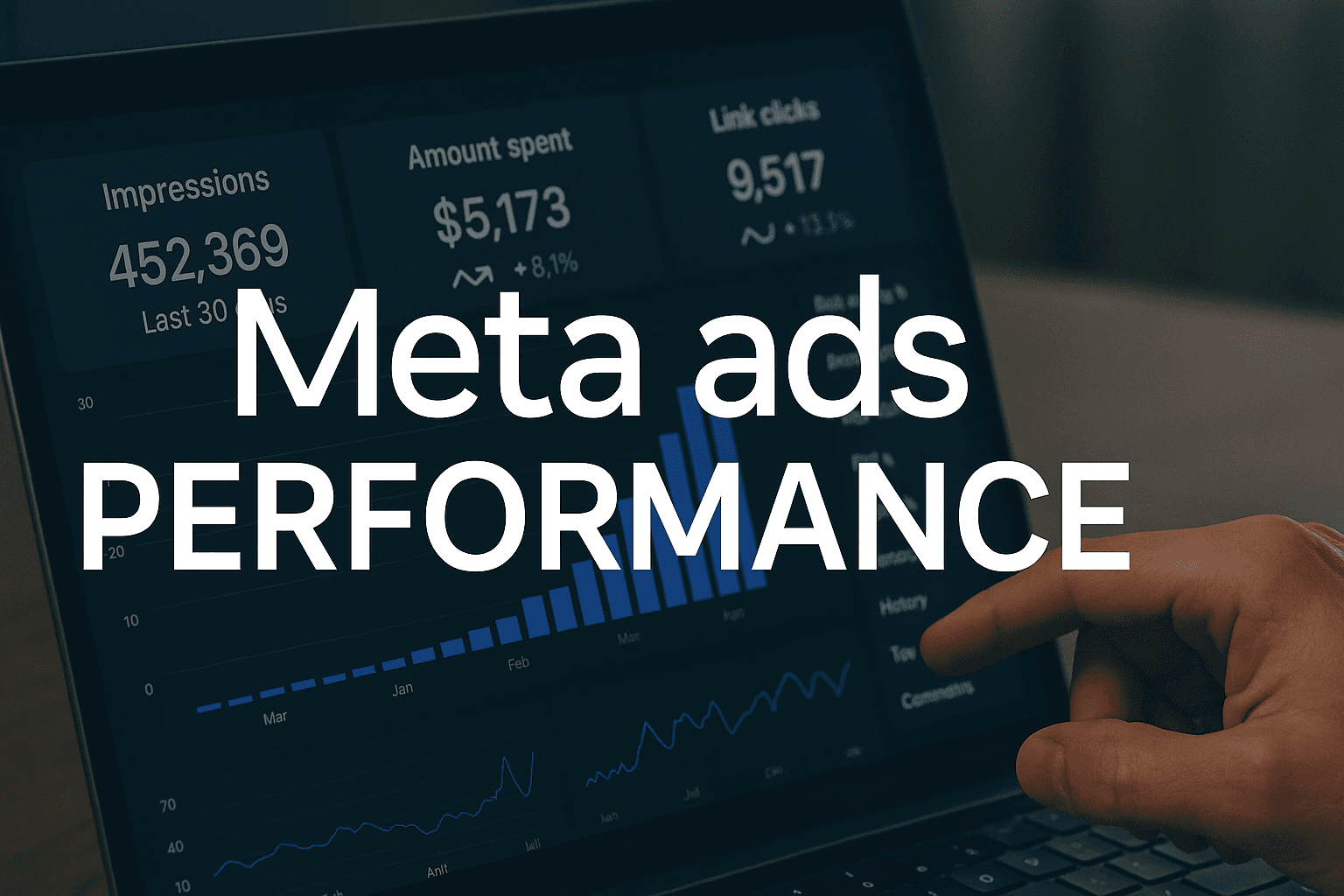
You're staring at your Meta Ads Manager dashboard at 11 PM on a Thursday. Your campaign has been running for three days. The numbers stare back at you: 47,000 impressions, 2.3% CTR, $1.87 CPC. But here's the question that keeps you up at night—is this actually good performance?
You compare your metrics to industry benchmarks. Your CTR looks solid. Your CPC seems reasonable. Yet your boss is asking why the campaign isn't driving more conversions, and you're not entirely sure how to answer.
This confusion isn't your fault. Meta ads performance has become exponentially more complex over the past few years. What used to be straightforward—launch ads, watch clicks, measure conversions—now involves navigating attribution windows, cross-device tracking, iOS privacy changes, and an algorithm that considers hundreds of signals you can't even see.
The truth is, most advertisers are flying blind. They're optimizing for metrics that look impressive in reports but don't actually move the needle for their business. They're making decisions based on incomplete data, misunderstanding what the algorithm actually rewards, and missing the hidden factors that separate campaigns that merely run from campaigns that truly perform.
Understanding meta ads performance isn't about memorizing the "right" CTR or CPC anymore. It's about grasping how Meta's ecosystem actually works—how the algorithm evaluates your ads, how attribution really functions across devices and time windows, how creative performance connects to audience targeting, and how all these elements interact to create the results that matter for your business.
This guide breaks down everything you need to know about meta ads performance. You'll learn what performance actually means beyond surface metrics, how Meta's algorithm determines which ads succeed, which components make or break your campaigns, and how to build a systematic optimization approach that compounds improvements over time.
By the end, you won't just understand your dashboard numbers—you'll know exactly what drives performance, how to measure what actually matters, and how to make optimization decisions that improve real business outcomes instead of just making reports look better.
The Meta Ads Performance Mystery That's Costing You Money
Here's the scenario that plays out in marketing departments every single day: You launch a Meta ads campaign with what feels like a solid strategy. The creative looks sharp. The targeting seems precise. The budget is reasonable. You hit publish, and then... the waiting game begins.
Three days later, you're staring at your Ads Manager dashboard trying to decode what the numbers actually mean. Your click-through rate is 2.1%. Your cost per click is $1.63. You've generated 412 link clicks from 19,524 impressions. But here's the question that keeps surfacing in every team meeting: Is this actually working?
You pull up industry benchmark reports. Your CTR falls within the "average" range. Your CPC seems competitive for your industry. Yet when you look at actual conversions, something feels off. The math doesn't quite add up to the ROI your business needs.
This confusion isn't a reflection of your marketing skills—it's a symptom of how dramatically Meta ads performance has evolved. What used to be straightforward measurement has become a complex ecosystem of attribution windows, cross-device tracking, iOS privacy restrictions, and an algorithm that evaluates hundreds of signals you never see in your dashboard.
The real problem? Most advertisers are optimizing for metrics that look impressive in reports but don't actually drive business results. They're making daily decisions based on incomplete data, misunderstanding what Meta's algorithm actually rewards, and missing the hidden factors that separate campaigns that merely spend budget from campaigns that generate profitable growth.
Think of it like trying to judge a basketball player's value by only looking at points scored. Sure, scoring matters—but what about assists, defensive plays, rebounds, and how their presence affects the entire team's performance? Meta ads performance works the same way. Surface metrics tell part of the story, but the complete picture requires understanding how multiple elements interact across the entire customer journey.
Understanding meta ads performance today isn't about memorizing the "right" CTR or knowing the average CPC for your industry. It's about grasping how Meta's advertising ecosystem actually functions—how the algorithm evaluates and delivers your ads, how attribution really works across devices and time windows, how creative performance connects to audience targeting, and how all these components combine to create the outcomes that matter for your business.
This guide breaks down everything you need to know about meta ads performance in practical, actionable terms. You'll discover what performance actually means beyond the metrics in your dashboard, how Meta's algorithm determines which ads succeed, which specific components make or break your campaigns, and how to build a systematic optimization approach that compounds improvements over time instead of chasing random wins.
By the end, you won't just understand your dashboard numbers—you'll know exactly what drives real performance, how to measure what actually matters for your business, and how to make optimization decisions that improve revenue and profitability instead of just making reports look better.
You're staring at your Meta Ads Manager dashboard at 11 PM on a Thursday. Your campaign has been running for three days. The numbers stare back at you: 47,000 impressions, 2.3% CTR, $1.87 CPC. But here's the question that keeps you up at night—is this actually good performance?
You compare your metrics to industry benchmarks. Your CTR looks solid. Your CPC seems reasonable. Yet your boss is asking why the campaign isn't driving more conversions, and you're not entirely sure how to answer.
This confusion isn't your fault. Meta ads performance has become exponentially more complex over the past few years. What used to be straightforward—launch ads, watch clicks, measure conversions—now involves navigating attribution windows, cross-device tracking, iOS privacy changes, and an algorithm that considers hundreds of signals you can't even see.
The truth is, most advertisers are flying blind. They're optimizing for metrics that look impressive in reports but don't actually move the needle for their business. They're making decisions based on incomplete data, misunderstanding what the algorithm actually rewards, and missing the hidden factors that separate campaigns that merely run from campaigns that truly perform.
Understanding meta ads performance isn't about memorizing the "right" CTR or CPC anymore. It's about grasping how Meta's ecosystem actually works—how the algorithm evaluates your ads, how attribution really functions across devices and time windows, how creative performance connects to audience targeting, and how all these elements interact to create the results that matter for your business.
This guide breaks down everything you need to know about meta ads performance. You'll learn what performance actually means beyond surface metrics, how Meta's algorithm determines which ads succeed, which components make or break your campaigns, and how to build a systematic optimization approach that compounds improvements over time.
By the end, you won't just understand your dashboard numbers—you'll know exactly what drives performance, how to measure what actually matters, and how to make optimization decisions that improve real business outcomes instead of just making reports look better.
Decoding Meta Ads Performance: Beyond the Surface Metrics
Most advertisers treat Meta ads performance like a simple scorecard. They check their CTR, glance at their CPC, maybe peek at their conversion rate, and call it a day. But here's the uncomfortable truth: those surface metrics are lying to you.
Not intentionally, of course. But when you focus exclusively on clicks and impressions, you're measuring activity instead of impact. You're tracking what happened without understanding whether it actually mattered for your business.
Think of it like judging a basketball player solely by points scored. Sure, scoring matters. But what about assists? Defensive stops? Rebounds? Court presence that creates opportunities for teammates? A player who scores 30 points but allows 40 points against them isn't actually helping their team win.
Meta ads performance works the same way. A campaign with a stellar 3.5% CTR might be driving clicks from people who will never convert. Another campaign with a modest 1.2% CTR could be attracting your ideal customers who go on to make repeat purchases for years.
The Complete Performance Picture
True meta ads performance encompasses four distinct layers that work together to create business results. Each layer reveals different insights, and optimization decisions that improve one layer can sometimes hurt another.
Awareness Metrics: These measure how effectively you're reaching your target audience. Reach shows unique users who saw your ads. Frequency indicates how many times the average person encountered your message. Brand lift studies (available for larger budgets) measure whether your ads actually increased brand awareness or consideration.
Engagement Metrics: This layer captures how people interact with your ads. CTR shows the percentage who clicked. Video completion rates reveal whether your message held attention. Social actions—likes, comments, shares—indicate whether your content resonated enough to prompt public interaction.
Conversion Metrics: Here's where most advertisers focus their attention. Cost per acquisition shows what you're paying for each conversion. ROAS (return on ad spend) reveals revenue generated per dollar spent. Conversion rate indicates what percentage of clickers actually complete your desired action.
Business Impact Metrics: This is the layer most advertisers ignore, yet it's the only one that actually matters to your bottom line. Customer lifetime value shows the total revenue a customer generates over their relationship with your business. Retention rates indicate whether acquired customers stick around. Revenue attribution connects ad spend to actual business growth.
Managing this comprehensive performance framework across multiple campaigns requires robust meta ads analytics tools that can aggregate data from various sources and provide unified performance insights.
Why Surface Metrics Mislead
Here's a scenario that plays out constantly: You're running two campaigns. Campaign A has a 2.8% CTR and $1.50 CPC. Campaign B has a 1.4% CTR and $2.75 CPC. Which one is performing better?
Based on surface metrics, Campaign A looks like the clear winner. It's getting twice the click-through rate at nearly half the cost per click. Most advertisers would pause Campaign B and scale Campaign A.
But what if Campaign A is attracting bargain hunters who never convert, while Campaign B is reaching serious buyers who become repeat customers? What if Campaign A's $1.50
Decoding Meta Ads Performance: Beyond the Surface Metrics
Most advertisers look at their Meta Ads Manager and see a wall of numbers: impressions, reach, frequency, CTR, CPC, CPM, conversions, ROAS. They pick a few metrics that seem important, track them religiously, and make optimization decisions based on whether those numbers go up or down.
This approach is like judging a basketball player's value by only looking at their points per game. Sure, scoring matters—but what about assists, rebounds, defensive plays, and how they elevate their teammates' performance? The same principle applies to meta ads performance.
True performance isn't a single metric or even a handful of metrics. It's a comprehensive ecosystem where awareness metrics influence engagement metrics, which drive conversion metrics, which ultimately determine business impact metrics. Each layer tells a different part of your campaign story, and understanding how they connect reveals the complete performance picture.
The Complete Performance Picture
Here's what most advertisers miss: a campaign with a 4% CTR and $0.80 CPC might look phenomenal in your weekly report, but if those clicks aren't converting, you're just paying for curiosity, not customers. Conversely, a campaign with a 1.2% CTR and $2.50 CPC might seem expensive and underperforming—until you realize it's generating a 6:1 ROAS because it's reaching people who actually buy.
The traditional view of meta ads performance focuses on what's easy to measure: clicks, impressions, and engagement rates. These metrics feel concrete and actionable. They change quickly, giving you the illusion of control and progress.
But the modern view of performance encompasses the entire customer journey. It includes customer lifetime value calculations that show whether you're acquiring profitable customers or just one-time buyers. It factors in attribution windows that reveal whether your ads are driving immediate conversions or playing a longer-term awareness role. It accounts for cross-device tracking that captures the reality of how people actually interact with your brand—seeing an ad on mobile during their commute, researching on desktop at work, and purchasing on a tablet at home.
Performance exists as an ecosystem, not as individual ad success. Your awareness campaigns create the foundation that makes your conversion campaigns more efficient. Your retargeting campaigns capitalize on the interest generated by your prospecting campaigns. Your creative performance influences your audience targeting effectiveness, which impacts your bidding efficiency, which determines your overall campaign profitability.
Consider this scenario: You launch two campaigns with identical budgets. Campaign A generates a 3.2% CTR with 500 link clicks at $1.20 CPC. Campaign B generates a 1.8% CTR with 280 link clicks at $2.10 CPC. Every instinct tells you Campaign A is winning—it's getting more engagement at lower cost.
But when you examine conversion data, Campaign A generated 12 purchases at $50 CPA, while Campaign B generated 31 purchases at $19 CPA. Campaign B's "worse" engagement metrics actually revealed better audience-offer alignment. The lower CTR filtered out curiosity clicks, and the people who did click were genuinely interested and ready to buy.
This is why evaluating campaigns using a multi-layered performance framework matters. You need awareness metrics to understand reach and brand impact. You need engagement metrics to gauge message resonance and creative effectiveness.
The Four Pillars of Meta Performance Measurement
Most advertisers treat Meta ads performance like a single number—a CTR here, a ROAS there, maybe a CPA if they're feeling sophisticated. But here's what separates campaigns that merely run from campaigns that actually drive business growth: understanding that performance exists across four distinct layers, each revealing different optimization opportunities.
Think of it like evaluating a basketball player. Points per game tells you something, but it doesn't capture assists, defensive impact, or how they elevate their teammates. Meta ads performance works the same way—you need multiple measurement layers to understand what's actually happening.
# Rewritten Content with Strategic Internal Links The first pillar is awareness metrics. This is where your ads enter someone's world for the first time. You're measuring reach (how many unique people saw your ads) and frequency (how often they saw them). If you're running brand campaigns, you'll also want to track brand lift studies that measure recall and perception shifts. These metrics matter most when you're introducing a new product, entering a new market, or building top-of-funnel awareness before conversion campaigns kick in. Understanding reach and frequency at this stage helps you gauge whether your message is actually breaking through to your target audience—or just burning budget on repetitive impressions to the same small group. When you analyze ad performance at the awareness level, you're looking for evidence that your creative resonates broadly enough to justify moving people down the funnel.
The second pillar covers engagement metrics—the signals that tell you whether your message actually resonates. Click-through rates, video completion rates (especially that critical 3-second and 15-second mark), social actions like shares and comments, and time spent with your content. High engagement metrics indicate your creative and messaging hit the mark, even if conversions haven't materialized yet. Low engagement with high reach? Your targeting might be broad, but your message isn't connecting.
The third pillar is where most advertisers live: conversion metrics. Cost per acquisition, return on ad spend, conversion rates, and cost per result based on your campaign objective. These numbers directly connect ad performance to business outcomes. But here's the trap—optimizing exclusively for conversion metrics without understanding the awareness and engagement foundation often leads to short-term wins that aren't sustainable.
The fourth pillar is business impact metrics, and this is where performance measurement gets real. Customer lifetime value, retention rates, revenue attribution across the entire customer journey, and repeat purchase behavior. A campaign with a $50 CPA might look expensive until you realize those customers have a $500 LTV. Another campaign with a $15 CPA might seem efficient until you discover 80% of those customers never make a second purchase.
Managing this comprehensive performance framework manually becomes overwhelming quickly, which is why many successful advertisers turn to AI tools for campaign management to automate tracking and optimization across all performance pillars.
Here's how this plays out in practice. Let's say you're running a campaign for a SaaS product. Your awareness metrics show you're reaching 100,000 people weekly with a frequency of 2.3—solid top-of-funnel exposure. Your engagement metrics reveal a 3.2% CTR and 45% video completion rate—people are interested enough to learn more. Your conversion metrics show a $42 cost per trial signup with a 2.8% conversion rate—reasonable acquisition costs. But your business impact metrics reveal that only 12% of trial signups convert to paid customers, and their average LTV is $180.
Now you have a complete performance picture. The problem isn't your ads—awareness and engagement are strong. The issue is either your trial experience or the quality of signups you're attracting.
The Hidden Mechanics Behind Meta Ads Performance
Understanding what happens behind the scenes when you launch a Meta ad campaign changes everything about how you optimize. Most advertisers see their Ads Manager dashboard as the complete picture, but it's actually just the surface layer of a complex system making thousands of decisions every second.
Meta's algorithm doesn't just show your ads to people and hope for the best. It's constantly evaluating, predicting, and adjusting based on signals you never see in your reporting. Every time someone scrolls past your ad, pauses for half a second, or clicks through and immediately bounces, the algorithm is learning and recalibrating its understanding of your campaign's performance potential.
Inside Meta's Performance Algorithm
Here's what actually determines whether your ad gets shown: Meta's algorithm runs a real-time auction every single time there's an opportunity to display an ad. But unlike a traditional auction where the highest bidder wins, Meta's system predicts the total value of showing your ad to each specific user.
This prediction combines three core factors: your bid amount, the estimated action rate (how likely this specific user is to take your desired action), and the ad quality score based on user feedback signals. A campaign with a lower bid can outperform a higher bid if the algorithm predicts better engagement and conversion likelihood.
The learning phase is where this gets particularly important for performance. When you launch a new campaign or ad set, Meta needs approximately 50 conversion events per week to stabilize its predictions. During this period, your performance data is inherently unstable—what looks like poor performance on day two might be the algorithm still figuring out which users are most likely to convert.
This is why experienced advertisers resist the urge to optimize too early. Every time you make a significant change during the learning phase, you reset the algorithm's understanding and start the learning process over. The campaign that looks disappointing on day three might have become your top performer by day seven if you'd let it complete the learning cycle.
Attribution Windows and Cross-Device Reality
The performance numbers in your dashboard tell different stories depending on which attribution window you're viewing. A 1-day click attribution window only credits conversions that happen within 24 hours of someone clicking your ad. A 7-day click window captures conversions up to a week after the click. View-through attribution credits your ad even when someone never clicked but converted after seeing it.
Here's why this matters more than most advertisers realize: Your customer's actual journey might look like this—they see your ad on their phone during their morning commute, research your product on their work computer during lunch, and finally purchase on their tablet that evening while watching TV.
That single conversion involved three different devices and multiple hours between initial exposure and final purchase. Depending on your attribution window settings, this conversion might be fully credited to your campaign, partially credited, or not credited at all. The performance you're seeing isn't wrong—it's just one version of the truth based on how you've configured your measurement.
The iOS 14.5 privacy changes made this even more complex. When users opt out of tracking, Meta loses visibility into significant portions of the customer journey. Your actual performance might be 20-30% better than what your dashboard shows, but you're making optimization decisions based on incomplete data.
Performance Feedback Loops That Drive Optimization. Every interaction with your performance analytics creates an opportunity to refine your approach. The most successful advertisers don't just review their metrics—they build systematic feedback mechanisms that turn data into continuous improvement. When you understand how to interpret signals from your campaigns and translate them into actionable adjustments, you create a compounding optimization effect that separates exceptional performance from merely acceptable results. This approach to AI optimization transforms reactive campaign management into proactive performance enhancement.
Putting It All Together
Meta ads performance isn't about hitting arbitrary benchmarks or obsessing over vanity metrics. It's about understanding the complete ecosystem—how Meta's algorithm evaluates your ads, how attribution really works across devices and time windows, how creative performance connects to audience targeting, and how all these elements interact to drive real business outcomes.
The advertisers who consistently win with Meta ads aren't necessarily the ones with the biggest budgets or the flashiest creative. They're the ones who understand that performance optimization is a systematic process, not a one-time fix. They track the right metrics for their business goals. They work with the algorithm's feedback loops instead of against them. They test consistently, scale strategically, and refresh proactively before fatigue kills performance.
Start with the foundation: proper tracking setup, clear performance goals aligned with business outcomes, and a testing framework that generates reliable insights. Then build systematically—optimize one component at a time, document what works, and compound those improvements over time. Small, consistent performance gains create massive competitive advantages when compounded over months and years.
The complexity of managing all these moving parts—tracking multiple attribution windows, testing creative variations, optimizing audience targeting, scaling efficiently, and refreshing before fatigue sets in—is exactly why successful advertisers increasingly turn to technology that can handle the systematic optimization while they focus on strategic decisions.
If you're ready to accelerate your Meta ads performance without drowning in manual optimization work, Get Started With AdStellar AI. Our platform automatically analyzes your top-performing creatives, headlines, and audiences—then builds, tests, and launches new ad variations at scale, so you can focus on strategy while AI handles the systematic optimization that compounds performance over time.