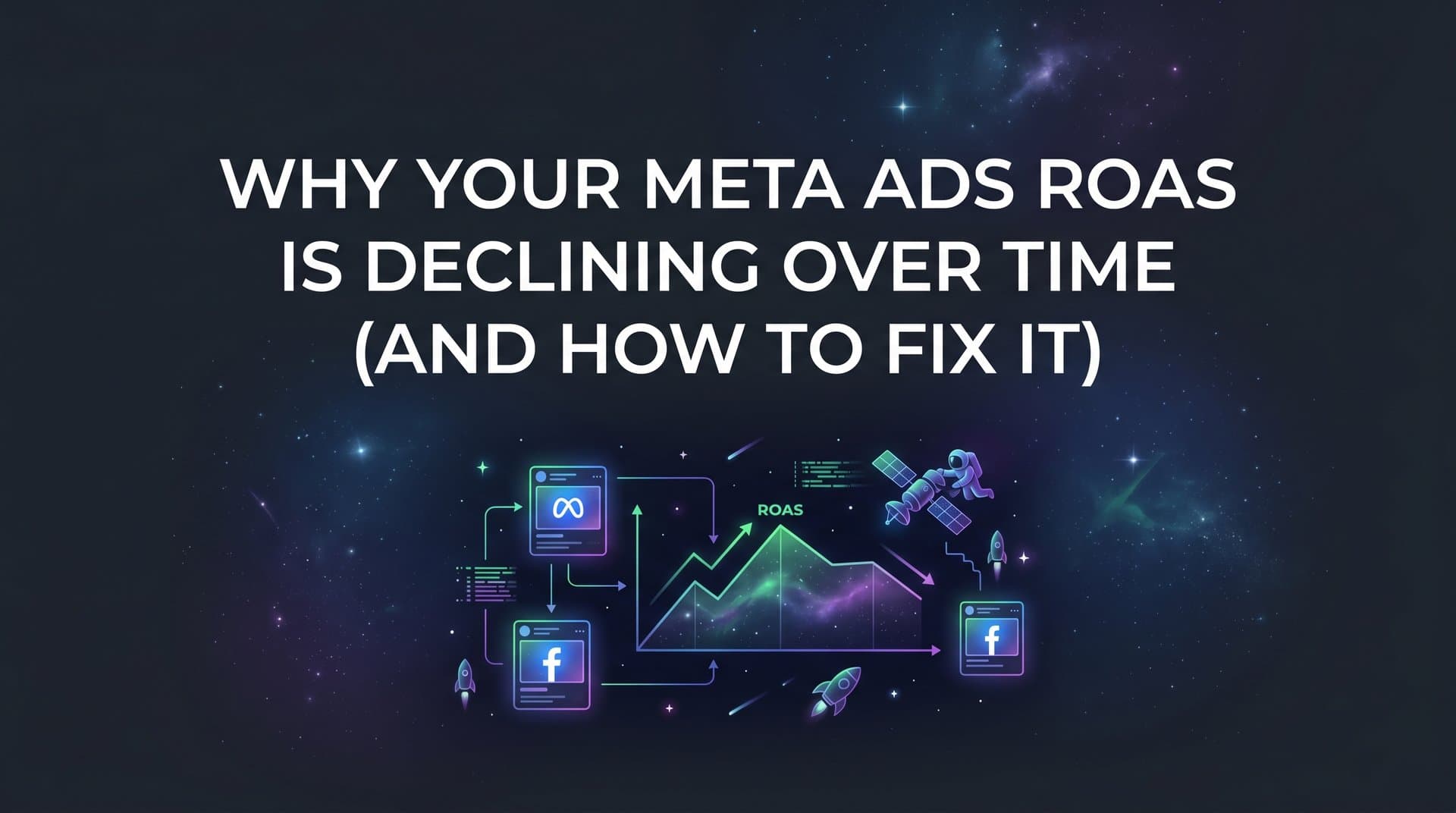
There's a pattern almost every Meta advertiser knows intimately. You launch a campaign, the early numbers look promising, ROAS climbs to a level you're proud of, and then, gradually, it starts slipping. A week passes. Then another. You haven't changed anything, the budget is the same, the targeting looks fine, yet the return keeps eroding. By the time you're staring at a ROAS that's half of what it was at launch, the frustration is real.
This is one of the most common and least talked-about challenges in Meta advertising. Not the dramatic crash of a campaign that never worked, but the slow, demoralizing decline of one that did. It feels personal, like the platform is working against you, but the reality is more mechanical than that. There are specific, identifiable forces behind every ROAS decline, and each one has a fix.
This article is a diagnostic guide. It walks through exactly why Meta ads ROAS declines over time, how to read the early warning signs before the damage compounds, and what experienced advertisers do to reverse the trend and keep performance stable across campaign cycles. If you've been chasing a ROAS that keeps moving further away, this is where you start.
The Hidden Forces Behind a Shrinking Return
When Meta ads ROAS starts declining over time, three structural forces are almost always at work. Understanding each one separately makes it much easier to diagnose which is driving your specific situation.
Ad Fatigue: This is the most common culprit, and it operates quietly. When the same audience sees the same creative repeatedly, engagement drops. Click-through rates fall, positive reactions dry up, and users start hiding the ad or scrolling past without registering it. Meta's algorithm reads these signals in real time. As engagement quality declines, your ad's relevance score deteriorates, and Meta begins deprioritizing your ad in the auction. The result is a double hit: you're paying more per impression while converting fewer of the people you reach.
Frequency is the metric to watch here. As frequency climbs, particularly past the three-to-four range for cold audiences, you're almost certainly in fatigue territory. The creative that drove your early ROAS isn't the problem. It worked. The problem is that it has run its course with the audience you're targeting.
Audience Saturation: Every target audience has a tiered structure of responsiveness. At the top are the users most likely to engage with your offer, the ones whose interests, behaviors, and intent signals align most closely with what you're selling. When a campaign launches, Meta's algorithm finds these high-value users first. They convert at strong rates, which reinforces the algorithm's confidence and keeps costs efficient.
But that pool is finite. As a campaign runs, Meta progressively exhausts the most receptive segment and begins serving ads to users further down the responsiveness curve. These users cost more to reach and convert at lower rates. Your cost per acquisition climbs, your ROAS falls, and from the outside it looks like the campaign has stopped working. It hasn't stopped working. It has simply run out of the best-fit users within the audience you defined.
Increasing Auction Competition: The Meta ads auction is dynamic. Advertiser competition fluctuates based on seasonality, industry trends, and the overall volume of advertisers competing for the same placements. A campaign that launched during a lower-competition window will naturally see its costs rise as more advertisers enter the auction for the same audience segments. The same budget that once bought strong reach and efficient conversions now buys less of both. This isn't a failure of your campaign. It's the baseline reality of operating in a real-time auction environment where pricing is never fixed.
Most ROAS declines are a combination of all three forces, with one typically leading the others. Identifying which is dominant in your situation is the first step toward an effective fix. Understanding the full picture of Meta ads performance declining helps you build a more resilient response strategy.
How Meta's Algorithm Works Against Stale Campaigns
The mechanics of Meta's delivery system create a compounding effect that accelerates ROAS decline once it begins. Understanding how the algorithm responds to performance signals helps explain why decline can feel sudden even when it has been building gradually.
Relevance rankings and auction cost: Meta evaluates every ad against three quality signals in the auction: Quality Ranking, Engagement Rate Ranking, and Conversion Rate Ranking. These aren't just vanity metrics. They directly influence how competitively your ad is priced and placed in the auction. An ad with declining engagement signals receives worse placements at higher effective CPMs, meaning you're paying more to reach less engaged users. The algorithm isn't punishing you arbitrarily. It's responding to real data about how users are interacting with your creative.
This creates a feedback loop that's difficult to break without intervention. Declining engagement leads to worse placement, which leads to lower-quality impressions, which leads to weaker conversion signals, which leads to further decline in rankings. Once this loop starts, simply waiting for performance to recover rarely works. Tracking the right Meta ads performance metrics is essential for catching this loop early.
The learning phase paradox: Meta's learning phase is a documented part of campaign delivery during which the algorithm is actively testing delivery strategies to find the most efficient way to achieve your objective. During this phase, performance is less stable and costs are often higher. The learning phase completes after a campaign accumulates sufficient optimization events, typically around 50 conversions per ad set per week.
Here's the tension: significant edits to a campaign reset the learning phase, destabilizing performance temporarily. But not making changes allows decay to compound. Experienced advertisers navigate this by making strategic, deliberate changes rather than reactive ones, and by structuring campaigns so that creative refreshes don't require resetting the entire campaign architecture.
iOS privacy changes and signal degradation: Apple's App Tracking Transparency framework, introduced in 2021 and continuing to shape the advertising landscape, reduced the volume of conversion signals Meta receives from iOS users. This affects the algorithm's ability to optimize delivery over time with the same precision it once had. Meta's own documentation acknowledges this as a factor in optimization quality and reported ROAS accuracy.
The practical implication is that Meta's algorithm is working with less complete data than it once was. This means optimization takes longer, reported ROAS can diverge from actual business outcomes, and campaigns that previously stabilized quickly may now require more time and more conversion volume to reach efficient delivery. It also means that historical ROAS benchmarks from before 2021 should be interpreted with caution, as attribution window changes and signal loss can make current performance appear weaker than it actually is relative to those earlier numbers.
Reading the Warning Signs Before ROAS Collapses
The most expensive version of ROAS decline is the one you don't catch until significant budget has already been wasted. The good news is that the deterioration almost always announces itself through specific metric shifts before it becomes a full collapse. Knowing what to look for changes your posture from reactive to proactive.
The four early indicators: These metrics tend to move before ROAS visibly drops, which makes them your early warning system.
Rising Frequency: When frequency climbs past the three-to-four range for cold audiences, fatigue is likely setting in. Monitor this weekly, not monthly.
Declining CTR: A falling click-through rate signals that the creative is losing its ability to stop the scroll. This often precedes CPM increases because the algorithm reads reduced engagement as a quality signal.
Increasing CPM: Rising CPMs indicate either increased auction competition or declining relevance scores, or both. When CPM rises without a corresponding improvement in conversion rate, ROAS will follow downward.
Widening CPC-to-Conversion Gap: If your cost per click is rising while your conversion rate holds flat or falls, you're paying more for traffic that converts at the same or worse rate. This gap is one of the clearest signals that something structural has shifted.
Using Meta's relevance diagnostics: Meta provides three ad relevance diagnostics in Ads Manager: Quality Ranking, Engagement Rate Ranking, and Conversion Rate Ranking. Each one points to a different layer of the problem.
A low Quality Ranking suggests the creative itself is being perceived as low-quality relative to competing ads targeting the same audience. A low Engagement Rate Ranking indicates the audience isn't finding the ad compelling enough to interact with. A low Conversion Rate Ranking points to a post-click problem, meaning the landing page or offer isn't converting the traffic that does click through. Knowing which ranking is underperforming tells you exactly where to focus your fix. A Meta ads performance tracking dashboard makes it significantly easier to monitor all three rankings in one place.
Setting performance baselines and threshold alerts: The most disciplined advertisers establish a performance baseline during the first two weeks of a campaign when results are relatively stable. They document expected ranges for ROAS, CTR, CPM, and frequency, then set threshold alerts so they're notified when any metric moves meaningfully outside that range.
This approach removes the guesswork from performance monitoring. Instead of checking in periodically and trying to judge whether a number looks bad, you have a defined trigger that tells you when action is required. Catching decline at the 10% deviation mark is far less costly than catching it at 40%.
Creative Refresh Strategies That Actually Reverse the Decline
When ROAS starts declining due to creative fatigue, the instinct is often to swap the image or tweak the headline. This rarely works. Cosmetic changes don't reset the engagement signals Meta has already collected on your ad, and they don't give the algorithm meaningfully new data to work with. Effective creative refresh requires a more deliberate approach.
What "refresh" actually means: A genuine creative refresh introduces new formats, new angles, and new messaging hooks, not just new visuals. If your declining ad is a static image with a product-focused headline, your refresh should explore video, UGC-style content, testimonial framing, or a problem-led narrative. The goal is to present your offer in a way that feels genuinely different to someone who has already scrolled past your previous version multiple times.
Format diversity matters more than most advertisers realize. A video ad and a static image ad can target the same audience with the same offer and generate completely different engagement profiles. Users who have fatigued on one format often respond to another, effectively extending the life of your targeting without requiring you to expand your audience. If the manual process of producing new creatives is a bottleneck, understanding how long Meta ads take too long to create can help you identify where to streamline.
Building from what already worked: The most efficient path to a new winning creative isn't starting from scratch. It's reverse-engineering your top performers. Analyze your historical winners and extract the specific elements that drove results: the hook structure in the first three seconds of a video, the visual layout that generated high CTR, the copy angle that resonated with your audience's core pain point.
New creative variations built around proven elements have a higher baseline probability of performing than purely experimental concepts. You're not guessing what might work. You're iterating on evidence. This is the difference between creative testing that feels like a lottery and creative testing that compounds over time.
Testing velocity as a competitive advantage: How quickly you can cycle through creative variations is as important as the quality of any individual creative. A testing pipeline that introduces two or three new variations per week shortens the window between a creative burning out and a new winner taking its place. That window is where ROAS decay lives.
Platforms like AdStellar are built specifically to accelerate this cycle. The AI Creative Hub generates image ads, video ads, and UGC-style creatives from a product URL, lets you clone competitor ads directly from the Meta Ad Library, and enables chat-based refinement of any creative. The bulk ad launch feature creates hundreds of ad variations in minutes, mixing creatives, headlines, and copy combinations and pushing them to Meta without the manual setup that typically bottlenecks creative testing. More variations tested simultaneously means faster discovery of the next winner and a shorter ROAS decay window between cycles. Advertisers looking to launch multiple Meta ads at once can dramatically compress the time between creative burnout and a new winning variation.
Audience and Campaign Structure Fixes for Sustained ROAS
Creative refresh addresses one dimension of ROAS decline. But if your audience is saturated or your campaign architecture is creating inefficiencies, new creatives alone won't hold performance for long. Structural fixes are the other half of the equation.
Expanding beyond saturated audiences: When a core audience is exhausted, the answer isn't always to find a completely different audience. It's often to expand the radius around what's already working. Lookalike audiences built from your best converters give Meta a fresh pool of users who share characteristics with your highest-value customers. Testing multiple lookalike tiers, from 1% to 5% and beyond, introduces progressively larger audiences at the cost of some precision.
Interest layering and broad targeting with strong creative are also worth exploring. Meta's algorithm has become significantly more capable of finding high-intent users within large, broadly defined audiences when it has good creative and conversion signals to work from. Restricting targeting too tightly can actually accelerate saturation by limiting the pool Meta has to optimize within. An AI Meta ads targeting assistant can help identify audience expansion opportunities before saturation sets in.
Campaign architecture adjustments: Prospecting and retargeting campaigns serve fundamentally different purposes and should be separated in your account structure. Mixing them in a single campaign creates audience overlap that inflates costs and muddies performance data. When you can't clearly see whether a conversion came from a cold audience or a warm retargeting touchpoint, optimization decisions become guesswork.
Campaign Budget Optimization can be a powerful tool for sustained performance, but it requires careful ad set structure. Too many competing ad sets within a single CBO campaign can cause budget to concentrate heavily in one direction, starving other ad sets of the data they need to optimize. Regular audits of budget distribution within CBO campaigns help ensure resources are flowing to the right places. Reviewing Meta ads budget allocation strategies can prevent this common structural inefficiency from quietly eroding your ROAS.
Continuous A/B testing as a structural habit: The advertisers who maintain strong ROAS over time aren't running better individual campaigns. They've built a system of continuous testing at both the ad set and ad level that generates a self-renewing performance engine. New audiences are tested against proven ones. New creative angles compete with current winners. Budget flows toward what's working while new challengers are always in the pipeline.
This approach transforms campaign management from a series of launches and declines into a continuous optimization loop. ROAS doesn't peak and crash because there's always a new winner ready to take over before the current one burns out.
Building a System That Prevents ROAS Decay from Repeating
Fixing a ROAS decline is valuable. Building a system that prevents it from becoming a recurring crisis is where the real competitive advantage lives. The shift required is from reactive management to proactive architecture.
Scheduling audits and setting rotation triggers: Rather than waiting for ROAS to drop before acting, experienced advertisers set predefined triggers that initiate creative review and rotation. A frequency threshold of four for cold audiences, a CTR decline of more than 20% week-over-week, or a CPM increase beyond a defined ceiling are all examples of objective triggers that don't require you to judge whether performance "feels" off.
Weekly creative audits, even brief ones, catch the early signals that monthly reviews miss. The goal is to build a rhythm where creative refresh is a scheduled, systematic activity rather than an emergency response. When rotation is proactive, you control the timing. When it's reactive, the algorithm has already been working against you for days or weeks.
How AI-powered platforms change the equation: The manual version of this system, running audits, generating new creatives, testing variations, and surfacing winners, is time-intensive enough that most advertisers can't sustain it at the pace required. This is where AI for Meta ads campaigns fundamentally changes the economics of creative management.
AdStellar is built around exactly this problem. The AI Campaign Builder analyzes your historical campaign data, ranks every creative, headline, and audience by real performance metrics, and builds complete Meta ad campaigns in minutes. Every decision comes with a transparent rationale, so you understand the strategy behind the output, not just the output itself. The AI Insights feature uses leaderboard rankings to score every creative element against your specific performance goals, whether that's ROAS, CPA, or CTR, so you can instantly identify what's working and what needs to be replaced.
The Winners Hub keeps your best-performing creatives, headlines, and audiences organized in one place with real performance data attached. When you're ready to launch a new campaign, you're not starting from zero. You're building on a library of proven assets that gets richer with every cycle.
The compounding creative library advantage: This is the long-term payoff of systematic creative management. Each campaign cycle produces new winning assets. Those assets inform the next cycle, which produces better-calibrated creatives faster. Over time, the gap between you and advertisers who are still running one creative until it dies and then scrambling to replace it grows wider.
The advertisers who consistently maintain strong Meta ads ROAS aren't doing something mysterious. They've built a process where creative, audience, and campaign structure are continuously refreshed based on real performance data. The system does the work that would otherwise require constant manual attention, and it compounds in their favor with every campaign they run.
The Bottom Line on ROAS Decline
Meta ads ROAS declining over time is not a sign that the platform has stopped working for you. It's a signal that the system needs a refresh. Ad fatigue, audience saturation, and auction competition are structural realities of the Meta advertising environment. Every advertiser faces them. The difference between those who maintain strong ROAS and those who watch it erode is whether they've built a process to stay ahead of these forces or whether they're always catching up to them.
The diagnostic framework in this article gives you the tools to identify what's driving your specific decline, whether it's creative fatigue, audience exhaustion, structural inefficiencies, or a combination. The fix is almost always a combination of fresher creative, expanded audiences, and tighter campaign architecture, executed consistently rather than as a one-time intervention.
The most durable competitive advantage in Meta advertising is a system that continuously generates, tests, and surfaces winning creative before the current generation burns out. That's the loop that keeps ROAS stable over time, and it's exactly what AdStellar is built to automate.
If you're ready to stop chasing declining numbers and start building a system that compounds in your favor, Start Free Trial With AdStellar and see how AI-powered creative generation, campaign building, and performance scoring can keep your Meta ads performing at their peak, cycle after cycle.