Evaluating SaaS tools for Meta advertising can feel like navigating a maze of pricing pages designed to confuse rather than inform. Features are listed without context, tier names vary wildly between platforms, and the differences between a $49 plan and a $499 plan are often buried in footnotes or described in language vague enough to mean almost anything.
If you have ever paid for a plan only to discover the AI features you needed were locked behind the next tier, or upgraded to a premium plan and used maybe 20% of what you were paying for, you already understand the problem. Meta Ads SaaS pricing is not just a cost question. It is a capability question, and getting it wrong in either direction has real consequences for your campaigns and your budget.
This article breaks down how Meta Ads SaaS pricing tiers are typically structured, what actually unlocks at each level, and how to match a plan to your real advertising workflow. Whether you are a solo marketer running a single product account or an agency managing dozens of clients, the goal is to help you cut through the noise and make a decision based on what you actually need, not what sounds impressive on a pricing page.
The Logic Behind Tiered Pricing in Meta Ads SaaS Platforms
Tiered pricing exists because the gap between a solo advertiser managing one product and an agency running 50 client accounts is enormous. These are not just different scales of the same workflow. They are fundamentally different operational realities with different tooling requirements, different creative volumes, and different levels of analytical complexity.
Platforms respond to this by using feature gating, which is the practice of reserving more advanced capabilities for higher-paying tiers. The logic is straightforward: core functionality sits at the entry level, and progressively more powerful features unlock as you move up. This benefits platforms by creating natural upgrade paths and benefits advertisers by keeping entry-level costs accessible.
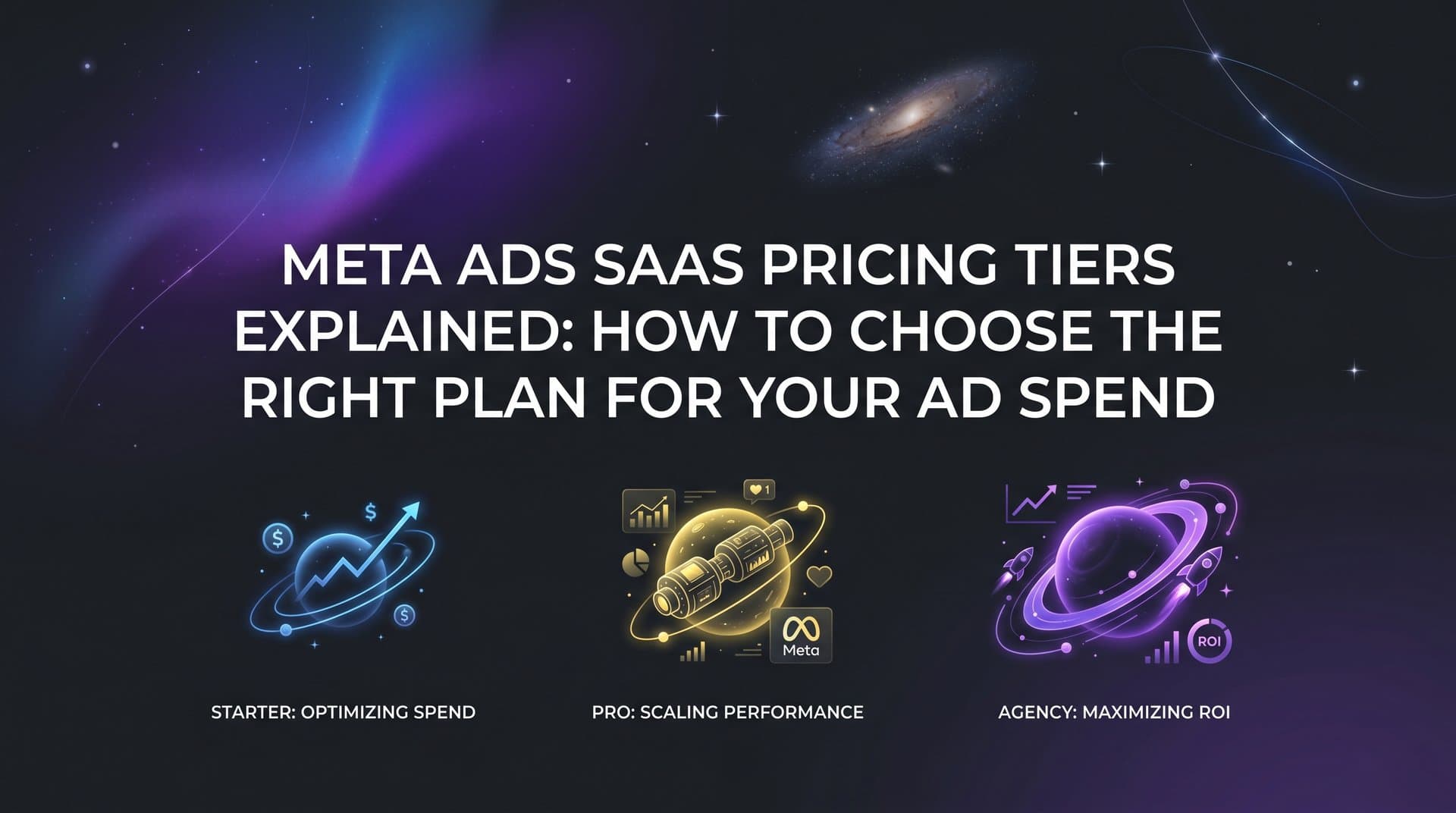
In the Meta Ads SaaS space, feature gating typically follows a predictable pattern. Basic ad creative generation and single account access are usually available at the lowest tier. Mid-tier plans add things like AI-powered campaign building, historical data analysis, and more robust performance reporting. Top-tier plans unlock bulk launching, deep AI insights with goal-based scoring, attribution integrations, and the kind of cross-campaign intelligence that agencies and high-spend advertisers need.
Understanding this structure before you start comparing pricing pages saves you from two common mistakes. The first is overpaying: subscribing to a top-tier plan because it sounds comprehensive when your actual workflow only requires a fraction of those capabilities. The second is underbuying: starting on the cheapest plan to save money, then hitting a capability ceiling mid-campaign when you need to scale creative testing or launch across multiple accounts.
The better approach is to map your current workflow and your near-term growth plans against the feature set at each tier, then choose the level that addresses your biggest bottleneck without paying for capabilities you will not realistically use in the next six months.
A Tier-by-Tier Breakdown of What You Actually Get
Entry-level plans, often labeled Hobby or Starter, are designed for small businesses, solo marketers, and advertisers who are either new to a platform or running a relatively contained operation. At this level, you typically get access to core ad creative generation, single account support, and a limited volume of campaigns or creative outputs per month. The focus is on giving you enough to evaluate the platform and run meaningful tests without committing to a higher price point.
For example, AdStellar's Hobby plan at $49 per month gives you access to AI ad creative generation, including image ads, video ads, and UGC-style avatar content. You can generate creatives from a product URL, clone competitor ads from the Meta Ad Library, and refine them using chat-based editing. For a small business owner or a marketer managing a single brand account, that creative capability alone can replace a significant chunk of design and production costs.
Mid-tier plans, typically labeled Pro, are where the platform starts to feel like a full advertising system rather than a creative tool. At this level, you generally gain access to multi-account management, AI-powered campaign building that draws on historical performance data, expanded creative generation limits, and performance analytics with more depth than basic reporting.
AdStellar's Pro plan at $129 per month adds the AI Campaign Builder, which analyzes your past campaigns, ranks creatives, headlines, and audiences by performance, and builds complete Meta Ad campaigns with transparent reasoning behind every decision. This is the tier where the platform starts doing strategic work, not just production work. For a performance marketer who is actively testing and optimizing, this level of automation and insight changes how much time you spend on setup versus analysis.
Top-tier plans, labeled Ultra or Agency level depending on the platform, are built for scale. These plans typically include bulk ad launching across hundreds of creative and audience combinations, full AI insights with ROAS and CPA-based scoring, winner tracking systems that organize top performers for reuse, and attribution integrations that connect ad performance to downstream conversion data.
AdStellar's Ultra plan at $499 per month includes all of the above plus the Winners Hub, which consolidates your best-performing creatives, headlines, and audiences in one place so you can pull them directly into future campaigns. It also includes integration with Cometly for attribution tracking, which matters significantly when you are managing large budgets and need to connect Meta performance data to actual revenue outcomes.
The Features That Actually Move the Needle at Each Level
Not every feature listed on a pricing page has equal impact on your results. Some are genuinely transformative for the right advertiser at the right stage. Others are nice to have but unlikely to change your day-to-day output. Here is how to think about which features actually matter at each tier.
At the entry level, the highest-value feature is AI ad creative generation. For small advertisers, the cost of producing quality creatives, whether through a designer, a video editor, or a UGC creator, is often the single biggest barrier to running effective tests. A platform that can generate image ads, video ads, and UGC-style content from a product URL removes that barrier almost entirely. The ability to clone competitor ads from the Meta Ad Library and refine them through chat-based editing adds another layer of creative leverage that would otherwise require significant manual effort.
At the mid tier, the AI Campaign Builder becomes the most impactful feature. This is not just about saving time during setup, though that matters. It is about the quality of the campaigns being built. When an AI analyzes your historical performance data, ranks your creatives and audiences by what has actually worked, and then builds a complete campaign with a clear explanation of why each element was chosen, you are starting from a much stronger position than if you were building from intuition or general best practices. The transparency component is particularly valuable: you understand the strategy, not just the output, which means you can learn from it and apply that knowledge over time.
At the top tier, two features stand out as genuine differentiators. The first is bulk ad launching. The ability to mix multiple creatives, headlines, audiences, and copy variations at both the ad set and ad level, and then launch hundreds of combinations in minutes rather than hours, fundamentally changes how quickly you can run meaningful tests. The second is AI Insights with goal-based scoring. When your leaderboards rank every creative, headline, copy variation, audience, and landing page against your specific ROAS and CPA targets, you stop guessing about what is working and start making decisions based on real performance data. The combination of fast launching and fast learning creates a compounding advantage that is difficult to replicate manually.
Matching a Pricing Tier to Your Ad Spend and Goals
The most reliable way to choose the right tier is to start with your current scale and your most pressing bottleneck, not with the feature list you wish you needed.
If your monthly ad spend is modest and you are managing one or two accounts, an entry-level plan covers your core needs. The primary value at this stage is creative production. If you are currently spending time or money on design work, an entry-level AI creative tool pays for itself quickly. You do not need bulk launching or multi-account AI campaign building yet, and paying for those features before you need them just adds cost without adding value.
When your ad spend grows to the point where creative testing and audience experimentation become critical to maintaining ROAS, a mid-tier plan starts to make clear sense. This is typically the stage where you are running enough campaigns that manual setup becomes a real time cost, and where the quality of your campaign structure starts to have a measurable impact on performance. The AI Campaign Builder at this tier does not just save hours of setup time. It brings a level of data-driven structure to your campaigns that is difficult to replicate manually, especially when you are managing multiple products or audiences simultaneously.
For agencies and performance marketers managing multiple clients or running large-scale campaigns, the evaluation criteria shift toward bulk launching capability and winner tracking. The question is not whether the platform can build good campaigns. It is whether the platform can help you operate at the speed and scale your client roster or budget demands. Bulk ad launching that creates hundreds of variations in minutes, combined with a Winners Hub that organizes proven creatives and audiences for reuse across campaigns, directly reduces time-to-launch and improves the consistency of results across accounts.
A practical rule of thumb: if the features at a given tier address your current biggest bottleneck and give you a clear path to the next stage of growth, that is the right tier. If you are paying for features that address problems you do not have yet, you are probably one tier too high.
Red Flags to Watch for on Meta Ads SaaS Pricing Pages
Not all pricing pages are created equal, and some are designed to obscure limitations rather than communicate them clearly. Here are the warning signs worth watching for when you are comparing platforms.
Hidden usage caps: Some platforms bury ad account limits, creative generation caps, or campaign volume restrictions in fine print rather than presenting them clearly in the tier comparison. Hitting one of those limits mid-campaign can disrupt active tests and force an unplanned upgrade at the worst possible time. Before committing to any plan, look specifically for what happens when you hit the limit, not just what the limit is.
Vague AI feature descriptions: Phrases like "advanced AI features" or "AI-powered optimization" without any specifics about what the AI actually does are a significant red flag. There is an enormous difference between an AI that generates static image ads and one that analyzes historical campaign data, ranks creatives and audiences by performance, builds complete campaigns with transparent reasoning, and scores every ad element against your specific goals. If a pricing page cannot tell you what the AI does in concrete terms, you cannot evaluate whether it is worth paying for.
No free trial or sandbox environment: Meta Ads SaaS tools are hands-on products. The quality of AI creative outputs, the usability of the campaign builder, and the relevance of the insights all depend heavily on your specific account, your audience, and your creative style. A platform that does not offer a free trial or a meaningful way to test before committing is asking you to make a significant decision with limited information. This is especially true at higher price points where the monthly cost is substantial.
Opaque upgrade paths: If it is unclear what you gain by moving from one tier to the next, or if the pricing page makes every tier sound equally capable, that is a sign the platform may not have a well-structured feature progression. A good pricing page should make it obvious why someone would upgrade and exactly what they gain when they do.
Putting It All Together: Choosing a Plan That Grows With You
The framework for choosing the right Meta Ads SaaS pricing tier comes down to three questions: What is your current scale? What is your biggest bottleneck right now? And does the platform have a clear upgrade path when your needs change?
Match your tier to your current scale, not your aspirational one. Prioritize the features that address the specific constraint holding your campaigns back, whether that is creative production, campaign building efficiency, or the speed and scale of your testing. And choose a platform where the upgrade path is transparent enough that you can see exactly what you gain as your needs grow.
AdStellar is built around exactly this kind of structured progression. The Hobby plan at $49 per month gives you AI creative generation across image ads, video ads, and UGC-style content. The Pro plan at $129 per month adds the AI Campaign Builder with full historical data analysis and transparent AI reasoning. The Ultra plan at $499 per month brings bulk launching, AI Insights with ROAS and CPA scoring, the Winners Hub, and Cometly attribution integration. Each tier has a clear purpose and a clear upgrade trigger.
All three tiers come with a 7-day free trial, which means you can test the creative generation, the campaign builder, and the analytics features against your actual account before making any commitment. As AI continues to reshape how Meta campaigns are built and optimized, the right SaaS tier is not just a budget line item. It is a strategic decision that determines how fast you can test, learn, and scale.
The best Meta Ads SaaS pricing tier is the one aligned with where you are right now and where you are headed next. Not the cheapest option that leaves you hitting ceilings, and not the most feature-packed plan that charges you for capabilities you will not use for another year. The right tier is the one that removes your biggest bottleneck today while giving you room to grow.
The only way to know which tier that is for your specific workflow is to test it hands-on. Pricing pages can tell you what features exist. Actually using the platform tells you whether those features work for your account, your audience, and your creative approach.
Start Free Trial With AdStellar and see firsthand how AI handles creative generation, campaign launching, and performance surfacing across all three tiers. Seven days is enough time to generate real creatives, build a real campaign, and get a clear read on which plan fits the way you actually work.