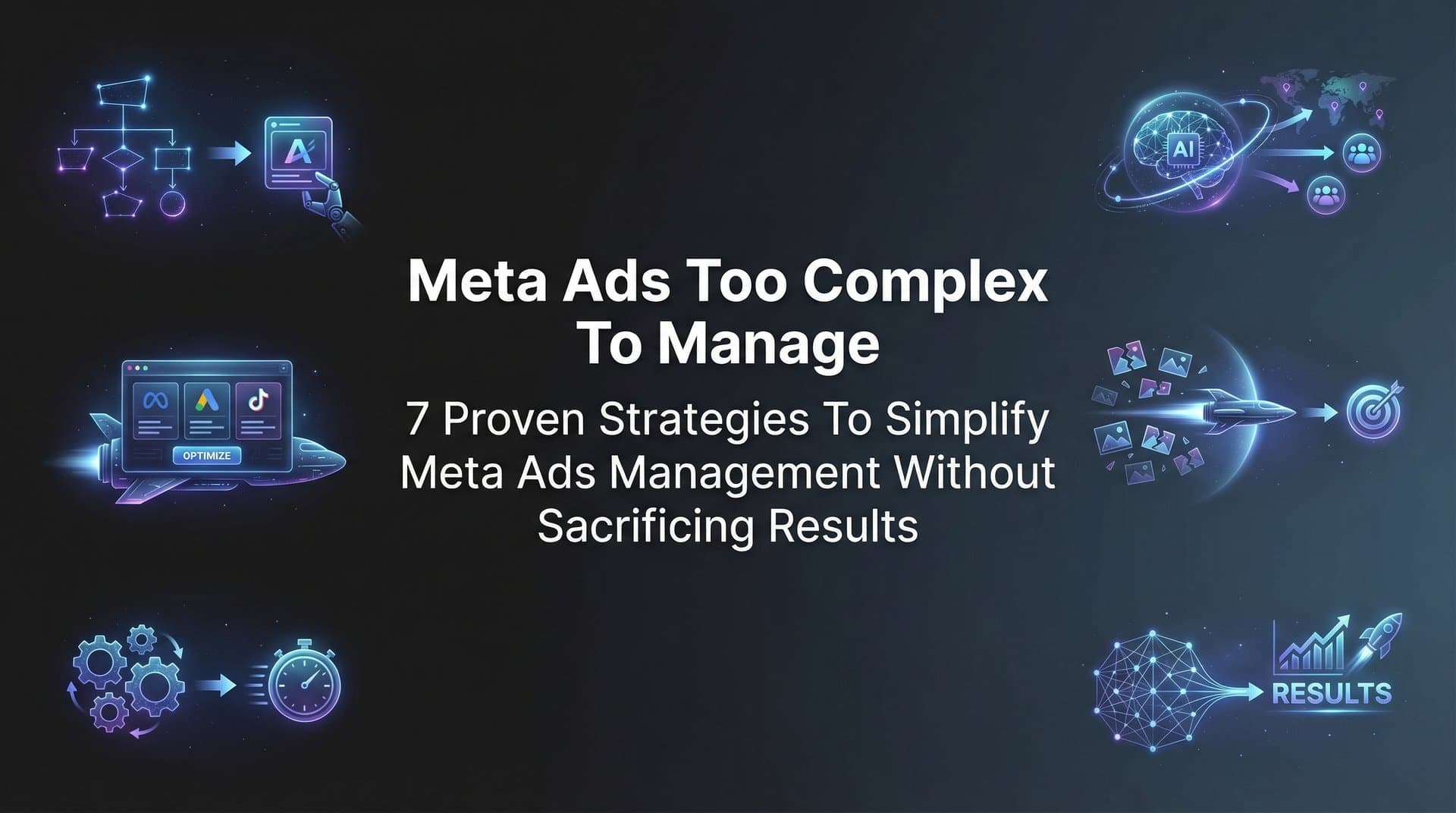
Meta Ads management has become a full-time job you never signed up for. Between tracking algorithm updates, juggling creative variations, monitoring audience performance, and decoding attribution data, many marketers find themselves drowning in tactical execution while strategic thinking takes a backseat.
The irony? All this complexity rarely translates to better results. Decision paralysis sets in when you're staring at 47 different campaign variations. Ad spend gets wasted testing creatives that never had a chance. Burnout becomes inevitable when campaign management consumes 80% of your workweek.
Here's the reality: You don't need to become a full-time Meta Ads specialist to run profitable campaigns. You need systems that remove friction, automation that handles repetitive tasks, and clarity about what actually drives performance.
The following seven strategies help marketers reclaim control over their Meta Ads without sacrificing results. Some are structural changes you can implement today. Others leverage AI-powered automation to eliminate entire categories of manual work. Together, they create a management approach that scales without burning you out.
1. Consolidate Campaign Structures to Reduce Management Overhead
The Challenge It Solves
Campaign sprawl happens gradually. You launch a test campaign for one product. Then another for a different audience. Soon you're managing 30 campaigns that each need daily monitoring, budget adjustments, and performance reviews. The administrative burden becomes crushing.
More campaigns don't automatically mean better performance. They often mean diluted budgets, fragmented data, and algorithms that can't optimize effectively because each campaign lacks sufficient volume.
The Strategy Explained
Campaign consolidation means merging redundant campaigns into fewer, stronger structures that give Meta's algorithm more data to work with. Instead of running separate campaigns for minor variations, you create unified campaigns that test multiple elements within a cohesive structure.
This approach aligns with how Meta's algorithm actually works. The system needs volume to identify patterns and optimize delivery. Spreading your budget across too many campaigns prevents the algorithm from gathering enough signal to make smart decisions. Understanding the Meta Ads learning phase helps you structure campaigns that exit learning faster.
The goal isn't to eliminate testing. It's to test more efficiently by consolidating similar objectives into campaigns that can scale.
Implementation Steps
1. Audit your current campaign structure and identify campaigns targeting similar audiences or promoting related products that could be combined.
2. Merge campaigns with identical objectives and let ad set-level targeting handle audience variations instead of creating separate campaigns.
3. Consolidate budgets from multiple small campaigns into fewer campaigns with higher daily spends, giving the algorithm more room to optimize.
4. Monitor performance for two weeks after consolidation to ensure the algorithm has time to re-learn and stabilize.
Pro Tips
Start with your lowest-performing campaigns when consolidating. Merge them into your strongest performers to leverage existing algorithmic learning. Keep your naming conventions clear so you can still track performance by product or audience segment even within consolidated structures.
2. Automate Creative Production Instead of Designing Everything Manually
The Challenge It Solves
Creative production is the biggest bottleneck in scaling Meta Ads. You need fresh creatives constantly because ad fatigue sets in quickly. But coordinating with designers, waiting for video editors, or hiring UGC creators takes weeks and costs thousands of dollars.
This bottleneck forces marketers into a painful choice: run the same creatives until performance tanks, or slow down campaign launches while waiting for new assets. Neither option is acceptable when you're trying to scale profitably.
The Strategy Explained
AI-powered creative generation eliminates the production bottleneck entirely. Modern platforms can generate scroll-stopping image ads, video ads, and UGC-style avatar content from nothing more than a product URL. You can also clone competitor ads directly from Meta's Ad Library to test proven concepts in your own campaigns.
The quality has reached a point where AI-generated creatives perform comparably to professionally designed assets in many categories. A dedicated creative management platform helps you organize and iterate on these assets efficiently.
This isn't about replacing human creativity. It's about removing the friction between having an idea and testing it in market.
Implementation Steps
1. Identify your highest-priority product or offer that needs fresh creative assets immediately.
2. Use an AI creative platform to generate multiple variations, including different angles, messaging approaches, and visual styles.
3. Launch these AI-generated creatives alongside any existing assets to compare performance directly.
4. Analyze which AI-generated concepts perform best, then use those insights to guide future creative direction.
Pro Tips
Don't overthink the first batch. Generate 10-15 variations quickly and let real performance data tell you what works. The speed advantage of AI creative means you can iterate based on market feedback rather than internal opinions about what might work.
3. Let Historical Data Guide Campaign Decisions
The Challenge It Solves
Most marketers have months or years of campaign performance data sitting in Meta Ads Manager, but extracting actionable insights requires hours of manual analysis. You know certain creatives performed better than others, but identifying exactly which elements drove that performance feels impossible.
This means you're essentially starting from scratch with every new campaign, ignoring valuable lessons buried in your historical data. You repeat mistakes because you can't easily identify what failed. You miss opportunities because you don't know which winning elements to reuse.
The Strategy Explained
Historical performance analysis means systematically reviewing past campaigns to identify patterns in what worked and what didn't. This goes beyond looking at campaign-level ROAS. It means ranking individual creatives, headlines, audiences, and copy variations by performance metrics that matter to your business.
The insight isn't just "Campaign A performed better than Campaign B." It's "This specific headline combined with this audience segment consistently delivers 40% lower CPA." That level of granularity transforms how you build new campaigns.
When you know which elements have proven track records, you can build new campaigns with confidence rather than guesswork. The right campaign management tool makes surfacing these insights automatic.
Implementation Steps
1. Export performance data from your last 90 days of campaigns, including creative-level and audience-level metrics.
2. Rank your creatives by your primary success metric, whether that's ROAS, CPA, CTR, or conversion rate.
3. Identify the top 20% of performers and analyze what they have in common in terms of visual style, messaging, format, or audience targeting.
4. Create a "winners library" where you document these high-performing elements for easy reference when building future campaigns.
Pro Tips
Look for elements that performed well across multiple campaigns, not just one-hit wonders. Consistency across different contexts suggests genuine effectiveness rather than lucky timing. Update your winners library monthly as new data comes in.
4. Replace Manual A/B Testing with Bulk Variation Launches
The Challenge It Solves
Traditional A/B testing on Meta means launching variations one by one, waiting for statistical significance, then launching the next test. This sequential approach is thorough but painfully slow. Testing five creative variations against three headlines across two audiences would take months using traditional methods.
The speed of testing directly impacts your ability to find winners before competitors do. Slow testing means missed opportunities and prolonged exposure to underperforming ads while you wait for conclusive data.
The Strategy Explained
Bulk variation launching means creating hundreds of ad combinations simultaneously by mixing multiple creatives, headlines, audiences, and copy variations at both the ad set and ad level. Instead of testing sequentially, you test everything in parallel and let the algorithm allocate budget toward winners automatically.
This approach leverages Meta's campaign budget optimization and dynamic creative features, but takes them further by pre-generating every meaningful combination rather than relying solely on dynamic assembly. A bulk Meta Ads creation tool handles the heavy lifting of generating these combinations at scale.
The result is compressed learning cycles. You identify winners in days instead of weeks.
Implementation Steps
1. Prepare your testing matrix by selecting 5-10 creatives, 3-5 headlines, 2-3 primary text variations, and 2-3 audience segments you want to test.
2. Use a bulk creation tool or platform that can generate every combination of these elements automatically rather than manually building each variation.
3. Launch all variations simultaneously with campaign budget optimization enabled so Meta can allocate spend toward the best performers.
4. Review performance after 3-5 days to identify clear winners, then pause underperformers and scale winners with increased budgets.
Pro Tips
Start with a smaller matrix if bulk launching feels overwhelming. Even testing three creatives against three headlines creates nine variations, which is already 9x faster than sequential testing. You can always expand the matrix once you're comfortable with the workflow.
5. Establish Goal-Based Scoring to Identify Winners Faster
The Challenge It Solves
When you're running dozens or hundreds of ad variations, identifying winners becomes subjective and time-consuming. Different team members might define success differently. One person focuses on CTR, another on conversion rate, another on ROAS. This inconsistency leads to confusion about which ads to scale.
Without clear benchmarks, you waste time debating whether a 1.2% CTR is good or whether a $45 CPA is acceptable. Every performance review becomes a negotiation instead of a data-driven decision.
The Strategy Explained
Goal-based scoring means establishing clear target metrics before launching campaigns, then automatically scoring every creative, headline, audience, and ad against those benchmarks. If your target CPA is $30, any ad delivering $25 CPA gets a high score. Any ad at $40 CPA gets flagged for review or pause.
This creates objective performance evaluation that removes subjectivity from decision-making. You're not debating whether an ad is "good enough." You're comparing it against predetermined success criteria that align with business objectives.
Scoring systems also create leaderboards that rank every element by performance, making it instantly clear which creatives, headlines, or audiences deserve more budget and which need to be retired. Many marketers find that Facebook Ads Manager feels too complex for this kind of analysis, which is why dedicated tools help.
Implementation Steps
1. Define your target metrics based on business objectives, including acceptable CPA, minimum ROAS, target conversion rate, and baseline CTR.
2. Document these targets in a shared location so everyone on your team evaluates performance using the same criteria.
3. Create a scoring rubric that assigns point values based on how far above or below target each metric falls.
4. Review your leaderboards weekly to identify top performers that deserve budget increases and bottom performers that need optimization or pausing.
Pro Tips
Your targets should be ambitious but achievable based on historical performance. If your average CPA over the last quarter was $35, setting a $20 target will frustrate your team. Start with targets 10-20% better than current performance, then tighten them as you improve.
6. Centralize Performance Insights in One Dashboard
The Challenge It Solves
Data fragmentation kills efficiency. You check Meta Ads Manager for campaign metrics, Google Analytics for website behavior, your attribution platform for customer journey data, and spreadsheets for historical trends. Synthesizing insights from multiple sources takes hours and often leads to incomplete analysis because you're missing context from other tools.
This fragmentation also makes it nearly impossible to spot patterns quickly. By the time you've gathered all the relevant data, the opportunity to act on it may have passed.
The Strategy Explained
Centralizing performance insights means consolidating all campaign reporting into a unified dashboard that shows creative performance, audience metrics, conversion data, and attribution insights in one view. You should be able to answer "What's working and why?" without switching between five different platforms.
The best centralized dashboards don't just display data. They surface insights by highlighting anomalies, identifying trends, and flagging opportunities that would be easy to miss when looking at isolated metrics. Context matters more than raw numbers.
This approach saves hours of manual reporting time while improving decision quality because you can see the complete picture instantly. A robust workflow management system ties reporting directly to action items.
Implementation Steps
1. Identify which metrics you actually check daily versus which ones you track out of habit but rarely act on.
2. Build or adopt a dashboard that displays your essential metrics in one view, prioritizing the data that drives decisions.
3. Connect your attribution platform, Meta Ads account, and any other relevant data sources so the dashboard automatically updates.
4. Establish a daily review routine where you spend 10 minutes scanning the dashboard for anomalies or opportunities rather than diving into individual platform reports.
Pro Tips
Resist the urge to track everything. A dashboard with 50 metrics is as useless as no dashboard because you can't process that much information quickly. Focus on the 5-7 metrics that most directly indicate whether campaigns are on track to hit your goals.
7. Adopt AI-Powered Campaign Building for End-to-End Simplification
The Challenge It Solves
Even after implementing the previous six strategies, Meta Ads management still requires significant expertise and time. You need to know how to structure campaigns, which audiences to target, how to write compelling ad copy, and how to interpret performance signals. This expertise gap prevents many marketers from scaling campaigns confidently.
The alternative is hiring specialists or agencies, but that introduces cost, communication overhead, and dependency on external teams who may not understand your business as well as you do.
The Strategy Explained
AI-powered campaign building platforms handle the entire workflow from creative generation to campaign launch to performance optimization. These systems analyze your historical data, identify which elements have driven success, and build complete campaigns with optimized audiences, headlines, and ad copy based on proven patterns.
What makes modern AI platforms different from basic automation is transparency. The best systems explain every decision they make, showing you why they selected specific audiences or recommended certain creative approaches. Exploring the best Meta Ads automation tools helps you find platforms that match your workflow needs.
This represents a fundamental shift from managing campaigns to guiding strategy while AI handles implementation.
Implementation Steps
1. Evaluate AI platforms that offer end-to-end campaign management, focusing on those that provide transparency into their decision-making process.
2. Start with a pilot campaign where you let the AI build and launch the campaign while you monitor performance closely.
3. Compare AI-built campaigns against your manually created campaigns to validate performance and build confidence in the system.
4. Gradually expand AI involvement as you become comfortable with the platform's decision quality and understand its strategic approach.
Pro Tips
Look for platforms that get smarter over time by learning from your specific campaign data rather than generic industry benchmarks. The AI should adapt to your unique business context, not force you to adapt to its assumptions about what works.
Your Implementation Roadmap
These seven strategies represent a progression from quick structural wins to transformative automation. You don't need to implement everything simultaneously. Start where the friction is greatest in your current workflow.
For most marketers, campaign consolidation and goal-based scoring deliver immediate relief because they reduce daily management burden without requiring new tools. These changes take hours to implement but create lasting efficiency gains.
From there, automating creative production removes the biggest bottleneck in scaling campaigns. When you can generate fresh creatives in minutes instead of weeks, your entire testing velocity accelerates. This unlocks the value of bulk variation launches because you finally have enough creative assets to test meaningfully.
The final stage is adopting AI-powered platforms that handle end-to-end campaign management. This isn't about doing less work. It's about removing friction so you can focus on strategy rather than execution.
The marketers who thrive in 2026 aren't the ones who manually manage the most campaigns. They're the ones who build systems that scale without proportionally increasing workload. They understand that simplifying Meta Ads management isn't about cutting corners. It's about eliminating unnecessary complexity so you can focus on what actually drives results.
Ready to transform your advertising strategy? Start Free Trial With AdStellar and be among the first to launch and scale your ad campaigns 10× faster with our intelligent platform that automatically builds and tests winning ads based on real performance data. From AI-generated creatives to campaign building to winner identification, everything happens in one platform with full transparency into every decision.