Running Meta ads can feel overwhelming when you're just starting out. Between choosing objectives, designing creatives, setting budgets, and targeting the right audience, there are dozens of decisions to make before your first ad even goes live. Many beginners spend weeks watching tutorials and reading documentation, only to launch a campaign that underperforms because they missed a critical step.
The good news is that modern Meta ads tools have simplified this process dramatically. AI-powered platforms now handle much of the heavy lifting, from generating ad creatives to optimizing audience targeting, so you can focus on your business goals rather than technical details.
This guide walks you through launching your first Meta ad campaign using a beginner-friendly tool. You'll learn how to set up your account, create compelling ad creatives without design skills, configure targeting that reaches your ideal customers, and track performance so you know what's working. By the end, you'll have a live campaign running and the confidence to scale your advertising efforts.
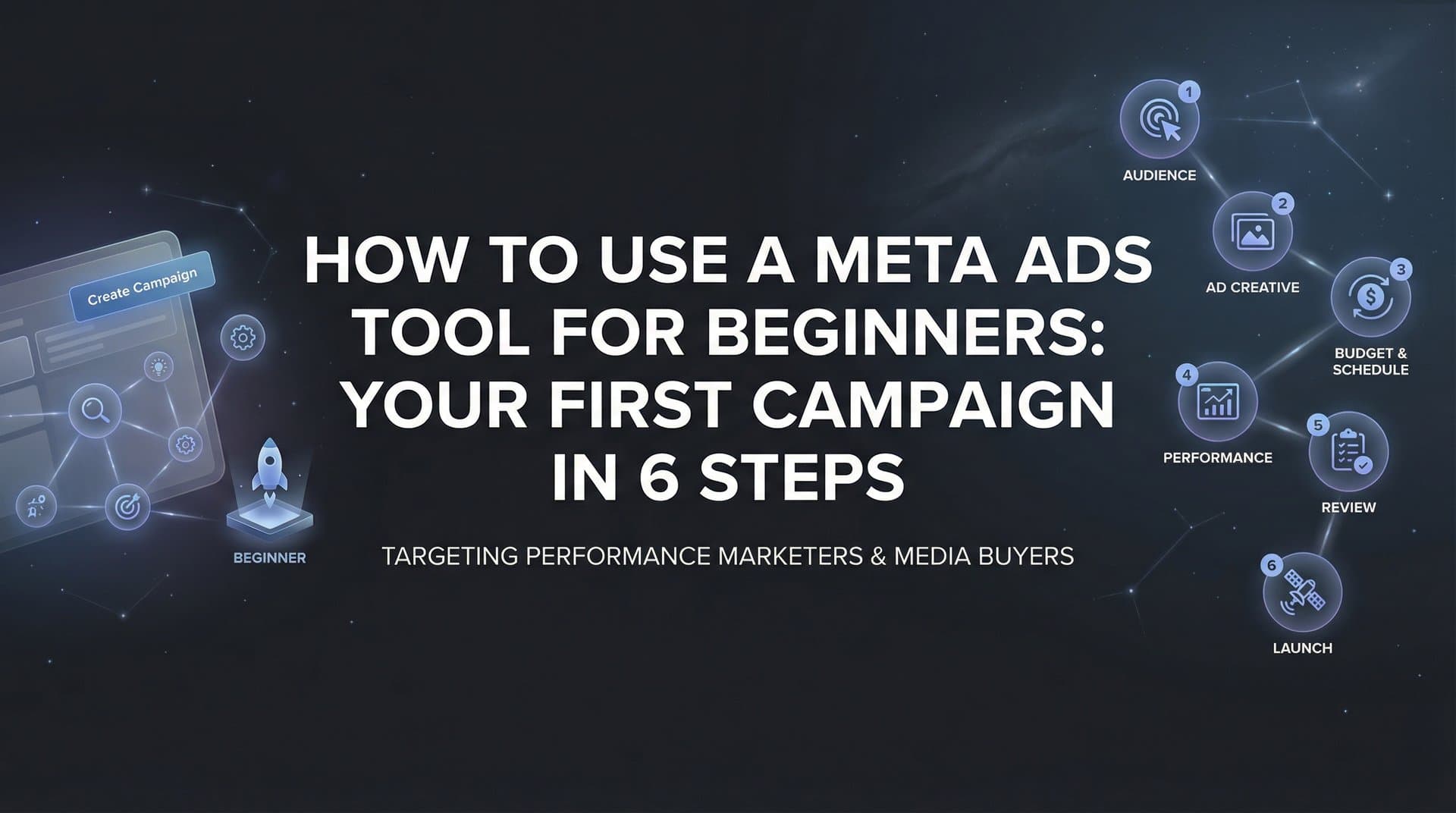
Step 1: Connect Your Meta Business Account and Set Your Campaign Goal
Before you can launch any ads, you need to establish the connection between your Meta Business Manager and your advertising tool. This integration allows the platform to access your ad account, create campaigns on your behalf, and pull performance data for analysis.
Start by navigating to your tool's account settings and locating the Meta integration option. You'll be prompted to log in with your Facebook credentials and authorize the connection. Make sure you're logged in with an account that has admin access to your Business Manager, otherwise the integration won't work properly.
Once connected, you'll need to select your campaign objective. This is arguably the most important decision you'll make because it tells Meta's algorithm what you want to achieve. Think of it like giving directions to a driver: if you don't specify the destination, you can't expect to arrive where you want to go.
Meta offers several objective categories. Awareness campaigns maximize the number of people who see your ads, making them ideal for brand building. Traffic campaigns drive clicks to your website or landing page. Lead generation campaigns collect contact information directly within Facebook or Instagram. Sales campaigns optimize for purchases and conversions on your website.
For your first campaign as a beginner, traffic or sales objectives typically provide the clearest results. You can see exactly how many people clicked through or made a purchase, giving you concrete data to evaluate performance.
Here's where tracking becomes critical. Before launching any campaign, verify that your Meta Pixel or Conversions API is properly installed on your website. This tracking code tells Meta when visitors take important actions like viewing products, adding items to cart, or completing purchases. Without it, the algorithm can't optimize your campaigns effectively because it doesn't know which ads are actually driving results.
Most modern ad tools include a tracking verification step during setup. Run a test by visiting your own website and triggering a conversion event, then check if it appears in your events manager. If you see the test event fire correctly, you're ready to proceed. If not, you'll need to troubleshoot your pixel installation before spending money on ads.
Your campaign goal also determines your budget strategy and bidding approach. Sales campaigns typically require higher budgets because Meta needs more data to find people likely to purchase. Traffic campaigns can start with smaller budgets since clicks are more common than purchases.
Step 2: Generate Ad Creatives Using AI
Creating scroll-stopping ad creatives used to require hiring designers, photographers, or video editors. Now, AI-powered tools can generate professional-quality ads in minutes, even if you have zero design experience.
The process starts with providing information about what you're advertising. Most AI creative tools work best when you give them a product URL. The AI analyzes your product page, extracting images, descriptions, key features, and benefits. It then uses this information to generate multiple creative variations automatically.
Let's say you're advertising a fitness supplement. You paste your product URL into the creative generator. The AI scans your page and identifies the product image, the main benefit (increased energy), the target audience (fitness enthusiasts), and your brand colors. Within seconds, it generates several image ad concepts featuring your product with compelling overlays, benefit-focused headlines, and eye-catching layouts.
But image ads are just the starting point. Video ads typically generate higher engagement rates on Meta platforms because they capture attention in crowded feeds. AI tools can now create video ads from static product images by adding motion effects, text animations, and transitions. You don't need to shoot any footage or learn video editing software.
UGC-style avatar ads represent another powerful creative format. These ads feature AI-generated presenters who speak directly to viewers, explaining your product's benefits in a natural, conversational way. They look and feel like authentic user-generated content, which often performs better than polished corporate advertising.
The beauty of AI creative generation is the speed of iteration. Don't like the color scheme? Ask the AI to adjust it. Want to emphasize a different product feature? Tell it to regenerate with that focus. Chat-based editing lets you refine creatives through simple text commands rather than learning complex design software. Exploring the best AI tools for meta advertising can help you find the right platform for your needs.
For your first campaign, generate at least three to five creative variations. This gives you options to test and helps you discover which visual approaches resonate with your audience. Some advertisers find that product-focused images perform best, while others see better results from lifestyle shots showing the product in use. The only way to know what works for your specific business is to test multiple approaches.
One common beginner mistake is overthinking the creative process. You don't need perfect ads to start, you need good enough ads to gather data. The AI handles the technical aspects of design quality, composition, and visual hierarchy. Your job is to ensure the creatives accurately represent your product and align with your brand voice. You can always refine and improve based on performance data after launch.
Remember that Meta platforms favor native content that blends into users' feeds. Your ads should look like regular posts rather than obvious advertisements. AI tools trained on high-performing Meta ads naturally incorporate these best practices, creating creatives that feel organic rather than intrusive.
Step 3: Define Your Target Audience
Even the most compelling ad creative won't drive results if you show it to the wrong people. Audience targeting determines who sees your ads, making it one of the most critical factors in campaign success.
Meta offers three primary targeting dimensions: demographics, interests, and behaviors. Demographics include age, gender, location, language, education level, and relationship status. Interests cover the pages people like, the content they engage with, and their stated hobbies. Behaviors track actions people take on and off Facebook, like purchase patterns, device usage, and travel habits.
For beginners, the temptation is to target everyone. After all, anyone could potentially be interested in your product, right? This approach typically fails because it forces Meta's algorithm to search through billions of users trying to find your customers. The broader your targeting, the more budget you waste showing ads to people unlikely to convert.
On the flip side, targeting too narrowly creates a different problem. If your audience is too small, Meta can't gather enough data to optimize delivery. You might also exhaust your audience quickly, showing the same people your ads repeatedly until they tune you out. A good rule of thumb for beginners is targeting an audience size between 500,000 and 2 million people.
This is where AI-powered audience suggestions become invaluable. Modern ad tools analyze your product information and campaign goal, then recommend audiences likely to convert. If you're selling yoga mats, the AI might suggest targeting women aged 25 to 45 interested in yoga, fitness, and wellness, located in areas with high yoga studio density. Understanding the Meta ads platform learning curve helps you set realistic expectations for mastering these targeting features.
Lookalike audiences offer another powerful targeting option, especially if you have existing customer data. You provide Meta with a list of your best customers (email addresses or phone numbers), and the algorithm finds other users who share similar characteristics. These lookalike audiences often outperform interest-based targeting because they're based on actual customer behavior rather than stated interests.
For your first campaign, start with one well-defined audience rather than trying to target multiple groups simultaneously. This focused approach makes it easier to interpret your results. If you target both yoga enthusiasts and runners in the same campaign, you won't know which group responded better to your ads.
Location targeting deserves special attention. If you ship nationwide, you might target the entire United States. But if you're a local business or have shipping restrictions, narrow your location targeting accordingly. You can also exclude locations where you don't want your ads shown, like areas where you don't ship or regions with low purchasing power for your product category.
Keep in mind that Meta's algorithm needs time to learn who responds best to your ads. When you first launch, the system tests your ads across your target audience, gathering data on who clicks, engages, and converts. Over time, it automatically shifts more budget toward the audience segments performing best. This optimization process works better with clearly defined audiences rather than extremely broad targeting.
Step 4: Write Headlines and Ad Copy That Convert
Your ad creative grabs attention, but your copy makes the sale. The words you choose in your headlines and ad text directly influence whether viewers click through or scroll past.
Effective ad copy follows a simple three-part structure: hook, benefit, and call to action. The hook captures attention by addressing a pain point or desire. The benefit explains what users gain by clicking. The call to action tells them exactly what to do next.
Let's break this down with an example. If you're advertising productivity software, a weak headline might read "New Project Management Tool Available." This states a fact but gives no reason to care. A stronger headline using the three-part structure would be "Drowning in Scattered Tasks? Organize Your Entire Workflow in One Dashboard. Start Your Free Trial Today."
The hook ("Drowning in Scattered Tasks?") identifies the pain point your audience experiences. The benefit ("Organize Your Entire Workflow in One Dashboard") explains the transformation your product delivers. The call to action ("Start Your Free Trial Today") provides a clear next step.
Writing compelling copy becomes much easier when you use AI assistance. Rather than staring at a blank screen trying to craft the perfect headline, you can generate multiple variations instantly. Input your product information and target audience, and the AI produces dozens of headline options exploring different angles. Many Facebook ads tools for beginners include built-in copywriting features to streamline this process.
Some headlines might emphasize speed: "Launch Projects 3× Faster." Others focus on ease of use: "Project Management So Simple, Your Entire Team Will Actually Use It." Still others highlight outcomes: "Stop Missing Deadlines and Start Delivering on Time." Testing these different messaging angles helps you discover which resonates most with your specific audience.
Your ad copy should match the sophistication level of your target audience. If you're advertising to industry professionals, you can use technical terminology and assume baseline knowledge. If you're reaching a general consumer audience, keep language simple and avoid jargon. The tone should also align with your brand personality and the platform where ads appear. Instagram audiences often respond better to casual, conversational copy, while LinkedIn audiences expect more professional messaging.
Meta allows you to provide multiple headlines and primary text variations for each ad. The platform then automatically tests different combinations to find the highest-performing pairings. This dynamic creative optimization means you don't need to manually create every possible combination. Provide three to five headline options and three to five copy variations, and Meta handles the testing for you.
One element beginners often overlook is the call to action button. Meta offers preset options like "Shop Now," "Learn More," "Sign Up," and "Download." Choose the button that most accurately reflects what happens when someone clicks. If clicking leads to a product page where they can purchase immediately, use "Shop Now." If it leads to an educational landing page, "Learn More" sets more accurate expectations.
Remember that your ad copy must comply with Meta's advertising policies. Avoid making exaggerated claims, using excessive punctuation or capitalization, or including prohibited content. AI copywriting tools typically flag potential policy violations, but it's worth reviewing Meta's advertising standards before launching.
Step 5: Set Your Budget and Launch the Campaign
Budget decisions determine how much you spend testing your ads and how quickly you gather performance data. Getting this right balances the need for meaningful results against the risk of overspending on unproven campaigns.
Meta offers two budget types: daily and lifetime. Daily budgets specify the maximum you'll spend each day, with campaigns running continuously until you pause them. Lifetime budgets set a total spending limit across a defined date range, with Meta distributing that budget across the campaign duration. For beginners, daily budgets typically work better because they're easier to understand and control.
So what's a reasonable starting budget? The honest answer is it depends on your campaign objective and product price point. As a general guideline, plan to spend enough to generate at least 50 optimization events (clicks, leads, or purchases depending on your goal) per week. This gives Meta's algorithm sufficient data to optimize delivery effectively. Reviewing Meta ads platform pricing plans can help you understand what investment level makes sense for your business.
If you're running a traffic campaign and expect a 1% click-through rate, you'll need roughly 5,000 impressions to generate 50 clicks. Depending on your target audience and competition, this might cost anywhere from $50 to $200 per week. Sales campaigns require higher budgets because purchases are less frequent than clicks. You might need to spend several hundred dollars to generate enough conversion data for optimization.
Many beginners start with $10 to $20 per day, testing for at least three to five days before making decisions. This approach provides enough data to identify clear winners and losers without risking significant budget on unproven campaigns.
Bulk launching capabilities in modern ad tools dramatically accelerate the testing process. Instead of manually creating individual ads, you can mix and match multiple creatives, headlines, copy variations, and audience segments. The platform generates every possible combination and launches them simultaneously. A dedicated bulk Meta ads creation tool makes this process even more efficient.
For example, if you have three ad creatives, three headlines, and two audience segments, bulk launching creates 18 unique ads (3 × 3 × 2). Each combination runs with a portion of your total budget, allowing Meta to quickly identify which pairings perform best. This systematic testing approach would take hours to set up manually but happens in minutes with bulk launching.
Before clicking the launch button, review your complete campaign setup. Verify your campaign objective matches your business goal. Confirm your tracking pixel is properly installed. Check that your target audience parameters are correct. Review your ad creatives to ensure they represent your brand accurately. Double-check your budget settings to avoid accidentally spending more than intended.
Most platforms include a campaign preview feature showing exactly how your ads will appear on Facebook and Instagram feeds. Use this to catch any formatting issues or text that gets cut off on mobile devices. Remember that the majority of Meta users access the platforms on smartphones, so mobile preview is more important than desktop.
Once you're confident everything is configured correctly, launch your campaign. Meta typically reviews new ads within a few hours, though this process can sometimes take up to 24 hours. You'll receive a notification once your ads are approved and actively delivering.
Step 6: Monitor Performance and Identify Winners
Launching your campaign is just the beginning. The real work happens in the days and weeks that follow as you analyze performance data and optimize based on what you learn.
The first 48 to 72 hours are critical for gathering initial signals. During this learning phase, Meta's algorithm tests your ads across your target audience, identifying who's most likely to engage or convert. Resist the urge to make changes during this period. Editing your ads or adjusting targeting resets the learning phase, forcing the algorithm to start over.
Focus on these key metrics during your first few days. Click-through rate (CTR) measures how many people who see your ad actually click on it. A CTR above 1% generally indicates your creative and copy are resonating with your audience. Cost per click (CPC) shows how much you're paying for each visitor to your website. Lower is better, but acceptable CPC varies dramatically by industry and competition.
If your campaign objective is conversions or sales, track your cost per acquisition (CPA) and return on ad spend (ROAS). CPA tells you how much you're spending to acquire each customer. ROAS measures revenue generated for every dollar spent on ads. A ROAS of 3.0 means you're generating $3 in revenue for every $1 spent on advertising. Using a Meta ads performance analytics platform simplifies tracking these crucial metrics.
AI-powered insights and leaderboards make performance analysis dramatically easier for beginners. Instead of manually calculating metrics and comparing ads, the platform automatically ranks your creatives, headlines, copy variations, and audiences by performance. You can instantly see which elements are driving the best results and which are underperforming.
Let's say your leaderboard shows that video ads are generating a 2.5% CTR while image ads only achieve 1.2%. That's a clear signal to shift more budget toward video creatives. Similarly, if one headline variation drives twice as many conversions as others, you know that messaging angle resonates with your audience.
The big question beginners struggle with is when to pause underperforming ads versus letting them continue running. As a general rule, give ads at least three to five days and a reasonable portion of your budget before making decisions. An ad that performs poorly on day one might improve as Meta's algorithm optimizes delivery. However, if an ad has spent 20% to 30% of your daily budget with zero conversions or engagement, it's safe to pause it and reallocate that budget to better performers.
Once you identify winning ads, the next step is scaling. You have two primary options: vertical scaling and horizontal scaling. Vertical scaling means increasing the budget on your winning ad sets. Start with small increases of 20% to 30% every few days rather than doubling budgets overnight. Aggressive budget increases can disrupt the algorithm's optimization and tank performance.
Horizontal scaling involves creating new ad sets that replicate your winning formula with slight variations. If a particular creative and audience combination is performing well, create similar ad sets targeting related audiences or using creatives with the same style. This approach spreads risk across multiple ad sets while capitalizing on proven success patterns. Leveraging Meta ads automation tools can help you scale campaigns more efficiently.
The learning loop is what separates successful advertisers from those who struggle. Every campaign generates data about what works for your specific business. AI-powered platforms incorporate these learnings into future campaigns, automatically selecting proven creative elements, prioritizing high-performing audiences, and suggesting optimizations based on your historical results. Your tenth campaign will perform better than your first because the system has learned from nine previous campaigns worth of data.
Commit to checking your campaign performance daily for at least the first week. This doesn't mean obsessing over every metric fluctuation, but you should be aware of major trends and catch any significant issues quickly. After the first week, you can shift to checking every few days as your campaigns stabilize.
Putting It All Together
You now have a complete roadmap for launching your first Meta ad campaign using a beginner-friendly tool. Let's recap the essential steps before you start.
Connect your Meta Business account and verify tracking is working properly. This foundation ensures you can launch campaigns and measure results accurately. Generate multiple ad creatives using AI so you have options to test. Don't aim for perfection, aim for variety that lets you discover what resonates with your audience.
Define a focused target audience that matches your ideal customer. Avoid the extremes of targeting everyone or narrowing so much you can't gather meaningful data. Create several headline and copy variations exploring different messaging angles. Let Meta's dynamic creative optimization test combinations automatically.
Set a reasonable starting budget you're comfortable testing with. Remember that advertising is an investment in learning what works for your business. Commit to checking performance daily for the first week, then adjust based on the data you collect.
The biggest advantage of using an AI-powered Meta ads tool is the continuous learning loop. Every campaign teaches the system more about what works for your business, making each subsequent campaign smarter. Your first campaign might break even or even lose money, but it generates invaluable data that improves future performance.
Start with one campaign, learn from the data, and build from there. Don't try to master every advanced tactic immediately. Focus on executing the fundamentals well: clear objectives, compelling creatives, relevant targeting, and consistent optimization.
The Meta advertising landscape continues to evolve, but these core principles remain constant. Successful campaigns combine creative that captures attention, targeting that reaches the right people, and copy that motivates action. AI tools simply make it faster and easier to execute these fundamentals at scale.
Ready to launch your first campaign? Start Free Trial With AdStellar and be among the first to launch and scale your ad campaigns 10× faster with our intelligent platform that automatically builds and tests winning ads based on real performance data. From generating scroll-stopping creatives to launching hundreds of ad variations in minutes, AdStellar handles the complexity so you can focus on growing your business.