The cursor blinks in Meta Ads Manager. You've got three browser tabs open comparing audience insights, a spreadsheet calculating potential ROAS scenarios, and a Slack thread debating whether to test video or carousel ads first. It's been forty minutes, and you haven't clicked "Publish" yet.
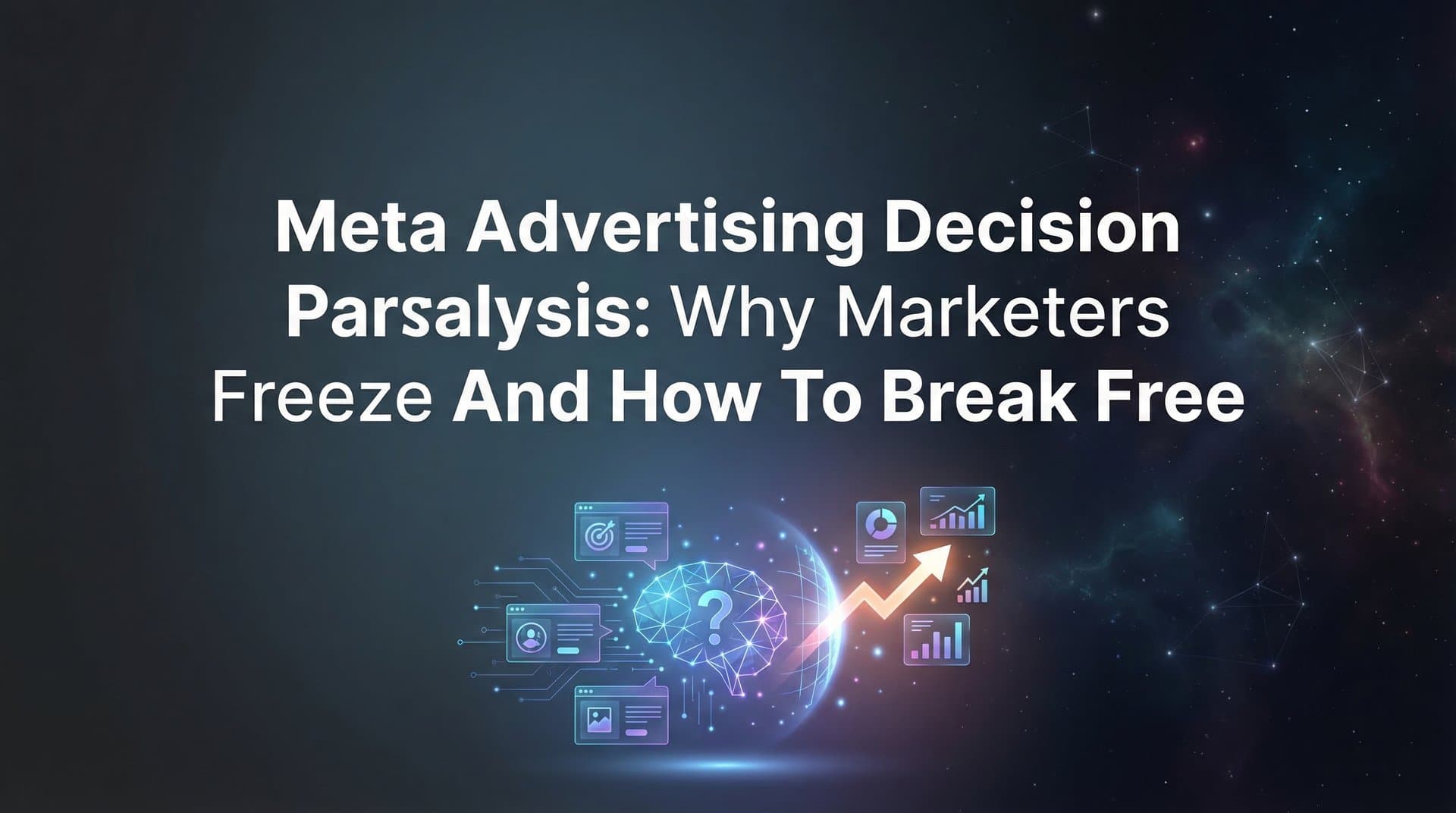
This isn't procrastination. It's meta advertising decision paralysis—the overwhelming inability to commit to campaign choices when confronted with endless options, conflicting performance signals, and the very real fear of burning through your budget on the wrong bet.
Here's what makes this particularly painful right now: Meta's advertising ecosystem has evolved into a labyrinth of complexity. You're not just choosing an audience anymore—you're navigating demographic layers, interest categories, behavioral signals, lookalike percentages, custom audience combinations, placement options across four platforms, creative format variations, optimization objectives, bidding strategies, and budget allocation models. Each decision branches into dozens more.
The result? Marketers freeze. Campaigns sit in draft mode for days. Opportunities slip away while competitors capture market share. And the irony? The hesitation meant to protect your budget often costs more than any single "wrong" decision ever would.
Let's break down why this happens, how to recognize when you're stuck in the loop, and most importantly—how to make confident decisions that actually get campaigns launched and learning.
The Psychology Behind Campaign Indecision
There's a well-documented phenomenon in behavioral economics called the paradox of choice: when people face too many options, they make worse decisions or avoid deciding altogether. Meta advertising amplifies this to an extreme degree.
Consider audience targeting alone. You can segment by age, gender, location, language, interests (with thousands of subcategories), behaviors, life events, job titles, education levels, relationship status, device usage, purchase behaviors, and travel patterns. Then layer in custom audiences from your website visitors, email lists, app users, and engagement data. Add lookalike audiences at percentages from 1% to 10%. Multiply this by the creative format options—single image, carousel, video, collection, instant experience—and placement combinations across Facebook Feed, Stories, Reels, Instagram Feed, Stories, Explore, Messenger, and Audience Network.
The decision tree becomes mathematically overwhelming. Your brain literally cannot process all possible combinations, so it does what brains do when overloaded: it stalls.
But here's where it gets worse. The fear of loss amplification kicks in. Behavioral research consistently shows that people feel potential losses about twice as intensely as equivalent gains. In advertising terms, the possibility of wasting $5,000 on a failed campaign triggers stronger emotional responses than the opportunity to generate $10,000 in revenue from a successful one.
This loss aversion creates a bias toward inaction. Not launching feels safer than launching wrong, even though the math clearly favors action. You're not being irrational—you're experiencing a predictable psychological response to risk asymmetry. Understanding Facebook advertising decision making difficulties can help you recognize these patterns in your own behavior.
Meta's ecosystem adds unique triggers that other platforms don't. The algorithm changes frequently, sometimes with public announcements, often without. Performance metrics can conflict—your CTR looks great, but your CPA is terrible. Your engagement is high, but conversions are low. Real-time reporting means you can check results every five minutes, creating a feedback loop that encourages constant second-guessing rather than patient optimization.
The pressure of real-time optimization creates what psychologists call decision fatigue. Every refresh of your dashboard presents new data points that could theoretically inform adjustments. Should you pause that underperforming ad set now or give it another day? Should you increase the budget on the winning campaign or wait to see if it's a fluke? The constant micro-decisions drain your mental resources until even simple choices feel insurmountable.
Warning Signs You're Stuck in the Decision Loop
Recognition is the first step to breaking free. Here's how paralysis actually manifests in your daily work.
The Browser Tab Syndrome: You repeatedly open Meta Ads Manager, review your draft campaigns, close the tab without publishing, then open it again thirty minutes later. You're cycling through the same information hoping something will suddenly make the decision obvious. It won't.
Endless A/B Test Planning: You've created a testing matrix with seventeen variables you want to test. You're planning to test everything before launching anything. The spreadsheet is immaculate. The campaigns remain unlaunched. Testing is valuable, but planning tests becomes procrastination when it prevents you from gathering actual data.
The "One More Data Point" Trap: You tell yourself you'll launch as soon as you analyze last quarter's performance, or review competitor research, or read that case study, or check one more benchmark report. There's always one more piece of information that feels critical but never quite closes the decision gap.
Time-based indicators reveal the problem even more clearly. Campaigns sitting in draft status for three, five, seven days. You're spending more hours researching best practices than you'd spend running the actual campaign. Launch windows pass—that seasonal opportunity, that product release, that promotional period—because you were still deliberating on the perfect audience configuration.
Your calendar tells the story: meeting after meeting discussing campaign strategy, but launch dates keep getting pushed back. "We need to refine the approach" becomes a recurring phrase that really means "we're not confident enough to commit." This workflow inefficiency compounds over time and affects your entire team's productivity.
The performance consequences compound silently. Your ad account shows stagnant spend because nothing new is launching. Your competitors' ads appear in your feed with messaging similar to what you've been planning for weeks—they're capturing market share while you deliberate. Seasonal trends peak and decline while your "perfect" campaign remains theoretical.
Your team feels it too. Marketing velocity slows to a crawl. Morale drops when effort doesn't translate to action. The creative team produces assets that sit unused. The analytics team prepares reports on campaigns that never launch. Everyone's working hard, but nothing's moving forward.
The Real Cost of Delayed Campaign Decisions
Let's translate paralysis into actual business impact, because the costs are more concrete than they feel in the moment.
Opportunity cost in advertising is brutally simple math. Every day you don't launch is a day of zero impressions, zero clicks, zero conversions, and zero learning data. If your target campaign would generate 50,000 impressions daily at a $20 CPM, that's $1,000 in potential reach you're not capturing. Multiply by the days or weeks spent deliberating, and you're looking at tens of thousands in missed exposure.
But the real cost isn't just the immediate lost conversions—it's the compounding effect of delayed learning. Meta's algorithm needs data to optimize. The learning phase typically requires around 50 optimization events per week per ad set to stabilize performance. Every day you delay launching pushes back the point where your campaigns reach optimal efficiency.
Think about it this way: if you launch today and spend three weeks in the learning phase, you'll be running optimized campaigns by week four. If you delay launch by two weeks deliberating, you won't reach optimization until week six. That's two additional weeks of suboptimal performance, or worse—two weeks where competitors are gathering learning data and you're standing still.
The learning phase penalty creates a vicious cycle. Hesitation delays learning, which leads to worse initial results, which increases future hesitation. Meanwhile, competitors who launched imperfect campaigns weeks ago are now running on optimized algorithms with rich performance histories informing their decisions. Understanding meta advertising budget waste helps quantify exactly how much these delays cost your business.
The team impact extends beyond marketing. Sales teams wait for leads that aren't coming because campaigns aren't running. Product launches happen without advertising support because you're still finalizing the media plan. Revenue targets get missed not because the strategy was wrong, but because it was never executed.
Decision paralysis also affects your professional development. You're not building the pattern recognition that comes from launching campaigns, seeing results, and iterating. The marketer who launches ten imperfect campaigns and optimizes based on real data will develop better instincts than the one who plans one perfect campaign that never goes live.
Decision Frameworks That Cut Through the Noise
The solution isn't to make decisions carelessly—it's to make them systematically. Here are frameworks that remove the emotional weight and create clear paths forward.
The 80/20 Campaign Launch Rule: Not all decisions carry equal weight. Identify the critical few that drive most of your results versus the trivial many that cause overthinking. For most Meta campaigns, the core drivers are: audience selection, offer/value proposition, and creative hook. Everything else—precise budget splits, minor placement tweaks, specific ad copy variations—contributes marginally to outcomes.
Focus your decision energy on those three elements. Make them good enough, not perfect. Then launch. You can optimize the remaining 80% of variables based on actual performance data rather than speculation.
Time-Boxing Your Decisions: Set strict deadlines for campaign decisions and stick to them religiously. Give yourself two hours to finalize audience targeting—not two days. When the timer ends, you commit to whatever option seems most promising based on available information.
This works because it shifts your mindset from "finding the perfect answer" to "making the best decision possible in the available time." The latter is actually achievable. Use performance data windows instead of endless research cycles. Look at your last 30 days of data, identify patterns, make a decision, move forward. A solid decision support system can accelerate this process significantly.
The Minimum Viable Campaign Approach: Borrowed from product development, this framework says launch with core elements only, gather real data quickly, and iterate based on actual performance rather than predictions.
Your minimum viable campaign includes: one primary audience (your best hypothesis), one core creative concept (your strongest hook), one clear offer, and a modest test budget. That's it. No elaborate testing matrix, no comprehensive audience segmentation, no creative variations testing twelve different headlines.
Launch this within 24 hours. Let it run for 3-5 days. Gather real performance data. Then make your next decision informed by actual results from your specific audience, not industry benchmarks or theoretical projections.
This approach transforms decision-making from a high-stakes bet into a low-risk experiment. You're not committing your entire budget to one strategy—you're investing a small amount to gather intelligence that makes your next decision exponentially easier and more informed.
Leveraging Data and Automation to Decide Faster
The most effective way to overcome decision paralysis is to remove yourself from decisions that don't require human judgment. This is where historical data and automation become game-changers.
Your past campaigns contain a goldmine of decision-making shortcuts. Which audiences have historically converted best for your offers? Which creative formats have driven the lowest cost per acquisition? Which ad copy angles have generated the highest engagement? These patterns provide clear direction for new campaign decisions without guesswork.
Create a simple performance database. Track your winning audiences, top-performing creative elements, successful budget allocations, and effective optimization strategies. When you're stuck on a decision, consult this library first. If carousel ads with user-generated content have consistently outperformed single images with stock photos, that's your answer—no deliberation needed. Implementing decision intelligence practices transforms how you approach these choices.
This historical analysis removes the emotional component from decisions. You're not making a scary bet on an unknown variable—you're repeating a pattern that's already proven successful in your specific account with your specific audience.
Automation accelerates this process exponentially. AI-powered tools can analyze thousands of data points across your campaign history, identify performance patterns, and recommend optimizations at a scale impossible for human analysis. They can test creative variations, audience segments, and budget allocations simultaneously, gathering learning data while you focus on strategic decisions. Exploring the best AI meta advertising tools available can dramatically reduce your decision burden.
The key advantage: automation handles the data-heavy, pattern-recognition tasks that cause human decision fatigue, freeing you to focus on creative strategy, offer development, and business alignment—the decisions that actually require human insight.
Building systematic workflows creates consistency that compounds over time. Establish repeatable processes for common campaign types. For product launches, you always start with a lookalike audience of past purchasers, test video against carousel creative, and allocate budget using a specific ramp-up schedule. For lead generation, you have a standard audience tiering system and creative testing protocol.
These workflows don't eliminate thinking—they eliminate decision fatigue on variables you've already optimized. You're not reinventing the wheel for every campaign. You're applying proven frameworks and reserving your mental energy for the unique aspects of each specific situation.
Building Long-Term Decision Confidence
The ultimate goal isn't just to launch your next campaign—it's to build a decision-making system that makes every future choice faster and more confident.
Start by creating your personal decision playbook. Document what works specifically for your accounts, your audiences, your products. This isn't about generic best practices—it's about your proven patterns. When you discover that Tuesday launches consistently outperform Friday launches for your audience, write it down. When you find that budget increases above 20% daily cause performance instability, document it. When certain interest categories reliably deliver qualified leads, catalog them.
This playbook becomes your decision shortcut library. Future you doesn't have to rediscover these insights through analysis paralysis—you've already done the work. Developing a template system for your campaigns codifies these learnings into repeatable assets.
Equally important: embrace imperfect action as a strategic advantage. Reframe "failed" campaigns not as mistakes but as learning investments. That audience test that didn't convert? You now know definitively that segment isn't viable—valuable information that prevents future waste. That creative concept that underperformed? You've eliminated an option and can focus resources elsewhere.
The marketer who launches quickly, fails fast, and iterates based on real data will always outperform the one seeking perfect decisions. Speed of learning beats precision of planning in environments that change as rapidly as digital advertising.
Establish continuous improvement feedback loops. After every campaign, conduct a brief post-mortem. What worked? What didn't? What surprised you? What will you do differently next time? These insights feed directly into your decision playbook, making each subsequent campaign launch easier and more informed than the last.
Track your decision velocity as a metric. How long does it take you to go from campaign concept to launch? Measure it monthly. Set goals to reduce that timeline. Celebrate when you launch campaigns faster, even if the results are imperfect. You're building the muscle memory of confident decision-making.
Moving Forward With Confidence
Meta advertising decision paralysis isn't a personal failing—it's a predictable response to genuine complexity in modern digital advertising. The platform offers unprecedented targeting precision and creative flexibility, but that power comes with cognitive overhead that can freeze even experienced marketers.
The path forward combines psychological awareness with practical systems. Recognize the warning signs early: the endless tab-switching, the perpetual "one more data point" delays, the campaigns that sit in draft mode for days. Implement time-boxing to force decisions within reasonable windows. Adopt the minimum viable campaign approach to gather real data quickly rather than theorizing endlessly.
Leverage your historical performance data as a decision shortcut. Build systematic workflows that handle routine choices automatically, freeing your mental energy for strategic decisions that actually require human judgment. Document your learnings in a personal playbook that makes every future decision faster and more confident.
Most importantly, reframe action itself as the goal. An imperfect campaign launched today will teach you more and generate more value than a perfect campaign launched next month. The algorithm needs data to optimize. Your business needs momentum to grow. Your team needs execution to maintain morale.
That campaign you've been deliberating on? The one with the draft creative and the audience segments you've refined seventeen times? Launch it. Set a modest budget, commit to a three-day learning window, and gather real performance data. You'll learn more in 72 hours of live results than in three weeks of theoretical planning.
And if you're ready to eliminate the decision bottlenecks entirely, consider how AI-powered platforms can transform your workflow. Start Free Trial With AdStellar AI and experience how intelligent automation analyzes your performance history, identifies winning patterns, and builds optimized campaigns automatically—removing the paralysis-inducing decisions while you focus on strategy and growth.
The best campaign decision you can make is the one that gets you out of planning mode and into execution. Make it today.