Every dollar you invest in Meta campaign automation should work harder than the manual processes it replaces. Yet most marketers focus exclusively on monthly subscription costs while overlooking the real pricing equation: team hours saved, campaign performance gains, and the compound effect of faster optimization cycles.
The challenge isn't finding the cheapest automation tool—it's identifying solutions that deliver measurable returns within weeks, not months.
For digital marketers managing multiple Meta ad accounts, the stakes are high. Choose wrong, and you're locked into a platform that drains budget without moving performance metrics. Choose right, and automation becomes your competitive advantage, freeing your team to focus on strategy while AI handles execution at scale.
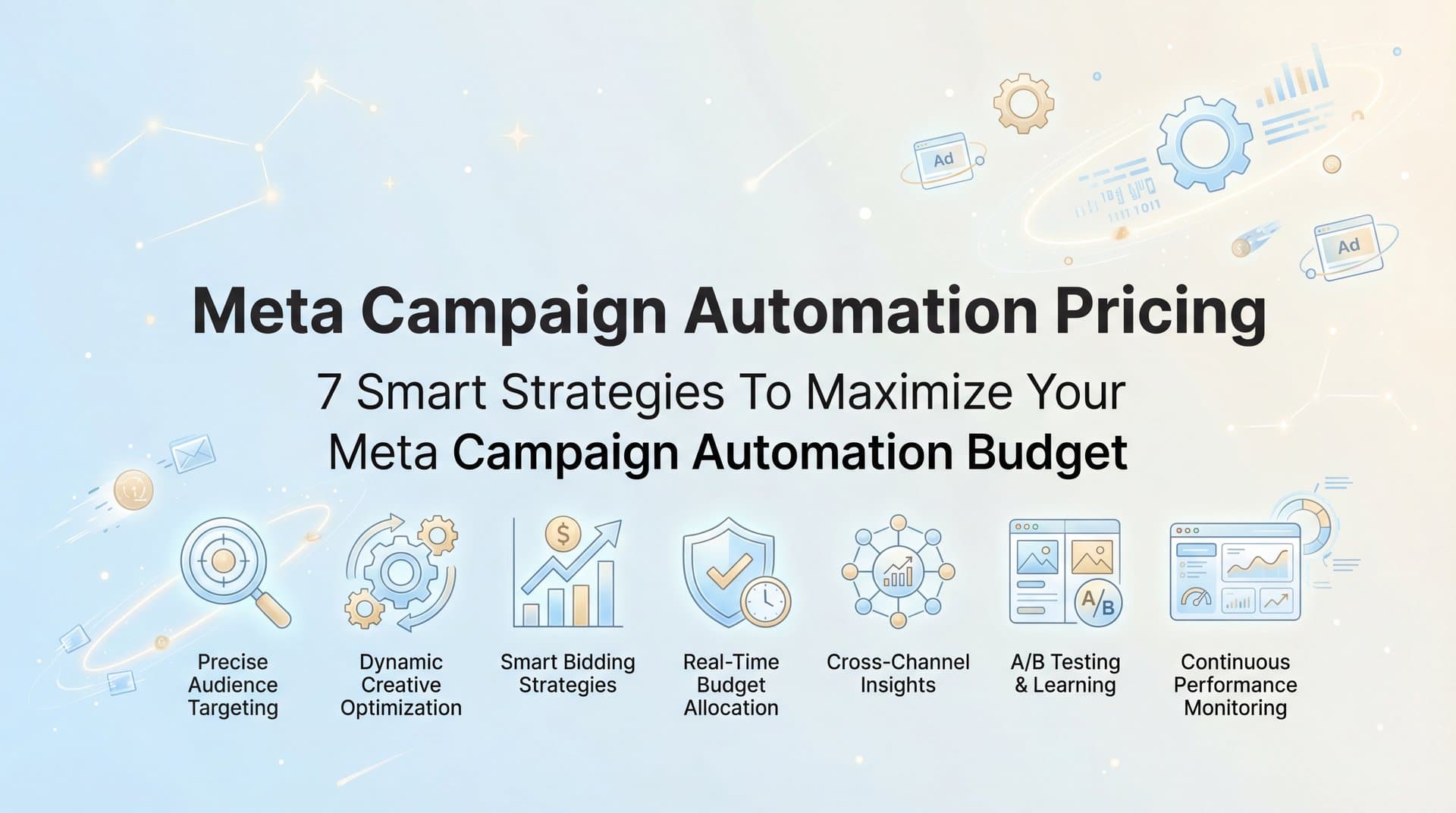
This guide breaks down seven proven strategies to evaluate Meta campaign automation investments through the lens of actual business impact. You'll learn how to calculate true costs, match pricing to your workflow, and negotiate terms that align with your growth trajectory—ensuring every automation dollar delivers genuine ROI rather than just adding complexity to your marketing stack.
1. Calculate Your True Cost of Manual Campaign Management First
The Challenge It Solves
Most teams evaluate automation pricing in a vacuum, comparing monthly fees without understanding what they're currently spending on manual processes. This creates a distorted cost-benefit analysis where a $500/month tool seems expensive—until you realize your team burns 40 hours monthly on tasks that software could handle in minutes.
Without a documented baseline, you can't accurately measure automation ROI or justify the investment to stakeholders who see only the new line item on the budget sheet.
The Strategy Explained
Before evaluating any automation platform, spend two weeks documenting exactly how your team currently manages Meta campaigns. Track time spent on campaign setup, audience research, creative testing, budget adjustments, and performance reporting. Multiply those hours by your team's actual cost (salary plus overhead, typically 1.4× base pay).
Include hidden costs that rarely appear on timesheets: context switching between accounts, late-night campaign fixes, missed optimization windows, and the opportunity cost of strategic work postponed because your team is buried in execution tasks.
This baseline becomes your negotiation leverage and ROI benchmark. If manual processes cost $3,000 monthly in team time, a $600 automation platform that eliminates 80% of that work delivers immediate positive returns.
Implementation Steps
1. Create a time-tracking spreadsheet with categories: campaign planning, audience setup, creative uploading, ad copywriting, budget management, performance monitoring, and reporting. Have team members log actual time for two weeks.
2. Calculate fully-loaded hourly costs for each team member (annual salary ÷ 2,080 hours × 1.4 for benefits and overhead). Multiply tracked hours by these rates to get true monthly cost.
3. Document qualitative costs: How many campaigns launch late because of bandwidth constraints? How often do optimization opportunities slip through because no one has time to monitor performance? What strategic projects get delayed?
Pro Tips
Don't rely on estimates—actual time tracking reveals surprising patterns. Many teams discover they spend more time on repetitive setup tasks than strategic optimization. Factor in error correction time, too. Manual processes inevitably create mistakes that require additional hours to identify and fix, compounding the true cost of doing things by hand.
2. Match Pricing Tiers to Your Actual Ad Spend Volume
The Challenge It Solves
Automation platforms typically tier pricing based on ad spend volume, but many marketers either overpay for capacity they don't need or underestimate growth and hit costly overage fees. This misalignment creates budget friction—either wasting money on unused features or facing surprise charges that throw off financial planning.
The problem intensifies for seasonal businesses or agencies with fluctuating client rosters, where rigid pricing tiers don't accommodate natural volume variations.
The Strategy Explained
Start by analyzing your Meta ad spend over the past twelve months, identifying your baseline monthly average, peak months, and growth trajectory. Look for seasonal patterns and account for planned expansion. This data reveals which pricing tier genuinely matches your usage pattern.
Pay special attention to how platforms handle growth. Some charge aggressive overage fees when you exceed tier limits, while others offer flexible scaling. The best solutions provide buffer room above your current spend without forcing you to pay for capacity you won't use for months.
For agencies managing multiple client accounts, calculate combined ad spend across all clients to understand total volume. Some platforms price per workspace regardless of spend, making them dramatically more cost-effective for agencies than tools that charge based on aggregate advertising dollars.
Implementation Steps
1. Pull twelve months of Meta ad spend data from Ads Manager. Calculate monthly average, identify your highest-spend month, and note any clear seasonal patterns (Q4 peaks, summer lulls, etc.).
2. Project forward six months based on growth plans. If you're currently spending $50,000 monthly with 20% growth targets, you'll hit $60,000+ within half a year. Choose tiers that accommodate this trajectory without forcing a mid-contract upgrade.
3. Compare how different platforms handle volume. Request specific pricing for your current spend plus 30% buffer. Ask explicitly about overage policies, upgrade timing, and whether you can adjust tiers monthly or must commit annually.
Pro Tips
Negotiate tier flexibility upfront. Many platforms will customize plans for businesses with documented growth trajectories or seasonal fluctuation. If your spend varies significantly month-to-month, seek solutions with usage-based pricing rather than rigid tiers. The goal is pricing that scales with your business, not pricing that penalizes success.
3. Prioritize Time-to-Value Over Feature Count
The Challenge It Solves
Feature-rich platforms often come with premium pricing and lengthy implementation timelines. Teams spend months configuring complex systems, attending training sessions, and building custom workflows—all while continuing manual processes because the new tool isn't ready. The result: you're paying for automation that hasn't automated anything yet.
This extended ramp-up period delays ROI and creates internal resistance as teams question whether the investment will ever pay off.
The Strategy Explained
Evaluate automation platforms based on how quickly they deliver tangible results, not how many features they list on the pricing page. The best solutions work immediately after connecting your Meta account, using AI to analyze existing performance data and launch optimized campaigns within hours, not weeks.
Time-to-value matters more than feature completeness because every day you spend in setup mode is a day you're still paying manual process costs. A platform that delivers 80% of the functionality you need but starts working today beats a 100% solution that requires two months of configuration.
Look for platforms with intelligent defaults that leverage your historical campaign data automatically. Systems that require extensive manual setup before providing value create a catch-22: you need them working to justify the cost, but they won't work until you invest significant additional time.
Implementation Steps
1. During sales demos, ask specifically: "If I sign up today, how long until my first AI-generated campaign launches?" Vague answers about "customization" and "onboarding" signal extended timelines. Clear answers like "within 60 seconds of connecting your account" indicate true automation.
2. Request trial access that mirrors real usage, not a sanitized demo environment. Connect your actual Meta account and measure how long it takes to launch a complete campaign. Time everything: account connection, data sync, campaign planning, and execution.
3. Calculate break-even timing. If a platform costs $500 monthly and saves 30 hours of team time worth $75/hour, you break even in one month—but only if the tool actually saves those hours from day one. Extended setup periods push break-even further out.
Pro Tips
Beware of platforms that require extensive "professional services" or "implementation consulting" before you can use core features. These hidden costs inflate total investment and delay returns. The best automation tools work intelligently out of the box, learning from your existing campaign data rather than requiring you to teach them your business from scratch.
4. Evaluate Agency-Specific Pricing Models
The Challenge It Solves
Agencies managing multiple client accounts face a unique pricing challenge: platforms designed for single businesses often charge per account, per user, or based on combined ad spend—making them prohibitively expensive when managing dozens of clients. A tool that costs $200 for one business becomes $6,000 monthly when multiplied across thirty client accounts.
This pricing structure forces agencies to either absorb unsustainable costs or pass them to clients, eroding margins or making services less competitive.
The Strategy Explained
Seek platforms with agency-specific pricing that charges per workspace or offers unlimited client accounts under a single subscription. This model aligns costs with your business structure rather than penalizing you for having more clients.
The difference is dramatic. Per-seat pricing charges for every team member who needs access, which scales poorly as your agency grows. Per-workspace pricing might charge for each client account, creating the same multiplication problem. The most agency-friendly model provides unlimited workspaces with pricing based on your team size or total ad spend across all clients.
Also evaluate white-label capabilities and client reporting features. If you'll present automation-generated campaigns as your agency's work, you need platforms that support your brand identity without constant "powered by" badges that undermine your positioning.
Implementation Steps
1. List your current client count and projected growth over the next year. Calculate total combined ad spend across all clients. Use these numbers to compare pricing models: per-client, per-user, aggregate spend-based, and unlimited workspace options.
2. Request detailed agency pricing from each platform you're evaluating. Ask explicitly: "If I manage 25 client accounts with 5 team members accessing the platform, what's my monthly cost?" Compare the actual numbers, not the advertised starting prices.
3. Assess workspace management features. Can you easily switch between client accounts? Does each workspace maintain separate campaign history and performance data? Can you grant clients view-only access to their specific workspace without exposing other client data?
Pro Tips
Negotiate volume discounts based on your agency's total value. If you're bringing $500,000 in combined monthly ad spend across all clients, you have leverage to request custom pricing. Many platforms will create agency partner programs with preferential rates for businesses that commit to managing multiple accounts exclusively on their platform.
5. Factor in Integration Costs and Attribution Tools
The Challenge It Solves
The advertised price of Meta campaign automation rarely reflects total cost of ownership. Many platforms require separate attribution tracking tools, charge extra for API access, or nickel-and-dime you for essential integrations that should be standard. What looks like a $400/month solution becomes $800 once you add the attribution platform, premium API tier, and third-party connectors.
This fragmented pricing makes true cost comparison difficult and creates budget surprises as you discover required add-ons during implementation.
The Strategy Explained
Build a complete ecosystem cost model that includes every tool required to run effective automated campaigns. Start with the automation platform's base price, then add attribution tracking (essential for understanding which campaigns actually drive conversions), API access fees (some platforms charge for higher rate limits), and any required middleware or integration tools.
Look for platforms that bundle attribution tracking or integrate seamlessly with established tools without additional charges. The best solutions include direct Meta API integration as standard, eliminating the need for separate connector services that add cost and complexity.
Consider the hidden time cost of managing multiple disconnected tools. If your automation platform, attribution system, and reporting dashboard don't communicate automatically, your team spends hours manually correlating data—defeating the purpose of automation in the first place.
Implementation Steps
1. Create a complete tech stack list for Meta campaign management: automation platform, attribution tracking, analytics, reporting, creative management, and any other tools your workflow requires. Note which integrations are essential versus nice-to-have.
2. For each automation platform you're evaluating, map out integration requirements. Does it include attribution? Does it connect natively to your existing tools? Are there API limits that require paid upgrades? Calculate the all-in monthly cost including every necessary component.
3. Evaluate data flow between systems. Request detailed documentation on how campaign data moves from Meta through the automation platform to your attribution tool and reporting dashboard. Identify any gaps that require manual export/import or additional middleware.
Pro Tips
Platforms that offer integrated attribution tracking or partner directly with established attribution tools often deliver better total value than cheaper automation-only solutions. The time saved managing a unified system and the accuracy gained from seamless data flow typically justify slightly higher base pricing. Ask specifically about attribution partnerships and whether the platform includes conversion tracking setup as part of onboarding.
6. Test Performance Improvements During Free Trials Strategically
The Challenge It Solves
Most teams waste free trials by exploring features randomly rather than gathering data that proves or disproves ROI. They end the trial with a vague sense that the tool "seems helpful" but no concrete evidence of time savings or performance improvements—making it impossible to justify the investment to stakeholders or compare platforms objectively.
Without structured testing, you're making expensive decisions based on intuition rather than data.
The Strategy Explained
Treat free trials as controlled experiments designed to answer specific questions: Does this automation reduce campaign launch time? Does it improve performance metrics? Does it free up team capacity for strategic work? Design your trial to generate quantifiable answers.
Run parallel tests where possible. Launch some campaigns through the automation platform and comparable campaigns manually, measuring time investment and performance outcomes for both. This head-to-head comparison provides clear evidence of value or reveals that the automation doesn't deliver meaningful improvements for your specific use case.
Focus trials on your highest-priority workflow bottlenecks. If campaign setup consumes most team time, measure setup speed. If optimization is your pain point, track how quickly the platform identifies and scales winning ad variations. Match trial focus to your documented manual process costs from Strategy 1.
Implementation Steps
1. Before starting any trial, define success metrics: campaign launch time, cost per result, time spent on optimization, number of campaigns managed per team member. Document baseline performance for these metrics using your current manual process.
2. Design a structured trial plan. Week 1: Connect accounts and launch first automated campaign, tracking setup time. Week 2: Monitor performance and compare to manual campaigns with similar targeting and creative. Week 3: Test advanced features like bulk launching or AI-driven optimization. Week 4: Measure total time saved and performance deltas.
3. Involve your entire team in the trial. Have different team members test the platform to assess learning curve and usability. Track not just what the tool can do, but how quickly your team can leverage its capabilities without extensive training.
Pro Tips
Request trial extensions if needed to gather sufficient data. Most platforms will grant additional time for serious evaluators running structured tests. Document everything: screenshots of time savings, performance comparisons, team feedback. This evidence becomes invaluable during pricing negotiations and internal approval processes, transforming "we think this might help" into "this saved us 35 hours and improved ROAS by 18% during the trial period."
7. Negotiate Based on Long-Term Value and Commitment
The Challenge It Solves
Most marketers accept listed pricing without negotiation, assuming software prices are fixed. Meanwhile, businesses that negotiate secure 20-40% discounts, custom terms, and added value that dramatically improves their cost-benefit equation. This reluctance to negotiate leaves significant money on the table and creates competitive disadvantage against savvier buyers.
The challenge intensifies for growing businesses that need flexibility as their usage scales, but standard contracts lock them into rigid terms that don't accommodate expansion.
The Strategy Explained
Approach automation platform pricing as negotiable, especially when you can demonstrate long-term commitment or significant growth potential. Vendors prefer annual contracts with predictable revenue over month-to-month arrangements, creating leverage for buyers willing to commit.
Build your negotiation around mutual value. If you're an agency bringing multiple client accounts or a fast-growing business with documented expansion plans, you're a valuable customer worth offering preferential terms. Quantify your value: "We're currently managing 15 client accounts with plans to reach 30 within six months" gives vendors reason to invest in the relationship.
Look beyond price reduction to negotiate terms that matter: flexible tier adjustments as you grow, extended trial periods, included professional services, custom integrations, or performance guarantees. Sometimes maintaining list price while adding substantial value delivers better total returns than a simple discount.
Implementation Steps
1. Gather negotiation leverage before initial pricing discussions. Document your current ad spend, growth trajectory, and potential to bring additional accounts or team members onto the platform. Prepare trial performance data showing concrete results if available.
2. Request custom pricing based on annual commitment. Present your usage projections: "We'll start at $X monthly ad spend but expect to reach $Y within six months. What pricing can you offer for an annual contract that accommodates this growth without tier change fees?"
3. Negotiate beyond price. Ask for: extended onboarding support, quarterly business reviews, priority feature requests, flexible contract terms that allow tier adjustments, or inclusion of premium features at standard pricing. Vendors often have more flexibility on value-adds than pure price reduction.
Pro Tips
Time negotiations strategically. Vendors are most flexible at quarter-end when sales teams have targets to hit. If you're evaluating multiple platforms, use competitive pressure: "Platform X offered us this pricing—can you match or improve it?" Never accept the first price without discussion. Even a simple "Is there flexibility on this pricing?" often reveals room for negotiation you didn't know existed.
Putting It All Together
Smart Meta campaign automation investment starts with understanding what you're really paying for—not just software, but time reclaimed, performance improved, and growth enabled. The strategies outlined here shift evaluation from simple price comparison to comprehensive value analysis.
Begin by documenting your current manual costs, giving you the baseline that makes ROI calculation possible. Match pricing tiers to your actual usage patterns, avoiding both overpayment for unused capacity and surprise overage fees. Prioritize platforms that deliver value immediately rather than after months of setup, and for agencies, seek workspace models that don't penalize you for managing multiple clients.
Factor in the complete ecosystem cost including attribution and integrations, then use free trials strategically to gather real performance data rather than vague impressions. Finally, negotiate terms that align with your growth trajectory and long-term value to the vendor.
The right automation investment pays for itself within months through time savings and improved campaign performance. The wrong investment—chosen purely on lowest price—creates ongoing friction, underutilized features, and marginal returns that never justify the cost.
Ready to transform your advertising strategy? Start Free Trial With AdStellar AI and be among the first to launch and scale your ad campaigns 10× faster with our intelligent platform that automatically builds and tests winning ads based on real performance data.