Let's be direct about something: the way most marketers build Meta campaigns is broken. Not because they lack skill or strategy, but because the process itself is fundamentally inefficient. Every campaign starts from scratch. Every audience gets configured manually. Every creative gets uploaded one at a time. And by the time everything is live, the market has moved or the budget window has closed.
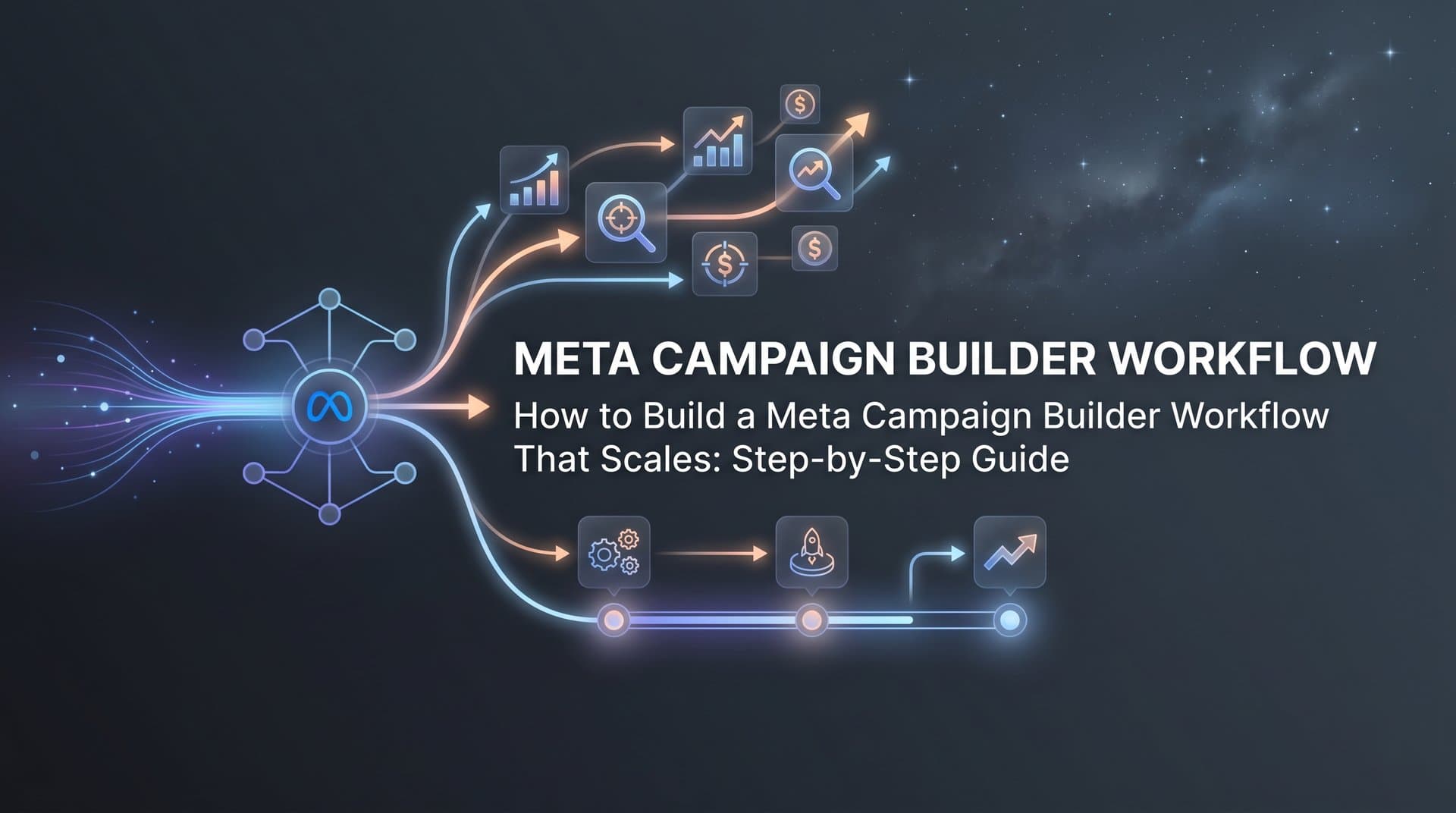
A structured meta campaign builder workflow solves this at the root level. Instead of treating each campaign as a standalone project, you build a repeatable system with defined stages, standardized templates, and automation handling the repetitive work. The result is faster launches, more consistent testing, and cleaner data that actually tells you what works.
This guide walks you through six concrete steps to build that workflow from the ground up. We cover everything from auditing your current process and generating creatives with AI, through campaign assembly, bulk launching, and the performance analysis loop that makes the whole system compound over time.
Whether you are a solo performance marketer juggling multiple accounts or an agency managing campaigns for a roster of clients, this workflow is designed to help you move faster without cutting corners on strategy. By the time you finish reading, you will have a documented, repeatable process ready to apply to your next Meta campaign, and every campaign after that.
Step 1: Audit Your Current Process and Identify Bottlenecks
Before you can build a better workflow, you need an honest picture of your current one. Most marketers skip this step and jump straight to new tools or tactics. That is a mistake. Without understanding where time is actually going, you end up optimizing the wrong things.
Start by mapping every task involved in taking a campaign from idea to live. Write it out in order, from the initial creative brief through asset production, audience research, campaign setup in Ads Manager, QA, and final launch. Do not skip the handoffs between steps, because those transitions are often where the most time disappears.
Once you have the full list, look for the three most common bottlenecks in Meta campaign workflows.
Creative production delays: Waiting on designers or video editors to produce assets is one of the most common sources of campaign lag. If your creative pipeline depends on external resources or lengthy revision cycles, your entire workflow slows down every time you need new variations.
Manual audience setup: Rebuilding audiences from scratch for each campaign, duplicating ad sets one at a time, and manually entering targeting parameters are repetitive tasks that consume hours without adding strategic value. Adopting meta ads campaign automation can eliminate much of this manual overhead.
Slow iteration cycles: When it takes days to analyze results and make adjustments, you lose the compounding advantage of fast testing. Campaigns that should be refined weekly end up running on stale settings for weeks at a time.
For each step in your mapped workflow, estimate how long it typically takes. Be honest. Include the time spent waiting, not just the time you are actively working. Then flag which steps require genuine human judgment, such as setting strategy, defining brand voice, or making budget calls, versus which steps are repetitive and mechanical, such as resizing creatives, duplicating ad sets, or creating copy variations.
That second category is where automation creates the most immediate value. The goal is not to remove humans from the process. It is to remove humans from the parts of the process that do not benefit from human thinking.
Success indicator: You have a written list of every step in your current workflow, with time estimates attached and bottlenecks clearly marked. This becomes your baseline for measuring improvement as you build the new system.
Step 2: Build Your Creative Asset Library with AI
Here is a counterintuitive truth about campaign workflow efficiency: the biggest gains do not come from optimizing your campaign settings. They come from fixing your creative pipeline. Creatives are the single most important variable in Meta advertising performance, and they are also the most common source of delays and bottlenecks.
The traditional approach, briefing a designer, waiting for drafts, requesting revisions, resizing for placements, and repeating for every new angle, creates a creative bottleneck that limits how fast you can test and iterate. AI creative generation eliminates that bottleneck entirely.
Modern AI ad tools let you generate image ads, video ads, and UGC-style avatar content directly from a product URL. You can also clone high-performing competitor ads directly from the Meta Ad Library, using what is already working in your market as a starting point for your own creative variations. This is not about copying competitors. It is about understanding proven creative formats and building your own versions faster. Platforms built around AI driven meta advertising make this entire process seamless.
Once you have generated your initial batch of creatives, organize them systematically. A disorganized creative library is almost as bad as no library at all, because assets get lost, duplicated, or used in the wrong context.
Organize by format: Separate your static image ads, video ads, and UGC-style content into distinct folders or tags. Each format performs differently across placements and audiences, so keeping them separate makes campaign assembly much faster.
Organize by angle: Tag each creative with its core messaging angle. Common angles include testimonial-style, problem-solution, feature highlight, social proof, and offer-focused. Knowing your angle at a glance helps you balance your creative mix and avoid over-indexing on a single approach.
Organize by funnel stage: Label creatives as prospecting or retargeting. A creative that works for cold audiences often performs differently with warm audiences who already know your brand. Keeping these separate prevents you from running the wrong message to the wrong audience.
One of the biggest advantages of AI-powered creative tools is the ability to refine and iterate through chat-based editing rather than going back to a designer every time. Want to test a different headline overlay? Adjust the color scheme? Swap the product image? You can make those changes in seconds, which means you can build a much larger creative library in a fraction of the time.
Aim for a minimum of five to ten creative variations per campaign. This is not arbitrary. With fewer variations, you do not have enough data to draw meaningful conclusions about what is actually driving performance. More variations mean faster signal, and faster signal means faster optimization.
Success indicator: You have a tagged, organized creative library with multiple formats, angles, and funnel-stage labels, ready to plug directly into your campaign setup without any additional production work.
Step 3: Define Your Campaign Architecture and Naming Conventions
A creative library without a clear campaign structure is like having great ingredients with no recipe. This step is about creating the template that turns your assets into organized, scalable campaigns.
Start with the three-level Meta campaign structure and define what decisions get made at each level. Understanding meta campaign structure fundamentals is essential before you begin configuring anything in Ads Manager.
At the campaign level, you are choosing your objective and setting your overall budget approach. Your objective should align with your funnel stage. Prospecting campaigns typically use reach, traffic, or conversion objectives aimed at cold audiences. Retargeting campaigns focus on conversions or catalog sales for warm audiences. Do not mix objectives across funnel stages within the same campaign, because Meta's delivery algorithm optimizes based on the objective you select.
At the ad set level, you are defining audiences and placements. Plan your audience segments before you open Ads Manager. Common segments include prospecting lookalikes based on your customer list, interest-based audiences for cold prospecting, retargeting audiences built from website visitors or video viewers, and custom audiences from your CRM or email list. Each segment should be its own ad set so you can analyze performance independently.
At the ad level, you are pairing specific creatives with specific copy variations. This is where your organized creative library pays off. Instead of hunting for assets during campaign setup, you pull directly from your tagged library.
Naming conventions deserve their own attention. Experienced media buyers treat naming conventions as non-negotiable, and for good reason. When you are analyzing performance across dozens of campaigns, ad sets, and ads, your naming structure is what makes reporting manageable.
A practical naming structure for campaigns might look like this: Date, Objective, Audience Type, Creative Angle. For example: 2026-05 CONV Prospecting-Lookalike Problem-Solution. This tells you immediately when it launched, what it is optimizing for, who it is targeting, and what creative approach it is using, without opening a single ad. A well-designed campaign template system codifies these conventions so your team never has to reinvent them.
Use historical performance data to inform your priorities. If lookalike audiences have consistently outperformed interest-based audiences in past campaigns, allocate more budget to lookalikes in your initial structure. If video ads have historically driven lower CPA than static images, weight your ad-level mix accordingly. Let your data guide the template.
Success indicator: You have a documented campaign template, including objective selection logic, audience segments, and naming convention, that you can apply to any new campaign without having to make these decisions from scratch each time.
Step 4: Assemble Campaigns Using AI-Powered Building Tools
With your creative library organized and your campaign architecture defined, you are ready to actually build campaigns. This is where AI-powered campaign builders fundamentally change the workflow.
Traditional campaign assembly in Ads Manager is a manual, sequential process. You configure each setting one at a time, select audiences, add creatives, write copy, set bids, and repeat for every ad set and ad variation. It is time-consuming even for experienced marketers, and it scales poorly when you need to launch multiple campaigns simultaneously.
AI campaign builders work differently. Instead of requiring you to configure every setting manually, they analyze your historical campaign performance data and use it to make informed recommendations. The AI ranks your past creatives, headlines, and audiences by effectiveness, then uses those rankings to build complete campaign structures with recommended settings. Exploring the best meta ads campaign builder options can help you find the right tool for your workflow.
Think of it like having a strategist who has read every report from every campaign you have ever run and is using all of that context to set up your next one. The difference is that the AI does this in minutes, not hours.
A critical feature to look for in any AI campaign builder is transparency. You should be able to see the rationale behind every recommendation. Why did the AI select this audience over that one? Why did it pair this creative with this copy variation? Understanding the reasoning lets you validate the strategy and override decisions where your own judgment or brand knowledge adds context the AI does not have.
This is important: AI campaign builders are not meant to replace your strategic thinking. They are meant to handle the configuration work so your strategic thinking can focus on higher-level decisions. Review every AI recommendation before approving it. The goal is informed speed, not blind automation.
Pair the AI's audience and settings recommendations with your organized creative library. Pull your top-rated creatives from your Winners Hub, match them with the strongest copy variations, and let the AI handle the structural assembly. This combination of human-curated assets and AI-driven configuration is where the real efficiency gains compound.
The continuous learning loop is what makes this step increasingly valuable over time. Each campaign you run generates performance data. That data feeds back into the AI's analysis, making its recommendations more accurate for the next campaign. The system gets smarter with every launch, which means your workflow becomes more efficient the longer you use it.
Success indicator: You have fully assembled campaigns with AI-recommended settings reviewed, understood, and approved. You can explain why each key decision was made, because the AI showed you its reasoning.
Step 5: Launch at Scale with Bulk Ad Variations
One of the most well-established principles in Meta advertising is that creative volume drives faster learning. The more variations you test, the faster you identify winners. But there is a practical problem: creating and launching hundreds of ad combinations manually in Ads Manager takes an enormous amount of time, which is why most marketers test far fewer variations than they should.
Bulk launching solves this problem directly. Instead of configuring each ad variation one at a time, you define your variables, multiple creatives, multiple headlines, multiple copy blocks, multiple audiences, and a bulk launch tool generates every combination and pushes them all live simultaneously. Dedicated meta ads launcher tools are specifically designed to handle this at scale.
To use this effectively, think in combinations. If you have five creatives, three headline variations, two copy blocks, and two audience segments, that is 60 unique ad combinations. Manually creating those in Ads Manager would take hours. With bulk launching, it takes minutes.
Before you hit launch, a few things need to be in place.
Budget per variation: Each variation needs enough spend to generate statistically meaningful data. Spreading your budget too thin across too many variations means none of them get enough impressions to tell you anything useful. Set a minimum daily budget per ad set that reflects realistic delivery expectations based on your audience size and typical CPMs. Understanding common meta ads budget allocation issues will help you avoid this trap.
Tracking confirmation: Verify that your Meta Pixel is firing correctly on all relevant conversion events before anything goes live. If you are using an attribution integration such as Cometly, confirm that the connection is active and that conversion data is flowing properly. Launching without confirmed tracking means you are flying blind on performance, and you will not be able to make reliable optimization decisions.
QA your naming conventions: With bulk launching, it is easy for naming errors to multiply across dozens of ads simultaneously. Run a quick check to confirm that your campaign, ad set, and ad names follow your established convention before launch. Fixing naming errors after the fact is tedious and creates reporting confusion.
Once everything is confirmed, launch. The goal is to get meaningful data in market as quickly as possible so you can move to the optimization phase. The faster you launch, the faster you learn.
Success indicator: Your campaign is live with all variations running, tracking is confirmed across all conversion events, and your naming conventions are consistent throughout the account structure.
Step 6: Analyze Results, Surface Winners, and Feed the Loop
Launching is not the end of the workflow. It is the beginning of the most valuable part: the analysis and optimization loop that makes the entire system compound over time.
The challenge with analyzing Meta campaign performance at scale is that you can quickly end up with hundreds of data points across creatives, audiences, headlines, copy, and landing pages. Without a structured approach to analysis, it is easy to get lost in the numbers or to focus on metrics that feel important but do not actually correlate with business outcomes.
Leaderboard-style rankings cut through that complexity. Instead of reviewing every ad individually, you rank all of your elements by the metrics that matter most to your business. For most performance marketers, those are ROAS, CPA, and CTR. Sort your creatives by ROAS. Sort your audiences by CPA. Sort your headlines by CTR. The winners and losers become obvious immediately. A thorough guide to meta campaign optimization can help you build a rigorous analysis framework.
Goal-based scoring takes this a step further. Rather than just ranking elements against each other, you score them against your specific performance benchmarks. If your target CPA is $30, every ad element gets scored based on how it performs relative to that goal. This means you are not just finding your best performers in relative terms. You are identifying which elements are actually hitting your business targets.
Once you have identified your winners, save them. This is where a centralized Winners Hub becomes essential to the workflow. When a creative, headline, audience, or copy variation consistently performs above benchmark, it should be captured in a permanent library of proven assets with its real performance data attached. Not just a note that it worked, but the actual ROAS, CPA, and CTR it delivered.
The next time you build a campaign, you start from that library. Instead of beginning with untested assets, you begin with elements that have already proven they work. This is the compounding advantage of a structured workflow: each campaign makes the next one better.
For underperformers, move quickly. Letting low-performing variations run on meaningful budget while you wait for more data is a common and expensive mistake. If an element is significantly below benchmark after sufficient spend, cut it and reallocate that budget to your proven winners. Once you are ready to grow your winners, a solid meta campaign scaling strategy ensures you can increase spend without destroying performance.
Feed your winning data back into your AI campaign builder for the next cycle. The AI's recommendations improve as it accumulates more performance history from your specific account. Over time, the gap between your initial campaign setup and your optimized setup narrows, because the AI is starting from a better baseline each time.
Success indicator: You have a clear performance report showing top and bottom performers across all elements, winners are saved to your creative library with performance data attached, and underperformers have been paused or cut.
Putting It All Together: Your Repeatable Meta Campaign Workflow
Here is the complete workflow in checklist form, ready to apply to your next campaign.
1. Audit your current process and document every step with time estimates and bottlenecks clearly marked.
2. Build and organize an AI-generated creative library with multiple formats, angles, and funnel-stage labels.
3. Define your campaign architecture with standardized naming conventions and pre-planned audience segments.
4. Assemble campaigns using AI tools that leverage historical performance data, and review the rationale behind every recommendation.
5. Launch at scale with bulk ad variations across creatives, headlines, copy, and audiences, with tracking confirmed before going live.
6. Analyze performance with goal-based scoring, save winners to your library, cut underperformers quickly, and feed insights into your next campaign build.
This workflow transforms campaign building from a manual, time-consuming grind into a repeatable system that gets smarter with every cycle. The first time you run it, you will save hours. By the tenth campaign, the compounding effect of your winners library and AI learning loop will make your initial setup dramatically more accurate than anything you could achieve starting from scratch.
Platforms like AdStellar are purpose-built for exactly this workflow. From AI creative generation and competitor ad cloning to AI-powered campaign assembly, bulk launching, leaderboard rankings, and a centralized Winners Hub, AdStellar handles every stage of the process in one place. No toggling between tools. No losing track of what worked. One platform from creative to conversion.
Start Free Trial With AdStellar and put this workflow into action today. Your first seven days are free, and your first campaign will show you exactly how much time you have been leaving on the table.