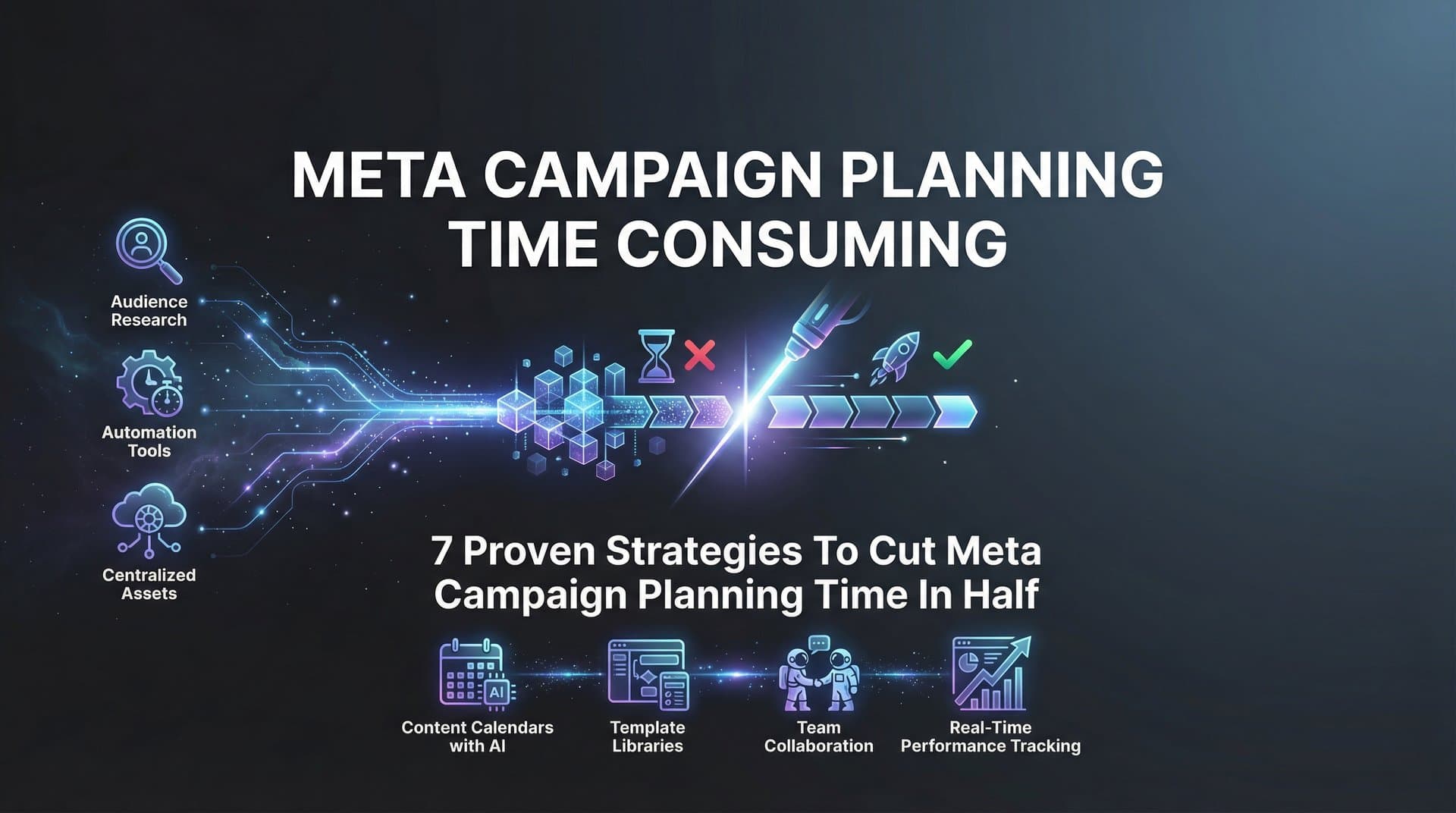
Meta campaign planning eats up more time than it should. You know the drill: researching audiences, briefing designers, writing copy variations, structuring campaigns, and finally launching everything manually. What starts as a simple campaign idea turns into a multi-day project involving multiple team members and endless revisions.
The problem isn't that Meta campaigns are inherently complex. The problem is that most marketers are still using workflows designed for a pre-AI era. They're manually building every creative, researching every audience from scratch, and launching ads one by one.
Here's what changes when you optimize for speed: you test more ideas, identify winners faster, and scale campaigns while they're still hot. The strategies below target the specific bottlenecks that turn campaign planning into a time sink. Each one eliminates redundant work without sacrificing the strategic thinking that drives results.
1. Build a Reusable Creative Asset Library
The Challenge It Solves
Every new campaign sends you back to square one. You're recreating hooks, redesigning layouts, and reinventing visual styles that already worked in previous campaigns. This creative amnesia wastes hours and ignores your most valuable resource: proven performance data.
Without an organized system, your best-performing assets get buried in folders or lost in old campaigns. Your team can't quickly access what worked, so they start fresh every time instead of building on success.
The Strategy Explained
Create a centralized library of your proven creative elements organized by performance metrics. This means cataloging winning headlines, hooks, visual styles, color schemes, and layouts with the data that proves they convert.
Tag each asset with relevant details: campaign objective, audience type, product category, and key metrics like CTR, CPA, and ROAS. When planning a new campaign, you can instantly pull assets that have already proven successful with similar audiences or objectives.
The goal isn't to reuse the exact same ad forever. It's to start with a foundation that works and adapt it for your current campaign, cutting creative development time from days to hours. This approach aligns with a streamlined Meta campaign planning workflow that eliminates redundant steps.
Implementation Steps
1. Audit your last 10-20 campaigns and identify the top 20% of performers across creatives, headlines, and copy.
2. Create a simple spreadsheet or folder structure organized by campaign type (prospecting, retargeting, product launch) with performance data attached to each asset.
3. Establish a process where every campaign's winning elements get added to the library within 48 hours of identifying strong performance.
Pro Tips
Include the context around each asset: what audience it worked with, what time of year, what product category. This context helps you make smarter decisions about when to reuse versus when to create something new. Update your library monthly to keep it fresh and retire assets that stop performing.
2. Use AI to Generate Ad Creatives from Product URLs
The Challenge It Solves
Creative production creates the biggest bottleneck in campaign planning. You need to brief designers, wait for drafts, provide feedback, wait for revisions, and repeat until you have something launchable. For video content, add video editors and actors to the coordination nightmare.
This dependency on creative resources means you can't move as fast as your testing schedule demands. When you identify a winning product or angle, you're stuck waiting days or weeks to produce the creatives needed to scale.
The Strategy Explained
AI creative generation tools can now produce image ads, video ads, and UGC-style content directly from a product URL. You provide the link, and the AI analyzes the product, generates relevant visuals, writes ad copy, and creates multiple variations ready to launch.
This approach eliminates the back-and-forth with designers and the time spent briefing creative teams. You can generate dozens of creative variations in minutes instead of waiting days for a single design. The AI pulls product details, features, and benefits directly from your website, ensuring accuracy without manual input. Leveraging AI-driven Meta campaign planning transforms how quickly you can move from concept to launch.
For video content specifically, AI can create UGC-style avatar videos that look like authentic customer testimonials or product demonstrations without requiring actors or video production.
Implementation Steps
1. Choose an AI creative platform that generates both static and video ads from product URLs and integrates with Meta's ad platform.
2. Test the AI with 3-5 of your best-selling products, generating multiple creative variations for each to identify which AI-generated styles perform best with your audience.
3. Establish a workflow where you generate AI creatives first for rapid testing, then invest in custom production only for proven winners that justify the additional time and cost.
Pro Tips
Use chat-based editing features to refine AI-generated creatives without starting from scratch. Most AI tools let you adjust colors, layouts, and messaging through simple text commands, giving you control without the time investment of traditional editing.
3. Clone and Adapt Competitor Ads
The Challenge It Solves
Starting creative development from a blank canvas wastes time and increases risk. You're guessing at what might work instead of learning from what already works in your market.
Competitor research typically involves manually screenshotting ads, organizing them in folders, and trying to recreate similar concepts with your design team. This process takes hours and still leaves you guessing about the strategic thinking behind successful competitor campaigns.
The Strategy Explained
The Meta Ad Library provides transparent access to every active ad running on Facebook and Instagram. Instead of reinventing creative approaches, you can identify which competitor ads have been running for months, indicating strong performance, and adapt those proven concepts for your products.
Modern AI tools can clone competitor ads directly from the Ad Library and adapt them for your brand. You're not copying ads verbatim. You're identifying proven patterns in messaging, visual style, and hooks, then applying those patterns to your unique value proposition. Understanding the Meta Ads campaign cloning process helps you replicate success systematically.
This research-first approach means you're building on validated concepts rather than testing blind. You still need original creative, but you're starting with strategic intelligence about what resonates with your target audience.
Implementation Steps
1. Search the Meta Ad Library for your top 5 competitors and identify ads that have been running continuously for 60+ days across multiple placements.
2. Analyze the common patterns in their successful ads including hook structures, visual styles, benefit statements, and calls-to-action.
3. Use AI creative tools that can clone and adapt these ads for your brand, maintaining the proven structure while customizing the content for your products.
Pro Tips
Look beyond your direct competitors to adjacent industries selling to the same audience. A skincare brand can learn from supplement brands targeting the same demographic. This cross-industry research often reveals fresh approaches your direct competitors haven't adopted yet.
4. Let Historical Data Drive Audience Selection
The Challenge It Solves
Audience research and selection consumes hours of campaign planning time. You're manually reviewing past campaigns, trying to remember which audiences performed well, and making educated guesses about which segments to test next.
Without systematic analysis, you end up retesting audiences that already failed or overlooking segments that consistently drive conversions. This inefficiency means wasted ad spend and slower optimization cycles.
The Strategy Explained
Your historical campaign data contains clear signals about which audiences convert and which don't. Instead of manual analysis, use tools that automatically rank every audience you've tested by actual performance metrics like ROAS, CPA, and conversion rate.
This data-driven approach transforms audience selection from guesswork into pattern recognition. You can instantly see that "women 25-34 interested in sustainable fashion" consistently outperforms broader targeting, or that lookalike audiences based on purchasers beat interest-based targeting by 40%. Implementing a Meta Ads campaign scoring system makes these insights actionable.
When planning new campaigns, you start with proven winners and test strategic variations rather than rebuilding audience strategies from scratch. The AI learns from every campaign, continuously refining its recommendations based on fresh performance data.
Implementation Steps
1. Connect your Meta Ads account to an analytics platform that tracks audience performance across all campaigns and provides ranking based on your specific goals.
2. Review the top 10 performing audiences from the last 90 days and identify common characteristics or patterns that explain their success.
3. Build new campaigns starting with these proven audiences, then add 2-3 strategic test audiences that share characteristics with your winners.
Pro Tips
Set clear performance thresholds based on your business goals. If you need a $50 CPA to be profitable, filter out any audience that hasn't achieved that benchmark. This prevents you from retesting audiences that can't hit your targets regardless of creative quality.
5. Create Campaign Templates for Recurring Objectives
The Challenge It Solves
You're rebuilding the same campaign structures repeatedly. Every product launch follows the same pattern: prospecting campaign, retargeting campaign, engagement campaign. Yet you're manually recreating this structure each time, adjusting settings, and hoping you didn't forget a critical configuration.
This repetitive setup work adds hours to every campaign and introduces inconsistency. Different team members might structure campaigns differently, making performance comparison difficult and creating gaps in your funnel.
The Strategy Explained
Standardize your campaign structures for common objectives into reusable templates. A product launch template includes the complete campaign architecture: prospecting ad sets with your proven audience segments, retargeting sequences for website visitors, and engagement campaigns for social proof building. Using Meta Ads campaign templates ensures consistency across every launch.
These templates capture not just the structure but the strategic thinking behind it. Budget allocation ratios, bid strategies, placement selections, and optimization settings are all preconfigured based on what works for that objective type.
When you need to launch a new product, you're starting with a proven framework that just needs creative assets and minor customization. This approach reduces campaign setup from hours to minutes while ensuring consistency across all your campaigns.
Implementation Steps
1. Identify your three most common campaign objectives and document the complete structure for each including ad sets, targeting, budgets, and optimization settings.
2. Create these structures as saved templates in your Meta Ads account or use a campaign management platform that supports template-based launching.
3. Refine your templates quarterly based on performance data, updating audience selections, budget allocations, and settings to reflect current best practices.
Pro Tips
Build flexibility into your templates with placeholder elements that require customization. For example, include slots for "seasonal hook" or "current promotion" so users know exactly what needs to be updated for each campaign while maintaining the proven structure.
6. Batch Launch Ad Variations with Bulk Tools
The Challenge It Solves
Testing at scale requires launching dozens or hundreds of ad variations. When you're building each ad manually in Meta Ads Manager, this process becomes prohibitively time-consuming. You're copying ad sets, duplicating ads, swapping creatives, and adjusting copy one element at a time.
This manual approach limits how many variations you can test, which directly limits how quickly you find winners. You might have five strong creatives and four audience segments, but manually building all 20 combinations takes so long that you settle for testing fewer variations.
The Strategy Explained
Bulk launching tools let you create every combination of your campaign elements in minutes. You select multiple creatives, headlines, primary text variations, audiences, and placements, and the system generates every possible combination automatically. Exploring Meta Ads campaign automation reveals how these tools eliminate manual bottlenecks entirely.
This approach transforms testing from a linear process into a parallel one. Instead of launching five ads, analyzing results, then launching five more, you launch 50 variations simultaneously and let the data reveal the winners.
The real power comes from mixing elements at both the ad set and ad level. You can test the same creative across different audiences while also testing multiple creatives within each audience, creating a comprehensive test matrix without manual campaign building.
Implementation Steps
1. Prepare your campaign elements in batches: 5-10 creatives, 3-5 headline variations, 2-3 primary text options, and 3-5 audience segments.
2. Use a bulk launching platform that connects to Meta and generates all combinations automatically with proper naming conventions for easy analysis.
3. Set up your bulk launch with appropriate budget distribution so each variation gets sufficient spend to generate meaningful data without exhausting your budget on underperformers.
Pro Tips
Start with smaller test matrices until you understand your platform's capabilities. Testing 3 creatives across 3 audiences creates 9 variations, which is manageable. Once you're comfortable analyzing bulk test results, scale up to larger matrices that test more variables simultaneously.
7. Automate Winner Identification with Performance Scoring
The Challenge It Solves
After launching campaigns, you're manually reviewing metrics across dozens of ads to identify top performers. You're exporting data to spreadsheets, calculating custom metrics, and trying to spot patterns across creatives, audiences, and copy variations.
This analysis paralysis delays optimization decisions. By the time you identify a winner, you've spent budget on underperformers longer than necessary. You're also making subjective decisions about what constitutes a "winner" without consistent criteria.
The Strategy Explained
Performance scoring systems automatically rank every element of your campaigns against your specific goals. You set target benchmarks for metrics like ROAS, CPA, and CTR, and the AI scores every creative, headline, audience, and landing page based on how close they come to hitting those targets.
This creates objective leaderboards that instantly show you what's working. Your top-performing creative isn't just the one with the highest CTR. It's the one that delivers the best combination of engagement and conversion efficiency relative to your goals. Learning how to improve Meta campaign performance starts with implementing these automated scoring mechanisms.
The system continuously updates as new data comes in, so you always have current rankings without manual analysis. When an ad starts declining, the scoring reflects it immediately, triggering optimization decisions before you waste significant budget.
Implementation Steps
1. Define your success metrics and target values based on your business model (for example, $40 CPA, 3.5x ROAS, 2% CTR).
2. Implement a platform that automatically scores all campaign elements against these benchmarks and provides ranked leaderboards for creatives, audiences, headlines, and landing pages.
3. Establish rules for action based on scores: ads scoring below 60% of your target get paused, ads scoring above 120% get increased budget, elements consistently scoring high get added to your winner library.
Pro Tips
Weight your scoring based on what matters most to your business. If you prioritize profitability over volume, give ROAS a higher weight than CTR in the scoring algorithm. This ensures the system identifies winners that align with your actual business objectives, not just vanity metrics.
Putting It All Together
Cutting Meta campaign planning time in half isn't about rushing through important decisions. It's about eliminating the repetitive manual work that bogs down your workflow without adding strategic value.
Start with the foundation: build your creative asset library and establish campaign templates for your most common objectives. These two changes alone will reduce setup time for every future campaign.
Next, layer in AI-powered creative generation to eliminate your dependency on external creative resources. When you can generate dozens of ad variations from a product URL in minutes, you unlock testing velocity that manual production simply can't match.
Then implement bulk launching to transform how you test. Instead of building ads one at a time, create comprehensive test matrices that evaluate every combination of your best elements simultaneously.
Finally, automate winner identification with performance scoring so you're making optimization decisions based on objective data rather than manual analysis.
Marketers who adopt this complete workflow typically shift from spending three to five days on campaign planning and setup to launching complete campaigns in a single afternoon. The time you reclaim doesn't disappear into other busy work. It goes directly into strategic thinking, testing more ideas, and scaling the winners faster.
Ready to transform your advertising strategy? Start Free Trial With AdStellar and be among the first to launch and scale your ad campaigns 10× faster with our intelligent platform that automatically builds and tests winning ads based on real performance data.