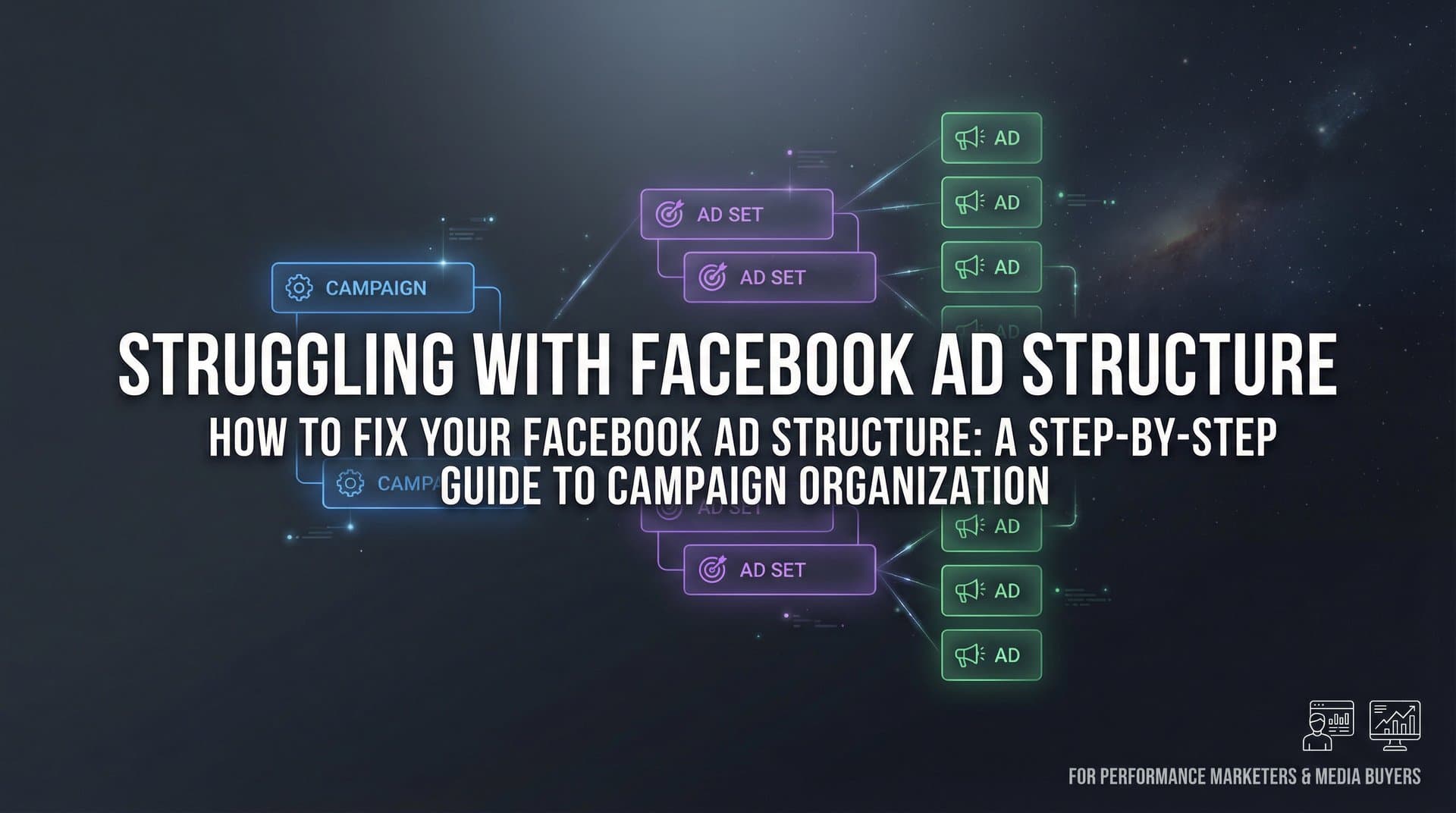
If you're struggling with Facebook ad structure, you're not alone. Many advertisers find themselves with campaigns that feel chaotic—overlapping audiences, unclear naming conventions, and budgets scattered across too many ad sets. The result? Wasted spend, inconsistent performance, and difficulty identifying what's actually working.
A well-organized campaign structure is the foundation of profitable Meta advertising. When your structure is clean, you can test systematically, scale winners confidently, and troubleshoot problems quickly. When it's messy, every decision becomes guesswork.
This guide walks you through a practical, step-by-step process to audit your current setup, implement a proven organizational framework, and maintain clarity as you scale. Whether you're managing campaigns for your own business or handling multiple client accounts, these steps will help you build a structure that supports growth rather than hindering it.
Step 1: Audit Your Current Campaign Structure
Before you can fix your Facebook ad structure, you need to understand exactly what you're working with. Start by exporting your campaign data from Ads Manager. Navigate to the Campaigns tab, click the checkbox next to the campaign name column header to select all campaigns, then click "Export Table Data" in the top right. Choose "Export with custom columns" and include metrics like spend, results, cost per result, and campaign status.
Now comes the detective work. Open your export and look for red flags that signal structural problems. The most common issue? Overlapping audiences. If you're running multiple ad sets targeting "women 25-45 interested in fitness" with slightly different parameters, you're essentially competing against yourself. Meta's auction system will pit these ad sets against each other, driving up your costs unnecessarily.
Another critical red flag is having too many ad sets per campaign. If you see campaigns with 10, 15, or 20 ad sets, you've likely fragmented your budget so much that no single ad set can gather enough data to optimize effectively. Meta's algorithm needs volume to learn, and spreading your budget across too many ad sets starves each one of the data it needs. Understanding these Facebook campaign structure problems is the first step toward fixing them.
Document which campaigns are active versus paused, and note their current performance metrics. You might discover that you have dozens of paused campaigns cluttering your account—remnants of past tests or seasonal promotions. While these don't actively hurt performance, they make navigation and analysis unnecessarily difficult.
Create a simple spreadsheet mapping out your current audience segments and where they live across campaigns. List each ad set's targeting parameters side by side. This visual inventory often reveals surprising patterns—maybe you're targeting the same lookalike audience in three different campaigns, or your retargeting audiences haven't been updated in six months and now include people who purchased a year ago.
Success indicator: You have a clear inventory of all active campaigns and can identify structural problems. You should be able to answer questions like "How many ad sets am I running right now?" and "Which audiences appear in multiple campaigns?" without logging into Ads Manager.
Step 2: Choose Your Campaign Structure Framework
With your audit complete, it's time to choose the organizational framework that will guide your rebuild. The three main approaches are Campaign Budget Optimization (CBO), Ad Set Budget Optimization (ABO), and hybrid strategies that combine both.
Campaign Budget Optimization lets Meta's algorithm distribute your budget across ad sets within a campaign based on performance. You set one budget at the campaign level, and the system automatically allocates more spend to the ad sets delivering the best results. CBO works particularly well when you have multiple audiences you want to test but aren't sure which will perform best. The algorithm can shift budget dynamically throughout the day based on real-time performance.
Ad Set Budget Optimization gives you granular control by setting individual budgets for each ad set. This approach is valuable during testing phases when you want to ensure each audience receives equal exposure regardless of early performance signals. It's also useful when you have specific budget allocations mandated by business requirements—for example, if you need to spend exactly $500 testing a new product line regardless of initial results.
Many experienced advertisers use a hybrid approach: ABO for testing new audiences and creative variations, then graduating winners into CBO campaigns for scaling. This gives you control during the validation phase while leveraging automation for optimization once you've identified what works. For a deeper dive into these approaches, review Facebook ad campaign structure best practices that top advertisers follow.
Your framework should match your advertising goals. For prospecting new customers, CBO often delivers better results because the algorithm can quickly identify which cold audiences respond best. For retargeting, where you're working with smaller, more defined audiences, ABO might make more sense because you want consistent exposure across specific segments like cart abandoners or past purchasers.
Most advertisers benefit from separating prospecting and retargeting into distinct campaigns. Why? These audience types have fundamentally different behaviors and conversion rates. Mixing them in the same campaign—even with CBO—often results in the algorithm over-allocating budget to retargeting because those conversions come easier and cheaper. This starves your prospecting efforts, limiting your ability to find new customers.
Consider segmenting campaigns by funnel stage as well. Top-of-funnel awareness campaigns have different objectives and success metrics than bottom-of-funnel conversion campaigns. Keeping them separate makes performance analysis clearer and prevents budget from flowing away from critical conversion activities toward less immediately profitable awareness efforts.
Success indicator: You've selected a framework that matches your business model and advertising goals. You can articulate why you chose CBO, ABO, or hybrid, and you understand which campaigns will use which approach.
Step 3: Create a Naming Convention System
A consistent naming convention transforms your Ads Manager from a confusing mess into an organized system where anyone can understand what a campaign does just by reading its name. The key is building a formula that includes essential information at each level—campaign, ad set, and ad.
Start with a basic structure: Campaign_Objective_Audience_Date. For example: "PROS_CONV_LAL-Purchasers-2%_Feb26" immediately tells you this is a prospecting campaign, optimized for conversions, targeting a 2% lookalike audience based on past purchasers, launched in February 2026. Compare that to "Test Campaign 3" which tells you absolutely nothing.
At the campaign level, include the campaign type (PROS for prospecting, RETARG for retargeting, TEST for experiments), the optimization objective (CONV for conversions, TRAFFIC, ENGAGEMENT), and the launch date. This lets you quickly filter and analyze performance by campaign type or time period.
At the ad set level, add the specific audience segment, geographic targeting if relevant, and placement information if you're testing different placements. For example: "RETARG_CONV_CartAband-7d_US_FeedOnly_Feb26" tells you this ad set targets people who abandoned their cart in the last 7 days, only shows in the US, runs exclusively in feed placements, and launched in February 2026.
At the ad level, include the creative format and variation identifier. "Video_TestimonialA_HeadlineV1" tells you this is a video ad featuring testimonials (version A) with headline variation 1. When you're split testing creative elements, this naming clarity becomes essential for tracking which combinations perform best.
Document your naming convention in a shared document that team members can reference. Include examples for each campaign type you run regularly. This documentation ensures consistency even when different people are building campaigns, and it helps future you remember what "LAL-Eng-3%" means six months from now.
Success indicator: Anyone can understand what a campaign targets just by reading its name. You can filter your campaigns by type, audience, or date without needing to open each one individually.
Step 4: Consolidate and Reorganize Your Ad Sets
Now comes the structural rebuild. Start by identifying ad sets with overlapping audiences. Use Meta's Audience Overlap tool—found in the Audiences section of Ads Manager—to check how much crossover exists between your targeting parameters. If two ad sets have more than 20-25% overlap, you're creating unnecessary competition.
The solution is either merging similar ad sets or implementing proper exclusions. If you're running separate ad sets for "women 25-35 interested in yoga" and "women 30-40 interested in fitness," consider whether these really need to be separate. The age ranges overlap significantly, and the interests are closely related. Combining them into one broader ad set might actually improve performance by giving the algorithm more budget to work with.
When you do need separate ad sets—for example, testing different value propositions to different audience segments—use exclusions to prevent overlap. If you're targeting a 1% lookalike audience in one ad set and a 2% lookalike in another, exclude the 1% audience from the 2% ad set. This ensures each person only sees ads from one ad set, eliminating self-competition. Consider using an automated Facebook targeting tool to streamline this process across multiple campaigns.
Aim for three to five ad sets per campaign maximum. This gives the algorithm enough budget per ad set to gather meaningful data while maintaining some segmentation for analysis. If you currently have 15 ad sets in a campaign, you're probably fragmenting your budget too much. Meta's learning phase requires approximately 50 conversion events per ad set per week to optimize effectively. Spreading your budget across too many ad sets means none of them reach this threshold, leaving you stuck in "learning limited" status.
As you consolidate, move winning ads from fragmented ad sets into your new consolidated structure. Don't just pause old ad sets and lose that creative—identify which ads were performing well and migrate them to your reorganized campaigns. You can duplicate ads across ad sets without losing their social proof (likes, comments, shares), preserving the engagement that helps performance.
Success indicator: Each ad set has a distinct, non-overlapping audience with sufficient budget to exit learning phase. You can explain why each ad set exists separately and what unique audience segment it serves.
Step 5: Implement Budget Allocation Rules
Budget allocation is where many advertisers unknowingly sabotage their own campaigns. The fundamental rule: each ad set needs enough budget to generate statistically significant data. A common guideline is setting your daily ad set budget at roughly 10 times your target cost per acquisition during the learning phase.
If your goal is conversions at $50 each, you need at least $500 daily per ad set to give the algorithm sufficient data to optimize. Running that same ad set at $100 daily means you'll only generate two conversions per day, which isn't enough data for Meta's system to identify patterns and improve targeting.
This math explains why consolidation matters so much. If you're spreading a $1,000 daily budget across 10 ad sets, each ad set only gets $100. But if you consolidate to three ad sets, each gets $333—much closer to the threshold needed for effective learning. Understanding what Facebook campaign optimization requires helps you make smarter budget decisions.
Decide whether you'll use campaign-level or ad set-level budget control based on your framework choice. If you're using CBO, set your budget at the campaign level and let the algorithm distribute it. However, consider setting ad set spending limits within CBO campaigns to prevent the algorithm from over-allocating to one audience. You might set a minimum spend of $100 and maximum of $600 per ad set, ensuring each audience gets tested while preventing one from dominating the budget.
Create a budget scaling protocol before you need it. Define clear rules: when performance hits a specific ROAS or CPA target for three consecutive days, increase budget by 20%. Never increase by more than 20-30% at once, as dramatic budget changes can reset the learning phase. Document how often you'll evaluate for scaling—daily reviews lead to over-adjustment, while weekly reviews provide more stable data.
For seasonal businesses or promotional periods, plan your budget allocation in advance. If you know you'll need to scale aggressively for a product launch or holiday sale, start increasing budgets gradually in the weeks leading up to the event rather than making massive changes the day before.
Success indicator: Each ad set has enough budget to generate statistically significant data. You have documented rules for when and how to scale budgets based on performance, removing emotion from scaling decisions.
Step 6: Establish a Testing Protocol Within Your Structure
A clean structure means nothing if you don't have a systematic way to test improvements. The key is separating testing from scaling—you need dedicated space for experiments that won't disrupt your proven performers.
Designate specific campaigns for testing. Create a "TEST_CREATIVE" campaign where you validate new ad formats, images, or video concepts. Build a "TEST_AUDIENCE" campaign for exploring new targeting parameters. Keep these separate from your "SCALE_WINNERS" campaigns that run your proven combinations. This separation protects your profitable campaigns from the volatility of testing while ensuring you're always searching for better approaches.
Define your testing variables clearly and test one element at a time. If you change both the audience and the creative simultaneously, you won't know which change drove the results. Testing "women 25-35 with new video ad" versus "women 35-45 with new video ad" isolates the age variable. Testing "women 25-35 with new video ad" versus "women 25-35 with existing image ad" isolates the creative variable. Managing too many Facebook ad variables is one of the biggest challenges advertisers face during testing.
Set clear success criteria before launching tests. Don't just run tests and hope something works—define exactly what "success" means. For example: "This test succeeds if CPA drops below $45 after 1,000 impressions" or "This audience test succeeds if ROAS exceeds 3.5x after $500 spend." Having predetermined criteria prevents you from cherry-picking results or letting tests run indefinitely without making decisions.
Create a workflow for graduating winning tests into your scaling campaigns. When a test meets your success criteria, don't just leave it running in the test campaign—migrate it to your main scaling campaign where it can receive more budget. Document what you learned from the test so you can apply those insights to future creative or audience decisions.
Limit how many tests you run simultaneously. Testing too many variables at once fragments your data and makes it difficult to identify true winners. A practical approach: run two to three creative tests and one to two audience tests at any given time, ensuring each test receives enough budget to generate meaningful results.
Success indicator: You have a repeatable system for testing new elements without disrupting proven performers. You can point to specific tests running right now, explain what variable each is testing, and state the success criteria for each.
Step 7: Set Up Ongoing Maintenance and Monitoring
The final step is building habits that keep your structure clean over time. Without ongoing maintenance, even the best-organized campaigns gradually drift back into chaos as you launch new tests, pause underperformers, and respond to performance fluctuations.
Schedule weekly structure reviews on your calendar. Block 30 minutes every Monday morning to audit your account. Check for new audience overlap that might have emerged as you added ad sets. Look for budget drift—are some ad sets spending significantly more or less than intended? Identify campaigns that have been paused for more than 30 days and archive them to reduce clutter.
Create a maintenance checklist to ensure consistency. Your weekly review might include: pause ad sets with CPA above target for seven consecutive days, refresh creative in ad sets showing frequency above 3.0, check for audience fatigue signals like declining CTR despite stable creative performance, review winning ads to identify patterns worth scaling, and update audience exclusions as your retargeting pools grow. These repetitive Facebook ad tasks can be streamlined with the right systems in place.
Use automated rules in Ads Manager for basic maintenance tasks. Set up a rule to automatically pause ad sets when CPA exceeds your threshold by 50% for three consecutive days. Create a rule to send you a notification when daily spend exceeds 150% of your intended budget. These automated safeguards catch problems quickly without requiring constant manual monitoring. For more advanced automation, explore the best Facebook ad automation tools available.
Document learnings from each campaign cycle. When you pause a campaign, add a note explaining why—"audience fatigued after 60 days" or "creative stopped working after product price increase." These notes become invaluable reference material for future decisions. Six months from now, you might consider retargeting website visitors from 90 days ago, and your notes will remind you that this audience segment never performed well historically.
Review your naming convention quarterly. As your business evolves, you might need to add new identifiers or adjust your format. Update your documentation and apply the new convention to future campaigns while leaving existing campaigns unchanged to maintain historical consistency.
Success indicator: Your structure stays clean over time instead of gradually becoming chaotic again. You can demonstrate that you've maintained consistent naming, prevented audience overlap, and kept campaigns organized through multiple months of testing and scaling.
Your Campaign Structure Blueprint
A clean Facebook ad structure isn't a one-time fix—it's an ongoing discipline that pays dividends in clearer data, faster optimization, and more profitable scaling. By auditing your current setup, choosing the right framework, implementing consistent naming conventions, consolidating ad sets, allocating budgets strategically, establishing testing protocols, and maintaining regular reviews, you transform campaign chaos into systematic growth.
Here's your quick-reference checklist to verify you've completed each step: audit completed with documented red flags, framework chosen (CBO, ABO, or hybrid) based on your goals, naming convention documented and applied to active campaigns, ad sets consolidated with proper exclusions to eliminate overlap, budgets aligned to learning phase requirements with scaling rules defined, testing protocol active with designated test campaigns and success criteria, and weekly maintenance scheduled on your calendar.
The transformation from chaotic to organized doesn't happen overnight, but each step builds on the previous one. Start with the audit this week. Implement your naming convention next week. Consolidate ad sets the following week. This gradual approach prevents overwhelm and lets you validate each improvement before moving to the next. Once your structure is solid, you can focus on learning how to scale Facebook ads efficiently without breaking what works.
If managing this structure manually feels overwhelming—especially across multiple accounts or when scaling rapidly—AI-powered tools can automate much of this work. Start Free Trial With AdStellar AI and experience how specialized agents can build properly structured campaigns based on your historical performance data, automatically selecting winning audiences, creatives, and budget allocations while maintaining the organizational clarity you need for long-term success.
The key is getting started. Your campaigns won't organize themselves, but with the framework outlined in this guide, you now have a clear path from chaos to clarity. Pick one step, implement it this week, and build from there. Your future self—and your advertising performance—will thank you.