
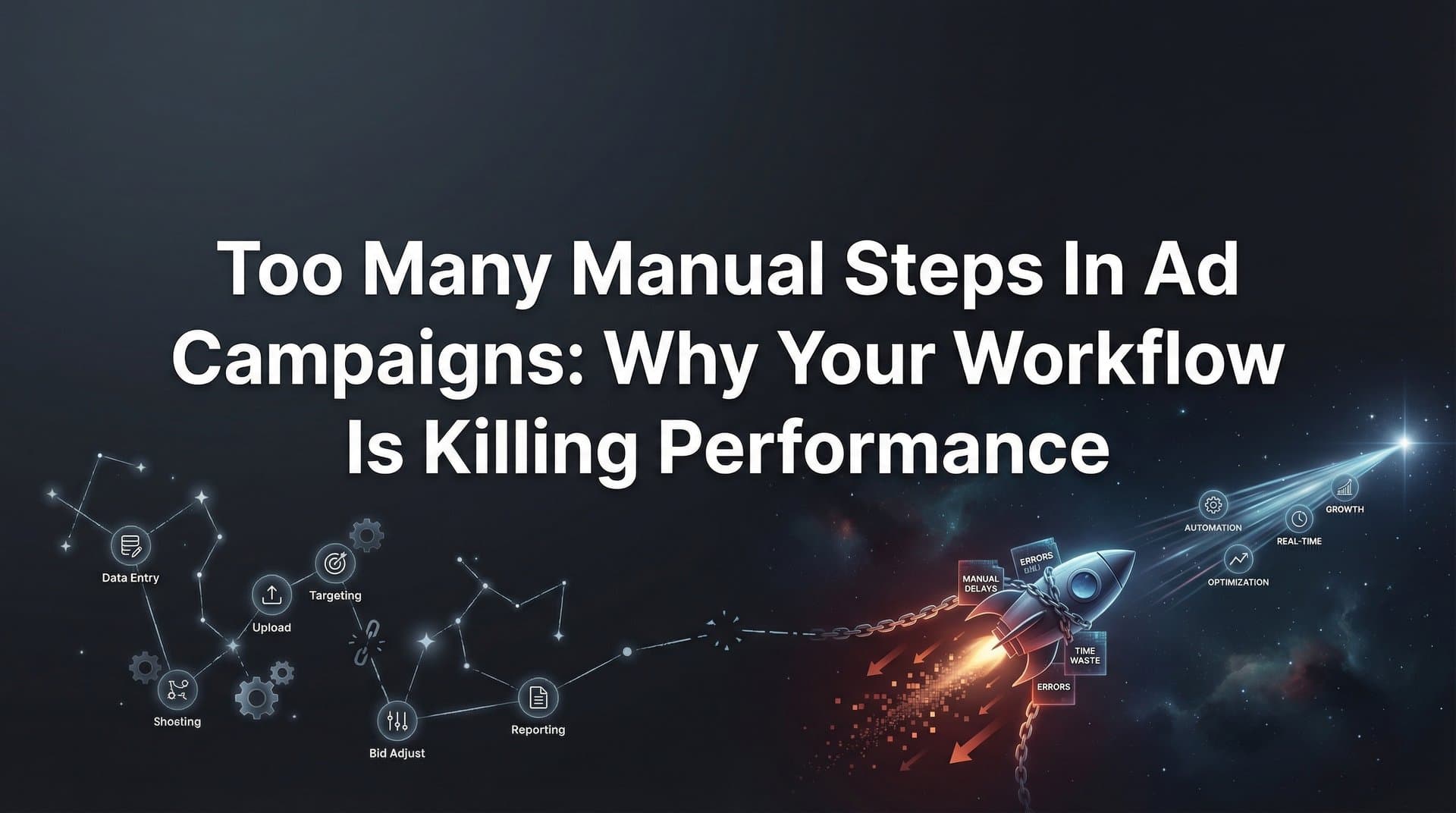
Picture your typical campaign launch morning. You've got your coffee, your creative assets are approved, and you're ready to get your new Meta ads live. But first, you need to manually configure audience settings for Ad Set 1. Then copy those settings to Ad Set 2, but swap the age range. Then Ad Set 3 needs the same targeting but different placements. Now multiply that across 12 different ad variations, each requiring its own creative upload, headline input, description field, UTM parameter, and budget allocation.
Three hours later, you're still clicking through dropdown menus.
This is the manual step trap that's quietly suffocating modern ad campaigns. The platforms have grown more sophisticated, the targeting options more granular, the creative formats more diverse—but the workflow? Still built around individual field entries and one-at-a-time configurations. What should be strategic work has devolved into high-stakes data entry, where one misplaced decimal point or wrong audience selection can burn through thousands in ad spend.
The real cost isn't just the hours lost to repetitive tasks. It's the campaigns you don't launch because the overhead feels overwhelming. It's the creative variations you don't test because setting them up takes too long. It's the strategic insights you never discover because you're too busy being a human copy-paste machine.
The Anatomy of a Manual-Heavy Ad Workflow
Let's break down what actually happens when you launch a Meta campaign the traditional way. You start with campaign objectives—selecting your goal, naming your campaign with a consistent convention, setting your budget type. Simple enough for one campaign, but you're rarely launching just one.
Next comes the ad set level, where complexity multiplies fast. You're building your audience: selecting demographics, interests, behaviors, and custom audiences. Then configuring placements—do you want Feed, Stories, Reels, or all of them? What about Audience Network? Each decision requires clicking through menus, reviewing options, and making selections.
Now comes budget allocation. You need to decide whether to set budgets at campaign or ad set level, determine your bid strategy, and configure any scheduling. If you're testing multiple audiences, you're repeating this entire process for each variation, manually ensuring consistency where needed while intentionally varying the test parameters.
At the ad level, things get even more granular. Upload your creative assets—images, videos, carousels. Write your primary text, headline, and description. Configure your call-to-action button. Add your destination URL with properly formatted UTM parameters for tracking. Select your display link. Review how everything renders across different placements.
Here's where the multiplication effect becomes brutal: if you're launching 10 creative variations across 5 different audiences, you're looking at 50 individual ads. Each one needs its creative uploaded, its copy entered, its tracking configured. Even if you're testing identical creatives across audiences, you're still manually creating each ad, selecting the same image file five times, typing the same headline five times, pasting the same URL five times.
The platforms offer some bulk tools—duplicate functions, quick edits—but they're Band-Aids on a workflow that fundamentally wasn't designed for the scale modern performance marketing demands. You end up developing elaborate spreadsheet systems, naming conventions, and folder structures just to keep track of what you've configured and what still needs attention. Understanding the difference between Meta campaign tools vs manual setup becomes essential for teams looking to escape this cycle.
And this is all before the campaign even launches. Once ads are running, the manual work continues: checking performance, pausing underperformers, adjusting budgets, creating new variations based on what's working. The cycle never stops.
Hidden Costs Beyond Wasted Hours
The obvious cost of manual-heavy workflows is time. Hours spent on configuration are hours not spent analyzing data, developing creative strategy, or exploring new growth channels. But the less visible costs often hurt more.
Error accumulation is the silent killer. When you're manually entering data across dozens of fields, mistakes are inevitable. A mistyped UTM parameter means you can't properly track which campaign drove those conversions. A budget cap set at $500 instead of $50 burns through your daily spend in the first hour. A creative matched to the wrong audience wastes impressions on people who'll never convert.
These aren't theoretical scenarios. They're the daily reality for teams managing campaigns at scale. And the cruel irony is that the more careful you try to be—triple-checking every field, reviewing every setting—the more time you waste, creating a vicious cycle where being thorough means being slow. This is exactly why Facebook ads taking too much time has become one of the most common complaints among performance marketers.
Then there's opportunity cost, which might be the most expensive hidden expense of all. Every hour spent on manual configuration is an hour not spent on strategic work. You could be analyzing why certain audience segments outperform others. You could be developing new creative concepts based on engagement patterns. You could be exploring emerging platforms or testing innovative ad formats.
Instead, you're copying and pasting audience settings.
This creates what we call scaling paralysis. Teams recognize they should be testing more variations—different headlines, alternative images, new audience segments. The data clearly shows that more testing leads to better performance. But the manual overhead makes iteration feel prohibitively expensive. So you stick with what you know, launching fewer variations, testing less aggressively, and ultimately leaving performance on the table.
The psychological toll matters too. Talented marketers didn't get into this field to be data entry specialists. When the bulk of your day involves repetitive tasks rather than creative problem-solving, burnout follows. Team members disengage. Your best people start looking for roles where their strategic thinking actually gets used.
Where Manual Steps Pile Up in Meta Campaigns
Understanding where manual work accumulates helps you identify the biggest bottlenecks in your workflow. Some areas create more friction than others.
Campaign Structure Configuration: This is where many teams lose their first hour. You're creating the same campaign settings across multiple ad sets because you want to test different audiences against identical creatives. Meta makes you configure each ad set individually—same optimization goal, same conversion event, same attribution window, but manually entered each time. If you're testing five audiences, you're entering those settings five times, hoping you don't accidentally change something that should stay consistent.
Creative Asset Management: You've got your creative files ready—images, videos, carousel cards. Now you need to upload them to the right campaigns, match them with the correct copy variations, and ensure they're displaying properly across placements. If you're running dynamic creative testing, you're uploading multiple versions of each asset, organizing them into logical groups, and manually selecting which combinations to test. The platform doesn't remember your preferences or learn from past successful pairings.
Audience Building and Targeting: Building custom audiences requires switching between different tools and interfaces. You might pull a customer list from your CRM, create a lookalike audience in Meta, layer on interest targeting, exclude previous converters, and set geographic and demographic parameters. Each campaign variation requires rebuilding these audience combinations, even when you're using similar targeting logic. Managing too many Facebook ad variables becomes a significant challenge as your testing matrix expands.
Tracking and Attribution Setup: Every ad needs proper UTM parameters so you can track performance in your analytics platform. That means manually constructing URLs with source, medium, campaign, and content parameters for each variation. Get one character wrong and your attribution breaks. Forget to update the campaign name in your UTMs and you can't differentiate between tests.
Performance-Based Optimization: Once campaigns are running, manual work continues. You're monitoring performance dashboards, identifying underperformers, manually pausing ads that aren't hitting targets, and reallocating budgets to winners. You see a creative that's crushing it and want to expand it to new audiences? That means manually creating new ad sets with that winning creative, rebuilding audience targeting, and configuring budgets—essentially starting the whole process over. The Facebook ads manual work bottleneck becomes most apparent during these optimization cycles.
The common thread across all these areas is repetition without memory. You're doing the same tasks over and over, but the platform doesn't learn from your patterns or remember what worked last time. Every campaign launch feels like starting from scratch.
The Automation Spectrum: From Shortcuts to Full AI
Not all automation is created equal. Understanding the spectrum helps you evaluate what level of automation actually solves your manual step problem versus just shifting the work around.
Platform-Native Automation: Meta offers tools like Advantage+ campaigns and automated placements. These can be helpful for specific use cases—Advantage+ Shopping campaigns, for example, automate much of the targeting and creative optimization. But you're still manually setting up the campaign framework, uploading creatives, and configuring core parameters. The automation happens within the boundaries you define, not in the setup process itself.
These tools also come with tradeoffs. You gain speed but lose granular control. You can't always see exactly why the algorithm made certain decisions or easily replicate winning approaches across other campaigns. For teams that need transparency and learning, platform-native automation can feel like a black box.
Bulk Editing and Template Systems: Many teams build their own efficiency systems—spreadsheet templates, bulk upload tools, naming convention standards. These reduce some repetition. You can duplicate a successful campaign structure and swap in new audiences. You can use CSV uploads to create multiple ads at once rather than one-by-one through the interface.
This is definitely better than pure manual work, but it's still human-orchestrated. You're the one deciding what to duplicate, which settings to change, and how to structure your tests. The system doesn't learn from performance data or suggest what to try next. It's a faster way to execute your existing workflow, not a fundamentally different approach. Exploring the differences between Facebook automation vs manual campaigns can help you understand where your current approach falls on this spectrum.
AI-Powered Campaign Building: This represents a different paradigm entirely. Instead of automating individual tasks, AI systems analyze your historical performance data to understand what actually works for your business—which creative elements drive results, which audience segments convert, which messaging resonates. Then they autonomously build new campaigns based on those insights.
The difference is intelligence plus execution. The system doesn't just speed up your existing process; it makes strategic decisions about campaign structure, audience targeting, and creative selection based on real performance patterns. When a certain headline consistently outperforms others, the AI prioritizes it in new campaigns. When an audience segment shows strong engagement, the system automatically tests similar audiences. Modern AI marketing tools for Facebook campaigns are designed to handle this level of intelligent automation.
This level of automation removes manual steps not by making you faster at clicking buttons, but by eliminating the need to click them in the first place. You define your goals and constraints; the AI handles the tactical execution.
Building a Leaner Campaign Launch Process
Whether you're ready for full AI automation or just want to reduce manual friction, certain principles can streamline your workflow immediately.
Start With a Workflow Audit: Track your time for one week of campaign work. Note every manual step—how long it takes, how often you repeat it, and where errors occur. You'll likely find that 80% of your time goes to 20% of tasks. Those high-volume, repetitive tasks are your automation priorities. Maybe it's audience configuration. Maybe it's creative uploading and matching. Maybe it's UTM parameter construction. Whatever consumes the most time with the least strategic value should be first on your automation list.
Standardize Before You Automate: Automation works best with consistency. Develop clear naming conventions for campaigns, ad sets, and ads. Create standard UTM parameter structures. Define your audience building logic. When your manual process is systematic, it becomes much easier to automate or template. Chaos doesn't automate well—you just get automated chaos.
Leverage Historical Performance Data: Stop treating every campaign launch like a blank slate. Your past campaigns contain valuable intelligence about what works. Which audience segments have the lowest cost per acquisition? Which creative formats drive the highest engagement? Which headlines generate the most clicks? Use this data to inform new campaigns rather than starting from scratch each time.
This doesn't mean only running proven winners—you still need to test new approaches. But you can make educated starting points based on performance history rather than guessing from zero.
Prioritize High-Impact Automation: You don't need to automate everything at once. Focus on the areas where automation delivers the biggest return. Bulk campaign launching often provides immediate relief—instead of configuring 50 individual ads, you can define your test matrix and let automation create all the variations. Creative-to-audience matching is another high-impact area, especially if you're testing multiple creative variations across different segments. Reviewing the best automation tools for Facebook advertising can help you identify which solutions address your specific bottlenecks.
Build Feedback Loops: The best workflows aren't just efficient at launching campaigns; they're designed to learn. Create systems that capture performance insights and feed them back into your next launch. When you pause an underperforming ad, document why it failed. When a campaign crushes it, analyze what made it work. This organizational learning becomes the foundation for smarter automation.
From Execution Mode to Strategic Mode
Too many manual steps in ad campaigns isn't just a productivity problem—it's a strategic ceiling that limits what your team can achieve. When you're trapped in execution mode, spending hours on configuration and data entry, you're not operating at your highest value. The opportunity cost of manual workflows extends beyond the immediate time waste to the insights never discovered, the creative concepts never tested, and the scaling opportunities never pursued.
The goal of reducing manual steps isn't to remove human judgment from advertising. It's to redirect that judgment toward decisions that actually matter. You shouldn't be spending your mental energy remembering to update UTM parameters or ensuring budget caps are correctly entered. You should be analyzing why certain messaging angles resonate with specific audience segments. You should be developing creative concepts that push boundaries. You should be identifying emerging opportunities before your competitors.
The evolution from manual to automated campaign management mirrors the broader shift in marketing from tactical execution to strategic orchestration. The teams that thrive aren't necessarily those who can click faster through campaign setup interfaces. They're the ones who've built systems—whether through templates, processes, or AI-powered platforms—that handle the repetitive heavy lifting while preserving human creativity and strategic thinking for where it creates real value. Learning how to scale Facebook advertising campaigns effectively requires this fundamental shift in approach.
Modern ad campaign management demands scale, speed, and precision that manual workflows simply can't deliver consistently. The platforms have evolved to offer more targeting options, more creative formats, more optimization levers. Your workflow needs to evolve too, moving from human-powered repetition to intelligent automation that learns from performance and executes based on what actually works.
Ready to transform your advertising strategy? Start Free Trial With AdStellar AI and be among the first to launch and scale your ad campaigns 10× faster with our intelligent platform that automatically builds and tests winning ads based on real performance data.


