Another Tuesday morning, and you're already seven browser tabs deep. One tab has Meta Ads Manager open. Another has your creative brief template. A third holds the Slack thread where you're waiting for the design team to send over those three ad variations you requested yesterday. Tab four is your spreadsheet tracking which audiences you've already tested. Tab five? That's the Google Doc where you're drafting headline variations while you wait.
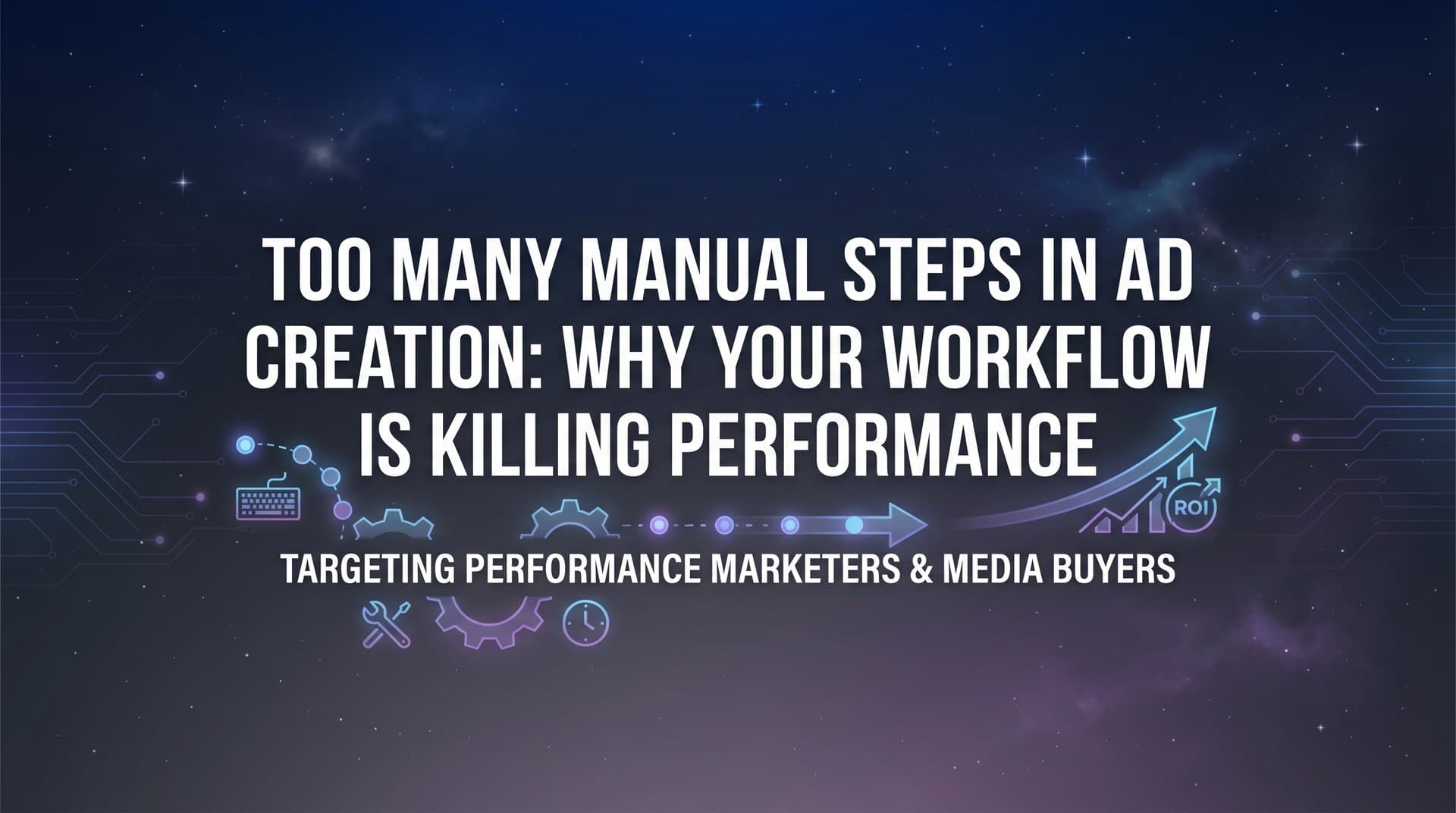
This is the reality of manual ad creation. Not the glamorous strategy sessions or the thrill of launching breakthrough campaigns. Just the grinding, repetitive work of coordinating assets, copying settings, and stitching together campaigns piece by piece.
The worst part? While you're managing this coordination circus, your competitors are already three testing cycles ahead. They're not smarter or better funded. They've just figured out how to eliminate the manual friction that's eating your entire week.
The Anatomy of a Manual Ad Creation Workflow
Let's walk through what actually happens when you need to launch a new Meta ad campaign the traditional way. Understanding each step reveals exactly where time disappears and why scaling feels impossible.
It starts with the creative brief. You outline your campaign concept, target audience, key messaging, and visual direction. This gets sent to your design team or freelancer, who adds it to their queue. If you're lucky, you'll see first drafts in 48 hours. More realistically? Four to five business days.
While waiting for creatives, you start drafting copy variations. You need multiple headlines, primary text options, and description variations to test what resonates. Each variation gets saved in a document, ready to be manually entered into Ads Manager later. You're building in a vacuum, unable to see how copy pairs with visuals until everything comes together.
The design team delivers your assets. But they're not quite right. The product image needs to be more prominent. The color scheme doesn't match your brand guidelines. Back to revisions, another two days minimum. Meanwhile, your launch timeline is slipping.
Finally, you have approved creatives. Now comes the campaign setup marathon. You open Meta Ads Manager and start building: campaign objective, budget allocation, ad set configuration. For each audience you want to test, you manually create a new ad set, re-enter targeting parameters, set bid strategies, and configure placement options.
Then you upload creatives to each ad set. Copy and paste your headline variations. Copy and paste your primary text. Double-check your UTM parameters. Triple-check your pixel tracking. One missed parameter means unreliable attribution data for the entire campaign.
You want to test three creatives against four audiences with five headline variations? That's 60 individual ads you're building by hand. Each one requires uploading the image, entering copy, configuring the destination URL, and reviewing before publishing. This is why Facebook ad creation takes too long for most marketing teams.
Three hours later, your campaign is live. But you're not done. You need to document everything in your tracking spreadsheet: which creative is in which ad set, what audiences you're testing, your hypothesis for each variation. Without this documentation, you'll never remember your testing logic when results start coming in.
And this entire process? You'll repeat it next week for your next campaign. And the week after that. The manual workflow never ends.
Where Manual Processes Break Down
The creative bottleneck creates the most obvious friction. Your campaign performance depends on testing multiple visual approaches, but each variation requires designer time. Want to test image ads against video ads against UGC-style content? That's three different production workflows, each with its own timeline and coordination overhead.
Video content amplifies this problem. A simple 15-second product video might require scripting, filming or animation, editing, revisions, and final rendering. By the time you have a testable video ad, market conditions may have shifted. Your competitor already tested and optimized their video approach while you were still in post-production.
The dependency on creative resources limits your testing velocity. You can't rapidly iterate on visual concepts when each iteration requires a formal request, approval process, and multi-day turnaround. Testing becomes a luxury instead of a standard practice. This is a core reason why manual Facebook ad creation becomes a bottleneck for growing brands.
Copy and targeting redundancy wastes hours on pure repetition. You've identified your top-performing audience segments, but testing new creatives against them means manually rebuilding those audience configurations in every new campaign. Age ranges, interests, behaviors, exclusions—all entered by hand, again and again.
The same applies to copy elements. You know certain headline formulas work for your brand, but using them in new campaigns means copying from old ads or your swipe file document. There's no system that remembers "this headline generated a 2.1% CTR last month" and makes it instantly available for your next campaign.
Manual duplication introduces errors. You accidentally set the wrong age range in one ad set. You forget to exclude existing customers from a prospecting campaign. You use the wrong UTM parameter and now you can't properly attribute conversions. These mistakes happen because humans aren't designed for perfect repetition of tedious tasks.
Analysis paralysis slows your optimization cycle to a crawl. Meta Ads Manager shows you data, but it doesn't tell you the story. You need to manually export performance metrics, build comparison charts, calculate which creative elements are actually driving results, and identify patterns across campaigns.
This analysis work happens after hours or on weekends because your days are consumed with building and launching campaigns. By the time you've identified that Creative B outperforms Creative A by 40%, you've already spent another week's budget on the underperforming variation.
The coordination overhead between teams creates communication bottlenecks. Your creative team works in design tools. Your media buying team works in Ads Manager. Your analytics team works in dashboards and spreadsheets. Nobody has a shared view of what's working, what's being tested, and what should be prioritized next.
The Real Cost of Too Many Manual Steps
Opportunity cost is the silent killer of manual workflows. While you're spending three days coordinating one campaign launch, your market is moving. Competitors are testing new angles. Customer preferences are shifting. Seasonal trends are emerging and fading.
Testing velocity determines who wins in performance marketing. The team that can test more variations, identify winners faster, and scale successful approaches will outperform the team with better strategy but slower execution. Manual processes cap your testing velocity at a level that makes competitive advantage nearly impossible.
Think about what you're not testing because the manual overhead is too high. You have ideas for new creative angles, audience segments, and messaging approaches. But launching each test requires hours of work, so you only pursue the ideas you're most confident about. This conservative approach means you never discover the unexpected winners that only emerge through volume testing.
Creative fatigue and burnout drain your strategic capacity. After spending your morning uploading ad variations and checking tracking pixels, you don't have mental energy left for creative thinking. The repetitive tasks that should take minutes consume hours, leaving no bandwidth for the strategic work that actually moves performance. Understanding the manual Facebook ad creation challenges is the first step toward solving them.
Your job title says "Performance Marketer" or "Media Buyer," but your daily reality is "Campaign Assembly Line Worker." The strategic insights, creative experimentation, and optimization work that attracted you to this role gets squeezed into the margins of your day.
This leads to decision fatigue. By the time you finish building a campaign, you're too exhausted to critically evaluate whether your targeting makes sense or if your copy could be stronger. You launch what you've built because starting over means another three hours of manual work.
Inconsistent execution creates performance variability that has nothing to do with your strategy. One campaign performs poorly not because the creative was weak, but because you accidentally excluded your best-performing age range. Another campaign shows inflated conversion numbers because you forgot to exclude existing customers.
These execution errors make it impossible to trust your performance data. You can't confidently scale a winning campaign when you're not certain the win came from your strategy versus luck in avoiding setup mistakes. Manual processes introduce too many variables that corrupt your testing methodology.
The lack of standardization means every team member builds campaigns slightly differently. One person structures ad sets by audience, another by creative, another by placement. When someone goes on vacation or leaves the company, their replacement inherits a chaotic system with no clear logic or documentation.
How AI-Powered Platforms Eliminate Manual Friction
AI creative generation collapses the entire design coordination workflow into minutes. Instead of briefing a designer and waiting days for deliverables, you provide a product URL and let AI generate scroll-stopping image ads, video ads, and UGC-style avatar content automatically.
The AI analyzes your product page, extracts key features and benefits, and creates visual concepts that highlight what matters. Want to test different angles? Generate multiple variations instantly. Need video content? AI creates it without filming, editing, or rendering delays. The creative bottleneck simply disappears. Exploring AI ad creation tools for Meta reveals just how much time you can reclaim.
This doesn't mean generic, templated ads. Modern AI creative tools understand composition, color psychology, and platform-specific best practices. They can clone competitor ads from the Meta Ad Library, giving you a proven visual approach to iterate on. Or they can build creatives from scratch based on your brand guidelines and campaign objectives.
The real power comes from chat-based refinement. See an AI-generated ad that's 80% right? Tell the AI what to adjust in plain language, and it makes the changes instantly. No design software required. No waiting for your designer to have availability. Creative iteration becomes conversational.
Automated campaign building eliminates the manual setup marathon. AI analyzes your historical campaign performance, identifies which creatives, headlines, audiences, and copy variations have driven results, and constructs complete Meta Ad campaigns with optimized settings in minutes.
Every decision comes with full transparency. The AI explains why it selected specific audiences based on past performance data. It shows you which headlines it's prioritizing because they've generated strong engagement. You understand the strategy, not just the output.
This approach gets smarter with every campaign you run. The AI builds a knowledge base of what works for your specific business, learning which audience combinations perform best, which creative styles resonate, and which messaging angles drive conversions. Your campaigns become more sophisticated over time without additional manual effort.
Bulk launching transforms how you approach variation testing. Instead of manually building 60 individual ads, you select multiple creatives, multiple headlines, multiple audiences, and multiple copy variations. The AI generates every combination and launches them to Meta in clicks. A dedicated bulk Facebook ad creation tool makes this process seamless.
Want to test three creatives against five audiences with four headline variations? That's 60 ads created and launched in minutes instead of hours. You can finally test at the volume required to identify true winners versus lucky flukes.
The bulk approach works at both the ad set and ad level, giving you complete control over how variations are structured. Test different audiences with the same creative. Test different creatives with the same audience. Mix and match at whatever granularity makes sense for your testing methodology.
Building a Streamlined Ad Creation System
Start by identifying your highest-friction manual steps. Track your time for one week and note exactly where hours disappear. For most marketers, creative production and campaign setup consume the majority of time. These become your automation priorities.
If creative bottlenecks are killing your testing velocity, implement AI creative generation first. The ability to produce testable ads in minutes rather than days will immediately increase your testing volume and reduce dependency on design resources.
If campaign setup and variation building consume your days, prioritize bulk launching capabilities. The time saved on repetitive configuration work compounds quickly when you're managing multiple campaigns simultaneously. Comparing Meta campaign tools vs manual setup helps clarify where automation delivers the biggest wins.
Centralize your winning assets in a system that makes them instantly reusable. Every time you identify a high-performing creative, headline, audience, or copy variation, it should be tagged and stored with its performance data attached.
A winners hub gives you a library of proven elements to pull into new campaigns. Instead of starting from scratch every time, you begin with components that have already demonstrated success. This dramatically increases your baseline performance while reducing the creative burden of constant novelty.
The key is having performance data attached to each asset. Not just "this creative worked," but "this creative generated a 1.8% CTR and $42 CPA in Q1 2026 when targeted at women 25-34 interested in sustainable fashion." Context makes winners reusable intelligently rather than randomly.
Implement AI insights to surface top performers automatically. Instead of manually analyzing campaign data every few days, let AI continuously monitor performance and alert you when clear winners emerge. When evaluating options, an automated ad creation tools comparison can guide your decision.
Leaderboards that rank your creatives, headlines, copy, audiences, and landing pages by actual metrics like ROAS, CPA, and CTR give you instant visibility into what's working. Set your target goals and the AI scores everything against your benchmarks, making optimization decisions obvious.
This shifts your role from data analyst to strategic decision-maker. You're not spending hours building comparison charts. You're reviewing AI-surfaced insights and deciding which winners to scale and which losers to cut. The analysis happens automatically; you focus on action.
Putting It All Together: From Manual Chaos to Automated Scale
The transformation from manual ad creation to AI-assisted execution is dramatic. What used to take three days of coordination, asset production, and campaign building now happens in under an hour. What required a team of designers, copywriters, and media buyers can now be managed by a single strategic marketer with the right tools.
This isn't about replacing human creativity with automation. It's about eliminating the repetitive, low-value tasks that prevent you from doing your best strategic work. AI handles creative generation, variation building, and performance analysis. You handle strategy, creative direction, and scaling decisions.
The mental shift is significant. Instead of asking "How can I find time to test this new audience?" you ask "What strategic hypotheses should I test this week?" The constraint changes from execution capacity to strategic thinking. That's where you want the bottleneck to be.
Your daily workflow transforms completely. Mornings that used to start with checking on designer deliverables and building campaign variations now start with reviewing AI-surfaced performance insights and deciding which winners to scale. You spend time on decisions that impact results, not tasks that simply need to be completed.
The competitive advantage compounds over time. While competitors are still coordinating their first campaign of the week, you've already tested 15 variations, identified three winners, and scaled them. Your learning velocity accelerates because you're running more experiments in less time.
Platforms like AdStellar represent this new approach to ad creation and campaign management. One platform handles creative generation from product URLs, AI-powered campaign building based on historical performance, bulk launching of hundreds of variations, and automatic surfacing of winning elements. The entire workflow from creative concept to scaled campaign happens in a single system.
The seven-day free trial gives you a risk-free way to experience what automated ad creation actually feels like. Generate your first AI creatives, let the AI build a campaign based on your past performance data, and launch variations in bulk. You'll immediately see where hours of manual work compress into minutes of strategic execution.
Ready to transform your advertising strategy? Start Free Trial With AdStellar and be among the first to launch and scale your ad campaigns 10× faster with our intelligent platform that automatically builds and tests winning ads based on real performance data.