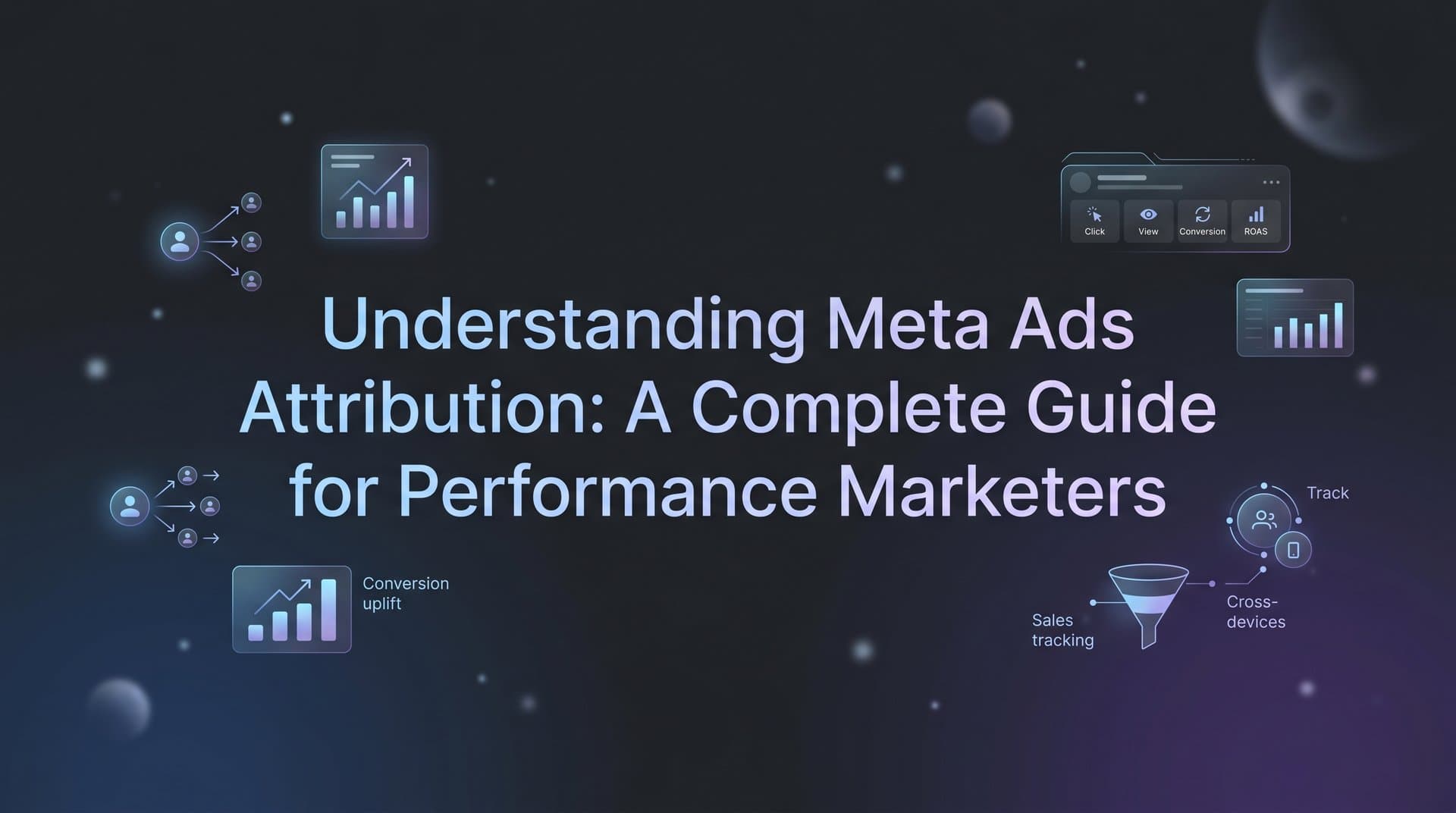
Attribution is one of those topics that every Meta advertiser knows they should understand but few actually feel confident about. You're looking at your Ads Manager dashboard, the numbers look promising, but then you open Google Analytics and everything looks completely different. Which one is right? Which campaign actually drove those sales? And if you can't answer those questions with confidence, how do you know where to put your next dollar?
This disconnect between ad spend and reported results is one of the most common frustrations in performance marketing. It's not a sign that something is broken. It's a sign that attribution is more nuanced than most platforms let on, and that understanding it is genuinely worth your time.
Attribution is not just a technical setting buried in Ads Manager. It is the foundation of every smart budget decision you make. Get it wrong, and you'll scale campaigns that aren't actually working while cutting ones that are. Get it right, and you have a clear, reliable signal that tells you exactly where your money is working hardest.
This guide covers everything you need to know: how Meta's attribution system actually works, what the different attribution windows mean in practice, why your numbers will almost always differ from Google Analytics, how to build a reliable data foundation with first-party signals, and how to use all of this to make sharper creative and budget decisions.
How Meta Decides Which Ad Gets the Credit
At its core, attribution is about answering one question: which ad interaction deserves credit for a conversion? When someone buys your product after seeing three of your ads over two weeks, clicking one, and then converting a few days later, who gets the trophy? Attribution is the system that decides.
Meta's attribution system works by connecting conversion events back to ad interactions. When a user visits your website and completes a conversion event, such as a purchase or a lead form submission, the Meta Pixel fires and sends that event data back to Meta. Meta then looks back through its records to find any ad interactions that user had within a defined time window and assigns credit accordingly.
The two types of interactions Meta tracks are click-through and view-through. A click-through interaction means the user actually clicked on one of your ads before converting. A view-through interaction means the user saw your ad, did not click it, but later converted anyway. Both types can receive attribution credit depending on your window settings.
View-through attribution is where many advertisers get their first surprise. Because Meta can attribute a conversion to an ad that a user simply scrolled past in their feed, campaigns can appear significantly more effective than they look in tools that only count clicks. This doesn't mean the data is wrong. Research consistently shows that ad exposure influences purchasing behavior even without a direct click. But it does mean you need to understand what you're looking at before drawing conclusions.
Here's the thing: Meta's attribution is self-reported within its own ecosystem. Meta is looking at interactions that happened on its own platform and matching them to conversions. It has visibility into ad impressions and clicks that no external tool can see, which is one reason its numbers will always differ from what you see in Google Analytics or any other web analytics platform.
The practical implication is that attribution in Meta is not about finding a single "true" number. It's about understanding what the number represents so you can use it consistently and make decisions on a level playing field across your campaigns.
Attribution Windows Explained: What 7-Day Click Actually Means
Your attribution window tells Meta how far back to look when assigning credit for a conversion. If someone converts today, should Meta look at ad interactions from the last 24 hours? The last seven days? Should it include views as well as clicks? The window you choose determines which conversions show up in your reports.
Meta Ads Manager currently offers four main attribution window options, set at the ad set level:
1-Day Click: Meta attributes a conversion if the user clicked your ad within the 24 hours before converting. This is the most conservative window and typically shows the fewest attributed conversions, but they are often the most directly tied to the ad interaction.
7-Day Click: Meta attributes a conversion if the user clicked your ad within the seven days before converting. This accounts for longer consideration cycles where someone might click an ad, think it over, and return to purchase days later.
1-Day View: Meta attributes a conversion if the user viewed your ad within the 24 hours before converting, even without clicking. This is typically used in combination with a click window rather than on its own.
7-Day Click and 1-Day View: This is the default setting in Meta Ads Manager. It combines a seven-day click window with a one-day view window, meaning Meta will attribute a conversion if the user either clicked your ad in the past week or simply viewed it in the past 24 hours. Because it captures both behaviors, it tends to report the highest conversion numbers.
Here's the critical concept that trips up a lot of advertisers: changing your attribution window does not change how many conversions actually occurred. It changes which conversions get reported to you. The real-world purchases happened regardless. What shifts is the lens through which Meta shows them to you.
This matters enormously when you're comparing campaigns. If Campaign A is running with a 7-day click and 1-day view window and Campaign B is running with a 1-day click window, you are not comparing apples to apples. Campaign A will almost certainly show more attributed conversions, not because it's performing better, but because it has a wider reporting net.
The practical takeaway is to standardize your attribution window before running any tests or comparisons. Pick one window that reflects your typical customer consideration cycle and apply it consistently. For most direct-to-consumer businesses with shorter purchase cycles, 7-day click and 1-day view is a reasonable default. For higher-consideration purchases, you might look at 7-day click on its own to reduce the noise from view-through attribution.
Consistency is not just a best practice here. It's the prerequisite for any comparison to mean anything at all. Understanding your Meta ads performance metrics in full context is what separates advertisers who scale confidently from those who are always second-guessing their data.
The Platform Discrepancy Problem
If you've ever looked at Meta Ads Manager and then opened Google Analytics and wondered if they're even tracking the same website, you're not alone. The discrepancy between Meta-reported conversions and what third-party analytics tools show is one of the most persistent sources of confusion in digital advertising.
The root cause is that these tools use fundamentally different attribution models. Meta uses an ad-side attribution model. It takes credit for any conversion where one of its ads appeared in the customer's journey within the attribution window, whether the user clicked or just viewed the ad. Google Analytics, by default, uses last non-direct click attribution, meaning it assigns credit to the last channel the user actively engaged with before converting.
Consider a common scenario: a user sees your Facebook ad on Monday, doesn't click it, searches for your brand on Google on Thursday, and converts after clicking an organic search result. In this situation, Meta may claim that conversion through view-through attribution. Google Analytics will attribute it to organic search. Both are technically correct within their own models. Neither is lying to you. They're just answering different questions.
This double-counting across platforms is normal and expected. The key is not to try to reconcile the numbers perfectly but to understand what each tool is measuring and use them accordingly. A dedicated Meta ads analytics platform can help you interpret these discrepancies more systematically rather than chasing perfect reconciliation manually.
The situation became more complicated with Apple's App Tracking Transparency framework, introduced with iOS 14.5. This change required apps to ask users for permission before tracking them across other apps and websites. A significant portion of iOS users opted out, which reduced Meta's ability to match conversion events back to specific users. The result for many advertisers was under-reporting of conversions in Ads Manager, particularly for purchases happening on mobile.
Meta's response was to introduce modeled conversions, where statistical models estimate conversions that cannot be directly tracked due to privacy restrictions. This modeling is designed to give advertisers a more complete picture, but it also means that some of the numbers you see in Ads Manager are estimates rather than directly observed events. Depending on your audience mix and tracking setup, this can cause Meta's reported numbers to be either higher or lower than what your analytics tools show.
Browser-level cookie restrictions add another layer. As major browsers have moved to restrict or eliminate third-party cookies, the Meta Pixel's ability to track users across sessions has been affected. This is precisely why server-side tracking has become so important, which leads directly to the next piece of the attribution puzzle.
Building a Reliable Attribution Foundation with First-Party Data
If the Meta Pixel is your only tracking mechanism, you are working with an incomplete signal. Browser restrictions, ad blockers, and privacy changes all create gaps between what actually happens on your website and what the Pixel reports back to Meta. The solution is to layer server-side tracking on top of your Pixel using the Meta Conversions API.
The Meta Pixel is a JavaScript snippet that fires in the user's browser when they take an action on your site. It's fast to implement and works well in ideal conditions. The Conversions API (CAPI) is a server-side integration that sends the same conversion events directly from your server to Meta, bypassing the browser entirely. Because it doesn't rely on the user's browser or any client-side restrictions, it captures events that the Pixel might miss.
Running both together is called a redundant event setup. Meta deduplicates the events on its end, so you won't inflate your conversion counts. What you gain is a much more complete data signal, particularly for iOS users and anyone browsing with privacy-focused settings. Pairing this with Meta ads attribution software gives you an even clearer view of which events are being captured and where gaps remain.
Inside Meta Events Manager, you can review your Event Match Quality (EMQ) scores. These scores indicate how well the customer information attached to your conversion events, things like email addresses, phone numbers, and browser data, matches actual Meta user profiles. Higher match quality means Meta can more accurately attribute conversions to specific ad interactions. Low match quality scores are often a sign that your tracking setup has gaps worth addressing.
First-party data goes beyond just fixing your tracking. Customer email lists, phone numbers, and purchase history collected directly from your audience are the most durable signals available in a privacy-first environment. Uploading customer lists as custom audiences and using them as seeds for lookalike audiences improves not just your targeting but also your attribution match rates, because Meta has a better chance of connecting conversion events to known users.
Stronger data signals don't just improve attribution accuracy. They also improve Meta's ability to optimize ad delivery toward users who are most likely to convert, which creates a compounding benefit across your entire campaign performance.
Reading Attribution Data to Find Your Real Winners
Clean attribution data is only useful if you know how to read it. Inside Ads Manager, the way you structure your reporting determines whether you're seeing signal or noise.
The first rule is consistency. Before you compare any two campaigns, ad sets, or creatives, confirm they are all using the same attribution window. Mixing a 7-day click campaign with a 1-day click campaign in the same report will produce misleading comparisons that can lead you to the wrong conclusions about what's actually working. Standardize the window first, then analyze.
When evaluating creative performance, look at attributed conversions alongside cost per result and ROAS within the same window setting. A creative that shows strong ROAS under a 7-day click window might look weaker under a 1-day click window, not because it stopped working, but because some of its conversions come from users who needed a few days to decide. Understanding your customer's consideration cycle helps you choose the window that most accurately reflects how your audience actually behaves. Falling into meta ads data analysis paralysis is a real risk when you're toggling between windows without a clear framework.
For audience efficiency, compare cost per acquisition across ad sets with identical attribution settings. Differences in CPA across audiences become meaningful signals once you've removed the variable of inconsistent windows.
Third-party attribution tools provide a cross-channel view that Ads Manager alone cannot offer. By pulling in data from Meta, Google, email, and other channels into a single model, these tools help you understand the full customer journey and avoid over-crediting any single platform. AdStellar integrates with Cometly for attribution tracking, which means you can connect your Meta campaign performance to a broader attribution picture without having to manually reconcile data across multiple dashboards.
The combination of consistent Ads Manager reporting and cross-channel attribution data gives you two complementary views: a granular look at how individual creatives and audiences perform within Meta, and a broader perspective on how Meta fits into your overall acquisition mix. Together, they sharpen every budget allocation decision you make.
From Attribution Clarity to Campaign Action
Understanding attribution is not an academic exercise. The reason it matters is that it directly changes the decisions you make about creatives, budgets, and audiences.
When you have clean attribution data with consistent window settings, creative testing becomes much more reliable. You can look at two ad variations and say with confidence that one drove more conversions within the same window, at a lower cost, with a higher ROAS. That confidence is what lets you scale winners and cut losers without second-guessing whether the numbers are comparable.
Without that clarity, creative testing becomes guesswork. You might cut an ad that was actually working because its conversions were being attributed under a different window, or scale a campaign that looks strong in Ads Manager but is actually double-counting conversions that belong to other channels.
This is where AI-powered platforms make a meaningful difference. Rather than manually sorting through attribution data to find patterns, platforms like AdStellar use attribution signals alongside historical performance data to surface top-performing creatives automatically. The AI Campaign Builder analyzes your past campaign data, ranks creatives, headlines, and audiences by real metrics like ROAS and CPA, and builds new campaigns informed by what has actually worked. Every decision comes with full transparency so you understand the reasoning, not just the output.
The workflow connects directly to attribution clarity. You generate ad creatives through the AI Creative Hub, launch hundreds of variations through Bulk Ad Launch, and then let the AI Insights leaderboards rank performance in real time. Winners get surfaced in the Winners Hub, where you can pull proven creatives, headlines, and audiences directly into your next campaign without starting from scratch.
Attribution data feeds this entire loop. When you know which ad actually drove conversions, the system learns faster, scales winners more confidently, and avoids wasting budget on variations that look good in a wide attribution window but don't hold up under a tighter one.
The result is a campaign workflow where every decision, from which creative to generate next to which audience to target, is grounded in reliable performance data rather than platform-reported numbers that you're not sure how to interpret.
The Bottom Line on Meta Ads Attribution
Attribution is not a one-time setup. It's an ongoing practice that shapes every creative test, budget allocation, and audience decision you make. The advertisers who get the most out of Meta are not necessarily the ones spending the most. They're the ones who understand what their data actually means and use it consistently.
The key takeaways from this guide: attribution windows change what gets reported, not what actually happened, so standardize before comparing. Meta's numbers will differ from Google Analytics because they use different models, and that's expected. The Pixel plus Conversions API together create a more complete signal than either alone. And first-party data is your most durable asset in a privacy-first tracking environment.
Understanding your attribution settings is the prerequisite to trusting your data. And trusting your data is the prerequisite to scaling with confidence.
If you're ready to put that confidence to work, Start Free Trial With AdStellar and experience a platform that surfaces winning creatives and campaigns based on real performance data. With built-in integration with Cometly for attribution tracking, you'll always have the full picture, from the first impression to the final conversion, in one place.