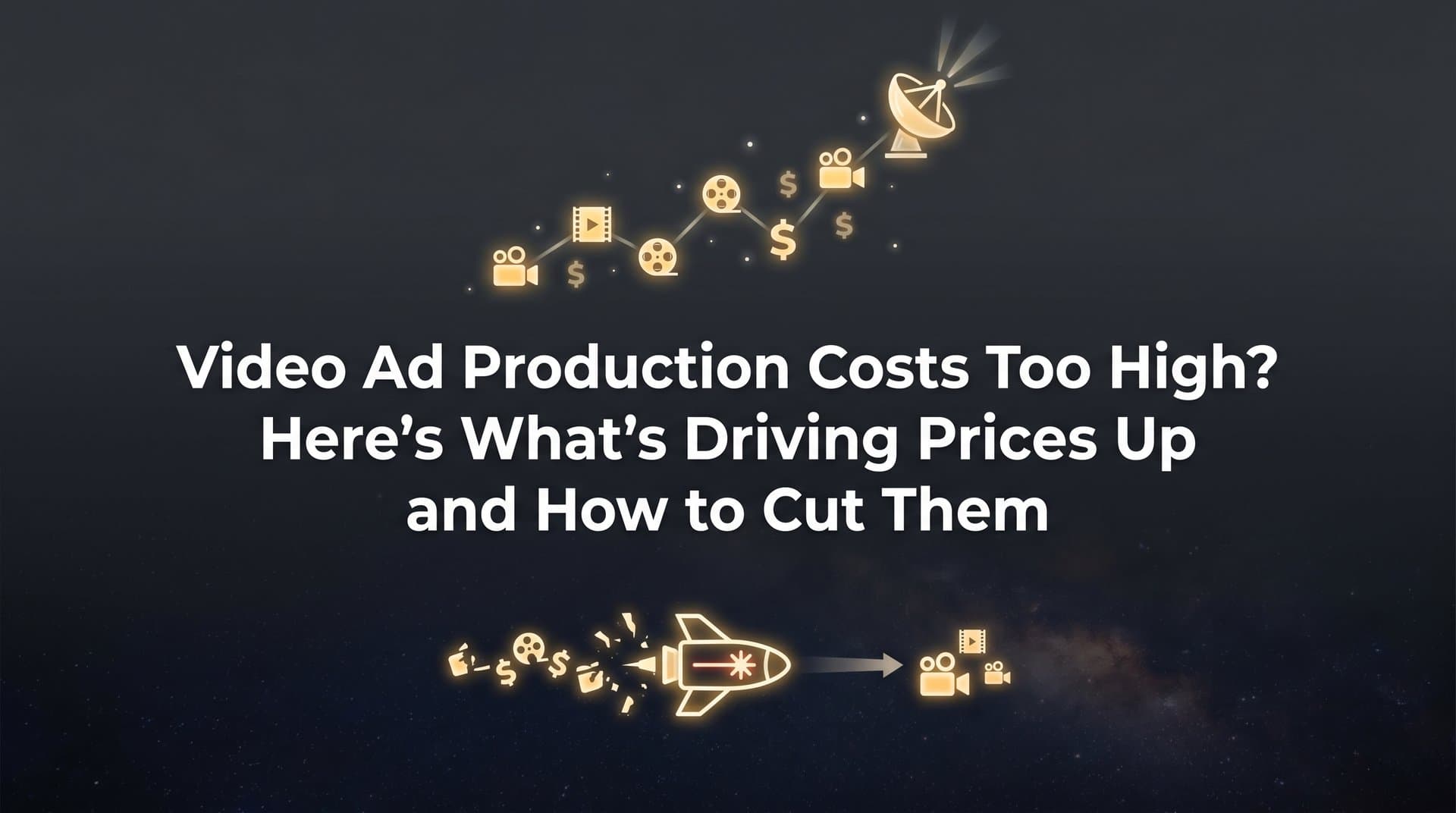
The math stops making sense somewhere around the third video quote. You need fresh video ads to compete on Meta—every marketer knows video outperforms static images. But when the production company sends over their estimate, the numbers tell a different story. $3,000 for a single 30-second ad. Another $1,500 for three variations. Two weeks minimum turnaround. And that's before you know if any of them will actually convert.
Here's the problem: performance marketing runs on testing. You need volume. Winners emerge from running 10, 15, sometimes 20 creative variations against each other. But traditional video production was built for a different era—the era of one perfect Super Bowl spot, not fifty Facebook ads tested in a week.
The gap between what you need and what you can afford keeps growing. Meanwhile, your competitors are somehow flooding feeds with fresh video content while you're still waiting on round two of revisions from last month's shoot. Something fundamental has shifted in how video ads get made, and if you're still thinking about production the old way, you're playing a game you can't win.
Let's break down where the money actually goes in traditional video production, why that model fails performance marketers, and what's changed in the past year that's rewriting the entire economics of video ad creation.
Where Every Dollar of Your Video Budget Disappears
Most marketers see the final invoice and assume the bulk went to the actual filming. That's rarely true. Video production costs stack up across three distinct phases, and the camera work is often the smallest piece.
Pre-Production: The Hidden Time Sink
Before anyone picks up a camera, you're paying for planning. Scriptwriting alone can run $500-$1,500 depending on complexity and revisions. Then comes storyboarding if you want to visualize shots before the shoot. Casting talent means reviewing submissions, conducting callbacks, negotiating rates. Location scouting eats hours of billable time as producers evaluate spaces, handle permits, coordinate access.
For a straightforward product demo, pre-production might be a few days. For anything involving a narrative or multiple scenes, you're looking at one to two weeks of work before production day even gets scheduled. All billable hours. Understanding how to reduce ad production costs starts with recognizing where these hidden expenses accumulate.
Production Day: The Minimum Viable Shoot
Here's where the rate structure kills you. Most video crews work in half-day or full-day minimums. Even if your actual shoot takes three hours, you're paying for four or eight. A basic crew—director, camera operator, audio tech, lighting—runs $2,000-$4,000 per day before equipment rental.
Add talent and the numbers jump fast. Professional actors charge day rates starting around $500 for non-union work, significantly more for union talent or anyone with a recognizable face. Studio rental adds another $500-$2,000 depending on the market and space requirements. Equipment packages—cameras, lights, audio gear, grip equipment—run $500-$1,500 per day.
That "simple" product video? You're at $4,000-$8,000 for a single production day, and you haven't edited a frame.
Post-Production: Where Timelines and Budgets Collapse
Editing is where the timeline estimates fall apart. The initial cut takes time, but the real cost comes from the revision cycle. Each round of changes—tightening the pacing, adjusting color grade, tweaking motion graphics, swapping music—burns hours at $75-$150 per hour for experienced editors.
Then you need versions. The 16:9 video for feed placements. The 9:16 vertical cut for Stories and Reels. The 1:1 square format for certain ad placements. Each variation requires reformatting, reframing shots, adjusting graphics and text overlays. What started as one video becomes three or four deliverables, each adding to the final bill.
Motion graphics and animation compound costs further. Adding animated text, product callouts, or transitions means bringing in a motion designer at premium rates. Sound design and mixing add another layer. By the time you receive final files, post-production often exceeds production costs.
The Testing Problem That Breaks Traditional Production
Traditional video production operates on a campaign mentality: create one great piece of content, run it everywhere, measure results. Performance marketing operates on a testing mentality: create many variations, let the data pick winners, kill losers fast, scale what works.
These philosophies are fundamentally incompatible with traditional production economics.
The Volume Math Doesn't Work
Effective creative testing on Meta requires volume. You're testing different hooks in the first three seconds. Different value propositions. Different visual styles. Different calls to action. If you're serious about finding winners, you need at least 10-15 creative variations in market simultaneously.
At traditional production rates, that's $30,000-$45,000 just to get into the testing phase. Most of those ads will lose. That's the point of testing—you don't know what works until you run it. But spending $3,000 per video when you know 70% will fail? The ROI math collapses before you launch. This is why ad testing taking too much time remains one of the biggest challenges for performance marketers.
So marketers compromise. They produce two or three videos instead of fifteen. They test less. They iterate slower. They miss winning concepts because they never had budget to test them. The production model forces you to play it safe when the algorithm rewards taking creative risks.
Turnaround Time Kills Momentum
You launch a campaign and one ad concept shows promise. The hook is working, but the offer needs adjustment. Or the creative is strong but you want to test three variations of the closing CTA. In an ideal world, you'd have those new versions live within 24-48 hours to capitalize on momentum.
Traditional production can't move that fast. Even if you skip pre-production and reuse existing footage, you're scheduling edit time, waiting for revisions, going through approval cycles. Best case scenario: one week. More realistic: two to three weeks. By then, the moment has passed. CPMs have shifted. Audience fatigue has set in. The opportunity window closed.
Performance marketing moves at algorithm speed. Traditional production moves at human coordination speed. The mismatch costs you winning campaigns.
Scope Creep Destroys Budget Predictability
The initial quote looks reasonable. Then the revisions start. The client wants the pacing faster. The product shot needs better lighting. Can we try a different music track? What if we adjusted the color grade to be warmer? Each reasonable request adds hours to the edit.
Before long, you're three revision rounds deep and the editor is politely mentioning that you've exceeded the included revisions in the original quote. The final invoice is 40% higher than estimated. Next time you'll be more careful about scope, but next time the same thing happens because the creative process is inherently iterative and the pricing model punishes iteration.
How UGC Creators Changed the Cost Equation
Somewhere around 2022, marketers noticed something interesting: the polished brand videos were getting outperformed by content that looked like it was shot on someone's iPhone in their kitchen. User-generated content style ads—raw, authentic, conversational—started crushing traditional production in head-to-head tests.
This wasn't just about creative preference. It was an economic disruption disguised as a creative trend.
The UGC Creator Model
UGC creators work differently than traditional talent. They typically own their own equipment—usually just a smartphone and ring light. They shoot in their own spaces. They often handle their own editing. And they charge per deliverable, not per day.
A typical UGC creator rate: $150-$400 per video, delivered within 3-7 days. For the cost of one traditionally produced video, you can commission 8-15 UGC pieces. The testing math suddenly works. Many brands now use an ecommerce UGC video tool to streamline this entire workflow.
The workflow is streamlined too. You send a brief with key talking points and product information. The creator films themselves using or discussing the product in their authentic style. They send you the raw footage or a rough cut. You can either use it as-is or hand it to your team for light editing and branding.
Why Authenticity Outperforms Polish
The performance gap between UGC-style content and traditional ads on social platforms comes down to context. When someone scrolls through Instagram or Facebook, they're not looking for ads. They're looking for content from people they know. UGC-style ads blend into that feed in a way that polished commercials never can.
The production imperfections actually help. Slightly shaky camera work signals "real person" not "brand message." Natural lighting instead of studio setups. Casual language instead of scripted copy. These aren't bugs—they're features that make the ad feel like native content rather than an interruption.
Many companies now run UGC ads alongside traditionally produced content and consistently see the UGC variations achieve lower CPAs and higher ROAS. The authentic approach resonates better with audiences who've developed sophisticated ad blindness to anything that looks too produced.
The Creator Network Advantage
Working with multiple UGC creators solves another problem: diversity of perspective. Instead of one creative team's vision of your product, you get ten different creators' authentic takes. Different demographics, different presentation styles, different angles on why the product matters.
This variety is gold for testing. You're not just testing different scripts—you're testing fundamentally different messengers and approaches. Some creators will naturally emphasize different product benefits. Some will appeal to different audience segments. The diversity generates insights you'd never get from a single production team's variations on the same concept.
AI Video Generation: Production Without the Production
UGC creators made video ads more affordable. AI video generation is eliminating production costs entirely for many use cases. The technology has reached a point where you can create scroll-stopping video content without cameras, talent, or editing software.
From Product URL to Video Ad in Minutes
Modern AI video tools can analyze a product page and generate complete video ads automatically. The AI extracts key product features, benefits, and visual assets, then constructs a video narrative with motion graphics, text overlays, and transitions. What traditionally required a creative brief, scriptwriting, and days of production now happens in minutes.
The output quality has improved dramatically. Early AI-generated videos looked obviously synthetic—robotic pacing, generic stock footage, awkward transitions. Current generation tools produce videos that blend seamlessly into social feeds, with dynamic pacing, platform-optimized formatting, and visual hooks designed to stop the scroll. An AI product video ad generator can now handle most of what used to require a full production team.
For product-focused ads where you're showcasing features and benefits rather than telling elaborate stories, AI generation covers 80% of use cases at a fraction of traditional costs.
UGC-Style Avatar Videos: The Talent Cost Killer
Here's where it gets interesting: AI can now generate UGC-style videos featuring realistic avatars that deliver your script with natural gestures, expressions, and voice inflection. No actors. No filming. No coordination.
You write the script or talking points. Select an avatar that matches your target demographic. The AI generates a video of that avatar presenting your message in a conversational, authentic style that mimics real UGC content. The avatars look and sound like real people sharing genuine product experiences.
This eliminates the entire talent cost structure. No casting. No day rates. No coordination of schedules. No contracts or usage rights negotiations. You can generate variations with different avatars, different scripts, different approaches in the time it used to take to send emails to potential UGC creators. Tools like a Shopify UGC video generator make this accessible even for smaller stores.
The cost implications are staggering. Where a UGC creator might charge $200-400 per video, AI avatar videos cost a fraction of that—often just the platform subscription fee with unlimited generation. The economics enable testing at a scale that was previously impossible.
Chat-Based Editing That Replaces Revision Cycles
Traditional editing means back-and-forth with an editor. "Can you make the intro faster?" "Let's try different music." "The product shot needs to be longer." Each request goes into a queue, gets implemented, comes back for review. Days pass.
AI video tools are adding conversational editing interfaces. You describe the change you want in plain language: "Make the opening hook more urgent" or "Add text overlay emphasizing the discount." The AI implements the change in seconds. You see the result immediately. If it's not quite right, you refine the instruction. The entire revision cycle that used to take days now happens in minutes.
This removes the psychological barrier to iteration. When each revision costs time and money, you hesitate to request changes. When changes happen instantly at no additional cost, you experiment freely. You try five different hooks instead of settling for the first acceptable one. You test variations you would have skipped because they weren't worth the revision cost.
Building a Smart Video Creative Strategy for Performance Marketing
The goal is not to eliminate traditional production or pick one approach over all others. The goal is to match the right production method to each creative need, maximizing your testing volume while controlling costs.
The Tiered Production Framework
Think about your video needs in three tiers. Tier one: high-volume testing content where you need many variations quickly to find winning concepts. This is AI generation territory—product feature videos, benefit-focused ads, UGC-style avatar content. Generate 15-20 variations, test them against each other, identify winners.
Tier two: proven concepts that need authentic human delivery. Once AI testing identifies winning hooks or value propositions, commission UGC creators to deliver those concepts in their authentic style. You've de-risked the creative direction with data, now you're adding the human authenticity that resonates on social platforms. Budget $150-400 per creator for 3-5 variations of your winning concept.
Tier three: brand flagship content and high-stakes campaigns where production value matters. This is where traditional production makes sense—product launches, brand awareness campaigns, content that will run for months and appear across multiple channels. Invest the $5,000-15,000 in professional production because the creative will work hard enough to justify the cost.
Most marketers do this backwards. They start with expensive production for unproven concepts, then can't afford to test properly. Start cheap, test volume, invest in winners. The comparison between AI ad creation tools vs traditional methods makes this strategy clear.
Using Bulk Creation to Test Before Committing Budget
AI tools that enable bulk video creation change the testing game entirely. You can generate 20 different video ads testing different hooks, offers, and approaches for less than the cost of a single traditionally produced video. Run them all. Let the algorithm and your audience tell you what works.
The winners that emerge from bulk testing give you confidence to invest more. You know the hook works. You know the value proposition resonates. Now you can confidently commission UGC creators or even traditional production to create premium versions of the proven concept. You're investing production budget in de-risked creative rather than hoping your expensive video will work.
This approach also accelerates learning. Instead of waiting weeks to produce and test a few variations, you're testing dozens of concepts simultaneously. You learn faster what resonates with your audience. You identify winning patterns—certain hooks, certain benefit framings, certain visual approaches—that inform all future creative development. An ecommerce video ad generator makes this bulk testing approach practical for any size business.
Measuring Cost Per Winning Creative, Not Cost Per Video
The wrong metric is cost per video produced. The right metric is cost per winning creative that drives profitable results. This reframes the entire conversation.
If traditional production costs $3,000 per video and you produce three videos with one winner, your cost per winning creative is $9,000. If AI generation costs $50 per video and you produce twenty videos with three winners, your cost per winning creative is $333. Even though the AI videos individually look less polished, you're acquiring winning ads at 1/27th the cost.
This metric also accounts for the opportunity cost of slow production. A winning creative that launches two weeks late because of production delays loses two weeks of profitable performance. The faster production method that gets winners in market sooner generates more total revenue even if the production quality is slightly lower.
Track cost per winning creative across your different production approaches. You'll likely find that the methods that feel "cheap" deliver the best economics because they enable the volume and speed that performance marketing requires.
The New Math of Video Ad Production
The conversation about video production costs needs a fundamental reset. The question is not "How do we afford traditional production?" The question is "How do we generate the most winning video ads for our budget?"
AI video generation has rewritten the economics. You can now test at scale without the traditional production overhead. You can iterate in minutes instead of weeks. You can generate dozens of variations for the cost of one traditionally produced video. The tools have reached a quality level where AI-generated content performs competitively in real campaigns, not just in theory.
This doesn't mean traditional production is dead. It means traditional production should be reserved for situations where its strengths—high production value, complex storytelling, brand prestige—actually matter. For most performance marketing needs, faster and cheaper wins.
The marketers winning on Meta right now are not the ones with the biggest production budgets. They're the ones testing the most creative variations, learning the fastest, and scaling winners aggressively. AI video tools make that approach accessible to any marketer willing to rethink how video ads get made.
Your competitors are already making this shift. The question is whether you'll adapt before the cost gap becomes insurmountable. Start Free Trial With AdStellar and be among the first to launch and scale your ad campaigns 10× faster with our intelligent platform that automatically builds and tests winning ads based on real performance data. Generate image ads, video ads, and UGC-style avatar content from a product URL. Launch complete campaigns to Meta with AI-optimized audiences and copy. Surface your winners automatically with real-time performance insights. No designers, no video editors, no production overhead. One platform from creative to conversion.