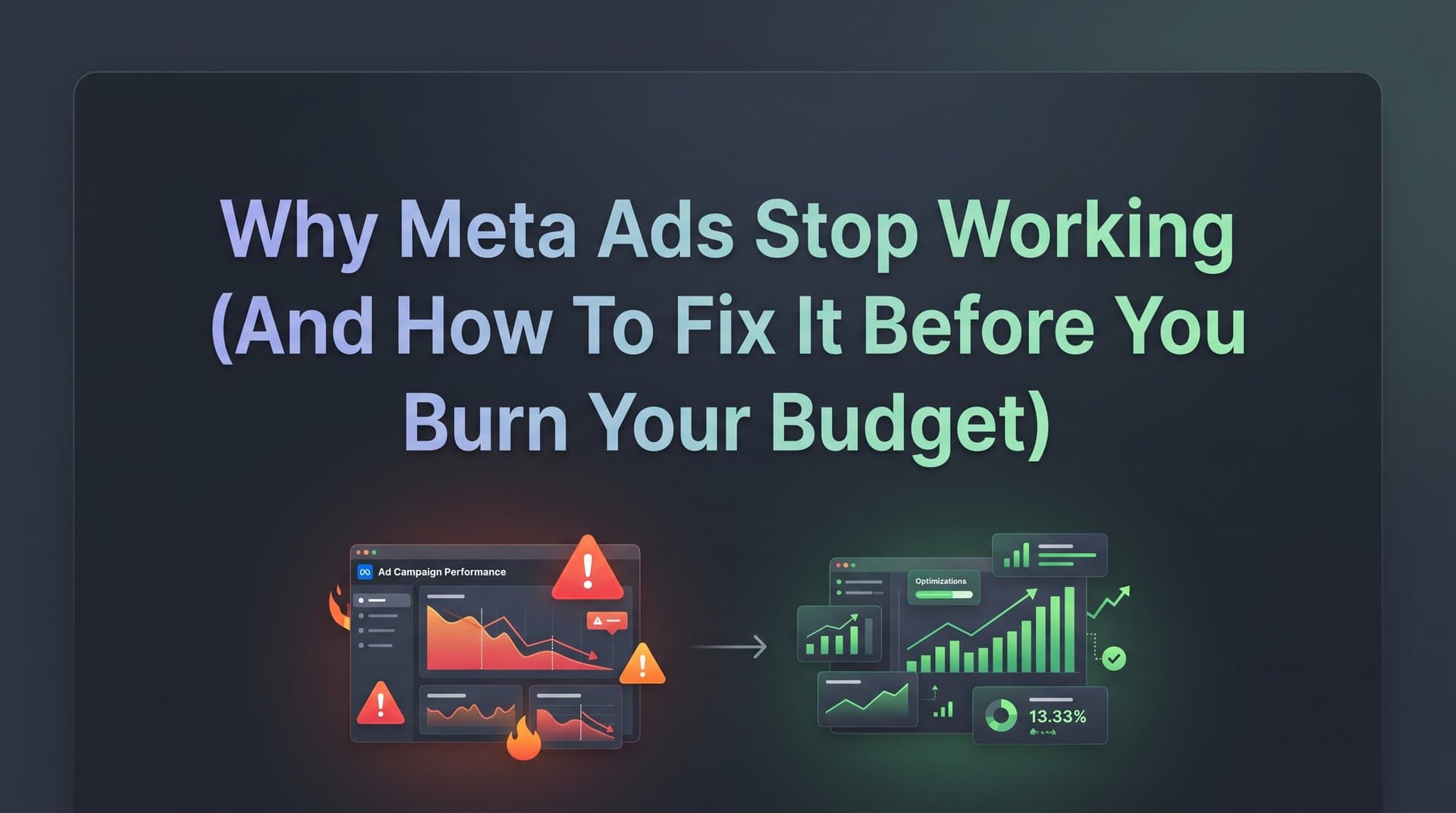
Meta ads are one of the most powerful paid channels available to digital marketers. They're also one of the most frustrating when performance starts sliding for no obvious reason. One month your campaigns are generating strong ROAS, your CPMs are manageable, and conversions are flowing. The next month, nothing has changed on your end, yet results are deteriorating by the week.
This is one of the most common experiences among Meta advertisers, and it's rarely caused by a single factor. More often, it's a combination of overlapping issues that compound quietly until the damage becomes impossible to ignore. The good news is that none of these causes are random. They follow predictable patterns, which means they're diagnosable and fixable.
This article breaks down the core reasons why Meta ads stop working, covering ad fatigue, audience exhaustion, algorithm shifts, creative decay, and structural campaign mistakes. More importantly, it explains what to do about each one before your budget takes the hit. If you're already running Meta campaigns and watching your numbers slip, this is the diagnostic framework you need.
Ad Fatigue: The Silent Budget Killer
Ad fatigue is what happens when your target audience has seen your creative enough times that they've stopped responding to it. It sounds simple, but the downstream effects on campaign performance are significant and often misread as a targeting or budget problem.
Meta's algorithm is constantly reading engagement signals to decide how aggressively to deliver your ads. When CTR starts falling and users scroll past without interacting, the algorithm interprets that as a relevance signal. It begins reducing delivery or increasing the cost required to maintain the same reach. You end up paying more for less, and the natural instinct is to increase the budget, which usually makes things worse by accelerating spend against an already-declining creative.
Frequency is the metric to watch here. Many experienced Meta advertisers treat a frequency score above 3 or 4 within a short campaign window as an early warning sign. When the same person has seen your ad four or more times in a week and hasn't clicked, they've effectively told the algorithm they're not interested. Meta surfaces frequency data directly in Ads Manager, so there's no excuse for not monitoring it. Understanding the full range of Meta ads performance metrics helps you catch these signals before they compound into serious decline.
The compounding problem is what makes fatigue particularly damaging. The longer a fatigued creative runs without being rotated, the deeper the performance hole becomes. Relevance signals deteriorate progressively, CPMs climb, and even when you eventually refresh the creative, it can take time for the algorithm to recalibrate. You're not just losing performance in the short term; you're potentially disrupting the campaign's delivery patterns in ways that take weeks to recover from.
What makes fatigue a silent killer is the lag between cause and visible effect. Your creative might start fatiguing on week two, but the ROAS impact doesn't become obvious until week four. By the time most marketers react, the problem has already compounded. The fix isn't reactive; it's building a system that rotates creatives before fatigue takes hold, not after it's already collapsed performance.
Audience Exhaustion and the Saturation Trap
Audience exhaustion is related to ad fatigue but fundamentally different in nature. Fatigue is about overexposure. Exhaustion is about reach ceiling. It happens when you've genuinely reached most of the qualified people within a defined segment, not just shown them too many ads.
Think of it this way: if your custom audience contains 50,000 people and your campaign has been running for several weeks, you may have already reached the majority of them multiple times. The pool of new, unconverted prospects within that segment is shrinking, and no amount of creative refresh will fix that. You need a larger or different audience.
Small audiences exhaust fastest. Custom audiences built from website visitors, email lists, or past purchasers are inherently limited in size. For cold traffic campaigns, audiences under 100,000 are generally considered too narrow for sustained performance at meaningful spend levels. The algorithm has fewer people to find, so it starts cycling back to the same users repeatedly, which inflates frequency and drives up CPMs simultaneously.
Lookalike audiences introduce a different kind of exhaustion. They're seeded from your custom audiences, which means their quality is directly tied to the health of the source list. As your seed audience ages or shrinks because fewer people are visiting your site or converting, the lookalike degrades in quality. The algorithm is working from an increasingly outdated signal to find similar users, which means the matches become less precise over time. Leveraging an AI Meta ads targeting assistant can help identify when lookalike quality is degrading and surface fresher audience signals automatically.
Audience overlap is another structural issue that accelerates exhaustion. When multiple ad sets within the same campaign are targeting overlapping segments, Meta's algorithm ends up competing against itself in the auction. This drives up your own costs, suppresses reach across all affected ad sets, and creates delivery instability. Meta provides an Audience Overlap tool in Ads Manager that lets you measure this directly. If two audiences share significant overlap, they shouldn't be running simultaneously without consolidation or exclusion layers in place.
The solution to exhaustion requires expanding or diversifying your audience strategy: broadening lookalike percentages, building new custom audiences from different data sources, or testing interest-based and broad targeting approaches to find new pockets of qualified users.
The Algorithm Shift Problem Nobody Talks About
Here's a scenario that trips up even experienced Meta advertisers. Your campaign structure is solid, your creative is fresh, and your audience is healthy. But performance is still declining. The culprit might not be anything you've done. It might be Meta itself.
Meta's algorithm is not static. It is continuously updated, and changes to delivery optimization, auction dynamics, and placement logic can silently break campaigns that were previously stable. Advantage+ placements, for example, have shifted how Meta distributes spend across surfaces, and campaigns optimized for specific placements can see unexpected delivery changes when Meta adjusts how it weights those placements in the auction. These changes aren't always announced with enough specificity for advertisers to anticipate the impact.
The most significant documented example of algorithm-adjacent disruption is Apple's iOS 14.5 update, which introduced App Tracking Transparency in April 2021. This change reduced the volume of conversion signals flowing back to Meta's pixel, and Meta publicly acknowledged the impact on targeting and measurement accuracy. Campaigns that previously relied on rich conversion data to optimize effectively suddenly had less signal to work with. The algorithm's ability to find the right users for conversion-focused campaigns was meaningfully impaired, and many advertisers saw performance drop without making any changes themselves.
The effects of that signal loss are still present. Campaigns targeting smaller conversion windows, particularly those optimized for 1-day click attribution, are working with less data than they were before iOS privacy changes took effect. This is a structural reality of the current Meta advertising environment, not a temporary glitch. Using AI marketing automation for Meta ads can help compensate for reduced signal by identifying patterns across broader data sets that manual analysis would miss.
Beyond platform changes, external market dynamics affect auction performance in ways that are easy to overlook. Seasonal demand shifts change how many advertisers are competing for the same impressions at the same time. During high-spend periods like Q4, CPMs rise across the board because more advertisers are bidding for the same inventory. A budget that delivered efficiently in August may produce noticeably worse results in November simply because the competitive landscape has changed. The same ad, the same audience, the same bid strategy can perform very differently depending on what's happening in the auction around it.
Understanding this means accepting that some performance variance is environmental, not a reflection of campaign quality. The right response is to monitor CPM trends as a leading indicator and adjust expectations and budgets accordingly during high-competition periods rather than over-optimizing campaigns in response to normal market fluctuations. Reviewing your Meta ads budget allocation strategies during these periods can protect efficiency when auction costs spike.
Creative Decay: Why Your Best Ad Has an Expiration Date
Every high-performing ad has a lifespan. This is true even for creatives that are genuinely excellent, with compelling hooks, strong offers, and clear calls to action. Creative decay is the process by which even your best performers see diminishing returns as novelty wears off and the creative's ability to stop the scroll weakens over time.
The mechanism is partly psychological and partly algorithmic. On the psychological side, users who have seen an ad before process it faster and with less attention. The hook that once made someone pause now gets recognized and dismissed in a fraction of a second. On the algorithmic side, as engagement signals weaken, Meta's delivery system gradually deprioritizes the creative in favor of alternatives that generate stronger interaction.
Not all creative formats decay at the same rate. Static image ads tend to lose impact faster than video because they deliver their full message instantly. Once a user has absorbed the image and the headline, there's nothing left to engage with on repeat exposures. Video ads, particularly those with strong narrative structures or multiple hooks, can sustain attention across more exposures because there's always the possibility of catching something new. That said, video is not immune to decay; it simply has a longer runway in many cases.
Single-format campaigns decay faster than multi-format ones. If you're running only static images, you're burning through your creative runway much faster than a campaign mixing video, carousel, and UGC-style formats. Each format reaches users differently and competes in different placement contexts, which distributes the fatigue load across a broader creative pool. Understanding how to scale Meta ads efficiently depends heavily on having enough creative diversity to sustain delivery without burning out any single format.
The critical mistake most advertisers make is treating creative refresh as a reactive measure. They wait until ROAS has dropped significantly before launching new creative tests, which means there's a gap between when the old creative stops working and when the new winner is identified and ready to scale. That gap is where budget gets wasted.
The solution is a continuous creative testing pipeline. Rather than running one or two proven ads and waiting for them to fail, the goal is to always have new variations in testing so that when a current winner starts to decay, there's already a successor ready to take its place. Bulk variation testing accelerates this process significantly. By generating multiple hooks, formats, and angles simultaneously and letting performance data identify the next winner, you compress the time between creative generations and reduce the budget exposure during transition periods.
Platforms like AdStellar are built specifically for this kind of systematic creative production. The AI Ad Creative feature generates image ads, video ads, and UGC-style content from a product URL, and the Bulk Ad Launch capability creates hundreds of ad variations in minutes, mixing creatives, headlines, and copy across ad sets. The Winners Hub then surfaces which combinations are actually performing, so you're always building the next campaign from proven elements rather than starting from scratch.
Structural Campaign Mistakes That Accelerate Decline
Sometimes Meta ads stop working not because of fatigue or algorithm shifts, but because of foundational structural problems in how campaigns are built and managed. These issues don't always show up immediately; they often surface gradually as campaigns scale or mature.
Budget and bid strategy mismatches are among the most common structural problems. A campaign with a budget that's too low relative to its audience size and conversion window may never properly exit Meta's learning phase. According to Meta's own guidance, ad sets typically need around 50 optimization events per week to achieve stable delivery. If your budget can't generate enough conversions to hit that threshold, the algorithm remains in a perpetual state of exploration, performance stays inconsistent, and you never get the efficiency gains that come with stable, optimized delivery. Diagnosing and resolving Meta ads budget allocation issues is often the fastest way to restore learning phase stability.
Frequent campaign edits compound this problem significantly. Every time you make a meaningful change to targeting, bid strategy, budget, or creative within an active campaign, Meta resets the learning phase for that ad set. Advertisers who are constantly tweaking in response to short-term fluctuations are inadvertently preventing their campaigns from ever stabilizing. The instinct to optimize is understandable, but over-optimization is one of the fastest ways to undermine campaign performance. The general principle is to make fewer, more deliberate changes and give each iteration enough time and budget to generate meaningful data before drawing conclusions.
Attribution window misalignment is a structural issue that causes a different kind of damage: it leads to misreading performance and making changes that actually hurt campaigns. Meta offers multiple attribution window options, including 1-day click, 7-day click, and view-through variants. If you're evaluating campaign performance based on 1-day click attribution while Meta is optimizing for a 7-day window, you're looking at an incomplete picture of the conversions your campaign is actually driving. You may see a campaign that looks underperforming on a 1-day basis and pause it, when in reality it was generating conversions that show up later in the attribution window. This misalignment between measurement and optimization creates a feedback loop where good campaigns get shut down and budget gets reallocated based on misleading data.
Aligning your attribution window settings with your actual conversion cycle and Meta's optimization target is a foundational step that many advertisers overlook, particularly when managing multiple campaigns across different product types with different purchase timelines. Following Meta ads campaign structure best practices from the outset prevents many of these attribution and learning phase problems before they have a chance to develop.
Building a System That Keeps Campaigns Healthy
The common thread running through every cause of Meta ad decline is that reactive management always costs more than proactive prevention. By the time performance problems are obvious in your dashboard, they've typically been developing for weeks. The goal is to build systems that catch early signals and respond before the damage compounds.
Creative refresh cadence is the most impactful lever most advertisers have direct control over. Rather than waiting for ROAS to drop before launching new creative tests, monitor frequency and CTR trends as leading indicators. Rising frequency combined with falling CTR is the earliest measurable signal that a creative is starting to fatigue. Building a habit of rotating creatives at that stage, rather than after performance has collapsed, keeps campaigns in a healthier delivery state and avoids the recovery lag that comes with fatigued ad sets.
Systematic creative testing at scale changes the economics of this process. When you're running only one or two creatives at a time, creative decay creates a genuine crisis because there's no successor ready to scale. When you're continuously testing multiple formats, hooks, and angles simultaneously, creative decay becomes a manageable transition rather than a performance emergency. There's always a next winner already in the data.
This is precisely the problem AdStellar is designed to solve. The AI Campaign Builder analyzes your historical campaign data, ranks every creative, headline, and audience by real performance metrics, and builds complete Meta campaigns in minutes. The AI Insights leaderboards score every element against your actual goals, whether that's ROAS, CPA, or CTR, so you can see at a glance which combinations are winning and which are fading. And because AdStellar's system learns continuously from each campaign, the recommendations improve over time rather than staying static.
For creative production specifically, AdStellar's Bulk Ad Launch feature creates hundreds of ad variations by mixing creatives, headlines, audiences, and copy, then launches them to Meta in clicks rather than hours. The Winners Hub collects your best-performing elements in one place so that every new campaign starts from a foundation of proven assets rather than guesswork.
The result is a continuous loop: generate new creatives, test at scale, surface winners, build the next campaign from those winners, and repeat. That loop is what keeps campaigns performing over time instead of peaking and declining.
The Bottom Line on Declining Meta Ad Performance
Meta ads stopping is not a mystery. It's a predictable pattern with identifiable causes, and every one of them has a solution. Ad fatigue degrades performance when creatives run too long without rotation. Audience exhaustion caps reach when segments are too narrow or too stale. Algorithm shifts and signal loss create environmental headwinds that require structural adaptation. Creative decay sets an expiration date on even your best performers. And structural campaign mistakes like learning phase disruption and attribution misalignment amplify every other problem.
The marketers who maintain consistent Meta performance over time aren't the ones who found a magic audience or a creative formula that never gets old. They're the ones who built systems for continuous testing, proactive refresh, and data-driven decision-making. They treat creative production as an ongoing operation, not a one-time project.
If you're ready to stop chasing performance decline and start building a campaign system that surfaces winners automatically, AdStellar gives you the tools to do it. From AI-generated creatives to bulk launch to real-time performance scoring, the platform handles the testing and optimization loop so you can focus on strategy.
Start Free Trial With AdStellar and be among the first to launch and scale your ad campaigns faster with an intelligent platform that automatically builds and tests winning ads based on real performance data. Seven days, no commitment, and a clear picture of what your Meta campaigns are actually capable of.