Most Meta advertisers have experienced this at some point: you spend real time crafting your ad copy, you feel good about it, you hit publish — and then nothing. The creative looks solid. The audience targeting seems right. But the results are flat, and you're left wondering what went wrong.
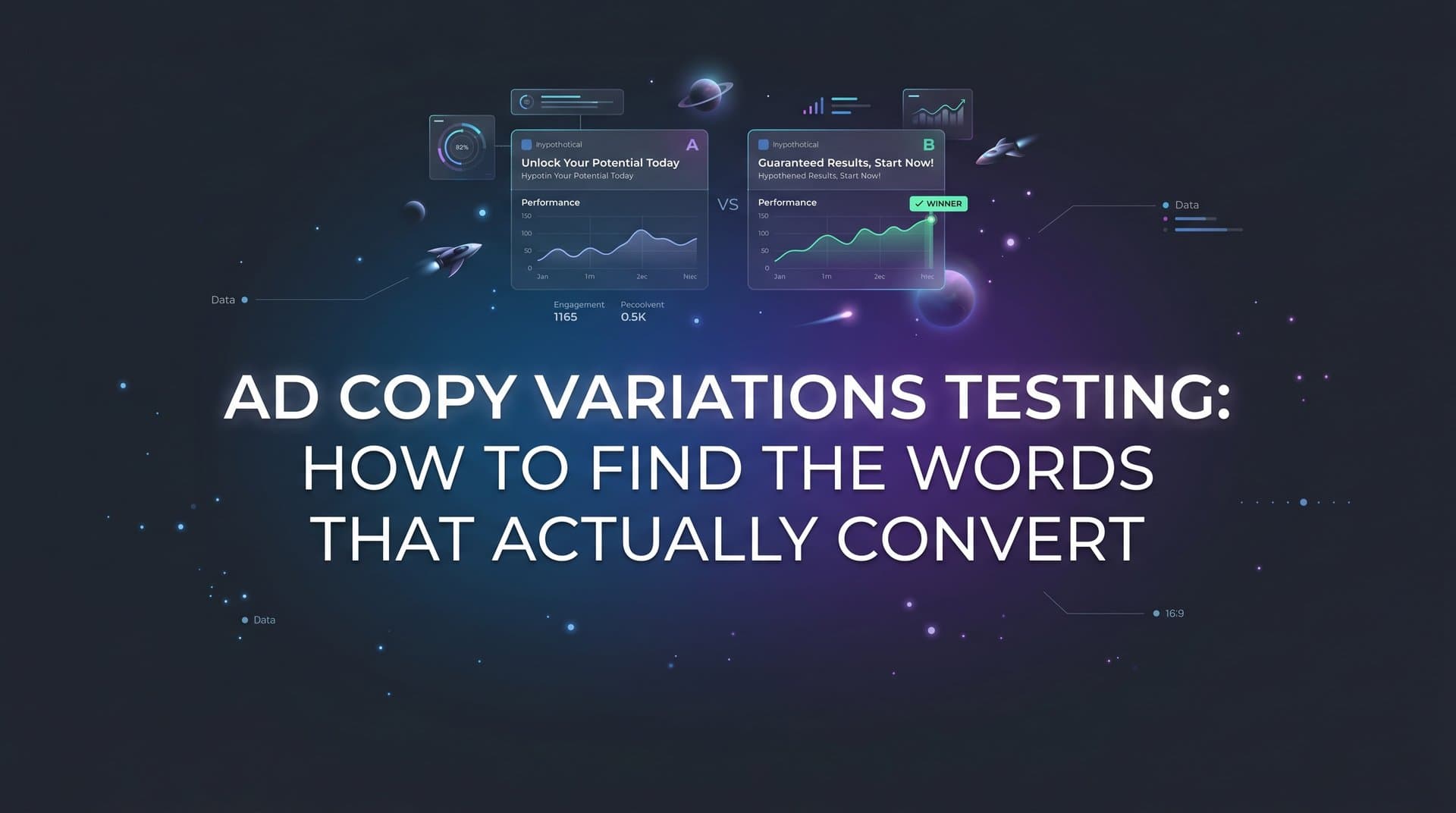
More often than not, the copy is the culprit. Not because it's bad writing, but because it's untested writing. There's a significant difference between copy that feels persuasive and copy that actually converts, and the only reliable way to close that gap is through systematic ad copy variations testing.
This isn't about endlessly tweaking words for the sake of it. It's about building a structured process that lets real performance data tell you which messages resonate, which emotional angles land, and which calls to action drive action. When you do it right, copy testing becomes one of the highest-leverage activities in your entire Meta advertising workflow. Every test you run generates intelligence. Every winner you identify compounds into better future campaigns.
By the end of this article, you'll understand which copy elements are worth isolating, how to structure tests that produce reliable conclusions, how to scale testing without burning through your budget, and how to turn one-off winners into a repeatable system that gets smarter over time.
Why Your Copy Instincts Are Just a Starting Point
Here's an uncomfortable truth about performance marketing: your intuition about what will resonate with your audience is a hypothesis, not a strategy. Even experienced copywriters with years of direct response knowledge regularly see their "best" copy underperform against something they wrote in ten minutes. This isn't a failure of skill. It's just how human psychology works in practice versus in theory.
The gap between what marketers expect and what audiences actually respond to is real and persistent. You might assume your audience cares most about price. Testing reveals they respond more to speed of delivery. You lead with a product benefit. The data shows a problem-framing angle drives three times the click-through rate. These kinds of reversals happen constantly, and the only way to surface them is to test.
What makes this especially important on Meta is that your copy variables don't operate in isolation. Your headline, primary text, call-to-action, and value proposition framing each influence performance independently. A weak headline can suppress an otherwise strong ad. An off-target CTA can undercut a compelling offer. When you run untested combinations of these elements, you're essentially stacking assumptions on top of assumptions.
The cost of this compounds quickly at scale. Meta's auction-based system means your budget is being spent whether your message connects or not. Every impression delivered against copy that doesn't resonate is a real dollar spent on a missed opportunity. When you're running multiple ad sets across multiple campaigns, unoptimized copy isn't just a performance problem. It's a budget problem.
Consider the difference between running the same untested copy for thirty days versus spending the first two weeks identifying your strongest message and the next two weeks scaling it. The second approach doesn't just improve your results. It fundamentally changes the efficiency of every dollar you spend.
This is why ad copy variations testing deserves to be treated as a core discipline rather than an occasional experiment. The marketers and agencies consistently generating strong Meta results aren't guessing better than everyone else. They're building systems that replace guessing with data.
The Elements Worth Testing and How to Build Real Variations
Effective copy testing starts with knowing which elements to isolate and how to create variations that are genuinely different from each other. This second part is where many advertisers go wrong. Swapping one adjective for another or changing a single word in your headline isn't a real variation test. It's noise.
The copy elements that consistently produce the most meaningful performance differences on Meta are: headline framing, primary text length and structure, CTA phrasing, and the core emotional angle or value proposition you lead with. Each of these operates differently and deserves its own testing focus.
Headline framing is one of the highest-leverage variables to test. The difference between a question-based headline ("Tired of ads that don't convert?"), a direct benefit statement ("Cut your CPA in half with smarter ad copy"), and a curiosity hook ("Most advertisers get this completely wrong") isn't cosmetic. These formats trigger different psychological responses and attract different types of attention in a busy feed. Reviewing Facebook ad copy examples across different formats can help you understand how each approach looks in practice.
Primary text length and structure is another meaningful variable. Short, punchy copy that gets to the point in two sentences performs well for audiences who already understand the category. Long-form narrative copy that walks through a problem and builds toward a solution can outperform for cold audiences who need more context before they trust an offer. Testing both approaches against the same audience reveals which mode your specific audience prefers.
Emotional angle and value proposition framing might be the most impactful variable of all. Fear of missing out, social proof framing, direct offers, problem-agitation-solution structures, and aspiration-based messaging all activate different motivations. Running variations that test genuinely different emotional angles gives you intelligence about what your audience actually cares about, not just what you assume they care about.
On the testing methodology side, understanding the difference between A/B testing and multivariate testing matters for your setup. A/B testing isolates one variable at a time, making it easy to attribute performance differences to a specific change. Multivariate testing runs multiple variables simultaneously and can surface interaction effects between elements, but requires significantly more traffic and budget to reach statistical confidence. For most advertisers, especially those with moderate budgets, A/B testing one meaningful variable at a time produces cleaner, more actionable data.
Building Tests That Actually Produce Reliable Conclusions
Running a copy test is straightforward. Running one that produces conclusions you can actually trust requires more discipline. The most common failure point isn't the test itself. It's the setup decisions made before the test launches.
The first and most important decision is defining your success metric before you touch the campaign builder. Are you optimizing for ROAS, CPA, CTR, or conversion rate? Each metric tells a different story, and mixing goals mid-test corrupts your data. If you start evaluating a test based on CTR because conversions are coming in slowly, then switch to CPA when volume picks up, you've introduced bias into your interpretation. Lock in your primary metric at the start and stick with it.
Audience segmentation is the second major setup consideration. The same copy variation should not run simultaneously across wildly different audience segments. Cold traffic audiences, warm retargeting pools, and lookalike audiences have different levels of brand familiarity and respond to different messaging approaches. Running a single copy test across all three segments at once means your results are a blended average of three different audience realities. Segment your tests to match your audience structure.
Statistical confidence is where many copy tests fall apart. The instinct to check results daily and call a winner as soon as one variation pulls ahead is understandable, but it leads to false conclusions. Early performance data on Meta can be noisy. An ad that looks like a clear winner at day two may regress toward average by day seven as the algorithm's learning phase stabilizes and broader audience segments are reached.
You need enough impressions and, more importantly, enough conversions before any conclusion is meaningful. The exact threshold depends on your conversion volume, but the principle is consistent: more data produces more reliable conclusions. Cutting tests short based on preliminary signals is one of the most expensive mistakes in performance marketing because it leads you to scale copy that may not actually be your strongest option. Following best practices for ad testing helps you avoid these costly shortcuts.
Practical guardrails help here. Set a minimum test duration before you review results. Define in advance how many conversions you need before calling a winner. Build these rules into your testing process so they're not negotiable when impatience kicks in.
Scaling Copy Testing Without Watching Your Budget Disappear
One of the reasons copy testing gets deprioritized is the perceived cost, both in time and budget. If building each ad variation requires manual setup, writing individual copy for each combination, and configuring separate ad sets one by one, the overhead quickly becomes prohibitive. Most teams don't have the bandwidth to run comprehensive tests at the frequency that would actually move the needle.
This is where bulk ad creation fundamentally changes the economics of copy testing. When you can generate dozens of copy variations and launch them as complete ad combinations in minutes rather than hours, the barrier to testing drops dramatically. The question shifts from "can we afford to test this?" to "how many variations should we run?"
AI-powered platforms take this a step further by analyzing which specific copy elements correlate with top performance across your historical campaign data. Rather than starting each new test from scratch, you're building on an accumulated understanding of what has worked. Which headline structures have historically driven your strongest CTR? Which emotional angles have produced the lowest CPA in your category? These patterns exist in your past campaign data. The question is whether you have a system to surface them. Automating ad testing for efficiency is how leading advertisers close this gap at scale.
AdStellar's AI Campaign Builder does exactly this. It analyzes your past campaigns, ranks every creative, headline, and copy element by real performance metrics, and uses that intelligence to build new campaigns. Every decision comes with a clear explanation of the rationale, so you're not just getting output. You're understanding the strategy behind it.
The Bulk Ad Launch feature extends this further by letting you mix multiple creatives, headlines, audiences, and copy variations at both the ad set and ad level. AdStellar generates every combination and launches them to Meta in clicks, not hours. For copy testing specifically, this means you can run comprehensive tests across multiple angles simultaneously without the manual setup bottleneck that usually forces teams to test fewer variables than they should.
The AI Insights leaderboard adds another layer by ranking your copy elements, headlines, and audiences against real metrics like ROAS, CPA, and CTR. Instead of manually reviewing performance across dozens of ad variations, you get a ranked view of what's working and why. Patterns across your copy library become visible, so you stop reinventing the wheel with every new campaign.
Building a System Where Winners Compound Over Time
The biggest missed opportunity in most copy testing programs isn't running bad tests. It's failing to capture and reuse what the good tests reveal. A winning headline from a campaign three months ago is valuable intelligence. If it's buried in a campaign dashboard nobody reviews, it might as well not exist.
Building what you might call a Winners Hub mentality means treating proven copy elements as assets, not artifacts. Every headline that outperforms its variations, every CTA that drives measurably better conversion rates, every primary text structure that consistently resonates with your audience deserves to be documented, organized, and made accessible for future campaigns.
AdStellar's Winners Hub is built around this principle. Your best-performing creatives, headlines, audiences, and copy elements are organized in one place with real performance data attached. When you're building a new campaign, you're not starting from intuition. You're starting from a curated library of elements that have already proven themselves in your specific market.
This feeds directly into the campaign build process. When historical performance data pre-selects the strongest copy elements before a campaign even launches, you're compressing the optimization timeline. Instead of spending the first two weeks of every campaign in the learning phase, you're launching with a higher baseline and using that campaign's data to push further. This is the foundation of a strong Meta ads creative testing strategy that improves with every cycle.
The result is a continuous testing loop with real compounding value. Every campaign generates new performance data. Every winner gets added to your library. Every new campaign launches with better starting material. Over time, this loop produces a copy intelligence advantage that's genuinely difficult to replicate through manual processes alone. Your copy library becomes a proprietary asset, built from your specific audience's actual behavior.
Copy Testing Mistakes That Quietly Drain Your Results
Even with the right framework in place, certain patterns consistently undermine copy testing programs. Knowing what to avoid is as important as knowing what to do.
Testing too many variables without structure is the most common problem. When you change the headline, primary text, CTA, and emotional angle simultaneously in a single test, any performance difference you observe could be attributed to any one of those changes, or to their interaction. You can't isolate the cause, which means you can't replicate the result with confidence. Discipline around variable isolation is what separates useful test data from expensive noise. Understanding what multivariate testing actually involves helps you decide when it's appropriate versus when simpler A/B isolation is the better call.
Declaring winners based on vanity metrics is the second major pitfall. Impressions and clicks are visible early and feel meaningful, but they don't tell you whether copy is actually driving business outcomes. An ad with a strong CTR that produces poor conversion rates is not a winner. Evaluate copy performance against the metric that actually matters for your campaign goal, and give tests enough time to accumulate downstream conversion data before drawing conclusions.
Ignoring audience fatigue is a mistake that catches even experienced advertisers off guard. Even genuinely strong copy degrades over time on Meta. As the same users see the same message repeatedly, performance erodes. Frequency increases. CTR drops. CPA climbs. This isn't a sign that the copy was never good. It's a natural cycle that every winning ad goes through eventually.
The fix is building a refresh cycle into your testing calendar rather than reacting to declining performance after it's already hurting your results. When you have a Winners Hub and a bulk creation process for Meta, rotating in fresh variations of proven angles becomes a manageable, proactive practice rather than a scramble.
The Bottom Line on Copy Testing
Ad copy variations testing is not a project you complete once and move on from. It's a discipline that runs continuously alongside every campaign you operate. The progression is consistent: start with a hypothesis, structure a test that isolates meaningful variables, gather enough data to reach reliable conclusions, scale what wins, and feed those winners back into the next cycle.
Each stage builds on the one before it. A well-structured test produces actionable data. Actionable data produces a genuine winner. A documented winner improves your next campaign's starting point. Over enough iterations, you build a copy intelligence library that reflects your actual audience's behavior, not your assumptions about it.
The manual version of this process is real work. Writing variations, setting up ad sets, reviewing performance, documenting winners, and rebuilding campaigns from scratch each time takes time that most teams don't have in abundance. This is precisely where AdStellar changes the equation.
AdStellar handles the full cycle from creative generation to campaign launch to winner identification. The AI Creative Hub generates image ads, video ads, and UGC-style creatives from a product URL or by cloning competitor ads directly from the Meta Ad Library. The AI Campaign Builder analyzes your historical performance data and builds complete campaigns with ranked copy elements and full transparency into the reasoning. Bulk Ad Launch creates and deploys hundreds of variations in minutes. AI Insights surfaces your top performers across every copy element, creative, and audience. And the Winners Hub keeps your proven assets organized and ready to deploy.
The result is a copy testing system that compounds with every campaign instead of resetting to zero each time. If you're ready to stop guessing and start building that kind of advantage, Start Free Trial With AdStellar and see how much faster your copy testing program moves when the platform is doing the heavy lifting.