Writing Facebook ad copy that actually converts is one of the hardest parts of running paid social campaigns. You need to grab attention in the first line, speak directly to a specific audience, match the right tone to the right placement, and do it all at scale across dozens of ad sets.
Most marketers end up in one of two traps. Either they spend too much time agonizing over every word, or they churn out generic copy that blends into the feed and gets ignored. Neither approach scales.
AI Facebook ad copy writers change that equation entirely. Instead of starting from a blank page, you start with a strong draft built from your product details, audience data, and proven copy frameworks. Then you iterate fast, test multiple angles simultaneously, and let performance data tell you what actually resonates.
This guide covers eight practical strategies for getting the most out of an AI Facebook ad copy writer, whether you are just getting started with AI-assisted copy or looking to sharpen a workflow you already have. Each strategy tackles a specific challenge that digital marketers and media buyers face daily, from writing for cold audiences to scaling winning copy across campaigns.
By the end, you will have a clear framework for using AI to write faster, test smarter, and drive better results from every campaign you launch.
1. Feed the AI the Right Inputs Before You Write a Single Word
The Challenge It Solves
Generic AI output is almost always the result of generic input. When you prompt an AI copy tool with nothing more than a product name and a vague audience description, you get copy that could belong to anyone in your category. The output sounds plausible but lacks the specificity that makes copy actually convert.
The fix is not a better AI tool. It is a better brief.
The Strategy Explained
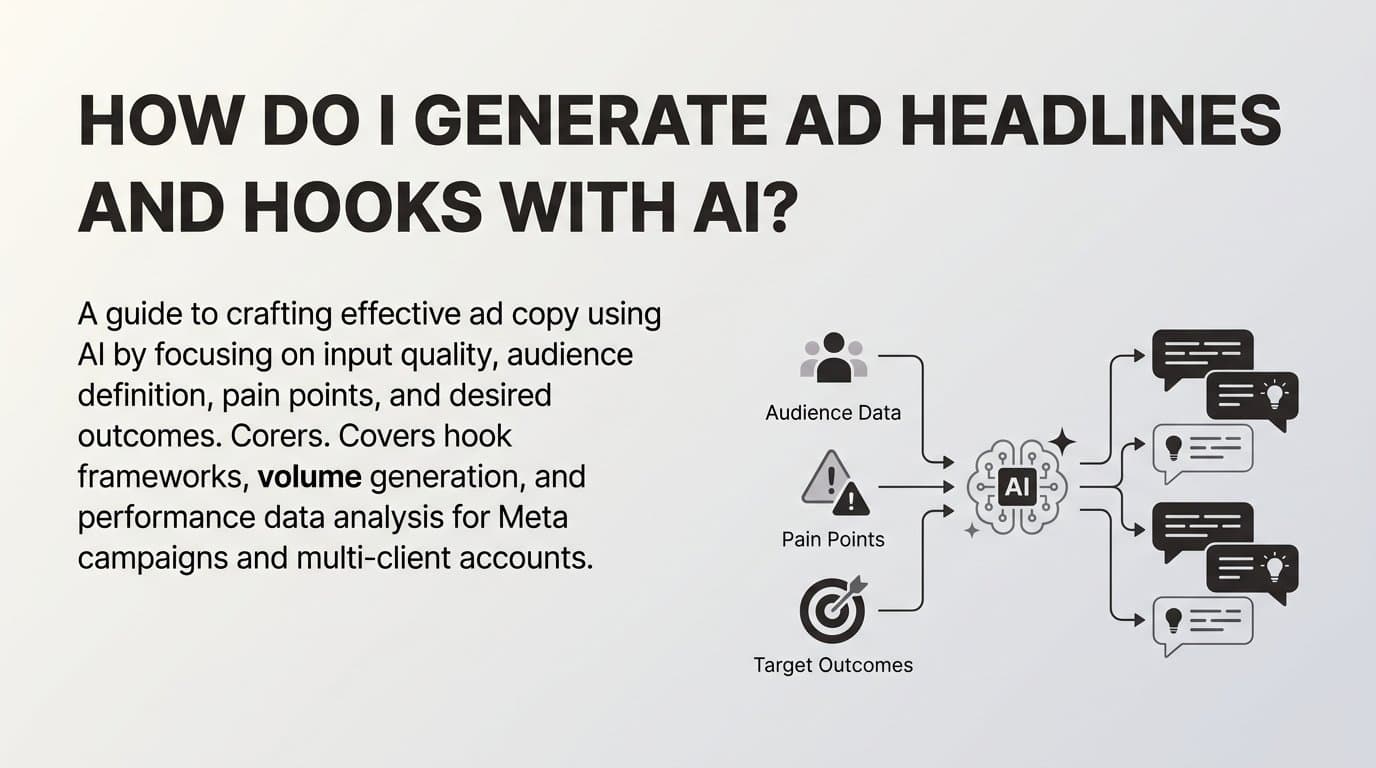
Before generating a single line of copy, build a structured input document that covers the essentials: what the product does, who it is for, what problem it solves, what makes it different, and what tone fits the brand. Think of this as a creative brief you would hand to a human copywriter, because that is exactly how the AI will use it.
The more specific you are about audience pain points, the more targeted the output becomes. Instead of "busy professionals," try "e-commerce founders who are running Meta ads themselves and losing time to manual campaign management." That level of specificity gives the AI enough context to write copy that feels personal rather than broadcast.
Include tone guidelines too. Words like "direct," "conversational," "urgent," or "aspirational" give the AI a register to write in, which keeps your output consistent across multiple copy variations.
Implementation Steps
1. Write a one-paragraph product summary that explains what it does, who it is for, and what outcome it delivers.
2. List three to five specific pain points your target audience experiences before finding your product.
3. Add two or three tone descriptors and, if possible, a sentence or two of existing brand copy the AI can use as a style reference.
4. Include any constraints: character limits, words to avoid, required calls to action, or compliance considerations specific to your category.
5. Paste this brief at the top of every AI copy session before you start generating variations.
Pro Tips
Save your brief as a reusable template and update it as your product evolves or your audience shifts. If you are using a platform like AdStellar, you can generate creatives directly from a product URL, which gives the AI built-in context from the start. The more you invest in the brief upfront, the less editing you will do on the back end.
2. Use AI to Write for Every Stage of the Funnel Separately
The Challenge It Solves
One of the most common copy mistakes in paid social is running the same messaging to cold audiences and warm retargeting audiences. Cold audiences have never heard of you. They need context, a clear value proposition, and a reason to care. Warm audiences already know you. They need specificity, social proof, and a reason to act now.
When copy ignores funnel stage, it either overwhelms people who are ready to buy or fails to educate people who are not.
The Strategy Explained
Structure your AI prompts around the intent level of each audience segment. For cold audiences, prompt the AI to lead with the problem before introducing the solution. For warm audiences, prompt it to lead with proof, specificity, or urgency. For hot audiences who have visited your site or added to cart, prompt for copy that removes objections and creates a clear path to conversion.
Funnel-stage copy differentiation is a standard practice in performance marketing, and AI makes it faster to execute across all three layers simultaneously rather than building them sequentially over weeks.
Implementation Steps
1. Define your three funnel stages clearly: cold (no prior awareness), warm (engaged but not converted), hot (high intent, close to purchase).
2. For each stage, write a one-sentence intent summary: what does this person know, feel, and need right now?
3. Prompt your AI copy tool separately for each stage, using the intent summary as a key input alongside your product brief.
4. Review outputs to confirm that cold copy educates, warm copy builds confidence, and hot copy removes friction.
5. Map each copy set to its corresponding audience segment in Meta Ads Manager before launching.
Pro Tips
Avoid the temptation to use your best-performing cold copy as retargeting copy just because it worked well. The audience context is completely different. Treat each funnel stage as its own creative brief, and you will see relevance improve across every layer of your funnel.
3. Generate Multiple Copy Angles Simultaneously and Test Them All
The Challenge It Solves
Sequential testing is slow. If you write one angle, run it for two weeks, then move to the next, you are burning time and budget before you find a winner. The better approach is to generate multiple angles at once and let performance data sort them out quickly.
The Strategy Explained
AI makes it practical to produce four or five distinct copy angles in the time it used to take to write one. The key is to vary the angle, not just the wording. An emotional angle focuses on how the customer will feel. A logical angle leads with features, specifications, or efficiency. A social proof angle opens with results or credibility signals. An urgency angle creates time or scarcity pressure.
Each of these speaks to a different psychological trigger. Different audience segments will respond to different triggers, and you cannot know in advance which one will land hardest for your specific product and audience. Testing all four simultaneously gives you real data instead of guesses.
Industry consensus among performance marketers holds that testing multiple copy angles simultaneously is more effective than iterating sequentially, because it surfaces winners faster without burning budget on prolonged single-variation tests.
Implementation Steps
1. Identify four core copy angles: emotional, logical, social proof, and urgency.
2. Prompt your AI tool to generate a distinct variation for each angle using the same product brief as the base.
3. Review each output to confirm the angle is genuinely distinct, not just a rewording of the same message.
4. Use AdStellar's Bulk Ad Launch feature to mix these copy variations with multiple creatives and launch every combination in one workflow.
5. Let AI Insights rank the variations by ROAS, CPA, and CTR so you can identify your winner without manual analysis.
Pro Tips
When you find a winning angle, do not stop there. Use the AI to generate five more variations within that same angle. Winning angles have staying power, and deepening them produces more mileage than pivoting to a new approach too quickly.
4. Match Your AI-Generated Copy to the Ad Placement and Format
The Challenge It Solves
Copy that works in a Facebook Feed ad often falls flat in a Story or Reels placement. The scroll behavior is different, the attention window is shorter, and the visual context changes completely. Running the same copy across every placement without adaptation is one of the most common reasons campaigns underperform on mobile-first formats.
The Strategy Explained
Meta's own Business Help Center recommends keeping primary text concise, typically under 125 characters for mobile-first placements, and leading with the value proposition. Stories and Reels demand even more front-loading because the viewer can swipe away in under a second.
When prompting AI for placement-specific copy, include the format as a constraint in your brief. Tell the AI which placement the copy is for, what the character limit is, and whether the copy needs to work alongside a visual or stand alone as text on screen. This shifts the AI's output from general-purpose to format-optimized.
Implementation Steps
1. List the placements you are running: Feed, Stories, Reels, Right Column, Messenger, and any others relevant to your campaign.
2. For each placement, note the character constraints and the primary behavior context (scrolling, swiping, browsing).
3. Add placement and format constraints directly to your AI prompt alongside the product brief.
4. Generate a separate copy set for each placement rather than adapting a single version manually.
5. When building your campaign in AdStellar's AI Campaign Builder, match each copy set to its corresponding placement to ensure format alignment before launch.
Pro Tips
For Stories and Reels, prompt the AI to write copy that leads with a question or a bold statement in the first three to five words. That is the only window you have before the swipe. Feed copy can afford slightly more context, but the first sentence still does the heaviest lifting.
5. Clone and Improve Competitor Copy Angles with AI
The Challenge It Solves
One of the fastest ways to understand what copy is working in your niche is to look at what your competitors are running. Most marketers know this in theory but do not have a structured way to turn competitor research into actionable copy for their own brand.
The Strategy Explained
The Meta Ad Library (available at ads.facebook.com/ads/library) is a publicly available tool that lets you view active ads from any Facebook page. You can search by brand, keyword, or category to see exactly what copy angles your competitors are using right now.
The process is straightforward. Find ads that have been running for a long time, because longevity is a strong signal that the ad is performing well enough to keep spending behind. Identify the copy structure: what is the hook, what is the value proposition, and what is the call to action? Then use AI to deconstruct that structure and rebuild it for your own product, brand voice, and audience.
This is not about copying. It is about learning from proven frameworks and adapting them with your own differentiation layered in.
Implementation Steps
1. Open the Meta Ad Library and search for your top two or three competitors.
2. Filter for active ads and look for any that appear to have been running for several weeks or longer.
3. Copy the primary text and headline from three to five ads that catch your attention.
4. Prompt your AI tool to analyze the copy structure and identify the angle being used (emotional, logical, urgency, social proof).
5. Ask the AI to rebuild that structure using your product details, your brand voice, and your unique differentiators.
Pro Tips
AdStellar includes a feature that lets you clone competitor ads directly from the Meta Ad Library and use them as creative inspiration within the platform. Pair that with AI-generated copy built around the same angle, and you can move from competitor research to a fully built campaign variation in a fraction of the usual time.
6. Build a Winning Copy Library from Your Best Performers
The Challenge It Solves
Most advertisers let their best-performing copy disappear into old campaign archives. When it is time to launch a new campaign, they start from scratch instead of building on what already worked. This is one of the most avoidable inefficiencies in paid social.
The Strategy Explained
A winning copy library is a structured collection of your top-performing copy organized by performance benchmark. ROAS, CPA, and CTR are the standard metrics used by Meta advertisers to evaluate copy and creative performance, and they give you an objective basis for deciding what belongs in the library.
The library serves two purposes. First, it gives you a reference bank of proven copy structures you can adapt for new campaigns without starting from zero. Second, it gives your AI tool better inputs. When you feed the AI examples of copy that has already performed well for your specific brand and audience, the output quality improves because the AI has a concrete style and structure to work toward.
Implementation Steps
1. Set performance thresholds for what qualifies as a winner in your account: a minimum ROAS, a maximum CPA, or a CTR benchmark you define based on your own data.
2. After each campaign cycle, review your top performers and pull the copy from any ad that hit your thresholds.
3. Save the copy in a structured document with tags for angle type, audience segment, funnel stage, and placement.
4. Use AdStellar's Winners Hub to consolidate top-performing assets, including copy, creatives, and audiences, in one place with real performance data attached.
5. Before your next AI copy session, pull three to five examples from the library and include them as style references in your brief.
Pro Tips
Organize your library by product line or campaign objective, not just by date. When you need copy for a retargeting campaign, you want to pull from retargeting winners specifically, not from your best cold acquisition copy. The more granular your tagging, the more useful the library becomes over time. For a deeper look at this approach, see how reusing winning Facebook ad elements can compound your results across campaigns.
7. Use AI to Write Copy That Aligns with Your Creative, Not Against It
The Challenge It Solves
Copy and creative that send different messages create friction for the viewer. If your visual shows a product in a lifestyle context but your copy leads with a discount, the two elements are pulling in opposite directions. This misalignment hurts relevance and drives up cost per result.
The Strategy Explained
Copy-creative alignment, sometimes called message match, is a foundational direct response principle. When the headline, body copy, and visual all reinforce the same single message, relevance improves and costs tend to decrease. The challenge is that copy and creative are often built separately and combined at the end without checking whether they actually reinforce each other.
AI makes it practical to write copy with the creative already in mind. When you prompt your AI tool, describe the visual: what is shown, what emotion it conveys, and what message it leads with. Ask the AI to write copy that continues or complements that message rather than introducing a new one. Understanding Facebook ad copywriting best practices around message match will sharpen how you brief the AI for every placement.
Implementation Steps
1. Before writing copy, write a one-sentence description of your creative: what does it show, and what is the primary message it communicates visually?
2. Include that creative description in your AI copy prompt as a constraint: "Write copy that reinforces this visual message rather than introducing a separate one."
3. Review the output and check that the hook in the copy connects directly to what the viewer sees in the first frame or image.
4. If you are using AdStellar to generate both creatives and copy, use the AI Ad Creative feature to build the visual first, then use the creative context as the brief for your copy generation.
5. Before launching, do a final alignment check: read the copy while looking at the creative and confirm they tell the same story.
Pro Tips
For video ads and UGC-style content, alignment is especially important in the first three seconds. The copy hook should mirror what the viewer sees and hears in the opening frame. If the video opens with a problem, the copy should open with the same problem. Consistency in that first moment dramatically reduces drop-off.
8. Scale What Works by Letting AI Refresh Copy Before It Fatigues
The Challenge It Solves
Ad fatigue is a recognized phenomenon in paid social where rising frequency leads to declining CTR and increasing CPM. When the same copy runs long enough, even your best audience starts tuning it out. Most advertisers either miss the early warning signs or wait too long before refreshing, by which point performance has already dropped significantly.
The Strategy Explained
The key is to refresh copy proactively rather than reactively. Meta's Ads Manager surfaces frequency metrics that help you identify when fatigue is starting to set in. A rising frequency combined with a declining CTR is a clear signal that your audience has seen the copy enough times that it is losing its impact.
When you catch this early, AI gives you a fast way to generate fresh variations of proven copy without losing the elements that made it work in the first place. The goal is not to write entirely new copy. It is to introduce enough novelty that the ad feels fresh while keeping the core angle, value proposition, and call to action intact. Knowing how to scale Facebook ads efficiently means building this refresh cadence into your workflow before fatigue sets in.
Implementation Steps
1. Set a frequency threshold in your reporting view. Many performance marketers treat a frequency above three to four as an early warning signal, though your threshold may vary by campaign objective and audience size.
2. When frequency rises and CTR begins to dip, pull the copy from your top-performing ad and identify its core elements: the hook structure, the value proposition, and the CTA format.
3. Prompt your AI tool to generate three to five new variations that keep those core elements but change the hook wording, the opening angle, or the framing of the value proposition.
4. Use AdStellar's Bulk Ad Launch to deploy multiple fresh variations simultaneously so you can identify the new top performer quickly rather than running one replacement at a time.
5. Archive the fatigued copy in your winners library with a note on the frequency and CTR trend at the point of refresh, so you have a record of its full performance lifecycle.
Pro Tips
When prompting AI to refresh fatigued copy, explicitly instruct it to preserve the winning angle and only change the surface-level language. Copy that worked had a reason for working. Changing the angle entirely is a new test, not a refresh. If you want to test a new angle, treat it as a separate creative experiment with its own budget allocation.
Putting It All Together: Your Implementation Roadmap
Eight strategies is a lot to absorb at once, so start with the two that will produce the fastest results. Strategy one, getting your inputs right, and strategy three, generating multiple angles simultaneously, will immediately improve copy quality and testing velocity. These two changes alone will change how quickly you find winners.
From there, layer in funnel-stage targeting and placement-specific copy to sharpen relevance across your campaign structure. As your campaigns mature, the winners library and fatigue refresh strategies become your competitive edge, turning past performance into a repeatable system that compounds over time.
The marketers seeing the best results with AI copy tools are not using them to replace strategic thinking. They are using them to execute that strategy faster, test more angles, and spend more time on decisions that actually move the needle.
AdStellar brings all of this together in one platform. You can generate image ads, video ads, and UGC-style creatives alongside your copy, build complete Meta campaigns with AI, and track exactly which combinations of copy, creative, and audience are driving your best ROAS. AI Insights ranks every element by real performance metrics against benchmarks you define. Winners Hub keeps your best assets organized and ready to reuse. No designers, no guesswork, no switching between five different tools.
Start Free Trial With AdStellar and be among the first to launch and scale your ad campaigns faster with an intelligent platform that automatically builds and tests winning ads based on real performance data.