Ad copy is one of those things that looks simple until you're actually doing it. You need a headline that stops the scroll, body text that builds enough trust to drive action, and a call to action that feels natural rather than pushy. Then you need to do that across multiple angles, multiple audiences, and multiple campaigns, all while the clock is ticking on your ad spend.
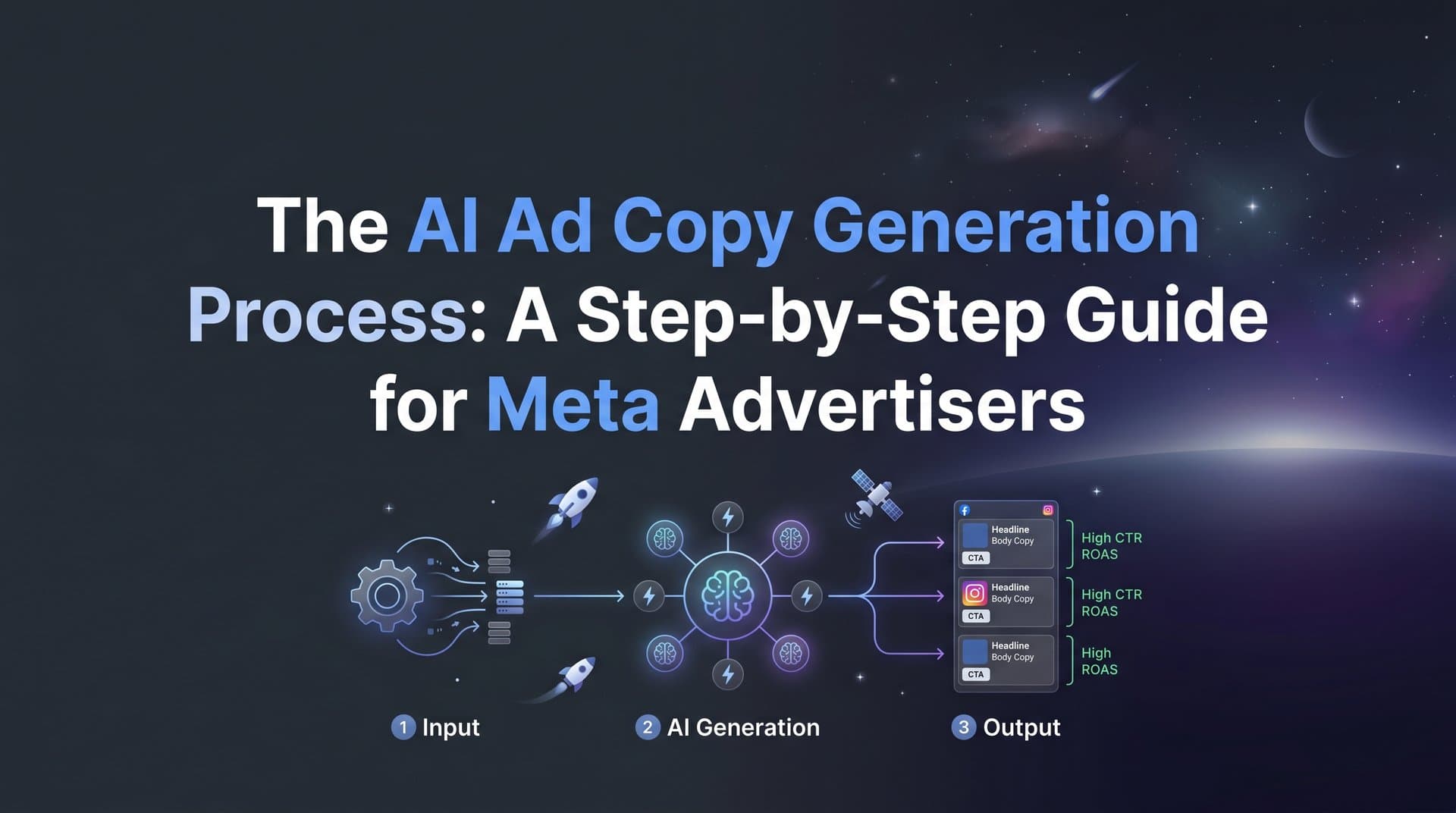
The AI ad copy generation process changes the math on this entirely. Instead of writing from scratch every time, you build a structured input, generate dozens of variations across different psychological angles, score them before a single dollar is spent, and let performance data tell you what actually works. The result is a repeatable system rather than a creative guessing game.
This guide walks through the complete process from defining your inputs to feeding learnings back into the next campaign cycle. Whether you're managing one brand or running ads across a portfolio of clients, these steps give you a faster, more structured way to produce copy that's built to perform on Meta placements.
Let's get into it.
Step 1: Define Your Copy Inputs Before AI Touches Anything
The quality of your AI-generated copy is almost entirely determined by the quality of what you put in. This is the step most advertisers skip or rush, and it's why so much AI copy ends up sounding generic and interchangeable.
Before you generate a single line, you need four core inputs ready: a clear product description, a defined target audience, your primary value proposition, and your campaign goal. These aren't optional context. They are the foundation the AI builds from.
Product Description: Write a brief that explains what the product does, who it helps, and what makes it different from alternatives. Be specific. "A project management tool for remote teams" is better than "a productivity app." "A skincare serum that reduces visible redness in under two weeks" is better than "a skincare product." The more precise the description, the more targeted the output.
Target Audience: Go beyond demographics. Define your audience in behavioral and emotional terms. What problem are they actively trying to solve? What have they already tried that didn't work? What outcome would make them feel like they finally found the right solution? Audience context like "small business owners who have tried paid ads before but couldn't make them profitable" produces very different copy than a generic age and interest targeting description.
Value Proposition: Identify the single most compelling reason someone should choose this product over alternatives. If you have three or four strong value props, rank them. The AI will use these as anchors for different copy angles.
Campaign Goal: This one matters more than most advertisers realize. Copy written for a cold traffic conversion campaign reads differently from copy written for a retargeting campaign. Retargeting audiences already know the brand, so the copy can be more direct and conversion-focused. Prospecting copy needs to do more work building awareness and trust. Define your objective before generating anything.
The common pitfall here is vagueness. "Increase sales" is not a goal. "Drive purchase conversions from cold audiences in the 25-44 age range who haven't visited the site before" is a goal. That specificity flows directly into more usable copy output. Understanding what to include in ad copy at this brief stage makes every downstream step more efficient.
Success indicator: You have a one-page brief covering product, audience, goal, and tone before generating a single line of copy. If you can't summarize your brief in a page, you don't have enough clarity yet.
Step 2: Generate Multiple Copy Angles at Once
One of the biggest mistakes in the AI ad copy generation process is generating a single variation and treating it as done. That approach trades one form of guesswork for another. You're still picking a winner before you have any data.
The right approach is to generate copy across at least three distinct psychological angles simultaneously, then let performance data identify which one resonates with your audience.
Problem-Focused Angle: This copy leads with the pain point. It names the frustration your audience is experiencing and positions the product as the relief. This angle tends to perform well with cold audiences who are actively aware of a problem but haven't committed to a solution.
Benefit-Focused Angle: This copy leads with the outcome. Instead of describing the problem, it paints a picture of what life looks like after the product solves it. This angle often resonates with audiences who are already solution-aware and comparing options.
Social Proof or Urgency-Focused Angle: This copy leans on external validation or time-based motivation. Think results other customers have experienced, limited availability, or a specific reason to act now. This angle can be particularly effective in retargeting, where the audience already knows the product and needs a final push.
Each angle should produce a complete ad copy set, not fragments. That means a headline, primary text, and description variation for every angle. You're building complete ad units, not a list of headlines to mix and match randomly.
Platforms like AdStellar let you generate copy variations tied directly to your creative assets, so the text and visual are developed together from the start. This matters because copy and creative that were built in isolation often feel mismatched when they're finally paired. A direct-response headline sitting over a lifestyle video creates friction. Building them together avoids that problem.
As you review generated copy, check for brand voice consistency and factual accuracy. AI handles persuasion structure and angle variety. Reviewing Facebook ad copy examples from high-performing campaigns can help you calibrate what good looks like before you finalize your variations. You verify that every claim is accurate and that the tone matches how your brand actually communicates.
Success indicator: You have at least six to nine complete copy sets covering three angles, each with a headline, body text, and description. You have not picked a favorite yet.
Step 3: Score and Filter Copy Before You Spend a Dollar
Not every AI-generated variation deserves budget. Launching everything you generate is wasteful and makes your results harder to read. This step is about applying a structured filter before anything goes live.
Use a three-part scoring framework to evaluate each variation before it enters your campaign.
Clarity: Can someone understand the offer in under three seconds? Meta ads appear in fast-moving feeds where attention is measured in fractions of a second. If your headline requires a second read to understand what's being offered, it won't perform. Read each variation cold and ask whether the offer is immediately obvious.
Relevance: Does the copy match the language and emotional context of your target audience? Copy that uses industry jargon your audience doesn't recognize, or that describes a pain point they don't actually feel, will underperform regardless of how well it's structured. Compare each variation against the audience brief you wrote in Step 1.
Specificity: Does the copy include a concrete outcome, number, or detail that makes it more credible than a generic claim? "Grow your business" is a weak headline. "Cut your campaign setup time in half" is stronger. Specificity builds credibility and gives the reader something tangible to respond to. Studying examples of good ad copy can sharpen your eye for what specificity looks like in practice.
Beyond the three-part framework, check that every variation has a clear call to action that matches the campaign objective. A conversion campaign needs a direct CTA like "Shop Now" or "Get Started." An awareness campaign can afford something softer. Mismatched CTAs are a common source of underperformance that gets blamed on the copy angle when the real issue is the instruction.
AdStellar's AI Insights feature scores ad elements against your actual performance goals, including ROAS, CPA, and CTR, so you're benchmarking against real data rather than subjective judgment. This is particularly useful if you've run previous campaigns, because you can see how new copy variations compare to your historical top performers before spending anything.
Remove any copy that is too generic, makes claims you can't verify, or doesn't align with the creative it will be paired with. A smaller, stronger pool of variations is more valuable than a large pool of mediocre ones.
Success indicator: You've narrowed your copy pool to the strongest two or three variations per angle, each with a clear offer, audience-relevant language, and a defined CTA that matches the campaign objective.
Step 4: Pair Copy with Creatives and Build Ad Combinations
Ad copy doesn't exist in isolation. The headline you write only works in context with the visual it sits next to. This step is where you build complete ad units by pairing your filtered copy variations with the appropriate creative assets.
The pairing logic matters. A direct-response headline focused on price or urgency pairs naturally with a clean, product-focused image. An emotional or aspirational angle pairs better with lifestyle photography or UGC-style video. When the tone of the copy and the visual are aligned, the ad feels cohesive. When they're mismatched, readers sense the disconnect even if they can't articulate why.
Once your pairings are mapped out, use bulk ad creation to build every copy-creative combination at once rather than manually assembling each individual ad. AdStellar's Bulk Ad Launch lets you mix multiple creatives, headlines, and copy sets to generate every combination in minutes. What would take hours of manual setup in Meta's Ads Manager happens in a fraction of the time, and every variation is structured and ready to launch. The bulk ad creation approach is especially valuable when you're managing multiple campaigns or client accounts simultaneously.
Organize your combinations by angle, not just by creative or copy variation. This is a structural decision that pays off significantly when you're reading results. If you group all problem-focused angle ads together, you can evaluate the angle as a whole rather than trying to interpret individual ad performance in isolation. You'll know whether the angle worked, not just whether one specific creative-copy pair happened to get clicks.
Set naming conventions at this stage so your campaign structure stays readable as you scale. A naming system like "Angle-Creative-Copy" (for example, "Problem-ProductShot-Headline2") makes it easy to sort and filter results later without having to open each ad to remember what it is.
Success indicator: Every filtered copy variation is paired with at least one creative, all combinations are organized by angle, and your campaign naming structure is clear enough that someone unfamiliar with the campaign could understand it at a glance.
Step 5: Launch with Structured Testing Built In
How you launch matters as much as what you launch. A strong set of copy-creative combinations can produce misleading results if the testing structure doesn't isolate the right variables.
The core principle is simple: keep audience targeting consistent across copy angle groups. If your problem-focused angle is running to one audience and your benefit-focused angle is running to a different one, any performance difference could be explained by the audience, the copy, or the interaction between them. You won't know which. Consistent targeting across angle groups means performance differences reflect the copy, which is the variable you're actually trying to evaluate.
Set a minimum test budget and time window before you start making optimization decisions. Meta's delivery algorithm needs time to gather data and stabilize its optimization signals. Pulling budget or making changes after 24 hours doesn't give the algorithm enough runway to work. Define your review timeline before the campaign goes live and commit to it. This removes the temptation to react to early noise. A structured approach to testing ad copy variations efficiently ensures your results reflect real performance differences rather than statistical noise.
AdStellar's AI Campaign Builder builds complete Meta campaigns with AI-optimized audiences and ad copy without requiring manual setup at every step. The AI analyzes past campaign data to inform audience selection and copy placement, which means your testing structure benefits from historical performance context rather than starting from zero every time.
Before results come in, document your hypothesis for each angle. Write down what you expect to happen and why. This keeps your post-campaign analysis objective. Without a pre-written hypothesis, it's easy to retroactively justify whatever happened to perform well and miss the actual insight.
Monitor early signals like CTR and cost per link click as leading indicators while conversion data accumulates. CTR tells you whether the copy is capturing attention in the feed. It won't tell you whether it's driving purchases, but it gives you directional signal early in the test window. Understanding automated ad testing frameworks can help you build a more disciplined review process from the start.
Success indicator: All ad combinations are live with consistent targeting per angle group, budgets are set with a defined review timeline, and you have a written hypothesis for each angle before results start coming in.
Step 6: Analyze Results and Feed Learnings Back into the Process
This is the step that separates advertisers who run AI copy generation as a one-time tactic from those who build it into a compounding system. The analysis phase is where you extract learnings that make every future campaign better.
After your test window closes, evaluate performance across the full funnel. CTR tells you whether the copy captured attention at the creative level. Conversion rate tells you whether it built enough trust and relevance to drive action. Both metrics matter, and a gap between them is often a signal worth investigating. High CTR with low conversion can indicate that the copy promised something the landing page didn't deliver, or that the audience who clicked wasn't actually the right buyer.
AdStellar's AI Insights leaderboards rank your copy elements by ROAS, CPA, and CTR, so you can see exactly which headlines and copy sets outperformed across your campaign. Rather than manually pulling data and building comparison tables, the leaderboard surfaces the ranked results directly. You can see at a glance whether the problem-focused angle drove better ROAS than the benefit-focused angle, and which specific headlines contributed most to that performance.
Move your winning copy into the Winners Hub so it's available for future campaigns without having to dig through old ad accounts or reconstruct what worked. The Winners Hub stores your best-performing creatives, headlines, and copy sets with their actual performance data attached. When you're building the next campaign, you're not starting from scratch. You're starting from proven.
Use losing copy as input for your next generation cycle. If the problem-focused angle underperformed, don't just discard it. Look at why. Was the problem framing too broad? Did it describe a pain point the audience didn't identify with? Adjust the framing and regenerate with that context added to your brief. The AI ad copy generation process gets sharper as you feed it more performance context over time. Reviewing common reasons Facebook ad copy stops resonating can surface framing issues you might otherwise miss.
Before you start the next cycle, update your copy brief with what you learned. Add notes about which angles resonated, which audience language connected, and which CTAs drove action. This updated brief becomes the foundation for your next round of generation, and the improvements compound with each iteration.
Success indicator: You have a ranked list of copy performers with clear angle-level conclusions, winners are saved in your Winners Hub for future use, and your brief is updated with new insights before the next generation cycle begins.
Putting It All Together
The AI ad copy generation process is not a shortcut. It's a system. And like any system, it produces better results the more consistently you run it.
Each step in this guide builds on the last. A strong brief produces better copy angles. Better copy angles produce cleaner test results. Cleaner test results produce more useful learnings. And those learnings feed back into a stronger brief for the next cycle. Over time, this compounding effect means you're not just generating copy faster. You're generating better copy faster, because the system has context that a blank-page approach never accumulates.
Platforms like AdStellar make this process significantly more efficient by connecting creative generation, campaign building, bulk launching, and performance analysis in one place. You're not switching between tools or losing context between steps. The AI learns from your actual campaign data, surfaces what's working, and gives you a clear path to scale it.
If you're still writing Meta ad copy from scratch for every campaign, this process will save you hours every week and reduce the guesswork that quietly drains budget. Start with a specific brief, generate more angles than feels necessary, score before you spend, and let performance data make the final call.
That's the process. Now go run it. Start Free Trial With AdStellar and launch your next campaign with AI-generated copy, bulk creative combinations, and real-time performance insights built in from day one.