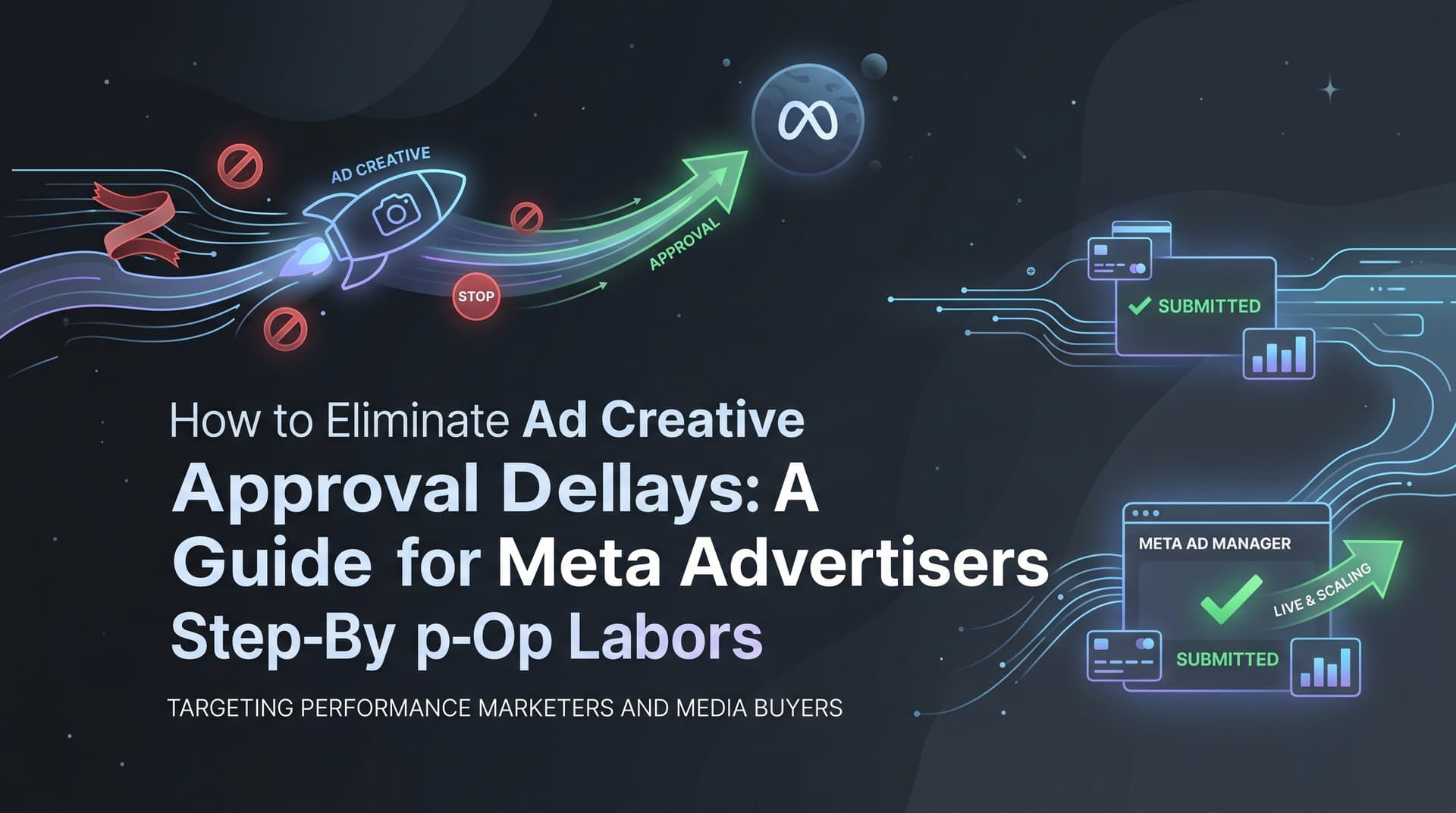
Ad creative approval delays are one of the most frustrating bottlenecks in paid social advertising. You've built the campaign, set the budget, and aligned the team. Then Meta's review process holds everything up. Or worse, a creative gets rejected after days of waiting, and you're back to square one.
For performance marketers and agencies managing multiple accounts, these delays compound fast. A single rejection can push a campaign launch by days, disrupt a product launch window, or cause you to miss a seasonal opportunity entirely.
The good news is that most approval delays are preventable. Meta's review system is largely automated, and it responds predictably to specific creative and copy patterns. When you understand what triggers rejections and build a workflow that accounts for those triggers from the start, delays shrink dramatically.
This guide walks you through a practical, step-by-step process to reduce ad creative approval delays on Meta. You'll learn how to audit your creatives before submission, structure your copy to avoid common flags, set up a pre-launch checklist, and build a faster iteration system when rejections do happen.
Whether you're running ads for an ecommerce brand, a SaaS product, or a client portfolio, these steps will help you get more ads approved faster and keep your campaigns moving without unnecessary interruptions.
Step 1: Understand What Triggers Meta's Review System
Before you can prevent ad creative approval delays, you need to understand what causes them. Meta's review process runs in two stages. First, an automated system scans your creative and copy for policy violations. If the automated scan flags something, or if the ad falls into a sensitive category, it moves to human review. Human review takes longer, and that's where most meaningful delays occur.
The automated system is pattern-based. It looks for specific content signals, language patterns, and visual elements that correlate with policy violations. It doesn't read meaning the way a human does. This is important because a perfectly reasonable ad can get flagged simply because it contains a phrase or image pattern that the system associates with prohibited content.
Here are the most common rejection triggers based on Meta's published Advertising Policies:
Personal attribute targeting language: Copy that implies knowledge of a user's personal characteristics, including health conditions, financial situation, age, race, or religion, is a hard policy violation. Even phrasing that sounds empathetic can trigger this flag.
Before-and-after imagery: Explicitly prohibited in health and fitness contexts. This includes side-by-side comparisons, transformation visuals, and anything that implies dramatic physical change.
Sensationalist or misleading claims: Superlative language without substantiation, urgency claims without factual basis, and exaggerated results all raise flags.
Text-heavy images: While Meta removed its strict 20% text rule years ago, high text density in images can still reduce delivery and trigger additional review scrutiny.
Landing page mismatches: If your destination URL doesn't match the advertised product, contains broken content, or uses aggressive pop-ups that block the page, the review process slows significantly.
It's also worth understanding the difference between a hard rejection and a soft flag. A hard rejection means your ad violated a specific policy and won't run without changes. A soft flag means the ad might still run, but it's been flagged for closer review, which extends your wait time without a clear resolution.
Account history matters here too. Accounts with prior violations or low ad quality scores tend to face slower, more scrutinized reviews across the board. A clean account history isn't just a nice-to-have; it directly affects how fast your ads move through the queue.
One practical tip: bookmark Meta's Advertising Policies page and review it quarterly. Policies update regularly, and what passed automated review six months ago may not pass today. A common mistake is assuming that a previously approved creative format is permanently safe. Understanding the full scope of Facebook ad creative approval delays and their root causes is the fastest way to build a review-resistant workflow.
Step 2: Run a Pre-Submission Creative Audit
The single most effective thing you can do to reduce ad creative approval delays is catch problems before you submit. A structured pre-submission audit takes ten minutes and can save you days of back-and-forth with the review system.
Here's what a thorough pre-submission audit covers:
Image and video checks: Look for excessive text overlay in your visual. Even without a hard percentage rule, dense text in images signals lower quality and invites more scrutiny. Check for before-and-after visuals, misleading imagery, or anything that could be interpreted as sensationalist. Be especially careful with facial expressions and body-focused framing. Close-up shots that emphasize physical flaws or dramatic emotional reactions can trigger flags even when the content itself isn't prohibited.
Copy checks: Scan your primary text and headline for first-person targeting language. Phrases like "Are you struggling with..." or "If you have trouble with..." immediately imply knowledge of the user's personal situation. Also watch for superlative claims that lack substantiation. "The best solution on the market" without any supporting context is a flag risk. Urgency language that implies scarcity without factual basis, such as "Only a few spots left" when that isn't actually true, is another common trigger.
Landing page alignment: The destination URL must match the product or service being advertised. If your ad promotes a specific product, the landing page should feature that product prominently. Broken links, redirect chains that lead to unrelated pages, and aggressive pop-ups that block content are all grounds for rejection. Check this every time, even if you've used the URL before. Pages change.
Text density in images: Use Meta's Text Overlay Tool to check image text density before submission. If the tool isn't available for your account, do a manual check: if text takes up more than roughly a quarter of your image, consider redesigning the creative to reduce it.
The goal of this audit is to eliminate every preventable flag before the creative enters the review queue. A zero-flag pre-submission review means you're ready to submit with confidence.
One practical way to make this process consistent across your team is to build a shared audit checklist. Keep it in a shared document or project management tool. Every creative that goes to review should pass through the checklist first, regardless of who created it or how confident the team feels about it. Consistency here is what prevents the occasional "obvious" mistake that slips through when people are moving fast. A robust Facebook ad creative management system makes this kind of structured review process far easier to enforce across teams.
The success indicator for this step is straightforward: if your pre-submission audit catches zero policy flags, the creative is ready to submit. If it catches something, fix it before submission rather than hoping the review system misses it.
Step 3: Structure Your Copy to Pass Automated Scanning
Copy is where many ad creative approval delays originate, and it's also where small changes make a significant difference. Meta's automated system scans ad copy for specific language patterns. It's not evaluating intent or meaning. It's matching patterns. Understanding this changes how you write.
The most important rule: avoid combining "you" with sensitive personal attributes. Phrases that pair second-person language with references to health conditions, financial struggles, age, or other personal characteristics are a reliable trigger. The system interprets this combination as implying knowledge of the user's personal situation, which violates Meta's policies on personal attribute targeting.
Here's how to reframe common copy patterns that tend to get flagged:
Instead of: "Struggling with debt? We can help." Use: "Tools to help manage finances more effectively."
Instead of: "Are you dealing with back pain?" Use: "Support for an active, comfortable lifestyle."
Instead of: "If you're overweight and want to change..." Use: "A fitness approach designed for real results."
The reframed versions communicate the same benefit without implying personal knowledge of the reader's situation. They also tend to be cleaner copy overall.
Keep primary text concise. Longer copy increases the surface area for potential flags. Every additional sentence is another opportunity for the automated system to find a pattern match. This doesn't mean your copy has to be sparse, but it does mean every line should earn its place.
For headlines, avoid clickbait phrasing, all-caps words, and excessive punctuation. "THIS WILL CHANGE EVERYTHING!!!" is a flag risk on multiple levels. Clean, direct headlines that communicate a clear benefit perform better in review and with audiences.
One of the most useful practices you can build is a copy reference document. Keep a running log of copy that has been approved and copy that has been flagged. After a few months, patterns become obvious. Certain phrases, structures, and tonal approaches will consistently clear review. Others will consistently flag. That document becomes your fastest reference when writing new copy under time pressure.
Another approach worth testing is submitting multiple copy versions across different ad sets. When you're unsure whether a specific phrase will clear review, running parallel versions lets you identify which phrasing moves through faster. This is one of the core principles behind a solid Meta ads creative testing strategy — systematic variation reveals what the review system responds to, not just what audiences prefer.
A common pitfall: copying competitor ad copy directly from the Meta Ad Library without reviewing it first. Just because a competitor's ad is running doesn't mean that exact copy is safe in your account context. Account history, category, and targeting settings all affect how the same copy is evaluated across different accounts.
Step 4: Set Up a Faster Review Workflow Inside Meta Ads Manager
Beyond the creative itself, how and when you submit ads affects how quickly they move through review. Building a smarter submission workflow reduces ad creative approval delays even when the creatives themselves are fully compliant.
Timing matters. Ads submitted during off-peak hours, typically late at night or on weekends in your target region, sometimes clear faster because review queue volume is lower. This isn't guaranteed, but when you're working toward a specific launch window, submitting during lower-traffic hours is a low-effort way to improve your odds.
Use campaign drafts strategically. Build and fully prepare your campaigns in draft mode before submitting anything. This gives your team time to complete a thorough audit without time pressure, and it means you can submit everything at once when the timing is optimal rather than trickling ads into the queue as they're finished.
When creating new ad variations, duplicate previously approved ads as your base rather than building from scratch. Approved ad structures carry less review friction. The system has already evaluated that format and cleared it. Starting from a clean, approved base reduces the number of new variables the system needs to evaluate.
Batch size also affects review speed. Submitting large volumes of ads simultaneously can slow individual review times compared to submitting in smaller, more manageable batches. If you're launching a large campaign, consider breaking submissions into groups rather than sending everything at once. Facebook ad launch delays caused by oversized batch submissions are a common and entirely avoidable problem.
The Account Quality dashboard in Meta Ads Manager is a tool many advertisers underuse. It gives you visibility into your account standing and any active policy issues that could be slowing all reviews across your account. Check it regularly, not just when something goes wrong. Catching a policy flag on your account before it compounds into a broader slowdown is far easier than recovering from one.
If an ad has been sitting in review for more than 24 hours and you're confident it's compliant, you can request a manual review through the Account Quality section. Use this option sparingly. It's most effective when you genuinely believe the automated system made an error and you can clearly articulate why the ad meets policy requirements. Overusing it on borderline creatives can reduce its effectiveness when you actually need it.
The success indicator here is consistent: ads moving from "In Review" to "Active" within the standard review window, which is typically under 24 hours for accounts in good standing with compliant creatives.
Step 5: Build a Rejection Response System That Doesn't Lose Time
Even with a strong pre-submission process, some rejections will happen. Meta's automated system isn't perfect, and edge cases exist in every category. The goal isn't to achieve zero rejections forever. The goal is to respond fast and accurately when rejections do occur, so you don't lose campaign momentum.
When an ad gets rejected, the first step is to read the rejection reason carefully. This sounds obvious, but many advertisers skim it and jump straight to making changes. The rejection reason tells you whether you're dealing with a hard policy violation or a quality issue, and that distinction determines your next move.
For a policy violation, identify the specific policy cited, make the targeted change to the creative or copy that addresses it, and resubmit. Don't make broad changes across the whole ad if only one element triggered the flag. Targeted fixes are faster and give you cleaner data on what actually caused the rejection.
For rejections you believe are false positives, use the Request Review option in Ads Manager to appeal. When you submit an appeal, include a clear explanation of why the ad is compliant. Reference the specific policy you believe was misapplied. Vague appeals are less effective than specific ones.
One critical mistake to avoid: duplicating a rejected ad and resubmitting it without changes. This creates a negative signal in your account history and doesn't resolve the underlying issue. The system will flag the duplicate, you'll have two rejected ads instead of one, and your account standing takes a hit.
If the same issue appears across multiple rejected ads, use Ads Manager's bulk editing tools to apply the fix across all affected ads simultaneously. Editing one ad at a time when the same change is needed across ten ads wastes time that could be spent on other priorities.
This is also where AI-powered creative tools become genuinely useful. When a creative is rejected, the fastest path forward is often generating a compliant variation quickly rather than manually reworking the original. Adjusting imagery, reframing the copy, or changing the creative format can be done in minutes with the right tools, reducing the gap between rejection and resubmission from hours to minutes.
Keep a rejection log. Note the ad, the rejection reason, the fix you applied, and whether the resubmission was approved. After a few months, this log becomes your fastest reference for future rejections. Patterns emerge quickly. The same triggers tend to appear repeatedly, and having a documented fix for each one means you're never starting from scratch when a familiar rejection comes in.
A common pitfall: abandoning a rejected concept entirely when only a minor adjustment was needed. Many strong-performing creatives have been discarded because the advertiser assumed a rejection meant the concept was fundamentally flawed. Often, a single copy change or image swap is all that's needed to clear review.
Step 6: Scale Compliant Creatives with Bulk Variation and Testing
Once you have a bank of approved, compliant creative formats and copy structures, the next challenge is scaling without reintroducing delay risk. Scaling carelessly by applying approved copy to new imagery or mixing formats without checking for compliance can bring ad creative approval delays back into a workflow you've worked hard to streamline.
The solution is to use proven creative frameworks as templates. If a specific image style, headline structure, and CTA combination has cleared review repeatedly and performed well, that combination becomes your base for new variations. You're not starting from scratch each time. You're iterating within a framework that the review system has already responded positively to.
Bulk ad creation is where this approach scales effectively. When you generate many variations from a compliant base structure, each variation inherits the same low-risk patterns. You're changing headlines, swapping product images, testing different CTAs, but the underlying structure that cleared review stays consistent. This keeps your approval rate high even as your creative volume grows. Facebook ad creative testing at scale works best when your compliant base templates do the heavy lifting across every new variation.
AdStellar's Bulk Ad Launch feature is built specifically for this. You can create hundreds of ad variations by mixing compliant creatives, headlines, and copy at both the ad set and ad level, then launch them all to Meta in minutes rather than hours. Instead of manually assembling each combination, the platform generates every permutation from your approved inputs and pushes them live simultaneously.
For generating new compliant creatives, AdStellar's AI Creative Hub lets you create image ads, video ads, and UGC-style avatar content from a product URL. You can also clone competitor ads directly from the Meta Ad Library, which gives you a compliant creative starting point without building from scratch. Refining any creative with chat-based editing means you can adjust framing, copy, and visual elements quickly when you need a variation that avoids a specific flag pattern.
AI Insights and leaderboard rankings take this further by identifying which creative formats consistently clear review and perform well against your actual goals. When you can see that a specific headline structure, image style, or CTA combination has a strong track record across both compliance and performance, you can prioritize those formats in future campaigns with confidence. A well-maintained Meta ads winning creative library makes this kind of data-driven prioritization possible without rebuilding your reference set from scratch each quarter.
The Winners Hub serves a practical function in this workflow. Your top-performing, approved creatives, headlines, audiences, and copy are all stored in one place with real performance data attached. When you're building a new campaign, you're pulling from proven winners rather than starting from a blank slate. This reduces both the creative production time and the compliance risk that comes with untested formats.
The success indicator for this step is a library of approved creative formats that your team can mix, match, and scale without restarting the compliance review process from zero. When your creative library is deep enough, ad creative approval delays stop being a campaign-level problem and become an edge case you handle efficiently when it occasionally appears.
Your Approval Delay Checklist: Putting It All Together
The six steps above form a complete system for reducing ad creative approval delays. Here's the full process in a format you can reference before every campaign launch:
Understand Meta's review triggers: Know the difference between hard violations and quality flags. Keep your Advertising Policies bookmark current and review it quarterly.
Complete a pre-submission creative audit: Check images for text density, before-and-after visuals, and sensationalist framing. Check copy for personal attribute targeting language and unsubstantiated claims. Verify landing page alignment before every submission.
Structure copy to avoid automated flags: Reframe benefit-led copy to remove second-person personal attribute targeting. Keep primary text concise. Maintain a reference document of approved and flagged copy patterns.
Optimize your submission workflow: Use campaign drafts for full audits before submitting. Duplicate approved ads as the base for new variations. Submit in smaller batches and monitor your Account Quality dashboard regularly.
Have a rejection response plan ready: Read rejection reasons carefully before making changes. Use bulk editing for repeated issues. Keep a rejection log. Appeal false positives with specific, policy-referenced explanations.
Scale from proven compliant frameworks: Use approved creative structures as templates. Generate bulk variations from compliant bases. Store winners for reuse.
The goal isn't just to avoid rejections. It's to build a repeatable system that keeps campaigns moving consistently, regardless of who on your team is running them or how many accounts you're managing simultaneously.
Tools like AdStellar reduce the manual effort across every step in this process. The AI Creative Hub generates compliant creatives from a product URL or competitor ad. The Bulk Ad Launch feature creates and submits hundreds of variations in minutes. AI Insights surfaces the formats that consistently clear review and perform against your goals. And the Winners Hub keeps your best approved creatives ready to deploy at any time.
The advertisers who scale fastest aren't the ones who never get rejected. They're the ones who have a system that catches most issues before submission and responds to the rest without losing momentum. Start Free Trial With AdStellar and build that system today, starting with the AI Creative Hub to generate your first batch of compliant ad creatives and see how much faster your campaigns can move when the workflow is built right from the start.