Creating ad creatives the traditional way is expensive, slow, and frustrating. You brief a designer, wait two days, get back something that misses the mark, revise it three times, and by the time you're ready to launch, your campaign window has narrowed or your budget has already shifted. For performance marketers and agencies managing multiple campaigns simultaneously, that bottleneck is a serious problem.
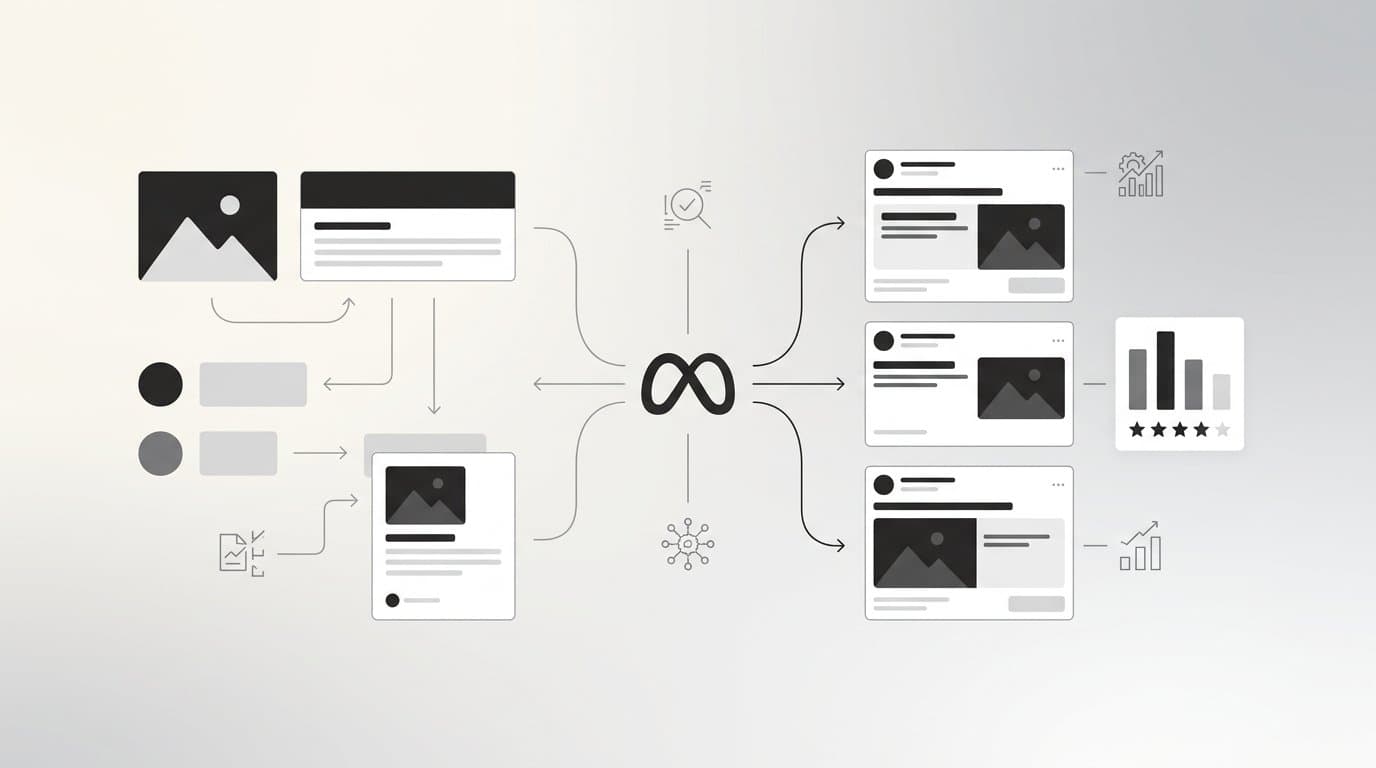
URL-based ad creative generation changes the equation entirely. Instead of briefing a designer or writing a creative spec document, you paste a product or landing page URL into an AI platform and let it do the heavy lifting. The AI scrapes your page, extracts your branding, product details, imagery, and messaging, and builds ready-to-launch ad creatives in minutes.
This guide walks through the exact process of generating ad creatives from a URL using AdStellar, covering every step from preparing your source page to refining creatives with chat-based editing and scaling with bulk launching. Whether you need image ads, video ads, or UGC-style avatar creatives, the same core workflow applies.
Here's what makes this approach particularly powerful for performance marketers: the entire process, from pasting a URL to having tested and ranked ad creatives running on Meta, can happen in a single session. No designers. No video editors. No agency handoffs. Just a URL, an AI platform, and a clear goal.
By the end of this guide, you'll have a repeatable workflow for ad creative generation from URLs that you can apply to any product, offer, or campaign. Let's get into it.
Step 1: Prepare Your URL and Set Your Creative Goals
Before you open AdStellar or paste a single URL, the quality of your source page will determine the quality of everything the AI generates. This step is worth taking seriously.
Choose the right URL type. Product pages, landing pages, and dedicated offer pages work best for ad creative generation from URLs. Avoid using your homepage. Homepages are designed to serve multiple audiences and communicate multiple messages at once, which gives the AI too much to work with and not enough specificity. A focused landing page with one product, one offer, and one call to action will produce sharper, more targeted creatives.
Verify your page is ready for scraping. Open your URL in an incognito browser window to see exactly what the AI will see. Check that the page loads quickly, that product imagery is high resolution and clearly visible, that your value proposition appears above the fold, and that your brand colors and logo are present. If any of these elements are missing or broken, fix the page before generating creatives. The AI can only work with what it finds.
Define your creative goal before you generate anything. Are you running an awareness campaign to reach cold audiences? A direct response campaign optimized for conversions? A retargeting campaign for people who visited but didn't buy? Each goal calls for different creative approaches, and knowing your goal upfront helps you evaluate the generated output more effectively. Understanding creatives in digital marketing and how they map to funnel stages will sharpen your thinking here.
Decide on your creative formats. Think about which placements you're targeting. Feed ads, Stories, and Reels each have different aspect ratios and viewer behaviors. Decide whether you need image ads, video ads, UGC-style avatar creatives, or a mix of all three. Having this decided before you start means you can generate everything you need in a single session rather than going back and forth.
Common pitfall to avoid: Using a URL with thin content, stock imagery, or vague product descriptions will produce weaker creative output. The AI is extracting a creative brief from your page. If your page doesn't clearly answer "what is this, who is it for, and why should I buy it," the generated creatives will reflect that ambiguity.
Success indicator: Before you touch the platform, you can clearly articulate your offer, your target audience, and the specific action you want someone to take after seeing your ad. That clarity will carry through every step that follows.
Step 2: Connect Your Meta Account and Enter Your URL
With your URL prepared and your goals defined, it's time to open AdStellar and get the AI working.
Log into AdStellar and navigate to the AI Creative Hub. This is your central workspace for generating and managing ad creatives. If you're new to the platform, the interface is designed to be straightforward: the creative generation input is prominently placed and clearly labeled.
Connect your Meta Ads account if you haven't already. This step matters more than it might seem. Connecting your Meta account early doesn't just enable direct campaign launching later in the workflow. It also allows AdStellar's AI to analyze your historical campaign data when building campaigns, which means the recommendations you get in later steps will be informed by what has actually worked for your account, not just generic best practices. The connection process follows Meta's standard OAuth flow and takes a few minutes to complete.
Paste your URL into the creative generation input field. AdStellar's AI immediately begins scraping the page. It extracts the product name, key benefits and features, existing copy and messaging, brand colors, and any imagery present on the page. This extraction process typically completes within seconds. If you want to understand how this compares to other approaches, exploring top AI-driven ad creative generation methods gives useful context.
Review the extracted data summary carefully. Before you generate a single creative, AdStellar surfaces what it found on your page. Read through this summary. Confirm that the product name is correct, that the key benefits reflect your actual selling points, and that the brand elements look right. If something is off, this is the moment to catch it, not after you've generated a batch of creatives built on inaccurate data.
Tip: Pages with a strong hero image and a clear, concise value proposition above the fold consistently produce higher-quality initial creatives. If your page buries the product benefit below a wall of text or uses imagery that doesn't clearly show the product, consider updating the page before this step. The AI treats your landing page as its creative brief, so the better the brief, the better the output.
Success indicator: The extracted data summary accurately reflects your product, your offer, and your brand. The AI has the right raw material to work with, and you're confident in moving forward to generation.
Step 3: Select Your Ad Formats and Generate Creative Variations
This is where ad creative generation from URLs becomes tangible. You've prepared your source material and confirmed the AI has extracted it correctly. Now you choose what to build.
Choose your creative formats based on your funnel stage. AdStellar supports three core creative types, and each serves a different purpose in your campaign strategy.
Image ads are well-suited for direct response campaigns and retargeting. They load instantly, communicate a clear message in a single frame, and perform consistently in Feed placements where users are scrolling quickly and making split-second decisions.
Video ads tend to drive stronger engagement and work particularly well for awareness campaigns targeting cold audiences. A short video gives you more time to tell a product story, demonstrate a benefit, or create an emotional connection before asking for a click.
UGC-style avatar creatives have become increasingly valuable on Meta because they blend naturally with organic content in feeds. When done well, they reduce the visual cue that something is an ad, which can lower ad fatigue and improve engagement rates. These are especially effective for direct-to-consumer brands where social proof and authenticity drive purchase decisions. For a deeper look at the software options available, the best UGC ad generation software guide covers the landscape well.
Select the number of variations to generate. More variations give you more to test. Rather than generating one or two creatives and trying to manually predict which will win, generate a broader set and let performance data make that determination for you. This is a core principle of effective performance marketing: the market tells you what works, not your gut.
Tip: Generate multiple format types in the same session. If you're running campaigns across Feed, Stories, and Reels, you need creatives optimized for each placement. Doing this in a single session, while the extracted URL data is fresh and loaded, is far more efficient than returning to the platform separately for each format.
AdStellar applies AI-optimized layouts, visual hierarchy, and headline structures to each generated creative, using the extracted URL data as the underlying brief. The output is not a generic template with your product image dropped in. The AI is actively making decisions about what to emphasize based on the content it extracted from your page.
Review the initial batch with a critical eye. Look for alignment between the generated creatives and your brand voice. Check that the headline clearly communicates your core offer, that the visual draws attention to the right element, and that the call to action matches the goal you defined in Step 1.
Success indicator: You have at least three to five distinct creative concepts ready for review, covering different visual approaches and messaging angles. You're not looking for perfection at this stage. You're looking for a strong starting point that you can refine in the next step.
Step 4: Refine Your Creatives with Chat-Based Editing
Having a batch of generated creatives is a great starting point, but refinement is where you bring your strategic judgment into the process. AdStellar's chat-based editing lets you make specific changes in plain language, without needing design tools or a designer on call.
Think of chat-based editing as having a conversation with a creative director who executes instantly. You describe what you want changed, and the AI makes it happen. No Figma files, no revision tickets, no waiting until tomorrow morning.
Focus your refinements on three core elements.
Visual clarity: Is the product or offer the most prominent element in the creative? Does the visual hierarchy guide the viewer's eye toward the key message and then the call to action? If the background is competing with the product, ask the AI to simplify it. If the imagery feels generic, ask for a different visual treatment.
Headline relevance: Your headline is doing most of the heavy lifting. A headline that speaks directly to your target audience's specific problem or desire will outperform a generic one every time. Ask the AI to generate headline variations focused on different angles: price and value, outcome and transformation, urgency and scarcity, or social proof. Test these as separate variations rather than replacing your original headline entirely. Pairing strong visuals with automated ad copy generation for Meta can significantly expand your headline testing surface.
CTA strength: A weak call to action costs you clicks. "Learn More" works in some contexts, but "Get 20% Off Today" or "Start Your Free Trial" communicates a specific, compelling reason to act. Ask the AI to suggest CTA alternatives if your current one feels passive.
For UGC-style avatar ads, chat-based editing is particularly valuable for adjusting the avatar's script and delivery tone. You can ask the AI to make the script more conversational, more direct, or more benefit-focused. You can also adjust the tone to match your brand voice, whether that's energetic and enthusiastic or calm and authoritative.
Common pitfall: Over-editing individual creatives before you've run any tests. It's tempting to keep refining until a creative feels perfect, but "perfect" is subjective. What you think will resonate and what your audience actually responds to are often different things. Refine broadly to ensure each creative is clear, on-brand, and communicates one offer to one audience. Then let the testing phase reveal what actually works.
Success indicator: Each creative in your refined batch clearly communicates one offer, one audience benefit, and one action. A stranger who knows nothing about your brand could look at any one of these creatives and immediately understand what you're selling and what you want them to do next.
Step 5: Scale with Bulk Ad Variations Before Launching
You've generated and refined a strong set of creatives. Now it's time to scale them into a proper test matrix before you launch. This is where AdStellar's Bulk Ad Launch feature becomes a significant operational advantage.
Understand what bulk launching actually means in practice. Rather than taking each creative and manually building an individual ad for each headline, copy variation, and audience combination, AdStellar generates every possible combination automatically. You select your creatives, your headline variations, your copy options, and your audience segments, and the platform builds every permutation and queues them for launch. What would take hours of manual ad building in Meta Ads Manager happens in minutes. This approach directly addresses the ad creative testing velocity problems that slow most performance teams down.
Use your URL-generated creatives as the base layer. The creatives you produced in Steps 3 and 4 are your visual foundation. Layer in manually written headline variations to expand the test matrix beyond what the AI generated. This combination of AI-generated visuals and human-crafted copy variations often produces the broadest and most effective test structure.
Organize your creatives in the Winners Hub before launching. AdStellar's Winners Hub is a centralized library of your best-performing assets. As you build your bulk launch batch, move your strongest creatives into the Winners Hub so they're easy to find and reuse in future campaigns. This is especially valuable for agencies managing multiple client accounts, where keeping proven assets organized and accessible saves significant time across campaigns. A well-maintained Meta ads winning creative library becomes one of your most valuable long-term performance assets.
Structure your variations with analysis in mind. It's easy to generate hundreds of ad combinations and end up with a data set that's impossible to interpret. Before you launch, group your variations logically. Keep image ads together, video ads together, and UGC creatives together. Within each group, isolate the variable you're testing, whether that's the headline, the copy angle, or the audience segment. Clean test structure makes it far easier to identify what's driving performance when the data comes in.
Tip: Avoid the temptation to launch every possible variation at once without a clear budget allocation strategy. More variations require more budget to reach statistical significance on each. Start with your strongest creative concepts across two or three audience segments, then expand based on what the initial data shows.
Success indicator: You have a structured batch of ad variations ready to launch, covering multiple creative formats and messaging angles, organized in a way that will make performance analysis straightforward once the campaign is live.
Step 6: Launch and Track Performance with AI Insights
Your creatives are generated, refined, and organized into a structured launch batch. Now you take them live and let the data do the work.
Launch directly to Meta from within AdStellar using the AI Campaign Builder. You don't need to export assets, open Meta Ads Manager, and rebuild everything manually. AdStellar handles the launch directly, keeping your entire workflow inside a single platform from creative generation to live campaign.
Let the AI analyze your historical data before confirming campaign settings. When you use the AI Campaign Builder, it doesn't just set up a generic campaign structure. It analyzes your past campaign performance, ranks your historical creatives, headlines, and audiences by what has actually worked, and builds a campaign structure informed by that data. Every recommendation comes with a clear rationale so you understand the strategic reasoning, not just the output. This transparency is particularly valuable if you're learning performance marketing or managing campaigns for clients who want to understand the strategy behind the spend.
Set your performance goals before your campaign goes live. AdStellar's AI Insights feature scores every creative against the benchmarks you define. If your goal is a specific target ROAS or a maximum CPA, set those numbers upfront. The platform will rank your creatives, headlines, copy, and audiences against those benchmarks in real time, surfacing winners and flagging underperformers as data accumulates. Understanding how Meta ads creative testing strategy works at a structural level will help you set benchmarks that are both ambitious and realistic.
Monitor the AI Insights leaderboards in the first 48 to 72 hours. This is typically when enough data has accumulated to start seeing meaningful performance patterns. The leaderboards rank your assets by ROAS, CPA, and CTR, giving you an at-a-glance view of which creative formats and messaging angles are resonating with your audience. You're not looking for a single definitive winner at this stage. You're looking for directional signals that tell you where to focus your budget and attention.
Connect Cometly for deeper attribution tracking. Metrics like CTR and CPA are useful, but they don't always tell the complete story of which creatives are driving real revenue. AdStellar integrates with Cometly to connect your creative performance data to actual conversion and revenue outcomes. This closes the loop between ad creative decisions and business results, which is especially important when you're making decisions about which creatives to scale and which to cut.
Pull top performers into the Winners Hub and use them as the starting point for your next session. This is where the workflow becomes a continuous improvement loop. Your best-performing URL-generated creatives become the benchmark for the next round of generation. You can use them as references when briefing new creative sessions, clone elements that are working, and build on proven messaging rather than starting from scratch each time.
Success indicator: Within the first 48 to 72 hours of running, you can clearly identify which creative formats and messaging angles are outperforming based on real data. You have at least one or two creatives in the Winners Hub ready to anchor your next campaign.
Your Repeatable Workflow for Ad Creative Generation from URLs
That's the complete six-step process, from a blank URL to live, ranked, and optimized ad creatives running on Meta. What used to require a design team, a video editor, a copywriter, and days of back-and-forth now fits inside a single focused session.
Here's a quick checklist to run through before every URL-based creative generation session:
URL is prepared: Product or landing page is publicly accessible, loads quickly, contains strong imagery, and clearly communicates your offer above the fold.
Meta account is connected: AdStellar is linked to your Meta Ads account to enable direct launching and historical data analysis.
Creative formats are selected and generated: You've chosen image ads, video ads, UGC-style creatives, or a combination, and generated multiple variations across formats.
Creatives are refined via chat editing: Each creative communicates one offer, one benefit, and one action clearly and concisely.
Bulk variations are structured and ready: Creatives are organized by format and testing variable, with a logical structure that will make performance analysis clean.
Campaign is live and tracked in AI Insights: Performance goals are set, the leaderboard is active, and Cometly attribution is connected.
The first time through this workflow, you'll likely spend an hour or two getting familiar with each step. By the third or fourth session, it becomes a fast, repeatable system that scales across products, clients, and campaigns without adding headcount or agency costs.
If you're ready to put this into practice, Start Free Trial With AdStellar and generate your first set of ad creatives from a product URL today. The 7-day free trial gives you full access to the AI Creative Hub, Bulk Ad Launch, AI Campaign Builder, and AI Insights so you can run the entire workflow from start to finish before committing to a plan.