Competitive research in Meta Ads has always followed the same frustrating pattern. You spot a competitor's ad performing well, you can tell it's working, and then you spend hours trying to reverse-engineer what makes it effective before briefing a designer who may or may not capture what you were going for. By the time your inspired version is live, you've lost days and the window may have already closed.
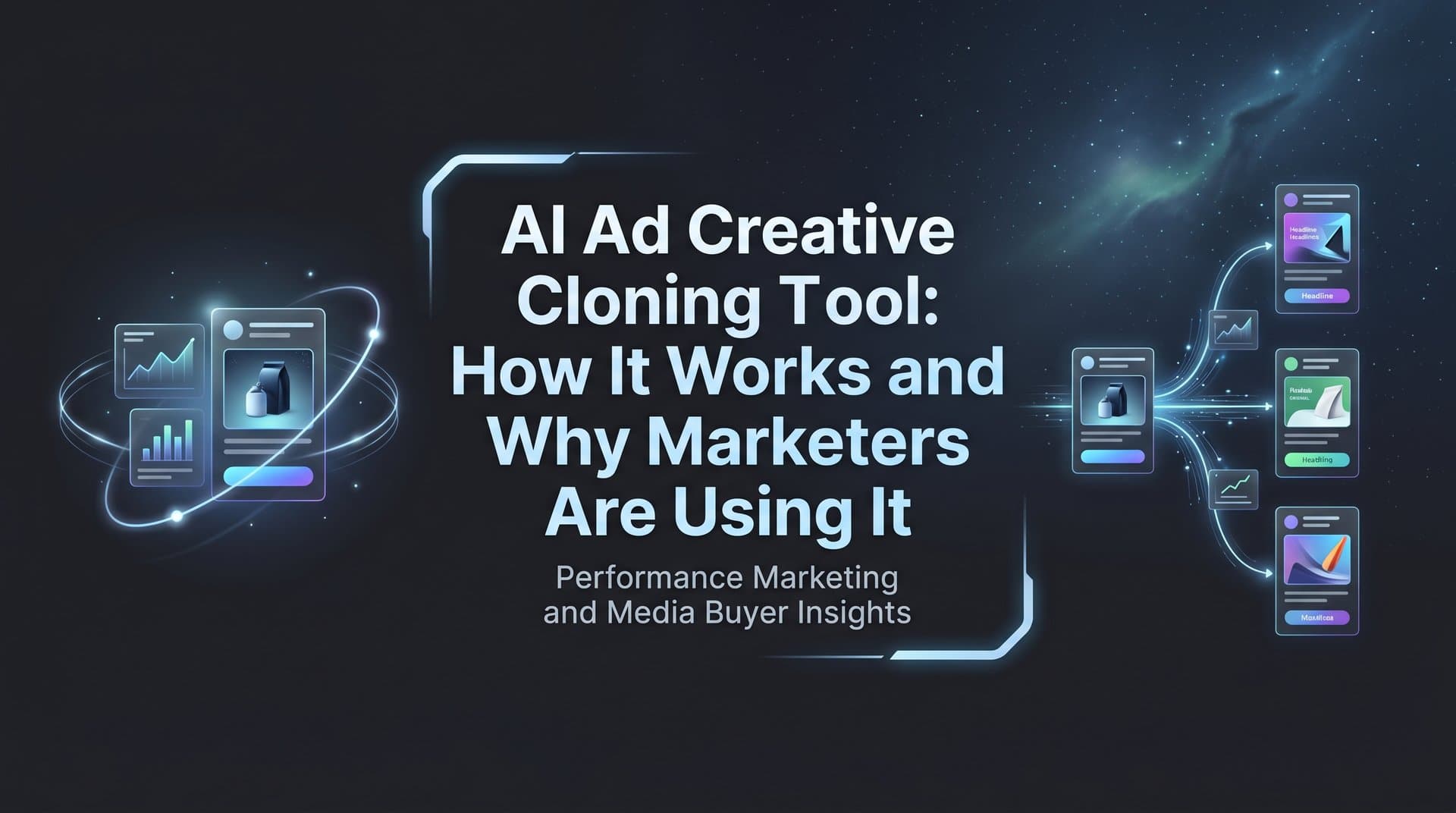
AI ad creative cloning tools exist to collapse that entire process. Instead of manually studying an ad, writing a creative brief, waiting on design, and hoping the output captures the original's strategic logic, a cloning tool does the analysis and generation in minutes. The result is a fresh, original creative built around your own product that reflects the structural patterns of a proven ad.
This article breaks down exactly how these tools work, what the technology is actually doing under the hood, what separates a genuinely useful cloning tool from a basic imitation, and how to build cloning into a repeatable creative testing strategy rather than treating it as a one-time shortcut. If you run Meta Ads and you're not using competitive creative intelligence as part of your workflow, this is where to start.
From Inspiration to Creation: What Creative Cloning Actually Means
The term "cloning" can raise eyebrows, so it's worth being precise about what an AI ad creative cloning tool actually does, and what it doesn't do.
Creative cloning is the process of analyzing an existing ad's structure, visual approach, messaging framework, and format, then using AI to generate a new, original creative that applies those same strategic principles to your own product or brand. The output is not a copy of the original. It is a fresh creative informed by the patterns that make the original work.
Think of it the way a skilled copywriter thinks about swipe files. The swipe file isn't there to plagiarize. It's there to study what's working structurally: the hook construction, the value proposition framing, the way the call to action is positioned. A cloning tool does that same analytical work automatically and then generates a new version built around your product, your brand identity, and your offer.
The source material for this process comes from publicly available resources, most notably the Meta Ad Library. Meta introduced the Ad Library as a transparency measure, and it has since become one of the most valuable competitive research tools available to performance marketers. Any active or recently inactive ad running across Facebook and Instagram is searchable. You can filter by advertiser, country, platform, and ad format, giving you a clear window into what your competitors are running right now.
What makes this legitimate, and not just ethically defensible but strategically sound, is that analyzing competitor advertising has always been standard marketing practice. Before the Meta Ad Library existed, marketers were screenshotting ads from their feeds, saving them to folders, and briefing designers to create inspired versions. The Ad Library made that research transparent and accessible. Cloning tools automate and accelerate what marketers were already doing manually.
The key distinction to hold onto: cloning captures strategic structure, not creative content. The visual composition approach, the emotional tone, the headline formula, the way the hook is constructed. Your cloned creative will look and sound like your brand because it is built from your assets and your copy. It just starts from a stronger strategic foundation than a blank brief.
The Technology Behind the Clone: How AI Reads and Rebuilds Ads
Understanding what's happening technically inside a cloning tool helps you use it more effectively. The process has two distinct layers: analysis and generation.
The analysis layer is where computer vision and natural language processing work together to deconstruct a source ad. Computer vision identifies the visual composition of an image or video: how the frame is structured, where the focal point sits, what color relationships are being used, how text is positioned relative to the visual elements, and what the overall aesthetic register is (clean and minimal, high-energy and saturated, lifestyle-oriented, product-focused). For video ads, this extends to pacing, scene structure, and the timing of key messages.
Natural language processing handles the text elements: the headline construction, the body copy tone, the call-to-action phrasing, and the emotional signals the language is designed to trigger. A well-built analysis layer doesn't just read the words; it identifies the persuasion structure underneath them. Is this ad leading with a problem the audience has? A transformation they want? A social proof signal? A scarcity or urgency mechanism? That structural pattern is what gets extracted.
The generation layer takes that structural blueprint and rebuilds it using your own inputs. Your product URL, your brand assets, your copy direction. Generative AI then produces a new creative: an image ad, a video ad, or a UGC-style creative using avatar technology, depending on what format you're targeting. The output reflects the winning formula identified in the source ad, but it's built entirely from your brand's materials and positioned around your specific offer.
This is where format flexibility matters significantly. A static image ad and a UGC-style video ad serve different placements and different audience mindsets. UGC-style creatives, the kind that look like organic content from a real person rather than a polished brand production, have become a dominant format on Meta because they blend into the feed naturally and tend to generate stronger engagement. AI-generated UGC using avatar technology lets brands produce this format without hiring creators, coordinating shoots, or waiting on production timelines.
After the initial generation, chat-based editing allows marketers to refine the output through natural language prompts. Want to adjust the tone, swap the headline, change the color direction, or try a different hook? You describe the change in plain language and the AI applies it. This removes the dependency on design software skills entirely and keeps the iteration process fast and accessible to anyone on the marketing team.
What to Look for in an AI Ad Creative Cloning Tool
Not all cloning tools deliver the same value. A few specific capabilities separate tools that genuinely accelerate creative production from those that add steps without adding much intelligence.
Direct Meta Ad Library Integration: A tool that connects directly to the Meta Ad Library removes the manual friction of screenshotting competitor ads, uploading them separately, and managing files across platforms. When you can search for a competitor's ads and clone directly from within the same platform where you build and launch campaigns, the entire workflow compresses. You're not context-switching between research tools and creative tools. You're moving from insight to action inside a single environment.
Multi-Format Creative Generation: The best cloning tools don't lock you into one creative format. Different placements across Facebook and Instagram respond to different formats, and different audience segments engage differently with static images versus video versus UGC-style content. A tool that can generate across all three, image ads, video ads, and avatar-based UGC creatives, gives you the flexibility to test format as a variable rather than defaulting to whatever the tool supports.
Performance Data Connectivity: This is the capability that separates useful tools from gimmicks. Cloning a creative and launching it is only the first step. The question that matters is whether your cloned creative is actually performing, and whether those performance signals are feeding back into future creative decisions. A cloning tool that exists in isolation from your campaign performance data forces you to manually reconcile what you created with what's converting. A tool that connects creative generation to real attribution metrics, ROAS, CPA, CTR, closes that loop automatically.
AdStellar's integration with Cometly for attribution tracking is a concrete example of this kind of connectivity. When the creative tool and the attribution platform share data, you can evaluate cloned creatives against the same performance benchmarks as everything else in your account, and the AI can factor those results into future recommendations.
Transparency in AI Reasoning: A growing concern among performance marketers is the black-box nature of AI tools. When an AI makes a creative recommendation or builds a campaign structure, understanding why it made that choice is valuable. It allows you to learn from the AI's analysis rather than simply depending on it. Tools that explain their reasoning, why a particular creative element was selected, what pattern in a source ad informed the generation approach, build more trust and make you a better marketer over time. Reviewing an AI ad creation tool comparison can help you identify which platforms prioritize this kind of transparency.
Cloning as a Testing Strategy, Not a One-Time Trick
The real leverage in creative cloning comes not from the single cloned creative but from what you do with it afterward. A cloned creative is a validated starting point, not a finished campaign.
Once you have a cloned creative that shows early promise, the logical next step is systematic variation testing. The structural blueprint you extracted from a competitor's winning ad gives you a framework. Within that framework, you can vary the headline, the opening hook, the visual treatment, the call-to-action phrasing, or the social proof element. Each variation tests a specific hypothesis about what's driving performance. Is it the hook? The value proposition framing? The visual composition? Variation testing built on a strong structural foundation generates answers faster than testing built on guesswork.
This is where bulk launching becomes essential. Generating a single variation manually and launching it one at a time is the bottleneck that slows most creative testing programs down. Bulk launching allows you to generate hundreds of ad variations from a single cloned structure, mixing different headlines, hooks, visuals, and copy combinations at both the ad set and ad level, and launch them all simultaneously. What would previously take days of creative production and campaign setup compresses into minutes.
The compounding effect of this approach is significant. Instead of testing one or two creative hypotheses per week, you can test dozens. Statistical winners emerge faster. Budget flows to what's working sooner. The creative testing cycle that used to take weeks can operate on a timeline of days.
The logical endpoint of this cycle is a Winners Hub: a curated library of your highest-performing creative structures, headlines, audiences, and copy combinations, all tagged with real performance data. When a cloned creative generates a winning variation, that variation doesn't disappear into a campaign archive. It gets stored as a proven asset that can be pulled into future campaigns directly, without starting the creative process from scratch again.
Over time, this library compounds. Each successful cloning and testing cycle adds more validated creative structures to your pool. New campaigns start from a stronger baseline. The gap between "we need a new creative" and "we have a live, tested creative" shrinks continuously.
Fitting Creative Cloning Into Your Full Campaign Workflow
Creative cloning doesn't operate in isolation. It's one part of a larger campaign workflow, and understanding where it fits helps you get the most out of it.
The cloning process produces raw creative material. What happens next is where AI campaign builders take over. A well-built campaign builder analyzes your historical performance data, ranking every creative, headline, audience, and copy combination by how it has performed against your actual goals, and uses that analysis to decide which cloned creatives to pair with which audiences, budgets, and placements. The creative and the campaign strategy inform each other rather than operating as separate processes.
Creative fatigue is one of the most consistent challenges in Meta Ads management. As audiences see the same ad repeatedly, performance declines. The response is typically to produce new creatives, but traditional production timelines mean teams are often scrambling to replace underperforming ads after performance has already dropped rather than rotating fresh creatives in before fatigue sets in.
Cloning tools change this dynamic. Because generating a fresh creative variation takes minutes rather than days, teams can maintain a pipeline of ready-to-launch creatives and rotate them proactively. You're not reacting to performance drops; you're staying ahead of them. The creative refresh cycle operates on the same timeline as the performance data, which is where it should be.
AI Insights and leaderboard rankings provide the visibility needed to make this proactive. When your creatives, headlines, copy, and audiences are ranked by real metrics against your specific performance goals, you can see clearly which cloned creatives are winning, which are plateauing, and which need to be replaced. The decision to rotate a creative is driven by data rather than gut feel about what looks fresh.
This data-driven evaluation also closes the feedback loop back to the cloning process itself. When you can see which structural patterns from your cloned creatives are generating the strongest ROAS and lowest CPA, you develop a clearer intuition for which competitor ads are worth cloning in the first place. The process gets smarter as it runs. Teams managing multiple accounts can explore Facebook ad creative management tools to see how this feedback loop scales across campaigns.
Putting It All Together: From Competitor Research to Winning Campaigns
The end-to-end workflow that AI ad creative cloning tools enable is straightforward once you see it as a complete system rather than a collection of individual features.
You spot a competitor's ad in the Meta Ad Library that looks like it's gaining traction. You clone its structure with AI, generating a fresh creative built around your own product and brand. You generate multiple variations of that cloned structure, testing different headlines, hooks, and visual treatments. You launch them in bulk, simultaneously, without the manual setup overhead. You measure performance with real attribution data connected to your actual conversion metrics. Winners get stored in your creative library and pulled into future campaigns. The cycle repeats, each time starting from a stronger baseline.
The value of this process is not in copying what competitors do. It's in learning from what the market has already validated and applying those lessons to your own brand faster than traditional creative production allows. A competitor's high-performing ad is evidence that a particular structural approach resonates with a particular audience. Cloning tools let you extract that evidence and act on it immediately, rather than spending weeks arriving at the same insight through manual testing.
AdStellar brings all of these capabilities together in one platform. From cloning competitor ads directly from the Meta Ad Library, to generating image ads, video ads, and UGC-style creatives with AI, to bulk launching hundreds of variations, to surfacing winners through AI Insights and leaderboard rankings, to storing proven creative structures in the Winners Hub for reuse. Every step of the workflow lives in a single environment, connected by performance data that makes each cycle smarter than the last.
If you're running Meta Ads and building creatives the traditional way, you're competing against teams that are already operating at this speed. The gap compounds quickly.