Most Meta advertisers aren't suffering from a lack of data. They're suffering from too much of it, arriving too fast, with no clear signal about what to actually do next.
You launch a campaign with a dozen creatives, three audiences, and multiple copy variations. Within 48 hours, your dashboard is populated with CTR figures, CPC breakdowns, impression counts, frequency data, and relevance scores. It all looks like information. But when you sit down to make decisions, a familiar problem surfaces: you can see what happened, but you have no confident answer to the question that actually matters. Which creative is driving results, and why?
Traditional analytics tools are built to report. They surface numbers, organize them into charts, and let you filter by date range. What they don't do is interpret. They don't tell you whether your top-performing ad is winning because of the visual, the headline, the audience, or some combination of all three. They don't connect patterns across campaigns. And they certainly don't tell you what to do with your budget tomorrow morning.
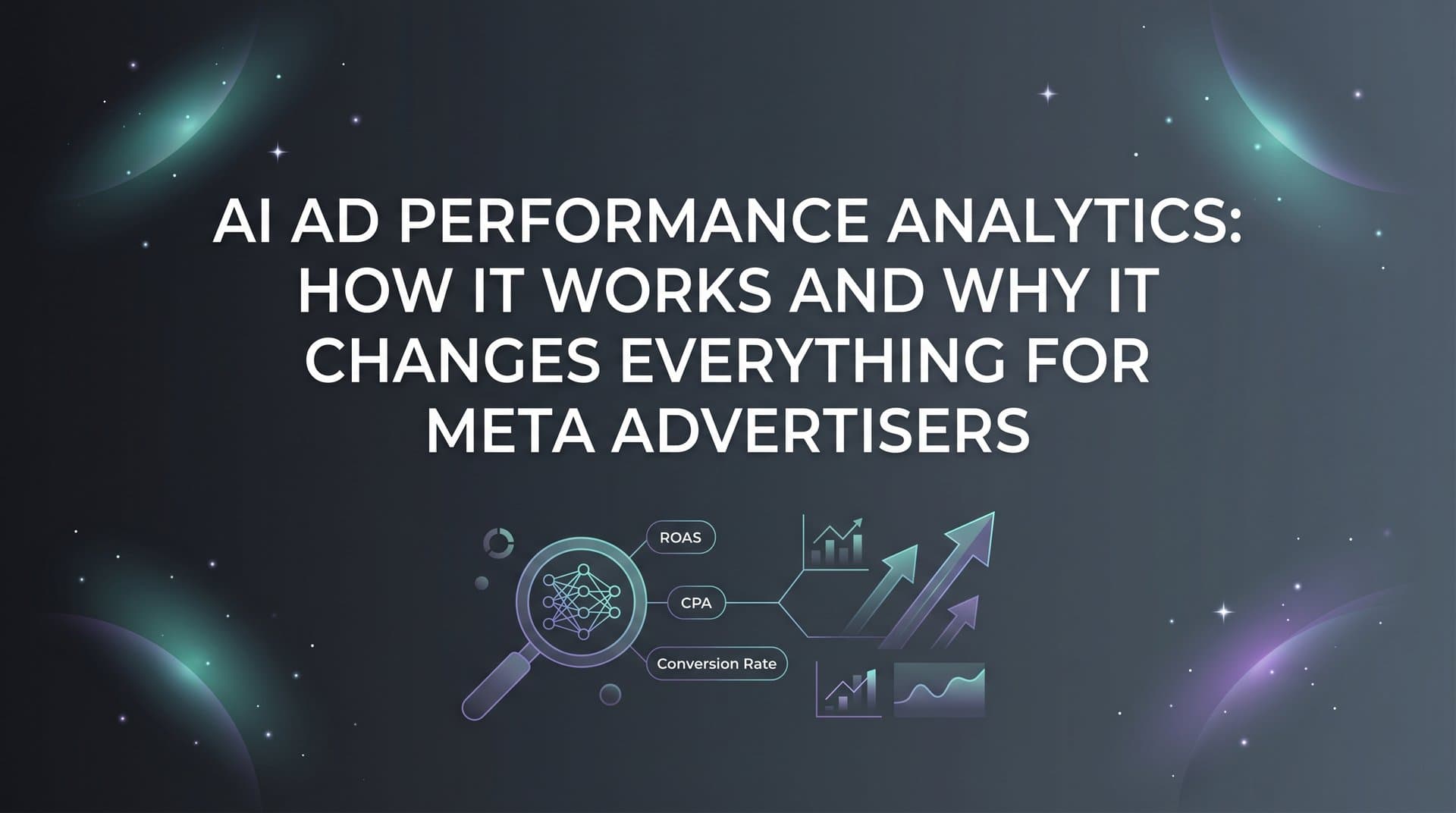
This is where AI ad performance analytics changes the equation. It's not a smarter dashboard. It's a fundamentally different approach: one that moves from reactive reporting to predictive, actionable intelligence. Instead of showing you what happened and leaving the rest to you, AI analytics processes performance data across every variable simultaneously, ranks elements by their contribution to your specific goals, and surfaces clear decisions rather than raw numbers.
This article breaks down how AI ad performance analytics actually works, what it measures differently, and how it closes the loop between data and decisions for Meta advertisers running real campaigns at real scale.
The Gap Between Raw Ad Data and Real Decisions
Here's the core problem with traditional Meta analytics: the tools are designed to present data, not interpret it. You get a column for CTR, a column for CPC, a column for reach. What you don't get is any guidance on which of those numbers should change your strategy, which are noise, and which actually correlate with the business outcome you care about.
This creates decision fatigue at scale. When you're running even a modest Meta campaign with multiple creatives, two or three audiences, and a handful of copy variations, the number of possible combinations you're evaluating grows quickly. A marketer looking at that data manually has to compare each element against every other element, control for spend differences, account for audience overlap, and somehow synthesize it all into a coherent optimization decision. That process is slow, error-prone, and exhausting.
The volume problem compounds over time. As you run more campaigns, your historical data grows, but your ability to meaningfully process it doesn't scale at the same rate. You end up relying on gut instinct or simple rules of thumb, "pause anything with a CTR below X," rather than genuinely understanding what's working and why. This is a pattern well-documented in Meta ads data analysis paralysis, where too many metrics actively kill campaign performance.
The cost of this gap isn't just inefficiency. It's budget. When winners are identified slowly, underperforming ads continue consuming spend in the meantime. When you can't confidently understand why a creative is working, you can't replicate that success intentionally in the next campaign. You end up running a new creative test from scratch rather than building on what you've already learned.
The interpretation bottleneck is the real problem. Raw data isn't the issue. The issue is that traditional analytics tools hand you a stack of numbers and walk away, leaving all the analytical work to you. AI ad performance analytics is built to solve exactly that problem by handling the interpretation layer automatically, at a speed and depth no human analyst can match.
What AI Analytics Actually Does With Your Campaign Data
AI ad performance analytics doesn't just organize your data differently. It applies machine learning to find patterns across multiple variables simultaneously, something that's simply impossible to do manually when you're evaluating hundreds of creative, audience, copy, and placement combinations at once.
Think of it this way. A traditional dashboard compares Ad A to Ad B. AI analytics evaluates every element within Ad A and Ad B, across every audience segment, at every placement, and ranks each element's contribution to your specific goal. That's a qualitatively different kind of analysis. Understanding how this works in practice is covered in depth when you look at how to analyze ad performance beyond surface-level metrics.
One of the most important concepts here is goal-based scoring. Not all metrics matter equally for every advertiser, and AI analytics that treats them equally will lead you in the wrong direction. A brand awareness campaign should optimize for reach and engagement. A direct response campaign should optimize for CPA and ROAS. An AI analytics system that scores every creative, headline, and audience against your specific goal avoids the common trap of optimizing for the wrong signal. A high-CTR ad that doesn't convert isn't a winner. An ad with modest CTR but strong downstream purchase rates is. Goal-based scoring captures that distinction automatically.
The continuous learning dimension is what separates AI analytics from any static tool. Machine learning models improve with more data. Every campaign you run feeds new performance signals back into the model, sharpening its ability to identify patterns specific to your brand, your audience, and your offer. Over time, an AI analytics system doesn't just tell you what worked last month. It develops an increasingly accurate model of what's likely to work next month, based on the full history of your campaigns.
This compounding value is meaningful for performance marketers. The longer you use an AI analytics system, the more accurately it can distinguish signal from noise in your data, and the faster it can surface actionable recommendations. It's the opposite of a static dashboard, which gives you exactly the same level of insight on day one as it does on day three hundred.
The Metrics AI Analytics Tracks Differently
The shift from ad-level analysis to element-level analysis is one of the most practically powerful things AI analytics does. Traditional reporting tells you that Ad 7 outperformed Ad 12. AI analytics tells you that the product demonstration format in the first three seconds of your video ads consistently outperforms lifestyle visuals for your core audience, across multiple campaigns and multiple months.
That's a fundamentally more useful insight. Knowing Ad 7 won doesn't tell you much about what to create next. Knowing that a specific hook format, visual style, or headline structure consistently drives stronger results gives you a repeatable creative strategy. The right Meta ad creative analytics software makes this element-level visibility possible at scale.
Creative-level intelligence: AI analytics breaks performance down below the ad unit to the individual element. Visual styles, color approaches, hook formats, product framing, and call-to-action structures can all be evaluated independently for their contribution to performance. This means you're building creative knowledge, not just tracking ad results.
Audience signal analysis: Different creative attributes resonate differently with different audience segments. AI analytics can identify which audience groups respond to which creative approaches, enabling targeting decisions that go well beyond broad demographic buckets. Instead of "women aged 25-44," you start to understand which creative signals activate purchase intent within that group.
Cross-campaign pattern recognition: This is where AI analytics delivers insights that no single-campaign analysis can surface. By connecting performance data across your full campaign history, AI can identify durable patterns: creative formats that consistently outperform, audiences that reliably convert, and headline structures that work across different offers. These cross-campaign insights are the foundation of a genuinely scalable Meta advertising operation.
The practical implication is that AI analytics turns your campaign history into a strategic asset. Every campaign you run generates data that makes your future campaigns smarter, as long as you have a system capable of extracting that intelligence and applying it forward. A historical ad data analyzer is what enables this kind of compounding intelligence across your full campaign archive.
From Insights to Action: How AI Closes the Loop
Insight without action is just information. The real value of AI ad performance analytics lies in how it translates complex multi-variable analysis into clear, executable decisions.
Leaderboard rankings are one of the most practical mechanisms for doing this. Rather than presenting a data table and leaving interpretation to you, a leaderboard takes AI's analysis and outputs a ranked priority list: these creatives deserve more budget, these headlines are outperforming, these audiences are converting efficiently, and these elements should be paused. The complexity of the underlying analysis disappears. What surfaces is a clear action list. This is precisely how AI ad performance scoring works to rank your winning ads automatically.
This matters enormously for campaign velocity. When you can look at a leaderboard and immediately know where to shift budget, you compress the optimization cycle from days to hours. You're not spending Tuesday morning manually comparing performance across dozens of ad sets. You're acting on a ranked list that reflects the AI's analysis of every relevant variable.
Winner identification and reuse is the next layer. AI analytics doesn't just tell you what's working. It enables you to pull winning elements directly into new campaigns without starting from scratch. If a specific headline is consistently ranking at the top of your leaderboard, that headline should be in your next campaign. If a particular creative approach is driving strong ROAS across multiple audience segments, it should be your starting point for the next creative brief, not something you rediscover through another round of testing.
Transparent rationale is what separates genuinely useful AI analytics from a black box. Knowing that Creative 4 is ranked first is helpful. Understanding why it's ranked first, whether it's the visual format, the opening hook, the audience match, or the landing page alignment, is what gives you the strategic understanding to replicate that success intentionally. Effective AI analytics explains its reasoning, not just its conclusions.
This transparency also builds marketer confidence. When you understand the logic behind an AI recommendation, you can apply judgment to it, validate it against your own knowledge of the brand and audience, and make a more informed decision than if you were simply following an unexplained output.
The Full Campaign Intelligence Loop
AI ad performance analytics is most powerful when it operates as a continuous loop rather than a point-in-time report. Understanding how that loop works helps you design a campaign operation that gets smarter with every cycle.
The loop begins before a campaign launches. AI analyzes your historical campaign data to inform creative selection, audience prioritization, and budget allocation. Rather than starting each campaign from a blank slate, you're starting from a data-informed baseline that reflects everything your previous campaigns have taught the system. This pre-campaign intelligence is one of the most underappreciated advantages of AI analytics: it means your first day of a new campaign is already smarter than the last day of your previous one.
During the campaign, AI monitors performance in real time and continuously updates its rankings. As data accumulates, the signal gets cleaner and the rankings become more reliable. Early in a campaign, the AI is working with limited data and its confidence intervals are wider. As spend accumulates and patterns emerge, the leaderboard stabilizes and the recommendations sharpen. A well-built Meta ads performance analytics platform handles this continuous ranking automatically without requiring manual intervention.
After the campaign, results feed back into the model. Every new data point refines the AI's understanding of what works for your brand, your audience, and your offer category. This is the continuous learning mechanism that makes AI analytics compound in value over time.
Bulk testing amplifies the entire loop. The more ad variations you launch simultaneously, the faster you generate statistically meaningful performance data, and the richer the signal the AI has to work with. Launching a hundred variations in a single campaign doesn't just give you more options to choose from. It compresses the time to identify winners, because the AI can compare performance across a much larger sample and identify patterns faster than a limited test would allow.
Attribution integration is the final piece that ensures the loop reflects reality. Platform-reported metrics can differ from actual business outcomes due to attribution window differences and multi-touch customer journeys. Connecting AI analytics to third-party attribution tracking means the performance data feeding the AI reflects actual conversions and revenue, not just what Meta's native reporting attributes. This matters because an AI making decisions based on inaccurate attribution data will optimize for the wrong outcomes. Understanding Meta ads attribution is the foundation of trustworthy AI analytics.
Building a Smarter Meta Ads Operation
The shift from manual interpretation to AI-driven decision making isn't about removing the marketer from the equation. It's about redirecting marketer attention to where it actually creates value: strategy, creative direction, and audience understanding. The data processing work, the pattern recognition, the ranking, the winner identification, these are tasks that AI handles faster and more accurately than any human analyst. This is the broader shift described in performance marketer ad automation, where AI replaces the most time-consuming manual campaign work.
When that processing work is automated, campaign velocity increases. You're optimizing daily instead of weekly. You're building on winners instead of rediscovering them. You're making budget decisions based on ranked intelligence rather than manual comparison. The cumulative effect is a more efficient advertising operation that improves continuously rather than plateauing.
A practical starting point is to audit your current analytics workflow and identify where the interpretation bottlenecks actually live. Where are you spending the most time manually comparing data? Where are decisions getting delayed because the analysis is too complex to complete quickly? Those are the gaps that AI analytics addresses most directly.
When evaluating AI analytics tools, look specifically for goal-based scoring (not one-size-fits-all metric weighting), transparent rationale (not black-box recommendations), and cross-campaign learning (not just single-campaign reporting). These three characteristics distinguish genuinely useful AI analytics from a faster version of the same dashboard you already have. Reviewing a comparison of ad tracking tools can help clarify which platforms actually deliver on these capabilities.
AdStellar is built around exactly this kind of connected intelligence. Its AI Insights feature surfaces leaderboard rankings across creatives, headlines, copy, audiences, and landing pages, all scored against your specific goals like ROAS, CPA, and CTR. The Winners Hub keeps your top-performing elements organized and ready to deploy into new campaigns instantly. The AI Campaign Builder analyzes your historical data before each campaign to inform creative and audience selection, and it gets smarter with every cycle. Bulk Ad Launch generates hundreds of ad variations in minutes, feeding richer data into the analytics loop faster. And Cometly integration ensures the performance data powering all of it reflects actual attribution, not just platform estimates. It's one connected workflow from creative generation to campaign intelligence, without the need for separate tools at each stage.
The Bottom Line
AI ad performance analytics doesn't replace marketer judgment. It amplifies it by handling the data processing work that currently consumes so much time and attention. When pattern recognition, element-level analysis, goal-based scoring, and winner identification happen automatically, marketers can focus on the decisions that actually require human judgment: creative strategy, brand positioning, audience development, and offer refinement.
The result is a faster, smarter advertising operation. One where optimization cycles compress, budget flows to winners more quickly, and every campaign makes the next one better. That's the compounding advantage that AI analytics creates over time, and it's why the gap between advertisers using it and those still relying on manual interpretation is likely to widen.
If you're ready to move from reactive reporting to genuine campaign intelligence, Start Free Trial With AdStellar and experience how AI insights, leaderboard rankings, and the Winners Hub turn performance data into faster, smarter decisions. The 7-day free trial gives you full access to see exactly how it works with your own campaigns.