Managing advertising campaigns in 2026 means juggling more variables than ever before. You're testing audiences, rotating creatives, adjusting budgets, analyzing performance metrics, and trying to scale what works—all while new data floods in every hour. The mental overhead is exhausting, and the opportunity cost is real: every minute spent on campaign mechanics is a minute not spent on strategy.
Enter AI agents: autonomous systems that don't just automate tasks but actually think through campaign decisions independently. These aren't the rule-based automation tools you've used before—those "if this, then that" workflows that break the moment something unexpected happens. AI agents perceive what's happening in your campaigns, reason through the best course of action, and execute changes without waiting for your input.
This article breaks down what AI agents actually are in the advertising context, how they work behind the scenes, and why they're fundamentally changing how smart marketers approach Meta campaigns. Whether you're managing one account or twenty, understanding AI agents isn't optional anymore—it's the difference between keeping pace and falling behind.
From Rule-Based Automation to Autonomous Decision-Making
Let's start with what AI agents aren't. Traditional automation in advertising platforms operates on rigid rules: "If cost per acquisition exceeds $50, pause the ad set." "If click-through rate drops below 1%, switch to backup creative." These rules work until they don't—and they require you to anticipate every scenario in advance.
AI agents operate differently. They're autonomous systems designed to perceive their environment, make decisions based on complex pattern recognition, and take action without constant human direction. In advertising terms, an AI agent for advertising continuously monitors campaign performance data, identifies patterns across thousands of variables, determines the optimal strategy, and executes changes independently.
The core difference lies in adaptability. Rule-based automation follows your script exactly. An AI agent writes its own script based on what it observes working in real-time. When audience behavior shifts, when creative fatigue sets in, when competitive dynamics change—the AI agent adjusts its approach without needing you to update a workflow.
Think of it like the difference between a thermostat and a smart climate system. A thermostat follows simple rules: temperature drops, heat turns on. A smart climate system learns your preferences, anticipates when you'll be home, adjusts for weather patterns, and optimizes for energy efficiency—all without you programming specific scenarios.
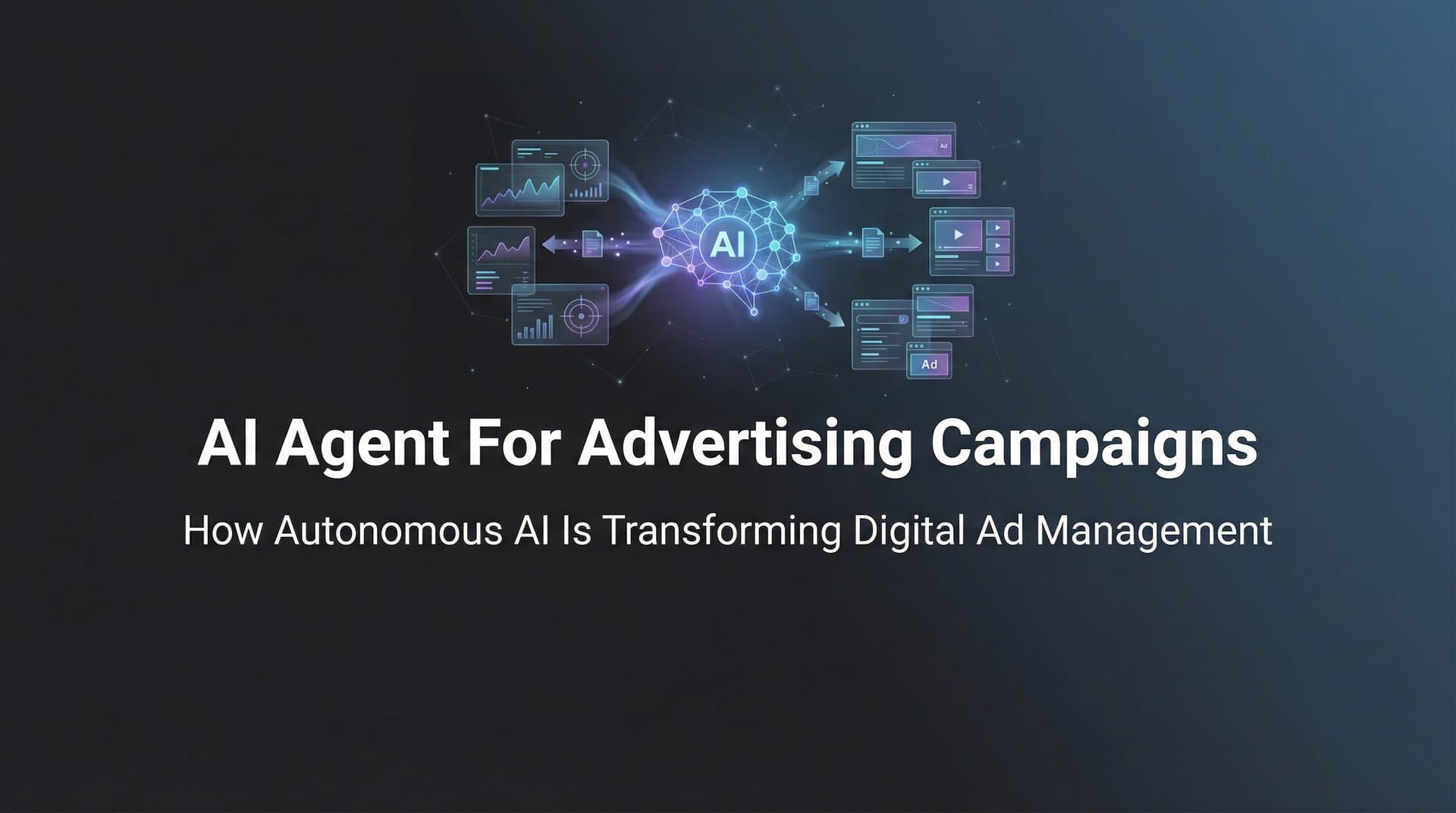
AI agents in advertising have three fundamental components working together. First, perception: the agent continuously ingests data from your campaigns, landing pages, historical performance, and even competitor signals. Second, reasoning: it analyzes this information to identify patterns, predict outcomes, and determine optimal strategies. Third, action: it executes decisions by building campaign structures, selecting creatives, adjusting budgets, or launching new tests.
This perception-reasoning-action loop happens continuously. An AI agent doesn't wait for you to check the dashboard and make adjustments. It's monitoring performance every hour, identifying micro-trends before they become visible in aggregate metrics, and making incremental optimizations that compound over time.
The autonomy factor is crucial here. You're not clicking through interfaces to approve every decision. You set strategic parameters—your goals, budget constraints, brand guidelines—and the AI agent operates within those boundaries. It's the difference between micromanaging every campaign detail and having a team member who understands your objectives and executes independently.
The Anatomy of an Advertising AI Agent
Here's where it gets interesting: sophisticated AI advertising platforms don't use a single monolithic agent. They deploy multiple specialized agents, each focused on a specific aspect of campaign management. This multi-agent architecture mirrors how high-performing advertising teams actually work—different experts handling different domains.
Consider audience targeting. A specialized targeting agent focuses exclusively on identifying and refining audience segments. It analyzes which demographic patterns, interest combinations, and behavioral signals correlate with conversions. It doesn't just apply your saved audiences—it reasons through which segments deserve more budget based on performance trends and which new combinations are worth testing.
Creative selection works similarly. A creative curator agent examines your asset library, identifies patterns in what's performing, and selects combinations of images, videos, headlines, and descriptions most likely to resonate. It's not randomly rotating creatives—it's applying pattern recognition from thousands of previous impressions to predict which combinations will drive results.
Budget allocation becomes particularly powerful with AI agents. A budget allocator agent monitors performance across all your campaigns and ad sets in real-time, shifting spend toward what's working and away from what's not. It operates faster than any human could, catching performance shifts within hours rather than days.
The real power emerges when these specialized agents collaborate. Imagine you're launching a new campaign. The page analyzer agent examines your landing page to understand your offer, value proposition, and target audience signals. It passes this intelligence to the structure architect agent, which designs the campaign framework—how many ad sets, which optimization goals, what placement strategy makes sense.
Meanwhile, the targeting strategist agent is determining which audience segments to pursue based on your historical data and the landing page analysis. The creative curator agent is selecting which visuals and formats to test. The copywriter agent is generating ad copy variations that align with your brand voice and the landing page messaging. The budget allocator agent is determining initial spend distribution across these elements.
All of this happens in parallel, with agents sharing insights and coordinating decisions. The director agent orchestrates the entire process, ensuring each specialized agent's decisions align with your overall campaign objectives. It's like having an entire advertising team working simultaneously, except it happens in minutes rather than days of meetings and revisions.
What makes this multi-agent approach powerful is specialization. Each agent develops deep expertise in its domain, processing patterns and correlations that would take humans weeks to identify. The targeting agent becomes exceptionally good at predicting which audience combinations will convert. The creative agent becomes expert at identifying visual patterns that drive engagement.
Real-World Applications: What AI Agents Actually Do for Campaigns
Let's get concrete about what AI agents handle in practice. Campaign building is the first major application. You provide a landing page URL and campaign objective. The AI agents analyze your page content, identify your value proposition, extract relevant keywords and themes, and construct a complete campaign structure.
This isn't template-based generation. The agents are reasoning through optimal campaign architecture based on your specific offer. They're determining how many ad sets make sense, which campaign objectives to use, what placement strategies align with your content type, and how to structure testing for maximum learning velocity.
Creative optimization is where AI agents demonstrate their pattern recognition capabilities. They examine your historical performance data to identify which creative elements—specific images, video styles, headline formulas, call-to-action phrases—have driven results. Then they select and combine these elements in new configurations, testing variations systematically.
The key advantage: AI agents can manage creative testing at a scale impossible for humans. They're simultaneously running dozens of creative variations, monitoring early performance signals, and making allocation decisions within hours. A creative that shows promise gets more budget. A creative showing fatigue gets rotated out. New variations get introduced continuously based on what's working.
Budget management becomes dynamic rather than static. Traditional approaches involve setting budgets and checking back periodically to adjust. AI agents monitor performance continuously, shifting spend in real-time based on performance signals. If one ad set is converting at half your target cost per acquisition while another is at double, the budget allocator agent is already moving money toward the winner.
This dynamic allocation happens across multiple dimensions simultaneously. The agent is considering time of day performance, day of week patterns, audience segment efficiency, creative performance, and dozens of other variables—then making allocation decisions that optimize for your specific goals.
Perhaps most valuable is the bulk testing capability AI agents enable. You can launch variations across audiences, creatives, and placements at scale, with agents managing the complexity. Instead of carefully setting up a few ad sets manually, you're testing comprehensively while AI agents handle the operational overhead.
The Continuous Learning Loop: How AI Agents Get Smarter Over Time
Here's what separates AI agents from static automation: they improve with use. Every campaign generates performance data that feeds back into the agents' decision-making models. This creates a continuous learning loop where each campaign makes the next one smarter.
The feedback mechanism works like this: an AI agent makes decisions about targeting, creatives, and budget allocation. Those decisions generate results—impressions, clicks, conversions, cost metrics. The agent analyzes which decisions correlated with positive outcomes and which didn't. This performance data updates the agent's understanding of what works for your specific business.
Over time, patterns emerge that wouldn't be visible in individual campaigns. The targeting agent learns that certain interest combinations consistently outperform for your product. The creative agent identifies that specific visual styles drive higher engagement with your audience. The budget agent discovers optimal times and days for your particular conversion goals.
This creates a compounding advantage. Your first campaign with AI agents establishes a baseline. Your tenth campaign benefits from patterns identified across the previous nine. Your hundredth campaign operates with a depth of learned knowledge that would take years to develop manually.
The learning isn't just about what works—it's about understanding why. Advanced AI agent systems provide transparency into their reasoning. When an agent selects a particular audience segment, it explains the performance data that informed that decision. When it chooses specific creatives, it shows which historical patterns suggested those would perform well.
This transparency serves two purposes. First, it builds trust—you're not blindly accepting AI decisions but understanding the rationale behind them. Second, it enables human oversight—you can identify when an AI agent's reasoning aligns with your strategic intent and when it needs guidance.
The continuous learning loop also means AI agents adapt to market changes automatically. Audience behavior shifts, competitive dynamics evolve, platform algorithms update—and AI agents adjust their strategies based on what's currently working rather than what worked months ago.
When to Deploy AI Agents vs. Traditional Campaign Management
AI agents aren't universally superior for every advertising scenario. Understanding when to deploy them versus traditional manual management makes the difference between leveraging their strengths and fighting their limitations.
AI agents excel in high-volume testing environments. When you need to test dozens of audience combinations, creative variations, and placement strategies simultaneously, AI agents handle the operational complexity. They can manage more variables, process performance signals faster, and make allocation decisions at a scale that would overwhelm human managers.
Scaling proven winners is another ideal use case. Once you've identified what works, AI agents can systematically expand those successes—testing new audience segments with winning creatives, adapting successful campaigns to new products, or replicating high-performers across multiple accounts. Learning how to scale Facebook advertising campaigns becomes significantly easier when AI handles the execution complexity.
Managing multiple accounts or clients becomes dramatically more efficient with AI agents. Instead of context-switching between different campaigns, each requiring manual setup and monitoring, you can deploy AI agents across all accounts while you focus on strategic oversight. The agents handle execution while you focus on higher-level strategy.
However, certain scenarios still benefit from human-led approaches. Brand-sensitive campaigns where every creative and message needs careful review aren't ideal for fully autonomous AI agents. The risk of an AI-generated message missing brand nuance or tone outweighs the efficiency gains.
New market entry situations require human strategic thinking. When you're testing a completely new product category, audience, or market geography, the AI agent lacks historical performance data to inform decisions. Human intuition, market research, and strategic hypothesis testing are more valuable in these exploratory phases.
Creative strategy development remains a human domain. While AI agents can optimize creative execution—selecting which images, headlines, and formats to test—the fundamental creative strategy, brand positioning, and messaging framework still benefit from human creativity and strategic thinking.
The most effective approach combines both. Use AI agents for campaign execution, operational optimization, and scaling—the mechanical work that consumes hours but doesn't require strategic judgment. Reserve human attention for strategy development, creative direction, brand oversight, and interpreting broader market trends that inform campaign direction.
This hybrid model maximizes both efficiency and effectiveness. AI agents handle what they do best—processing vast amounts of data, managing complexity at scale, and making rapid optimization decisions. Humans focus on what we do best—strategic thinking, creative innovation, and understanding nuanced market dynamics that can't be reduced to performance metrics.
Putting AI Agents to Work: Getting Started
If you're ready to deploy AI agents in your advertising workflow, certain capabilities separate effective platforms from disappointing ones. Look for systems that offer true multi-agent architecture rather than single-function automation. The specialized agent approach—where different agents handle targeting, creatives, budget allocation—delivers better results than monolithic systems.
Data integration is non-negotiable. AI agents need access to your historical performance data to make informed decisions. Platforms that connect directly to Meta's API and can analyze your past campaigns have a significant advantage. They're not starting from zero—they're learning from your existing performance patterns. Exploring Meta advertising platforms with AI insights can help you understand what integration capabilities to prioritize.
Transparency features matter more than you might expect. You want platforms that explain why AI agents made specific decisions. When an agent selects certain audiences or creatives, understanding the reasoning helps you trust the system and provides oversight. Black-box AI systems that make decisions without explanation create anxiety rather than confidence.
Speed of execution is a practical consideration. The whole point of AI agents is efficiency. Platforms that can build complete campaigns in under a minute, launch bulk variations quickly, and make optimization decisions in real-time deliver the operational advantage you're looking for.
The ability to reuse proven elements is often overlooked but incredibly valuable. Look for platforms with features like a Winners Hub—a library of your best-performing audiences, creatives, and campaign structures that AI agents can reference when building new campaigns. This creates a compounding knowledge base rather than starting fresh each time.
Set realistic expectations for AI agent performance and timelines. These systems aren't magic—they need data to learn from. Your first few campaigns establish baseline performance and provide learning data. Expect meaningful improvements to emerge after the AI agents have managed enough campaigns to identify reliable patterns.
Start with campaigns where you have historical performance data. If you've been running Meta campaigns for months or years, AI agents can immediately leverage that learning. If you're completely new to advertising, consider running a few manual campaigns first to establish baseline data.
Finally, maintain strategic oversight even as you delegate execution to AI agents. Review the campaigns they build, examine the decisions they're making, and provide feedback through your platform's interface. The goal is collaborative intelligence—AI agents handling execution while you guide strategy.
The Intelligent Path Forward
We've reached an inflection point in advertising campaign management. AI agents represent more than incremental improvement—they're a fundamental shift from tools that assist marketers to systems that can autonomously execute campaign strategies. The perception-reasoning-action loop that defines AI agents enables them to manage complexity at a scale and speed impossible for human teams.
The multi-agent architecture approach, where specialized agents collaborate on different campaign functions, mirrors how effective advertising teams operate but without the coordination overhead. Each agent develops deep expertise in its domain—targeting, creative selection, budget optimization—while the system orchestrates their collective intelligence toward your campaign goals.
What makes this transformation sustainable rather than just hype is the continuous learning loop. Every campaign makes AI agents smarter. Every performance signal refines their decision-making. The compounding advantage of accumulated knowledge means your campaigns get progressively more efficient over time.
The most successful approach combines AI agent capabilities with human strategic oversight. Let AI agents handle campaign mechanics, operational optimization, and scaling execution. Reserve your attention for creative strategy, brand direction, and the market insights that inform campaign positioning. This hybrid model maximizes both efficiency and effectiveness.
As the future of advertising technology continues evolving, the gap between those who leverage it and those who don't will widen. The operational efficiency, testing velocity, and optimization speed that AI agents enable create competitive advantages that compound over time. The question isn't whether to adopt AI agents—it's how quickly you can integrate them into your workflow.
Ready to transform your advertising strategy? Start Free Trial With AdStellar AI and be among the first to launch and scale your ad campaigns 10× faster with our intelligent platform that automatically builds and tests winning ads based on real performance data. Our seven specialized AI agents—from the Director orchestrating strategy to the Budget Allocator optimizing spend—work together to build complete campaigns in under 60 seconds, with full transparency into every decision. Experience the future of advertising campaign management where AI handles execution while you focus on strategy.