Every digital marketer knows the drill: you launch five ad sets with equal budgets, check back six hours later, and discover Ad Set #3 is crushing it at $8 CPA while Ad Set #1 is burning money at $47 CPA. You manually shift budget from the losers to the winner. Two hours later, performance flips. You adjust again. By day three, you're checking your phone at dinner, during meetings, before bed—because the moment you look away, the algorithm gods seem to punish your best performers with budget starvation while feeding your worst ads like they're training for a marathon.
This exhausting cycle isn't just frustrating—it's fundamentally inefficient. Human reaction time operates in hours or days. Ad performance shifts in minutes. The gap between these timescales represents thousands of dollars in missed opportunities and wasted spend.
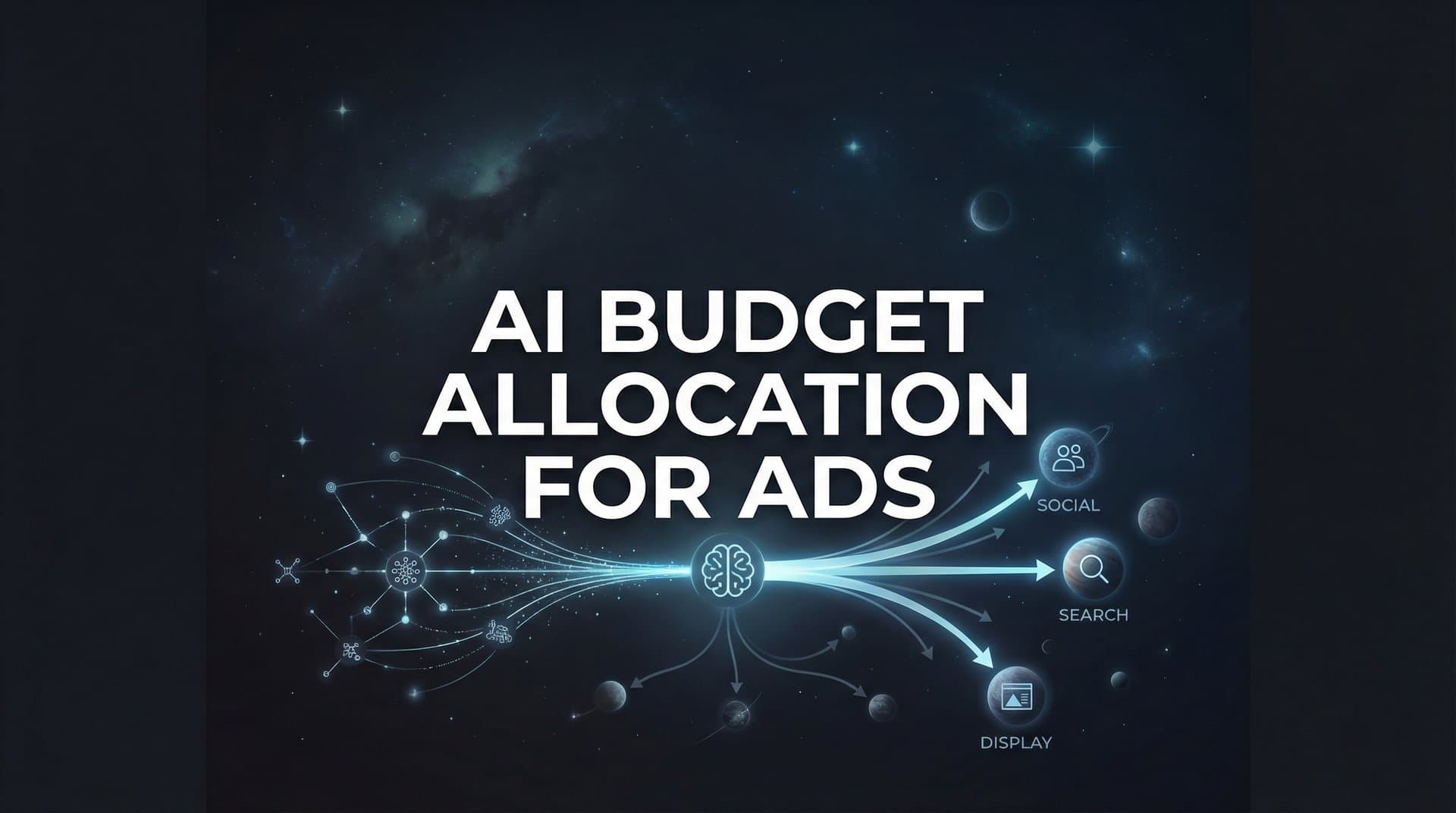
AI budget allocation changes this equation entirely. Instead of manually redistributing spend based on yesterday's performance, machine learning algorithms analyze real-time signals and shift budgets automatically—every hour, every minute, continuously optimizing toward your actual business goals. For marketers managing multiple campaigns or scaling aggressively, this shift from reactive human oversight to proactive algorithmic optimization isn't just convenient. It's transformative.
How Machine Learning Makes Spending Decisions in Real-Time
At its core, AI budget allocation solves a deceptively complex problem: given limited ad spend and multiple competing options, how do you distribute money to maximize results? The answer lies in sophisticated algorithms that process performance signals far faster and more comprehensively than any human could.
Modern AI systems monitor dozens of performance indicators simultaneously—click-through rates, conversion rates, cost per acquisition, return on ad spend, engagement metrics, and more. But they don't just track these numbers. They identify patterns, predict future performance, and make spending decisions based on statistical confidence rather than gut feeling.
Here's where it gets interesting: not all automation is created equal. Rule-based systems follow simple if-then logic: "If CTR drops below 2%, reduce budget by 20%." These rigid rules can't adapt to context or learn from outcomes. True machine learning approaches work differently. They build predictive models that forecast which campaigns, ad sets, or creatives will deliver the best results based on historical patterns and current signals.
Predictive Modeling: These algorithms analyze your historical campaign data to forecast future performance. If Ad Set A consistently converts better on weekday mornings while Ad Set B dominates weekend evenings, the system learns these patterns and adjusts budget allocation accordingly—before performance drops, not after.
Multi-Armed Bandit Optimization: This approach balances exploration versus exploitation. Think of it like this: you have multiple slot machines (your ad sets), each with unknown payout rates. Do you keep pulling the lever on the machine that's currently winning, or do you occasionally test the others to see if they've improved? Bandit algorithms solve this mathematically, allocating most budget to proven performers while reserving a portion for testing alternatives.
Reinforcement Learning: The most sophisticated systems learn from every spending decision. When they shift budget and performance improves, they reinforce that decision pattern. When a choice underperforms, they adjust their models. Over time, the AI becomes increasingly accurate at predicting which budget allocations will drive the best outcomes for your specific business.
The practical result? An AI system can detect that your conversion rate is climbing on Mobile News Feed placements at 3 PM on Thursdays and automatically shift budget from underperforming placements—all while you're in a client meeting or asleep. This real-time responsiveness creates compound advantages that manual management simply cannot match.
The Time-and-Performance Gap Between Human and Algorithmic Management
Let's be honest about what manual budget management actually looks like. You set initial budgets based on educated guesses or past performance. You check results once or twice daily—maybe more if you're particularly diligent or anxious. You make adjustments based on what you observe. Then you wait to see if those changes improve outcomes.
This cycle operates on a timescale of hours to days. AI operates on a timescale of minutes to seconds.
Consider the time investment alone. Managing budget allocation across even a modest campaign portfolio—say, five campaigns with three ad sets each—requires constant vigilance. You're logging into Ads Manager multiple times daily, comparing performance metrics, calculating which shifts make sense, implementing changes, documenting decisions. Industry professionals often report spending 30-60 minutes per day just on budget reallocation for moderately complex campaigns.
Now scale that to 20 campaigns. Or 50. The math becomes unsustainable quickly. You either hire more people to monitor campaigns, accept suboptimal performance from campaigns you can't actively manage, or burn out trying to do everything yourself. Understanding the full scope of Meta Ads budget allocation problems reveals just how widespread these challenges are across the industry.
AI systems monitor all campaigns simultaneously, 24/7, without fatigue or distraction. They don't need coffee breaks or sleep. They don't get overwhelmed managing 100 ad sets versus 10. The scalability advantage is obvious, but the performance implications run deeper.
Decision Speed: When an ad set's performance suddenly improves—maybe because your target audience is particularly active right now—AI can capitalize immediately by increasing budget allocation within minutes. By the time you notice the trend hours later, the opportunity window may have closed.
Data Processing Capacity: You might review 5-10 key metrics when making budget decisions. AI systems can simultaneously process dozens of signals: time-of-day patterns, device performance variations, placement effectiveness, audience segment responses, creative fatigue indicators, and competitive landscape changes. This comprehensive analysis leads to more informed decisions.
Emotional Detachment: Humans develop attachments to campaigns or creatives we personally like. We give underperformers "one more day" because we believe in the concept. AI evaluates performance objectively, shifting budget based purely on data rather than hope or personal preference.
The combination of speed, scale, and objectivity creates a fundamental performance advantage. AI-driven budget allocation doesn't just save time—it makes better decisions more consistently than manual management can achieve.
Where Automated Spend Distribution Creates Maximum Value
AI budget allocation isn't equally valuable in every scenario. Understanding where it delivers the biggest impact helps you deploy it strategically rather than treating it as a universal solution.
The clearest wins come from high-volume, multi-variant campaigns. When you're running dozens of ad sets targeting different audiences, testing multiple creatives, or managing campaigns across several products, manual budget optimization becomes a full-time job. This is where AI shines brightest—juggling complexity that would overwhelm human oversight.
Picture managing a campaign with 15 ad sets, each targeting different interest groups or demographic segments. Performance varies wildly: some audiences convert beautifully, others barely engage. Worse, these patterns shift throughout the week. Your B2B audience might convert best on Tuesday mornings, while your consumer segment peaks on weekend evenings. Manually tracking and responding to these fluctuations is practically impossible. AI handles it automatically.
Dynamic markets amplify AI's advantages. If you're advertising in competitive spaces where auction dynamics shift rapidly, or selling products with time-sensitive demand patterns, real-time budget optimization becomes critical. Think flash sales, event-driven marketing, or highly competitive industries where ad costs fluctuate throughout the day.
Scaling scenarios reveal another crucial use case. You've found a winning campaign that's converting at your target CPA. Now you want to scale from $500 daily spend to $5,000. Manual scaling is risky—increase budgets too quickly and performance often degrades as you exhaust your best audiences. AI systems can scale more intelligently, gradually increasing spend while monitoring performance signals and pulling back if efficiency declines.
Geographic Expansion: When you're running campaigns across multiple regions or countries, budget allocation becomes exponentially more complex. Different markets perform differently, time zones create overlapping peak periods, and currency fluctuations affect ROI calculations. AI can optimize across all these variables simultaneously.
Seasonal Businesses: If your demand fluctuates significantly—retail during holidays, tax services in spring, travel during summer—AI budget allocation can respond to changing conversion patterns faster than manual adjustments, maximizing revenue during peak periods while conserving budget during slower times.
Testing-Heavy Strategies: Marketers who constantly test new audiences, creatives, or offers benefit enormously from AI allocation. The system can quickly identify which tests show promise and shift budget accordingly, while deprioritizing underperformers—accelerating your learning cycle without constant manual intervention.
The common thread? Complexity and dynamism. The more moving parts your campaigns have, and the faster those parts change, the more valuable AI budget allocation becomes.
Configuration Essentials: Setting Up AI to Succeed
AI budget allocation isn't magic—it's mathematics. And like any mathematical system, it requires proper inputs to generate useful outputs. Setting up AI optimization correctly makes the difference between transformative results and disappointing underperformance.
Data requirements come first. Machine learning algorithms need sufficient information to identify patterns and make predictions. This means minimum conversion volumes—systems typically need at least 50 conversions per week across your campaign to make statistically valid optimization decisions. Below this threshold, the AI is essentially guessing, and its decisions won't be meaningfully better than random chance.
Historical performance data matters too. AI systems learn from past patterns to predict future outcomes. If you're launching entirely new campaigns with zero history, the AI starts cold. It can still optimize, but expect a learning period of several days to a week before performance stabilizes. This is why hybrid approaches often work best initially—let AI optimize established campaigns while you manually manage new tests.
Defining Optimization Goals Correctly: This is where many marketers stumble. AI will optimize toward whatever goal you specify, so choosing the wrong objective creates problems. If you optimize for clicks but actually care about conversions, you'll get lots of cheap clicks that don't convert. If you optimize for ROAS but need volume to hit revenue targets, you might achieve great efficiency on minimal spend.
Be specific about what success looks like. Are you trying to maximize conversions at any cost? Maintain a specific CPA ceiling? Hit a ROAS target while scaling volume? Each goal requires different optimization parameters. Most platforms allow you to set both primary objectives (maximize conversions) and constraints (don't exceed $30 CPA)—use both to guide AI toward outcomes that actually serve your business goals. Implementing proven Meta Ads budget allocation strategies from the start ensures your AI has the right framework to optimize effectively.
Common Setup Mistakes: Setting budget caps too low restricts the AI's ability to shift spend meaningfully. If each ad set has a $50 daily cap, the system can't reallocate effectively when one ad set could profitably spend $200. Conversely, setting no guardrails at all can lead to runaway spending on a single high-performing element while starving everything else.
Another frequent error: changing goals mid-campaign. If you switch from optimizing for link clicks to optimizing for purchases halfway through, you reset the AI's learning. The system has been training on one objective and suddenly needs to learn a completely different pattern. Consistency matters.
Attribution windows also affect AI decisions. If you're using a 7-day click attribution window, the AI makes budget decisions based on conversions that occur within seven days of an ad click. Changing this window alters which conversions the system attributes to which ads, effectively changing the data it learns from.
Finally, resist the urge to constantly override AI decisions. If you manually adjust budgets every few hours because you disagree with the AI's allocation, you're undermining the system's ability to learn and optimize. Set appropriate constraints upfront, then give the AI time to work—usually at least 3-5 days before evaluating performance.
Maintaining Control While Leveraging Automation
AI budget allocation is powerful, but it's not infallible. Understanding its limitations and maintaining appropriate human oversight ensures you get the benefits of automation without surrendering strategic control.
The cold-start problem affects all machine learning systems. When you launch new campaigns with no historical data, AI has nothing to learn from. Its initial budget decisions will be essentially random until it gathers enough performance information to identify patterns. During this learning phase—typically 3-7 days—you might see volatile performance as the system explores different allocations.
Brand awareness campaigns present another challenge. AI budget allocation typically optimizes toward measurable conversion events: purchases, sign-ups, downloads. But brand awareness goals are harder to quantify. Impressions and reach matter, but they don't directly indicate quality or impact. If your goal is building brand recognition rather than immediate conversions, AI optimization may prioritize the wrong metrics.
Over-optimization represents a subtler risk. AI systems excel at finding what works right now and doubling down on it. But this can create tunnel vision—allocating all budget to your current best-performing audience while neglecting to explore new segments that might perform even better. You might achieve excellent efficiency in the short term while missing opportunities for long-term growth.
Essential Human Oversight: Smart marketers use AI as a tool, not a replacement for strategic thinking. Set clear budget caps to prevent runaway spending. If an ad set can profitably spend unlimited budget, that's valuable information—but you still want guardrails to protect against algorithm errors or sudden market changes.
Regularly review which campaigns receive the most budget and why. If AI is heavily favoring one audience or creative, investigate whether that's revealing genuine performance advantages or whether you need to force more diversity to avoid audience fatigue and creative burnout. A robust Meta Ads performance tracking dashboard makes this ongoing monitoring significantly easier.
Maintain manual control over strategic decisions: which audiences to target, what products to promote, seasonal adjustments, competitive responses. AI optimizes tactics—how to distribute budget among existing options. You own strategy—which options to create in the first place.
Balancing Automation with Exploration: Consider reserving a portion of budget for manual testing outside AI optimization. Maybe 80% of your spend goes to AI-managed campaigns optimizing for conversions, while 20% funds manual experiments testing new audiences, creative concepts, or messaging angles. This ensures you're continuously feeding new possibilities into the system rather than optimizing within an increasingly narrow range.
Watch for diminishing returns. If AI keeps increasing budget on a winning ad set but CPA starts rising, the system might be exhausting that audience. Human judgment can recognize when it's time to cap spending and shift focus, even if the algorithm still sees that ad set as your best performer.
The goal isn't choosing between human management and AI automation. It's finding the right division of labor—letting AI handle the tactical work of continuous budget reallocation while you focus on strategic decisions, creative development, and long-term planning.
Implementation Strategy: Starting Smart with AI Budget Tools
The smartest approach to AI budget allocation isn't diving in headfirst—it's starting strategically and expanding as you build confidence and understanding.
Begin with a hybrid model. Identify your most stable, established campaigns—the ones with consistent performance and sufficient conversion volume—and enable AI budget allocation there first. These campaigns provide the clean data and predictable patterns that allow AI to demonstrate its value. Meanwhile, keep manual control over new campaigns, experimental tests, and strategic initiatives where human judgment remains most valuable.
This approach gives you a controlled comparison. You can directly observe how AI-managed campaigns perform versus manually managed ones, building confidence in the technology while limiting downside risk. As you see positive results, gradually expand AI management to additional campaigns.
Key Metrics to Monitor: Don't just look at overall performance—track how AI allocation decisions affect specific outcomes. Monitor your cost per acquisition trends over time. Is AI maintaining or improving efficiency as it reallocates budget? Watch your conversion volume. Efficiency means nothing if you're getting fewer total conversions.
Pay attention to budget distribution patterns. Which ad sets or campaigns receive the most spend? Does this align with your strategic priorities, or is AI optimizing toward short-term wins that don't serve long-term goals? If you notice concerning patterns—like 90% of budget flowing to a single ad set—that's a signal to adjust constraints or diversify your campaign structure. Understanding Meta Ads performance metrics explained in depth helps you interpret what the AI is actually optimizing toward.
Track the stability of your results. Some volatility is normal during the learning phase, but if performance swings wildly day-to-day even after a week or two, something's wrong. Either your campaigns lack sufficient data for reliable optimization, or your setup needs adjustment.
Integrated Automation Platforms: Platforms like AdStellar AI take budget allocation beyond simple spend distribution. The Budget Allocator agent analyzes historical performance across all your campaign elements—audiences, creatives, placements, timing—and distributes budget optimally from the start. This integrated approach means your campaigns launch with intelligent budget allocation already built in, rather than requiring separate setup and configuration.
More importantly, when budget allocation works in concert with AI campaign building, creative selection, and audience targeting, you get compound benefits. The system doesn't just optimize how much to spend—it optimizes what to spend it on, continuously learning which combinations of creative, audience, and placement drive the best results for your specific business. Exploring dedicated Meta Ads budget optimization software can help you evaluate which tools best fit your workflow.
Start small, measure carefully, and scale what works. AI budget allocation isn't an all-or-nothing proposition. It's a tool that becomes more valuable as you learn to use it effectively, and as your campaigns generate the data that makes AI optimization increasingly accurate.
The Bottom Line on Algorithmic Spend Optimization
AI budget allocation fundamentally changes the economics of digital advertising management. What once required constant human monitoring, rapid decision-making, and significant time investment now happens automatically—with better results, at greater scale, with less effort.
The value proposition is straightforward: machine learning algorithms can process more data, respond faster, and optimize more consistently than manual management. For marketers managing multiple campaigns or scaling aggressively, this isn't a minor convenience—it's the difference between sustainable growth and operational bottlenecks.
But the real transformation isn't just operational efficiency. It's strategic freedom. When AI handles the tactical work of budget reallocation, you reclaim time for higher-value activities: developing creative strategy, identifying new market opportunities, analyzing competitive dynamics, and actually thinking about your business rather than constantly reacting to campaign fluctuations. The shift toward automated budget optimization for Meta Ads represents one of the most significant efficiency gains available to modern advertisers.
The question isn't whether AI budget allocation works—the technology is proven. The question is whether your current approach to budget management is serving your business as effectively as it could. If you're spending hours each week manually shifting budgets, if you're struggling to scale campaigns without degrading performance, if you're managing enough complexity that something always gets overlooked—AI optimization solves these problems.
Start by evaluating where automation would create the most value in your specific situation. Look for high-volume campaigns with multiple variables, dynamic markets where performance shifts rapidly, or scaling scenarios where manual oversight becomes a constraint. These are the opportunities where AI delivers immediate, measurable impact.
Ready to transform your advertising strategy? Start Free Trial With AdStellar AI and be among the first to launch and scale your ad campaigns 10× faster with our intelligent platform that automatically builds and tests winning ads based on real performance data. Our seven specialized AI agents—including the Budget Allocator—work together to plan, build, and optimize complete campaigns in under 60 seconds, giving you the strategic freedom to focus on growing your business instead of managing spreadsheets.