Facebook advertising has evolved into a sophisticated ecosystem where success requires juggling audience targeting, creative variations, budget optimization, and performance analysis—often simultaneously across multiple campaigns. What used to take a skilled marketer hours of meticulous setup now demands even more precision as Meta's algorithm grows increasingly complex. AI campaign planners have emerged as a solution to this challenge, not by replacing strategic thinking, but by handling the execution work that consumes your most valuable resource: time.
These intelligent systems analyze performance patterns, automate repetitive tasks, and make data-driven decisions at a speed impossible for manual management. The result? Marketers can focus on strategy and creative direction while AI handles campaign construction, audience optimization, and budget distribution.
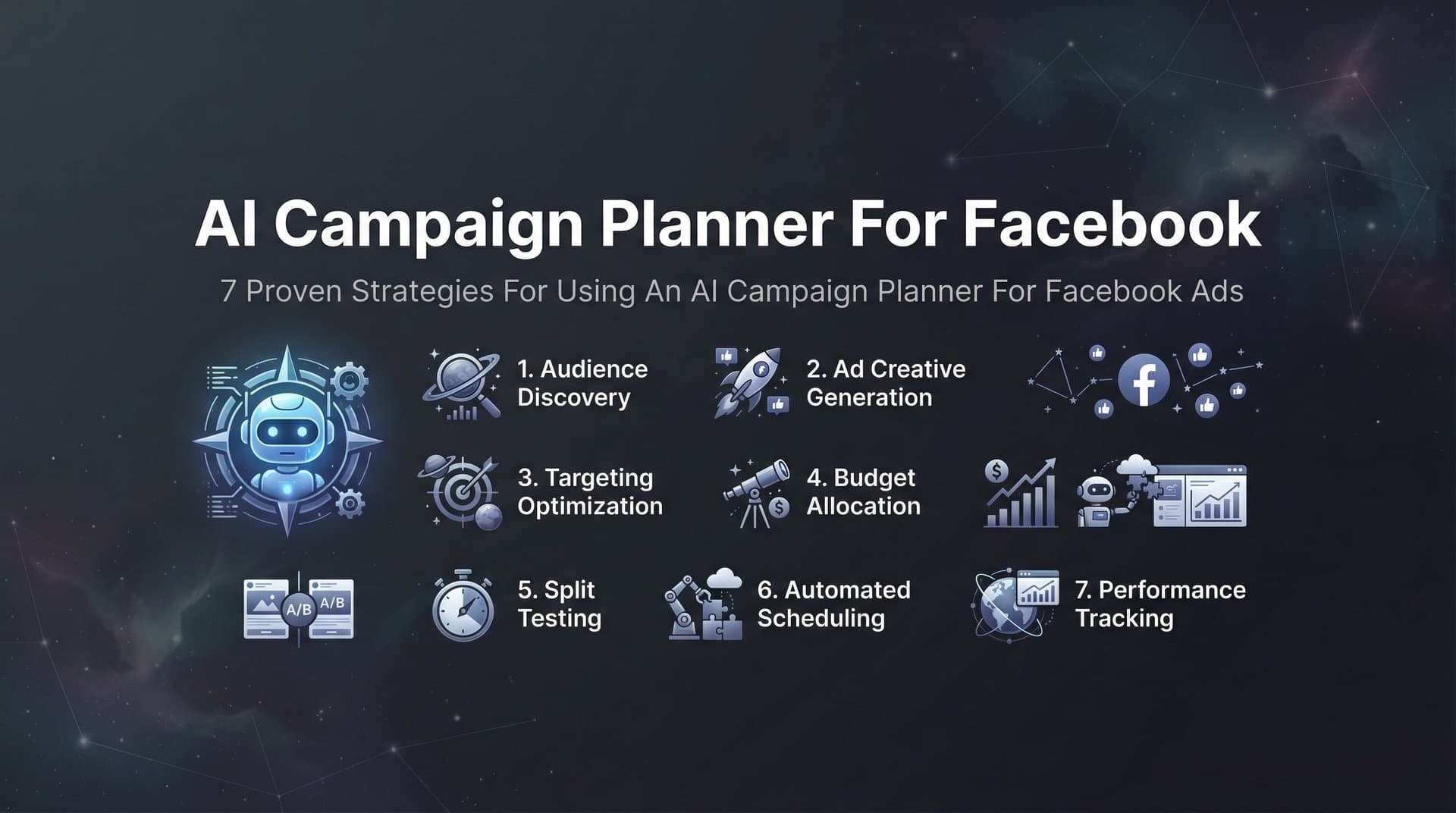
This guide presents seven proven strategies for maximizing results with an AI campaign planner. Each approach addresses a specific challenge in Facebook advertising and provides practical steps for implementation. Whether you're launching your first AI-assisted campaign or refining an existing workflow, these strategies will help you work smarter and achieve better returns on your ad spend.
1. Feed Your AI Planner Quality Historical Data
The Challenge It Solves
AI campaign planners make decisions based on patterns in your historical performance data. When that data is incomplete, inconsistent, or poorly organized, the AI works with a distorted view of what actually performs well. Many marketers jump into AI tools expecting immediate results, only to find the recommendations feel generic or miss the mark—usually because the underlying data doesn't tell a clear story.
The Strategy Explained
Before activating AI automation, invest time in data preparation. This means ensuring your Facebook Ads Manager has consistent naming conventions, complete conversion tracking, and sufficient performance history. AI systems identify patterns more effectively when they can compare apples to apples—campaigns with similar structures, audiences with clear definitions, and creatives with proper tagging.
The goal isn't perfection, but clarity. Your AI planner needs to understand which audiences responded to which messages, which creative elements drove conversions, and which budget levels produced optimal results. Clean, organized data allows the AI to make these connections accurately.
Implementation Steps
1. Audit your existing campaigns for naming consistency and ensure conversion tracking is properly configured across all active campaigns and ad sets.
2. Compile at least 30-60 days of performance data for the AI to analyze, focusing on campaigns with complete metrics rather than partial data from paused tests.
3. Document your best-performing campaigns separately, noting what made them successful (audience characteristics, creative approaches, messaging angles) to give AI context beyond raw numbers.
Pro Tips
Start with your Winners Hub mentality—identify your top 10-20% performing ads and ensure they're fully documented with all relevant attributes. This concentrated excellence gives AI a clear benchmark for what "good" looks like in your specific business context, allowing it to replicate success patterns more effectively.
2. Let AI Handle Audience Segmentation and Targeting
The Challenge It Solves
Manual audience targeting often falls into predictable patterns based on demographic assumptions or surface-level interests. Marketers tend to create audiences based on what they think should work, missing non-obvious combinations that actually drive conversions. Testing these manually requires launching multiple campaigns and waiting weeks for statistically significant results.
The Strategy Explained
AI campaign planners analyze thousands of data points to identify audience segments that share behavioral patterns, not just demographic similarities. These systems can detect that people who engage with certain content types, visit specific pages, or interact at particular times convert at higher rates—connections that might never surface in manual analysis.
The approach works by letting AI examine your historical performance data to identify which audience characteristics correlate with your best results. Rather than starting with assumptions about who your customer is, you're letting actual performance data reveal who responds to your offers.
Implementation Steps
1. Provide your AI planner access to comprehensive audience performance data, including both successful and unsuccessful targeting attempts to help it identify what differentiates winners from losers.
2. Set clear performance goals (cost per acquisition, conversion rate, return on ad spend) so the AI knows which audience segments to prioritize based on your business objectives.
3. Review the AI's audience recommendations before launching, looking for segments that challenge your assumptions—these often represent the most valuable discoveries.
Pro Tips
Don't immediately override AI suggestions that seem counterintuitive. When an AI campaign planner recommends an unexpected audience segment, it's typically based on performance patterns in your data. Test these recommendations alongside your traditional audiences to validate or challenge the AI's insights.
3. Automate Creative Testing at Scale
The Challenge It Solves
Traditional A/B testing limits you to comparing two or three creative variations at a time, requiring weeks to identify winning combinations. With multiple headlines, images, body copy options, and call-to-action buttons, the number of possible combinations quickly becomes unmanageable for manual testing. Most marketers end up testing only a fraction of potential creative variations.
The Strategy Explained
AI-powered creative testing operates differently than traditional split testing. Instead of comparing complete ad variations, AI systems test individual creative elements—headlines, images, body copy, CTAs—in multiple combinations simultaneously. The AI identifies which specific elements drive performance, then assembles new variations using proven components.
This approach accelerates learning because you're not testing complete ads in isolation; you're discovering which creative building blocks work best together. An AI campaign planner can test dozens of combinations in the time it would take to manually test three complete ads.
Implementation Steps
1. Create a library of creative assets organized by element type—collect 5-10 headline variations, 5-10 images, 3-5 body copy options, and 2-3 CTA buttons as your testing foundation.
2. Configure your AI planner to test these elements in combination, setting minimum budget thresholds for each variation to ensure statistically meaningful results before eliminating options.
3. Establish performance benchmarks that trigger automatic scaling—when the AI identifies a winning combination, allow it to increase budget allocation without manual approval within predefined limits.
Pro Tips
Pay attention to which specific creative elements the AI consistently selects across different campaigns. If certain headlines or images repeatedly appear in winning combinations, you've identified creative assets that resonate with your audience across contexts—these become your creative foundation for future campaigns.
4. Implement Dynamic Budget Allocation
The Challenge It Solves
Manual budget management creates an inherent lag between performance changes and spending adjustments. By the time you notice an ad set is underperforming and pause it, you've already spent budget that could have been redirected to better-performing campaigns. Conversely, winning ad sets often remain underfunded because you're not monitoring performance in real-time.
The Strategy Explained
Dynamic budget allocation allows AI to redistribute ad spend based on real-time performance signals. When an ad set starts converting efficiently, the AI increases its budget. When performance declines, budget flows to better opportunities. This happens continuously throughout the day, responding to performance shifts faster than any manual adjustment schedule.
The key is establishing strategic guardrails. You define the total budget, minimum and maximum spending limits per ad set, and performance thresholds that trigger reallocation. The AI operates within these boundaries, making tactical decisions while you maintain strategic control.
Implementation Steps
1. Define your budget boundaries by setting a total campaign budget, minimum spend per ad set (to ensure statistical significance), and maximum spend per ad set (to prevent over-concentration in a single audience).
2. Establish performance triggers that signal when to increase or decrease budget—typically based on cost per acquisition, conversion rate, or return on ad spend thresholds specific to your business model.
3. Configure monitoring intervals that determine how frequently the AI evaluates performance and makes budget adjustments, balancing responsiveness with stability (typically checking every 4-6 hours rather than continuously).
Pro Tips
Start with conservative reallocation limits—allow the AI to shift 20-30% of budget between ad sets initially, then expand these limits as you gain confidence in its decision-making. This graduated approach lets you validate the AI's judgment before giving it more control over budget distribution.
5. Use AI-Generated Copy as Your Starting Point
The Challenge It Solves
Writing ad copy for multiple campaigns, audiences, and creative variations consumes significant time. Staring at a blank screen trying to craft the perfect headline or body copy creates bottlenecks in campaign launches. Many marketers delay testing new campaigns simply because copywriting feels overwhelming when you need dozens of variations.
The Strategy Explained
AI copywriting accelerates the creative process by generating initial drafts based on your product, audience, and proven messaging patterns. Rather than starting from scratch, you begin with AI-generated options that you refine for brand voice, tone, and specific positioning. This approach transforms copywriting from creation to curation—you're selecting and improving rather than generating from nothing.
The most effective implementation treats AI copy as a collaborative first draft. The AI provides structure, messaging angles, and variations. You add brand personality, industry-specific nuance, and strategic positioning that reflects your unique value proposition.
Implementation Steps
1. Brief the AI copywriter with specific context including your product benefits, target audience pain points, desired tone, and any messaging that's performed well historically to guide its suggestions.
2. Generate multiple variations for each copy element—request 5-10 headline options, 3-5 body copy versions, and several CTA variations to give yourself selection options rather than accepting the first suggestion.
3. Refine the AI's suggestions by adding brand-specific language, industry terminology, and emotional resonance that matches your voice, then test these refined versions against the AI's original suggestions to validate your improvements.
Pro Tips
Create a feedback loop by noting which AI-generated copy elements perform best. When certain messaging angles or phrase structures consistently drive results, feed that insight back into future AI briefs. This trains the system to generate increasingly relevant suggestions aligned with your proven messaging patterns.
6. Build Campaigns in Bulk Without Sacrificing Quality
The Challenge It Solves
Launching multiple campaign variations manually means repeating the same setup steps dozens of times—selecting audiences, uploading creatives, writing copy, configuring budgets. This repetitive work not only consumes hours but introduces inconsistencies as you rush through later campaigns. The result: delayed launches and potential setup errors that impact performance.
The Strategy Explained
Bulk campaign creation through AI allows you to define campaign parameters once, then deploy multiple variations simultaneously. You specify your targeting criteria, creative elements, budget ranges, and strategic goals—the AI then constructs complete campaigns for different audiences, creative combinations, or testing scenarios in parallel.
This isn't about cutting corners on quality. The AI applies the same strategic framework consistently across all campaigns, ensuring each variation receives proper structure, targeting configuration, and creative implementation. You're scaling execution without scaling effort.
Implementation Steps
1. Define your campaign template by establishing the standard structure you want replicated—campaign objective, ad set organization, conversion events, and budget parameters that will remain consistent across variations.
2. Specify variation parameters including which elements should differ between campaigns (audiences, creative combinations, messaging angles) and how many variations you want to test simultaneously.
3. Review the AI's campaign builds before launching, checking a sample of the generated campaigns to verify they match your strategic intent and quality standards, then launch all variations simultaneously.
Pro Tips
Use bulk creation strategically for testing scenarios where you need multiple variations quickly—new product launches, seasonal campaigns, or when entering new markets. The speed advantage is most valuable when timing matters and you need comprehensive market coverage immediately rather than rolling out campaigns gradually.
7. Create a Continuous Learning Loop
The Challenge It Solves
Many marketers implement AI campaign planners but never examine why the AI makes specific recommendations. They treat it as a black box—campaigns launch, some perform well, others don't, but the underlying logic remains mysterious. This approach misses the opportunity to extract strategic insights from AI decision-making and limits your ability to improve results over time.
The Strategy Explained
A continuous learning loop means systematically reviewing AI recommendations, understanding the rationale behind its decisions, and documenting what works. When the AI suggests an unexpected audience segment, you investigate why. When it prioritizes certain creative elements, you examine the performance patterns that drove that choice. This process transforms AI from a tool into a teaching system.
The most sophisticated AI campaign planners provide transparency into their decision-making, showing you which data points influenced each recommendation. By studying these explanations, you develop a deeper understanding of what drives performance in your specific business context—insights that inform both AI-assisted and manual campaign strategies.
Implementation Steps
1. Schedule weekly AI review sessions where you examine recent campaign recommendations, focusing on decisions that surprised you or challenged your assumptions about what should work.
2. Document patterns in AI recommendations by tracking which audiences, creative elements, and budget strategies the AI consistently prioritizes across different campaigns—these patterns reveal your true performance drivers.
3. Feed insights back into your strategy by using what you learn from AI recommendations to refine your targeting criteria, creative briefs, and budget allocation philosophy for future campaigns.
Pro Tips
Create a "lessons learned" document that captures specific insights from AI recommendations—when the AI discovered a high-performing audience you hadn't considered, what characteristics defined that segment? When certain creative combinations consistently won, what made them effective? These documented insights become your strategic playbook.
Your Implementation Roadmap
Adopting an AI campaign planner for Facebook isn't about handing over control—it's about amplifying your strategic capabilities while eliminating time-consuming execution work. The marketers seeing the strongest results treat AI as a collaborative partner that handles repetitive tasks while they focus on creative strategy, brand positioning, and business objectives.
Start with your data foundation. Before activating any automation, ensure your historical campaign data is clean, organized, and comprehensive. This single step determines the quality of every AI recommendation that follows. From there, progressively implement automated targeting, creative testing, and budget allocation—each strategy building on the previous one.
The most significant shift happens when you move from questioning AI recommendations to understanding them. Review the rationale behind each decision. Document what works. Build a feedback loop that makes your AI planner increasingly effective over time. This approach transforms AI from a mysterious black box into a transparent system that continuously improves your advertising results.
Your next step: audit your current campaign data quality. Identify which of these seven strategies addresses your biggest workflow bottleneck. Then implement that single strategy completely before adding the next. This focused approach builds confidence in AI-assisted campaign management while delivering immediate improvements to your advertising efficiency.
Ready to transform your advertising strategy? Start Free Trial With AdStellar AI and be among the first to launch and scale your ad campaigns 10× faster with our intelligent platform that automatically builds and tests winning ads based on real performance data.