Meta advertising has evolved beyond simple campaign setup. Today's marketers face a constant cycle of audience research, creative testing, budget reallocation, and performance analysis—tasks that consume hours each week. The platforms have grown more sophisticated, but so have the demands on your time and attention.
AI marketing automation for Meta ads changes this equation. Rather than manually building every campaign element, modern automation tools handle the repetitive execution while you focus on strategy and creative direction. The result? Campaigns that launch faster, test more variations, and adapt to performance signals without constant manual intervention.
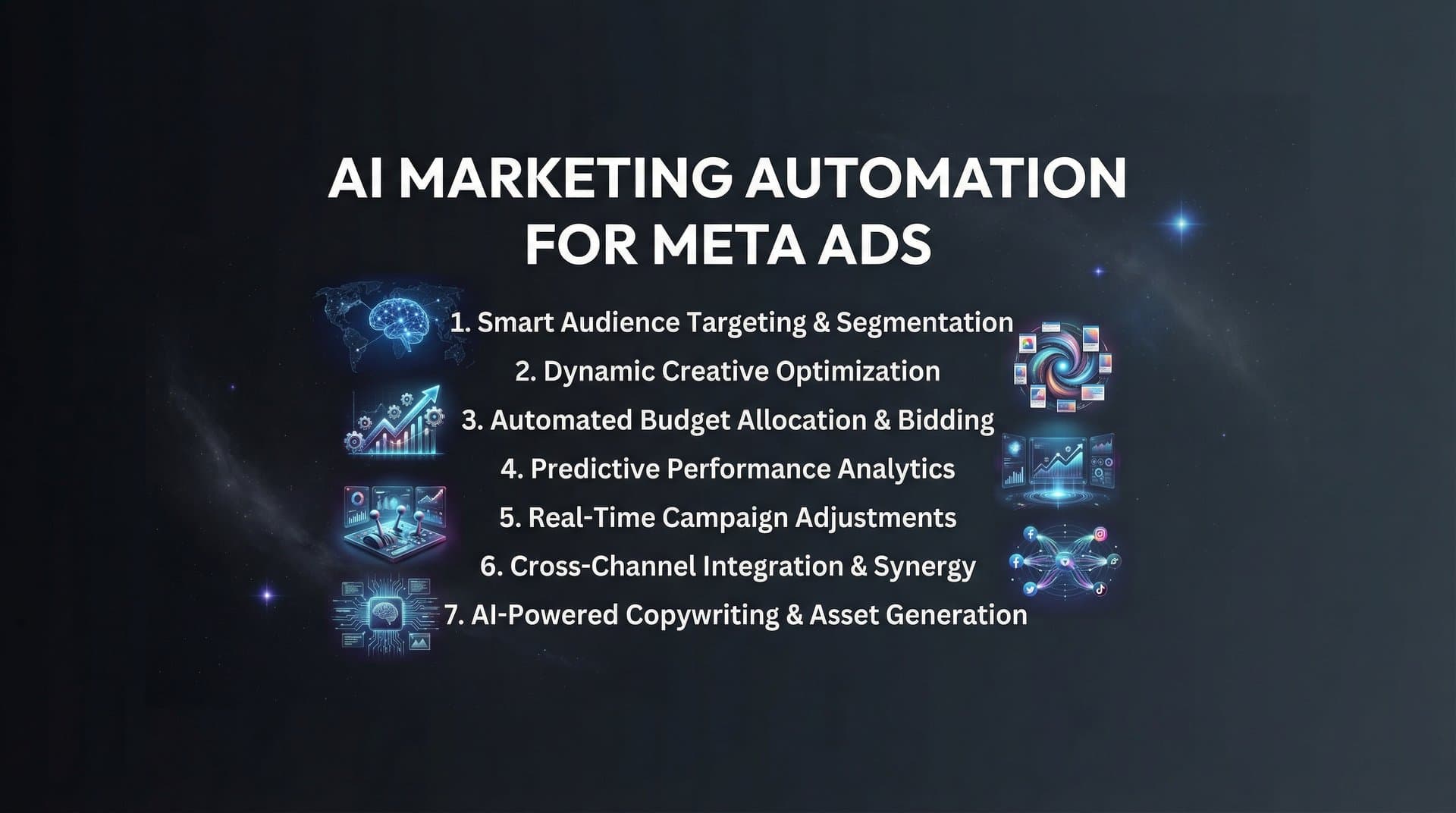
This guide explores seven practical strategies for implementing AI automation in your Meta advertising workflow. Each approach addresses a specific bottleneck in campaign management, from initial structure building to ongoing optimization. Whether you're managing campaigns for a single business or juggling multiple client accounts, these strategies will help you scale results without scaling your workload.
1. Automate Campaign Structure Building with AI Agents
The Challenge It Solves
Building Meta campaign structures manually means making dozens of decisions for each launch. Which campaign objective aligns with your goal? How should ad sets be organized? What naming conventions maintain clarity across hundreds of active campaigns? These decisions are necessary but time-consuming, especially when launching multiple campaigns weekly.
The cognitive load adds up. You're not just building campaigns—you're maintaining consistency across naming conventions, ensuring proper hierarchy, and avoiding structural mistakes that waste budget. For agencies managing multiple clients, this complexity multiplies with each account.
The Strategy Explained
Specialized AI agents can handle distinct elements of campaign construction. Think of it as assembling a team where each agent focuses on one aspect: a Director agent analyzes your goals and recommends campaign types, a Structure Architect organizes the hierarchy, a Targeting Strategist selects audiences, and so on.
This division of labor mirrors how experienced media buyers think through campaigns, but executes in seconds rather than hours. Each agent applies specific logic to its domain, then passes the output to the next agent in the workflow. The result is a complete campaign structure ready for review and launch.
The transparency matters as much as the speed. Quality AI systems explain their reasoning—why they recommended a particular campaign objective, how they structured ad sets, what informed their targeting choices. This visibility lets you maintain strategic control while delegating execution.
Implementation Steps
1. Define your campaign parameters clearly: conversion goal, target audience characteristics, budget range, and any creative constraints. The more specific your input, the more precise the AI output.
2. Let the AI agents build the initial structure, then review each element systematically. Check campaign objectives, ad set organization, and naming conventions for alignment with your standards.
3. Launch with small test budgets initially. Validate that the AI-built structure performs as expected before scaling. Use these early campaigns to refine your input parameters for future builds.
Pro Tips
Start with straightforward campaigns—single product promotions or lead generation with clear conversion goals. Master the basics before automating complex multi-product or retargeting structures. Document which input parameters produce the best results, then create templates for common campaign types you launch repeatedly.
2. Leverage Historical Performance Data for Audience Targeting
The Challenge It Solves
Audience targeting decisions typically rely on assumptions and broad demographic data. You guess which interests correlate with purchase intent. You estimate age ranges and geographic priorities. Sometimes these guesses work. Often they don't, and you've spent budget learning what doesn't convert.
Your historical campaign data contains patterns that manual analysis misses. Which interest combinations drove the highest conversion rates? What demographic segments showed strong engagement but poor conversion? Which lookalike audience percentages found the sweet spot between reach and relevance? These insights exist in your data, but extracting them manually is impractical at scale.
The Strategy Explained
AI can analyze your conversion data to identify targeting patterns that actually drove results. Instead of starting each campaign with fresh assumptions, the system reviews which audiences converted in previous campaigns and uses those patterns to inform new targeting decisions.
This approach works particularly well for businesses with substantial historical data. The AI identifies correlations between audience parameters and conversion outcomes, then suggests targeting configurations that mirror your best performers. It's pattern recognition applied to your specific business context.
The key difference from manual analysis is scale and speed. An AI can process thousands of data points across dozens of campaigns in seconds, identifying subtle patterns that would take hours of spreadsheet work to uncover manually.
Implementation Steps
1. Connect your historical campaign data to your AI automation system. Ensure conversion tracking has been consistent—the AI needs clean data to identify reliable patterns.
2. Review the AI's audience recommendations with skepticism initially. Cross-reference suggested targeting against your business knowledge. Does a recommended interest make sense for your product? Would that demographic actually convert?
3. Test AI-recommended audiences alongside your manual selections. Split test budgets between AI-suggested targeting and your traditional approach. Let performance data validate which method identifies better audiences.
Pro Tips
The quality of AI targeting recommendations depends entirely on your historical data quality. If your conversion tracking has been inconsistent or if you've frequently changed your conversion events, clean that data before relying on AI analysis. Focus the AI on campaigns with at least 50-100 conversions for statistically meaningful pattern recognition.
3. Scale Creative Testing Through AI-Powered Variation Generation
The Challenge It Solves
Creative fatigue hits fast on Meta platforms. An ad that converts well this week loses effectiveness next week as your audience sees it repeatedly. The solution is constant testing, but manually creating variations consumes significant time. You need different headlines, various descriptions, multiple calls-to-action—each combination representing a potential winner.
The math becomes overwhelming quickly. Five headlines times four descriptions times three calls-to-action equals 60 ad variations. Creating that many ads manually for a single campaign is impractical. Most marketers settle for testing 3-5 variations and hope one performs well.
The Strategy Explained
AI can generate ad copy variations at scale while maintaining your brand voice and messaging guidelines. You provide the core value propositions, key benefits, and brand parameters. The AI creates multiple versions of headlines, descriptions, and calls-to-action that express these elements in different ways.
This isn't about replacing creative strategy—it's about executing creative testing at a velocity that manual work can't match. You still define what makes your offer compelling and which benefits matter most. The AI handles the tactical work of expressing those concepts across dozens of variations.
The real power emerges when you combine AI-generated variations with bulk launching capabilities. Instead of testing 5 ads, you can test 50. Instead of one creative angle, you can explore five simultaneously. More tests mean faster identification of winning approaches.
Implementation Steps
1. Document your brand voice guidelines clearly. What tone should ads use? Which phrases align with your brand? What language should be avoided? Clear parameters produce better AI-generated variations.
2. Start with headline and description variations before expanding to full ad copy. Test AI-generated headlines against your manual versions to calibrate quality before scaling up.
3. Review all AI-generated variations before launch. Look for off-brand language, awkward phrasing, or messaging that doesn't align with your offer. Edit or remove variations that don't meet your standards.
Pro Tips
Feed the AI examples of your best-performing ad copy. The system can analyze what made those ads effective and incorporate similar elements into new variations. Also, use AI generation for systematic testing of specific elements—create 10 variations that test different value propositions, then 10 more that test different calls-to-action. Structured testing produces clearer insights than random variation.
4. Implement Bulk Launching for Rapid Campaign Deployment
The Challenge It Solves
Launching campaigns one at a time creates a significant bottleneck. You build the campaign structure, upload creative, configure targeting, set budgets, review everything, then launch. Repeat for the next campaign. If you're testing multiple approaches or managing several client accounts, this sequential process consumes entire days.
The opportunity cost is substantial. Time spent on campaign setup is time not spent on strategy, creative development, or performance analysis. For agencies, slow campaign deployment limits how many clients you can effectively serve.
The Strategy Explained
Bulk launching lets you deploy dozens of campaigns simultaneously. Instead of building and launching campaigns sequentially, you configure multiple campaigns in parallel, then launch them all at once. The time savings compound—what might take 6 hours of sequential launching happens in 30 minutes.
This approach works best when combined with templates and AI-populated variations. Create a campaign template with your standard structure, then let AI populate different targeting, creative, or budget variations across multiple instances. Review the batch, make any necessary adjustments, then launch everything together.
The velocity advantage is obvious, but there's a strategic benefit too. Bulk launching enables true parallel testing. Instead of testing one hypothesis this week and another next week, you can test multiple approaches simultaneously and identify winners faster.
Implementation Steps
1. Create campaign templates for your most common campaign types. Define the standard structure, naming conventions, and default settings. These templates become the foundation for bulk launching.
2. Use AI to populate variations across template instances. Let the system handle the repetitive work of adjusting targeting parameters, swapping creative elements, or modifying budgets across multiple campaigns.
3. Implement a systematic review process before bulk launching. Check a representative sample of campaigns thoroughly, then spot-check the rest. Don't sacrifice quality control for speed—a mistake multiplied across 50 campaigns is worse than launching slowly.
Pro Tips
Start with smaller bulk launches—maybe 5-10 campaigns—until you've refined your template and review process. The goal is to build confidence in the system before scaling to larger batches. Also, stagger your bulk launches slightly rather than launching everything at the exact same moment. This prevents any technical issues from affecting all campaigns simultaneously.
5. Build a Winners Library for Continuous Learning
The Challenge It Solves
Most marketers treat each campaign as a fresh start. You create new audiences, write new ad copy, design new creative—often forgetting which elements performed well in previous campaigns. This approach wastes valuable learning. Your past winners contain proven elements that could accelerate new campaign performance.
The problem is organizational. Where do you store information about which headlines converted best? How do you track which audience configurations drove the lowest cost per acquisition? Which creative formats generated the highest engagement? Without systematic documentation, this knowledge stays trapped in old campaigns or exists only in your memory.
The Strategy Explained
A winners library creates a repository of proven campaign elements that AI can reference when building new campaigns. Think of it as a database of your greatest hits—successful headlines, high-performing audiences, effective creative formats, optimal budget allocations—all tagged and categorized for easy retrieval.
The AI uses this library as a reference point. When building a new campaign, it can pull targeting parameters from your best-performing audiences, incorporate headline structures that drove high conversion rates, or suggest creative formats that historically engaged your audience. Each new campaign builds on proven foundations rather than starting from scratch.
This creates a continuous learning loop. New campaigns that perform well get added to the winners library. The library grows more valuable over time as it accumulates more proven elements. Your AI automation gets smarter with each successful campaign.
Implementation Steps
1. Audit your historical campaigns to identify clear winners. Look for campaigns that exceeded your target metrics—cost per acquisition, return on ad spend, conversion rate. Document what made them successful.
2. Extract specific elements from winning campaigns: exact targeting parameters, headline formulas, creative formats, budget allocation strategies. Store these as reusable components, not just as examples to reference.
3. Create a systematic process for adding new winners to your library. After each campaign reaches statistical significance, evaluate whether it contains elements worth preserving. Make library updates a regular part of your campaign workflow.
Pro Tips
Don't just save entire campaigns—break them down into components. A winning campaign might have effective targeting but mediocre creative, or great headlines but suboptimal budget allocation. Save the specific elements that drove success. Also, add context notes explaining why each element worked. "High-converting audience" is less useful than "High-converting audience: 35-50 age range, interest in specific competitor brands, excluded previous purchasers."
6. Use AI-Driven Budget Allocation Across Campaigns
The Challenge It Solves
Budget management across multiple campaigns creates constant decision-making overhead. Campaign A is performing well—should you increase its budget? Campaign B's cost per acquisition is rising—time to pause or reduce spend? Campaign C just launched—how long before you can evaluate its performance? These decisions multiply across dozens of active campaigns.
Manual budget management also introduces delays. You notice a campaign performing well, but you're busy with other tasks. By the time you increase the budget, the opportunity window may have shifted. Conversely, underperforming campaigns continue spending while you're focused elsewhere, wasting budget that could be reallocated.
The Strategy Explained
AI can monitor performance signals across all active campaigns and recommend budget adjustments based on predefined rules. You set the parameters—what metrics indicate strong performance, what thresholds trigger budget increases or decreases, how aggressively to reallocate spend—and the AI executes according to those guidelines.
This approach works particularly well for marketers managing many campaigns simultaneously. Instead of manually checking each campaign's performance daily, the AI continuously monitors everything and flags opportunities or problems. You review the recommendations and approve changes, maintaining control while eliminating the monitoring burden.
Some systems can automate budget adjustments entirely based on your rules. A campaign exceeding target return on ad spend automatically receives more budget. One underperforming for three consecutive days gets paused. This level of automation requires careful rule configuration, but it enables truly hands-off optimization.
Implementation Steps
1. Define clear performance thresholds for budget decisions. What cost per acquisition justifies a budget increase? What return on ad spend indicates a campaign deserves more investment? What signals suggest a campaign should be paused? Document these rules explicitly.
2. Start with AI recommendations rather than full automation. Let the system suggest budget changes, but review and approve them manually initially. This builds confidence in the AI's decision-making before enabling autonomous adjustments.
3. Monitor the results of AI-driven budget changes closely. Did campaigns that received increased budgets maintain their performance? Did paused campaigns actually deserve to be stopped? Use this feedback to refine your rules over time.
Pro Tips
Set conservative thresholds initially. It's better to miss some optimization opportunities than to have the AI make aggressive changes that waste budget. As you gain confidence in the system, you can increase the aggressiveness of your rules. Also, always maintain manual override capability—there will be situations where business context requires budget decisions that don't align with performance data alone.
7. Integrate Attribution Tracking with AI Decision-Making
The Challenge It Solves
Meta's native attribution has limitations that every experienced advertiser knows. Attribution windows don't capture the full customer journey. iOS privacy changes reduced data visibility. Multiple touchpoints across channels make it difficult to credit Meta ads appropriately. These attribution challenges lead to optimization decisions based on incomplete data.
The disconnect between attribution data and campaign optimization creates inefficiency. You might be using a third-party attribution tool that shows the true value of your campaigns, but your AI automation is making decisions based on Meta's native data. This mismatch means the AI optimizes toward the wrong goals.
The Strategy Explained
Connecting third-party attribution tools directly to your AI automation ensures optimization decisions reflect accurate performance data. Instead of relying solely on Meta's attribution, the AI incorporates data from your attribution platform—actual revenue generated, true customer acquisition costs, lifetime value patterns—into its decision-making process.
This integration is particularly valuable for businesses with longer sales cycles or multi-touch customer journeys. The AI can see which campaigns contributed to conversions even when Meta's attribution window missed them. It can identify campaigns that drive high-value customers versus those attracting one-time buyers. These insights lead to smarter optimization decisions.
The technical integration varies by platform, but the concept is consistent: your attribution tool becomes a data source that informs AI automation. The AI doesn't just optimize for Meta-attributed conversions—it optimizes for actual business outcomes as measured by your attribution system.
Implementation Steps
1. Select an attribution platform that offers integration capabilities with your AI automation system. Verify that the platforms can share data bidirectionally—attribution data flowing to the AI, campaign performance data flowing to the attribution tool.
2. Define which attribution metrics should inform AI decisions. Is it first-touch attribution, last-touch, or a multi-touch model? What conversion window accurately reflects your business? Configure the integration to pass the right data points.
3. Run parallel optimization initially. Let the AI make decisions based on both Meta's native data and your attribution platform data. Compare the results to validate that attribution-informed decisions actually improve outcomes.
Pro Tips
Don't completely discard Meta's native attribution data—it still provides value for short-term optimization and real-time feedback. Use attribution platform data for strategic decisions (which campaigns to scale, where to allocate budget) while using Meta's data for tactical optimization (which ads to keep running, when to refresh creative). The combination provides both immediate signals and accurate long-term measurement.
Putting It All Together
Implementing AI marketing automation for Meta ads isn't about adopting all seven strategies simultaneously. Start with campaign structure automation to create immediate time savings and build confidence in AI-assisted workflows. Once you're comfortable with automated structure building, layer in historical data analysis to improve targeting precision.
The marketers seeing the strongest results treat these strategies as building blocks. Campaign structure automation provides the foundation. Creative scaling and bulk launching multiply your testing velocity. Winners libraries and attribution integration create continuous improvement loops. Budget automation ensures optimal resource allocation across everything you're running.
Your role evolves from campaign executor to strategic director. Instead of spending hours building campaigns manually, you define the strategy, set the parameters, and review AI-generated outputs. The AI handles execution speed and scale. You handle creative direction, strategic priorities, and business context that no automation can replicate.
The competitive advantage isn't just efficiency—it's the ability to test more variations, launch campaigns faster, and optimize based on comprehensive data. While competitors manually build 5 campaigns per week, you're launching 50. While they test 3 ad variations, you're testing 30. That velocity advantage compounds over time into significantly better performance and market understanding.
Ready to transform your advertising strategy? Start Free Trial With AdStellar AI and be among the first to launch and scale your ad campaigns 10× faster with our intelligent platform that automatically builds and tests winning ads based on real performance data.