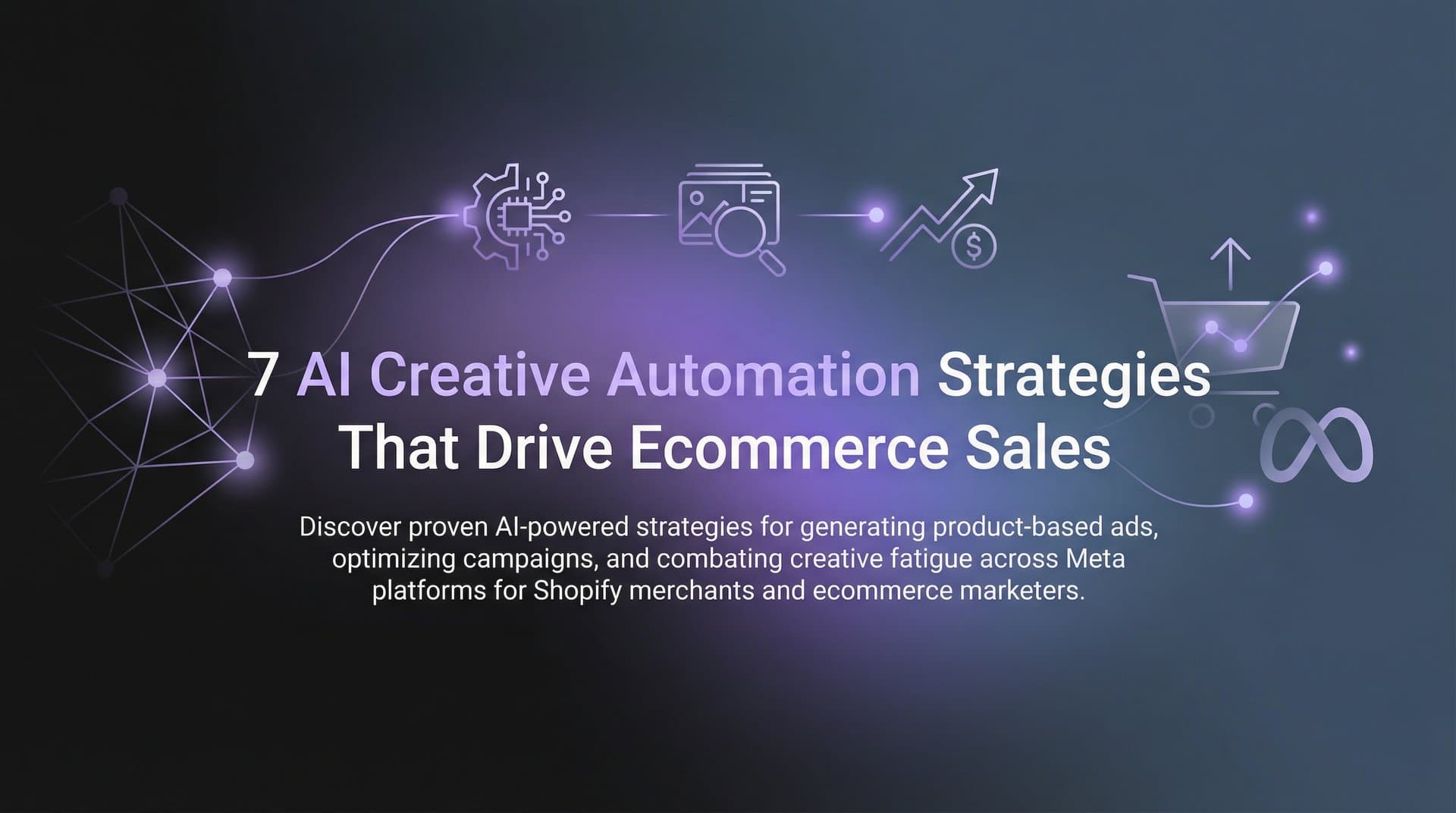
The ecommerce advertising landscape has fundamentally shifted. Manual creative production that once took days now happens in minutes. Campaign optimization that required constant human monitoring now runs intelligently in the background.
For ecommerce brands competing for attention across Meta, the question is no longer whether to adopt AI creative automation but how to implement it strategically.
This guide breaks down seven proven strategies for leveraging AI creative automation in your ecommerce advertising. Each approach addresses a specific challenge that ecommerce marketers face daily, from creative fatigue to scaling winning campaigns.
Whether you're running a Shopify store or managing ads for multiple ecommerce clients, these strategies will help you produce more effective ads, launch campaigns faster, and identify winners with precision.
1. Generate Product-Based Creatives at Scale
The Challenge It Solves
Most ecommerce brands struggle with a simple math problem: you need fresh creatives constantly, but design resources are limited. A single product might require image ads for feed placement, video ads for Stories, and UGC-style content for Reels. Multiply that by your product catalog, and you're looking at hundreds of creative variations.
The traditional approach means hiring designers, briefing them on each product, waiting for revisions, and still ending up with a backlog of products that never get proper creative attention.
The Strategy Explained
AI creative automation transforms a product URL into multiple ad formats without manual design work. You input your product page link, and the system analyzes the product images, descriptions, and key features to generate scroll-stopping creatives across different formats.
This approach works particularly well for ecommerce because AI can extract product benefits, create compelling headlines, and adapt visual styles to match different ad placements. The same product generates a static image ad for feed, a video showcasing features, and a UGC-style presentation, all from a single input.
The speed advantage is significant. What previously took a design team several days per product now happens in minutes, allowing you to maintain creative freshness across your entire catalog. Many brands are turning to creative automation tools to solve this exact challenge.
Implementation Steps
1. Select your highest-priority products based on margins, inventory levels, or seasonal relevance rather than trying to create ads for everything at once.
2. Input product URLs into your AI creative platform and specify which ad formats you need for your current campaign objectives.
3. Review the generated creatives and use chat-based editing to refine messaging, adjust visual emphasis, or test different benefit angles before launching.
Pro Tips
Start with your best-selling products to build confidence in the system before expanding to your full catalog. The AI learns from successful patterns, so feeding it proven products first helps establish quality benchmarks. Also, generate multiple variations per product immediately rather than one at a time. Testing different creative angles from day one reveals which messaging resonates fastest with your audience.
2. Clone and Improve Competitor Ad Strategies
The Challenge It Solves
Your competitors are running ads that work. You see them repeatedly in your feed, which means they're profitable enough to keep running. But reverse-engineering their creative strategy manually means screenshots, guesswork about messaging frameworks, and hoping your design team can recreate the magic.
Even when you identify winning competitor approaches, translating those insights into your own unique creatives takes significant time and creative resources.
The Strategy Explained
AI creative automation connects directly to the Meta Ad Library, allowing you to analyze competitor ads and generate inspired variations that maintain your brand identity. This isn't about copying. It's about identifying what's working in your market and creating unique executions that leverage similar principles.
The system analyzes the structure, messaging patterns, and visual approaches of successful competitor ads, then generates variations that apply those frameworks to your products. You get the strategic advantage of market research combined with the speed of automated creative production.
This strategy works especially well when entering new markets or testing unfamiliar product categories where you lack historical performance data. Understanding Meta ads for ecommerce stores gives you a competitive foundation to build upon.
Implementation Steps
1. Identify 3-5 competitor ads from Meta Ad Library that have been running consistently for weeks or months, indicating strong performance.
2. Use AI to analyze the messaging structure, visual hierarchy, and benefit presentation in those ads to understand why they resonate.
3. Generate your own variations that apply similar frameworks to your products while maintaining distinct creative execution that reflects your brand voice.
Pro Tips
Focus on ads that have been running for at least 30 days. Longevity in the Ad Library typically signals profitability. Also, look beyond your direct competitors to adjacent product categories. A winning creative strategy for fitness supplements might translate beautifully to skincare products if you adapt the messaging properly. The best insights often come from outside your immediate competitive set.
3. Automate Multi-Variant Testing Through Bulk Launching
The Challenge It Solves
Testing is how you find winners, but manual testing is brutally slow. Creating individual ad sets for every combination of creative, headline, audience, and copy variation means hours of repetitive work in Ads Manager. Most marketers end up testing fewer combinations than they should simply because the setup process is exhausting.
The result? You find local maxima instead of true winners because you never tested enough variations to discover what actually performs best.
The Strategy Explained
Bulk launching creates hundreds of ad variations by automatically combining different elements at both the ad set and ad level. You select multiple creatives, headlines, audiences, and copy variations, and the system generates every possible combination before launching them to Meta in minutes.
This approach dramatically increases your testing volume without increasing your workload. Instead of manually creating 50 ad variations, you define the elements you want to test and let automation handle the combinatorial math. Implementing ad creative testing automation transforms how quickly you can identify winning combinations.
The strategy is particularly powerful for ecommerce because products often have multiple benefit angles, audience segments, and seasonal messaging opportunities that all deserve testing.
Implementation Steps
1. Prepare your testing elements by creating 3-5 creatives, 3-5 headlines, 2-3 audience segments, and 2-3 primary text variations for your product.
2. Define your testing structure by deciding whether to vary elements at the ad set level (testing audiences) or ad level (testing creative and copy).
3. Launch all combinations simultaneously with consistent budgets so you can compare performance across a level playing field rather than staggered tests.
Pro Tips
Start with smaller test matrices before scaling to hundreds of variations. A 3x3x2 test (3 creatives, 3 headlines, 2 audiences) gives you 18 combinations, which is enough to find meaningful patterns without overwhelming your budget. Once you identify which variables matter most for your products, you can expand testing in those specific dimensions. Also, maintain detailed naming conventions from the start so you can easily analyze which elements drove winning performance.
4. Let AI Build Campaigns From Historical Performance Data
The Challenge It Solves
Every campaign you've run contains valuable data about what works, but that knowledge typically lives scattered across Ads Manager, spreadsheets, and your memory. When building new campaigns, you're essentially starting from scratch each time instead of building on proven insights.
Manual analysis of historical performance is time-consuming and prone to bias. You might remember the creative that performed well last month but forget about the audience segment that consistently delivered low CPAs across multiple campaigns.
The Strategy Explained
AI campaign building analyzes your complete advertising history, ranks every creative, headline, and audience by actual performance metrics, and uses those insights to construct new campaigns. The system identifies patterns you might miss, like specific headline structures that consistently drive conversions or audience combinations that outperform individual segments.
What makes this approach powerful is transparency. The AI doesn't just build campaigns; it explains why it selected each element, showing you the performance data that informed each decision. You understand the strategy, not just the output. Exploring Meta ads campaign automation software can help you leverage this data-driven approach effectively.
This creates a continuous improvement loop where each campaign feeds better data into the next one, and your advertising gets progressively more effective over time.
Implementation Steps
1. Connect your Meta Ads account so the AI can analyze your complete campaign history, including performance metrics for every creative, audience, and messaging element.
2. Define your current campaign objective and target metrics so the AI can prioritize elements that have historically delivered against similar goals.
3. Review the AI's recommendations and rationale before launching, using the transparency to learn which patterns drive performance in your specific market.
Pro Tips
The more campaign history you have, the better the AI performs, but you can start seeing value with as few as 3-5 completed campaigns. Also, pay attention to the AI's reasoning even when you disagree with a recommendation. Sometimes the data reveals counterintuitive patterns that your assumptions would have missed. Those moments of surprise often lead to breakthrough insights about your audience.
5. Score Every Ad Element Against Your Business Goals
The Challenge It Solves
Looking at campaign dashboards tells you which ads spent the most or generated the most clicks, but those vanity metrics don't necessarily align with your business objectives. A creative might have a fantastic CTR but terrible conversion rates. An audience might deliver high volume but miss your target CPA.
Without a systematic way to score elements against your actual goals, you end up optimizing for the wrong metrics or making decisions based on incomplete pictures of performance.
The Strategy Explained
Goal-based scoring ranks every element of your campaigns by the metrics that actually matter to your business. You set target benchmarks for ROAS, CPA, or CTR, and the system scores every creative, headline, audience, and landing page against those goals.
This transforms your performance data from a confusing spreadsheet into a clear leaderboard. You can instantly see which creatives are crushing your ROAS target, which audiences are delivering below your CPA threshold, and which headlines are driving the engagement rates you need. Understanding the Facebook campaign automation benefits helps you appreciate why systematic scoring matters.
The approach is particularly valuable for ecommerce where different products might have different profitability targets. Your scoring can reflect that a premium product needs higher ROAS while a volume product optimizes for lower CPA.
Implementation Steps
1. Define your target metrics based on actual business requirements, not industry benchmarks that might not reflect your specific economics.
2. Set up leaderboards for each element type so you can view top-performing creatives separately from top-performing audiences and headlines.
3. Review scores regularly to identify patterns, like certain creative styles consistently scoring high or specific audience segments always underperforming against your targets.
Pro Tips
Use different scoring criteria for different campaign objectives. Your prospecting campaigns might optimize for CTR and cost per landing page view, while your retargeting campaigns focus purely on ROAS. Also, look at the bottom of your leaderboards as much as the top. Identifying consistent underperformers helps you eliminate what doesn't work just as much as finding winners helps you scale what does.
6. Build a Winners Hub for Rapid Campaign Deployment
The Challenge It Solves
You've identified winning creatives, headlines, and audiences through testing, but that knowledge exists only in your memory or scattered across old campaigns. When you need to launch a new promotion or scale quickly, you're manually hunting through Ads Manager trying to remember which creative performed well three months ago.
This friction means you often start fresh rather than building on proven winners, essentially throwing away the expensive testing you've already done.
The Strategy Explained
A Winners Hub centralizes all your top-performing assets in one place with the actual performance data attached. Instead of searching through campaign history, you see your best creatives, headlines, audiences, and copy variations organized by performance metrics.
When building a new campaign, you simply select from your proven winners and deploy them immediately. This dramatically reduces launch time while increasing the probability of success because you're starting with elements that have already demonstrated strong performance. Many marketers use Meta campaign automation tools to maintain and leverage their winners library.
The real power comes from treating your Winners Hub as a living library that grows with every campaign. Each test adds new proven elements, and your arsenal of high-performing assets expands over time.
Implementation Steps
1. Establish clear criteria for what qualifies as a winner based on your goal thresholds, so only genuinely high-performing elements make it into your hub.
2. Organize winners by category such as product type, campaign objective, or seasonal relevance so you can quickly find relevant assets for specific situations.
3. Review your Winners Hub monthly to retire elements that no longer perform as creative fatigue sets in and refresh with newly identified top performers.
Pro Tips
Don't wait until you have dozens of winners to start building your hub. Even with three proven creatives and two strong audiences, you've created a foundation that beats starting from scratch. Also, add notes about why certain elements won. A creative that crushed during Black Friday might not work in March, but understanding the underlying appeal helps you adapt the concept rather than just reusing the exact asset.
7. Create UGC-Style Ads Without Creator Dependencies
The Challenge It Solves
User-generated content style ads consistently outperform polished brand content, but creating authentic UGC at scale is logistically challenging. You need to find creators, negotiate rates, provide products, wait for content delivery, handle revisions, and manage usage rights. The process is slow and expensive, especially when you need fresh UGC for multiple products.
Many ecommerce brands simply can't produce UGC fast enough to keep up with their testing velocity or product launch schedule.
The Strategy Explained
AI-generated UGC uses avatar technology to create authentic-looking video content without hiring creators. You can produce UGC-style ads that show someone using and recommending your product, complete with natural speech patterns and genuine-feeling testimonials.
The key advantage is speed and scalability. You can create UGC-style content for every product in your catalog, test multiple presentation angles, and refresh creative as often as needed without the coordination overhead of working with human creators. Leveraging Facebook ad creative automation makes this process seamless.
This doesn't replace all creator partnerships, but it fills the gap when you need UGC-style content quickly or for products where finding relevant creators is difficult.
Implementation Steps
1. Select products where UGC-style presentation would be particularly effective, typically items with clear before/after results or emotional benefits that resonate in personal testimonial format.
2. Write scripts that sound natural and conversational rather than overly promotional, focusing on specific benefits and use cases that real customers would mention.
3. Generate multiple avatar styles and delivery approaches to test which presentation resonates best with your audience before scaling production.
Pro Tips
Keep your initial UGC-style videos short, typically 15-30 seconds. Authentic UGC is rarely long-winded, and shorter videos perform better in feed placements anyway. Also, mix AI-generated UGC with real customer testimonials when possible. The combination gives you both the scalability of AI and the genuine authenticity of real users, creating a more robust creative portfolio than either approach alone.
Putting It All Together
Implementing AI creative automation for ecommerce isn't about replacing human creativity. It's about removing the bottlenecks that prevent good ideas from reaching your audience quickly.
Start with the strategy that addresses your biggest pain point. If creative production slows you down, begin with product-based generation. If you struggle to identify winners, focus on goal-based scoring and building your Winners Hub.
The ecommerce brands seeing the strongest results combine multiple strategies into a continuous loop: generate creatives, launch variations at scale, score performance against goals, save winners, and feed those insights back into the next campaign.
That cycle of creation, testing, and learning is where AI creative automation delivers compounding returns. Your first campaign might find a few winners. Your fifth campaign builds on proven elements and tests new variations simultaneously. Your twentieth campaign operates from a library of validated assets while still discovering fresh approaches.
The speed advantage matters more than most marketers initially realize. When you can generate creatives in minutes instead of days, you can respond to market shifts immediately. When you can launch hundreds of test variations in the time it used to take to build one campaign, you find winners faster and scale them while they're still fresh.
Ready to transform your advertising strategy? Start Free Trial With AdStellar and be among the first to launch and scale your ad campaigns 10× faster with our intelligent platform that automatically builds and tests winning ads based on real performance data.