Think about trying to build thousands of unique cars by hand versus using a modern assembly line. That’s the real difference between old-school manual ad creation and what’s possible today with creative automation tools.
So, what are these tools, exactly? At their core, they are software platforms designed to help marketing teams produce, manage, and scale ad creative way faster than any human team could. By taking over the repetitive design and production work, these tools let brands generate hundreds—even thousands—of ad variations for testing in minutes, not days. This isn't just a "nice-to-have" anymore; for paid social campaigns where personalization and speed are everything, it's essential.
Why Creative Automation Is No Longer Optional
On platforms like Meta, the need for fresh, personalized ad content is relentless. Every marketer has felt the sting of creative fatigue—that point where audiences see the same ads too often and performance just tanks.
Trying to manually create unique ads for every single audience segment, product, and promotion is a recipe for disaster. It’s painfully slow, incredibly expensive, and a surefire way to burn out your creative team. Creative automation steps in to solve this problem, acting as an intelligent bridge between your creative assets (images, videos, logos) and your performance data. Instead of a designer slogging through 50 ad variations, a platform can whip up 500 in the time it takes to grab a coffee.
Bridging Creative Production and Performance
But this isn't just about making things faster. It’s about making them smarter. These platforms introduce a new level of data-driven thinking that turns a chaotic, reactive creative process into a predictable engine for growth.
Here’s how they completely change the game:
- Massive Scale: Instantly generate countless ad variations by mixing and matching headlines, images, calls-to-action, and audience segments.
- Data-Informed Ideation: Look at past campaign performance to see which creative elements actually drive results, giving you a solid foundation for your next big idea.
- Reduced Manual Labor: Free up your designers and marketers from the tedious, copy-paste grind so they can focus on high-level strategy and genuinely new concepts.
This shift is happening right now. The generative AI market within creative fields—a huge part of these automation tools—is exploding. Projections show it hitting USD 4.06 billion by 2025, with a staggering 79% of companies already using AI to automate their creative workflows. For growth teams, this means you can finally scale personalized ads across global markets without having to hire an army of designers.
The point of creative automation isn't to automate creativity itself. It's about removing the friction from repetitive production, which ironically creates more space for strategic thinking and breakthrough ideas.
To really see the difference, let's break down the two approaches side-by-side.
Manual Ad Creation vs Creative Automation
The table below paints a clear picture of how these workflows stack up. On one side, you have the traditional, labor-intensive process. On the other, a streamlined, data-driven system built for modern advertising.
| Aspect | Manual Workflow | Automated Workflow |
|---|---|---|
| Speed | Slow; days or weeks per campaign | Fast; minutes or hours to generate variants |
| Scale | Limited; a few dozen variations at most | Massive; hundreds or thousands of variants |
| Cost | High; significant designer and marketer hours | Lower; reduces manual labor and resource costs |
| Testing | Limited and slow; difficult to test many ideas | Extensive and fast; enables rapid A/B testing |
| Data Use | Reactive; analysis happens after the campaign | Proactive; data informs creative from the start |
| Personalization | Difficult to achieve at scale | Easy to personalize for multiple segments |
As you can see, the automated approach doesn't just improve on the manual one—it fundamentally transforms it.
From Guesswork to a Growth Engine
Ultimately, creative automation tools change the very nature of campaign management. The focus shifts from just making ads to analyzing what works. By connecting creative inputs directly to performance outputs like ROAS and CPA, these platforms build a powerful feedback loop. You can learn more about how this works in our guide on AI ad creation.
This system allows teams to test more ideas, learn faster, and invest their budget with a level of confidence that was once impossible. If you want to dive deeper into the tech that powers these solutions, you can explore the specifics of Ad Creative AI.
How Automation Transforms Meta Ad Campaigns
Switching from manual ad creation to an automated workflow feels a bit like going from a single hand wrench to a full-blown robotic assembly line. Instead of painstakingly piecing together one ad at a time, you suddenly have the power to produce, test, and tweak campaigns at a scale that used to be completely out of reach for most teams.
This is a game-changer for Meta campaigns, where the audience’s hunger for fresh content never ends. Creative automation tools don't just speed things up; they fundamentally alter your entire approach. At its core, this shift is all about being able to generate hundreds of ad variations in minutes, not hours or days.
Let’s say you have five killer images, five headlines you think will work, and five different calls-to-action. If you had to create every possible combination by hand, it would be a mind-numbing task. An automation platform, on the other hand, can instantly mix and match these assets, spitting out 125 unique ad variations that are ready to go. This lets you cover far more ground, far faster, so you can find the perfect message for every single audience segment.
This diagram really captures that jump from the manual grind to an automated growth engine.
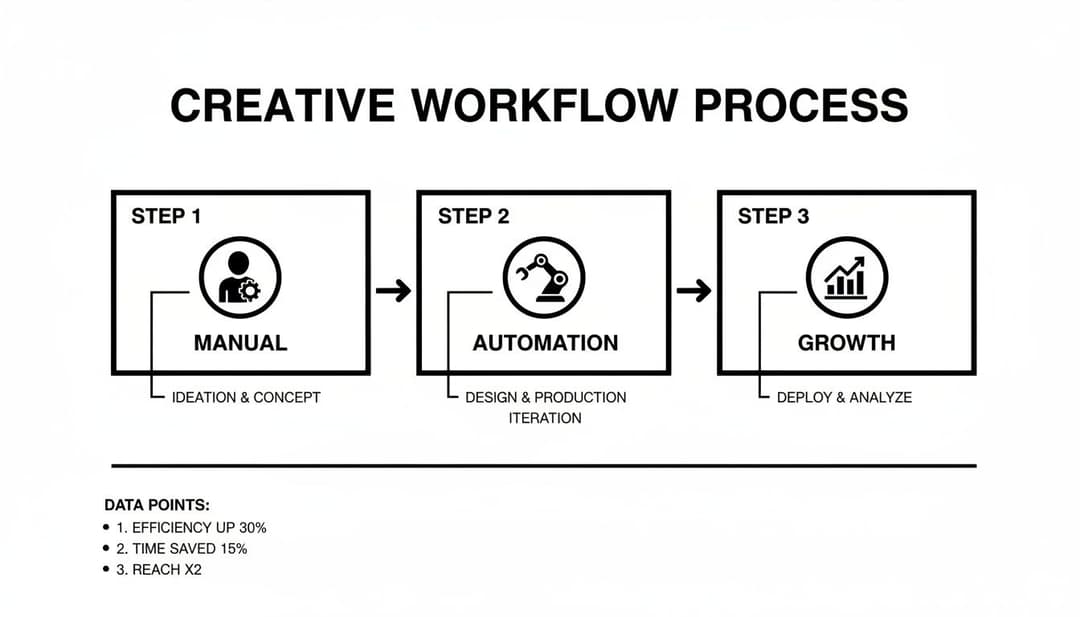
It shows how automation acts as a force multiplier, taking your human-led strategy and scaling it up to produce measurable, data-driven results.
From Raw Assets To Actionable Insights
The real magic of creative automation tools happens after the variations are made. The best platforms plug directly into your Meta Ads Manager, creating a powerful, nonstop feedback loop.
Here’s how that workflow typically breaks down:
- Ingest Historical Data: The platform scans your past campaign performance, figuring out which images, copy, and audience segments have delivered the best results for you before.
- Generate Variations at Scale: You feed it your new creative assets and copy ideas. The system then churns out hundreds of ad combinations, informed by both your new inputs and what it learned from your past winners.
- Launch and Test: With a single click, all those variations are pushed live into Meta Ads Manager as highly structured tests aimed at different audience segments.
- Analyze and Rank: As the performance data starts rolling in, the AI gets to work. It ranks every single ad variant against your main goal, whether that’s ROAS (Return on Ad Spend) or CPA (Cost Per Acquisition).
This whole process pulls guesswork out of the equation. Instead of crossing your fingers and hoping a creative hits, you get a clean, data-backed leaderboard showing you exactly what’s performing and what’s not. It becomes crystal clear which patterns are resonating with your audience.
The Continuous Optimization Loop
This data-driven cycle creates a flywheel of constant improvement. Once the AI flags the top-performing 5% of your ads, it doesn’t just stop. Platforms like AdStellar use that insight to make the next round of creative even smarter.
The goal is no longer just to launch ads. It’s to build an intelligent system that learns from every dollar spent, allowing you to make smaller, smarter bets to find the winners before scaling them with confidence.
This is exactly how performance marketing is evolving. In fact, AI usage in creative workflows has jumped by a staggering 220% in 2024 alone. This is part of a much bigger trend, with the global marketing automation market expected to swell from $7.23 billion in 2025 to $20.12 billion by 2034.
For any team focused on growth, producing thousands of ad variants is the new baseline. With 77% of marketers already on board with these tools, automation has become the key to scaling personalization.
This process also makes it incredibly efficient to repurpose content. For example, it can drastically simplify how to make Reels with existing video assets by quickly adapting them for different formats and placements. By automating how you find and scale your best ads, you build a system that constantly refines itself, driving better results over time. To see how this works specifically for Meta, check out our guide on using AI for Facebook Ads.
Essential Features of Top Automation Platforms
Choosing the right creative automation platform is a big deal. It can literally define the ceiling of your success on paid social. While tons of tools out there promise to speed up your workflow, the truly great platforms do way more than just batch-process a few ads. They become the central nervous system for your entire creative strategy, tying together your assets, data, and execution into one seamless system.
To make a smart choice, you need to know what separates a basic tool from a genuine growth engine. These features aren't just items to check off a list; they're the pillars that let you test more, learn faster, and scale your campaigns with real confidence. Let's break down the absolute must-haves for any top-tier creative automation tool.
Bulk Ad Creation Engine
At its core, a creative automation platform has to be brilliant at generating ad variations at scale. This is the feature that directly attacks the biggest bottleneck: manual production. Instead of a designer exporting dozens of individual files one by one, the platform should let you upload your core assets—images, videos, logos—and effortlessly mix and match them with all your headlines, ad copy, and calls-to-action.
The result? Hundreds of unique ad combinations, created almost instantly. This is the foundation for running any kind of meaningful A/B test or personalizing creative for different audience segments. A powerful engine doesn't just smash elements together; it gives you a structured way to manage all those variations so you can deploy them without losing your mind.
Seamless Meta Ads Integration
A platform's value drops to zero if it just creates another silo. The best tools offer deep, direct integration with Meta Ads Manager. This means you should be able to push hundreds of ad variations into your campaigns, whether new or existing, with a single click—all without ever having to leave the platform.
This seamless connection is crucial for two big reasons:
- Speed: It completely cuts out the tedious, error-prone process of manually uploading creatives and setting up ads one-by-one inside Meta's native interface.
- Data Flow: It allows the platform to pull real-time performance data back in, which is the fuel for the AI-powered features we’ll get into next.
AI-Powered Performance Insights
Making a ton of ads is only half the battle. The other, far more important half is figuring out what actually works. The best platforms use AI to chew through the performance data from your live campaigns, giving you clear, actionable insights that you just can't get from standard Meta reporting.
Instead of getting lost in spreadsheets, the tool should show you a ranked leaderboard of your best-performing creatives, headlines, and audiences. It should point out exactly which combinations are driving the highest ROAS or the lowest CPA. This is what turns a production tool into a strategic one, helping you make data-backed decisions about where your next dollar should go.
A great creative automation tool doesn’t just tell you what you launched; it tells you what you learned. It turns raw performance metrics into a clear roadmap for your next campaign.
Centralized Asset Library
For teams—and especially for agencies juggling multiple clients—organization is everything. A centralized asset library is non-negotiable. Think of it as the single source of truth for all your approved creative assets, from product shots and brand logos to video clips and ad copy templates.
This feature prevents team members from accidentally using outdated assets and keeps your brand looking consistent across every single campaign. It also makes building campaigns way faster, since all the components you need are pre-loaded and easy to find. Without it, you’re just asking for a chaotic mess of shared folders and conflicting file versions, which completely defeats the purpose of automation. To see how this ties into campaign structure, you can learn more about what is dynamic creative optimization in our deep-dive article.
Putting Creative Automation Into Practice
Theory is one thing, but let's get our hands dirty. To make this real, we'll walk through a practical example.
Meet "Glow," a fast-growing e-commerce skincare brand launching a new line of serums. Their goal is simple: find the winning ad combinations for their new product, and find them fast. The marketing team has all the raw materials ready to go—a handful of great product shots, a few short video clips, and several ideas for headlines and copy.
Doing this the old way, manually building and testing every possible combination, would tie up a designer for a week. With creative automation, they plan on getting it done in an afternoon.

Step 1: From a Handful of Assets to Hundreds of Ads
The process kicks off inside their creative automation tool. The team starts by uploading their core assets into the platform's media library. It’s a pretty straightforward list:
- Images: 5 hero shots of the new serum bottles.
- Headlines: 4 different hooks (e.g., "Unlock Your Radiance," "The Science of Glowing Skin").
- Body Copy: 3 descriptions, each hitting a different key benefit (hydration, anti-aging, natural ingredients).
- Calls-to-Action: 3 variations ("Shop Now," "Learn More," "Get Your Glow").
With these simple inputs, the platform's bulk creation engine takes over. By mixing and matching every single element, it instantly churns out 180 unique ad combinations (5 x 4 x 3 x 3). Each one is a distinct ad, ready to test. Just think about the soul-crushing copy-paste job that would have been for a designer.
Step 2: Launching the Creative Test
Now for the magic. Instead of downloading 180 files and painstakingly building a campaign in Meta Ads Manager, the Glow team uses a one-click push. The platform automatically structures a clean, comprehensive test campaign and launches all 180 ad variations directly to their target audiences.
This isn't just about saving a few hours. It’s about precision. The campaign is built from the ground up to gather clean, comparable data on every single variant, making sure the test results are actually reliable. You can dive deeper into this critical stage in our guide to automated creative testing.
Step 3: Pinpointing Winners with AI Insights
As the campaign runs, performance data starts flowing back into the automation platform. Within a couple of days, the AI insights dashboard lights up. It doesn't just spit back clicks and impressions; it ranks every single ad creative based on what Glow actually cares about: Return on Ad Spend (ROAS).
The AI quickly spots a clear pattern. Ads featuring one specific product image, paired with the "Science of Glowing Skin" headline and the "Shop Now" call-to-action, are crushing everything else. The platform flags the top 5% of ads that are driving the vast majority of the revenue.
This is where the game changes. You stop just "making more ads" and start "learning from every ad." The system pinpoints the winning ingredients, giving you a data-backed recipe for what to scale next.
Step 4: Scaling the Winners, Automatically
With the top performers clearly identified, the final step is to scale up. The Glow team uses an "AI Launch" feature. The platform grabs the proven winning ad combinations and automatically builds a new, optimized scaling campaign around them. It intelligently allocates more budget to the ads with the highest ROAS, simultaneously cutting the losers and doubling down on what’s working.
This entire workflow transforms a messy, week-long grind into a streamlined, data-driven operation. By 2026, this kind of creative automation will be standard practice for any marketer trying to keep up with content demands. Top platforms are already solving the problem of how to scale personalization without adding headcount—a non-negotiable for staying competitive. For agencies and e-commerce brands, this approach means producing more, optimizing smarter, and ultimately, unlocking more revenue.
Measuring the ROI of Your Automation Strategy
Investing in a new tool is always a big decision, and creative automation is no different. Stakeholders will want to see a clear return, but the value of these platforms goes far beyond simple cost savings. Measuring the real impact of your automation strategy means looking at a mix of hard performance metrics, efficiency gains, and even the positive ripple effects it has on your team.
The most direct way to justify the investment is to tie it straight to your bottom line. When you can test hundreds of ad variations instead of just a handful, you dramatically increase the odds of finding that one creative that blows your targets out of the water. This isn’t just theory; it’s something you’ll see reflected in your core campaign metrics.

Connecting Automation to Performance Metrics
Before you even start with a creative automation tool, get a solid baseline of your key performance indicators (KPIs). After a month or two of using the platform, pull the numbers again and compare them to your old benchmark. The story will be right there in the data.
Here’s a quick look at the kind of data you’ll want to have on hand to properly track ROI.
| Key Metrics For Measuring Creative Automation ROI | ||
|---|---|---|
| Metric Category | Specific KPI | How to Measure It |
| Direct Performance | Return on Ad Spend (ROAS) | By rapidly identifying and scaling top-performing creatives, you should see a direct lift in the revenue generated for every dollar spent. |
| Direct Performance | Cost Per Acquisition (CPA) | Higher testing velocity helps you find more efficient ad combinations faster, which should drive down the cost to acquire each new customer. |
| Engagement | Click-Through Rate (CTR) | More personalized and relevant ads naturally lead to higher engagement, which is reflected in your CTR. |
| Efficiency | Campaign Launch Time | Track the total hours (designer + media buyer) needed to launch a campaign from brief to live. Compare "before" vs. "after." |
| Efficiency | Creative Variation Output | Count the number of unique creative variations produced per week or month. This demonstrates increased capacity. |
| Team Impact | Employee Retention/Satisfaction | Use anonymous team surveys to gauge morale and job satisfaction. Track turnover rates on the creative and performance teams. |
These hard numbers provide the clearest evidence of ROI. For a deeper dive into tracking these figures, check out our guide to marketing campaign analytics.
Calculating Efficiency and Time Savings
While performance metrics are crucial, don't sleep on the operational improvements. The hours your team gets back from automating tedious production tasks represent a massive and immediate return. Think of it as reclaiming your team's most valuable asset: time.
To put a number on this, track how long it takes to launch a typical campaign before and after implementing automation. If a campaign launch used to take a designer and a media buyer a combined 10 hours and now takes just one hour, that's a 90% reduction in labor for that task alone. That’s a huge win.
The true ROI of automation isn't just about doing the same things faster. It's about unlocking the capacity to do things that were previously impossible, like testing 200 creative variations in a single afternoon.
This newfound efficiency allows your team to finally step off the production treadmill and shift their focus to high-value strategic thinking.
The Often-Overlooked Qualitative Benefits
Finally, don't ignore the less tangible—but equally important—benefits. Creative teams bogged down by an endless queue of requests for minor ad tweaks are often on a fast track to burnout. It’s a creativity killer.
Automating these repetitive tasks can lead to a significant boost in team morale and job satisfaction. Designers get back to doing what they love—developing new concepts—while media buyers can spend their time digging into performance data and refining strategy.
This creates a more sustainable and innovative work environment. While it’s harder to put a dollar value on it, reduced team burnout and higher employee retention are powerful indicators of a successful automation strategy. They ensure your most creative minds stay engaged and focused on driving real growth for the business.
Common Mistakes to Avoid With Automation
Getting a creative automation tool can feel like a massive upgrade, but even the slickest sports car needs a good driver. A common misstep is to just turn the software on and hope for the best, which is a surefire way to burn through your budget and miss out on huge opportunities. Real success isn't about flipping a switch; it's about changing how your team thinks and works.
Many teams stumble right out of the gate by treating the platform like a simple production tool instead of a strategic partner. They get hyper-focused on cranking out a high volume of ads but don't have a clear hypothesis for what they're actually testing. This "spray and pray" approach just creates a lot of noise, making it nearly impossible to find a real signal in the data.
Over-Automating Without a Human Strategy
One of the biggest pitfalls is trying to automate creativity itself. These platforms are absolute beasts at handling repetitive tasks and scaling up production, but they can't replicate human intuition or strategic thinking. You see this happen when teams set up a campaign on full autopilot, with no clear human oversight or creative strategy to guide it.
The teams that really win with automation use it to augment their creative process, not replace it. They let the tool do the heavy lifting—generating all the variations—which frees up their marketers and designers to focus on what humans do best:
- Dreaming up strong core concepts and compelling messaging angles.
- Digging into performance data to understand the "why" behind the numbers.
- Making smart decisions about which creative paths to explore next.
Garbage In, Garbage Out
Another classic mistake is feeding the platform low-quality ingredients. Think of a creative automation tool as a force multiplier; it just amplifies whatever you put into it. If you start with weak headlines, generic images, or uninspired copy, it will efficiently produce hundreds of weak, generic, and uninspired ad variations. The output is only ever as good as the input.
Your creative assets are the raw ingredients. The platform is the chef's kitchen. No matter how advanced the kitchen is, giving it bland ingredients will only result in a huge batch of bland food.
To get around this, you have to invest time upfront in developing high-quality, diverse creative assets. This means well-written copy that tests different emotional triggers and a library of distinct, on-brand visuals. The goal is to give the AI a rich palette to paint with, dramatically increasing the odds of finding a knockout ad combination.
Ignoring the Performance Insights
Finally, so many teams fail to close the feedback loop. They launch their automated campaigns, celebrate the time they saved, and then... nothing. They never dive into the performance insights the tool is generating. The platform might discover that a specific headline triples your click-through rate, but that insight is completely worthless if no one ever acts on it.
This is probably the costliest mistake of all because you're wasting both ad spend and learning opportunities. The real magic of creative automation tools is their ability to tell you exactly what resonates with your audience. The key to building a sustainable growth engine is to regularly review the performance data and use those insights to inform your next round of creative. Don't just automate production; automate learning.
Answering Your Lingering Questions
Even after seeing all the benefits, it’s natural to have a few final questions before jumping into a new way of working. Let's tackle the most common ones that pop up for marketers considering creative automation.
Will Creative Automation Tools Replace Human Creativity?
Not a chance. The entire point of these tools is to augment, not replace, human creativity. They’re built to crush the repetitive, soul-crushing work of resizing ads and swapping out copy, which frees up your creative team to do what they do best: strategize, dream up new concepts, and dig into performance data.
Think of it like giving a brilliant chef an entire kitchen full of high-end appliances. The tech doesn't come up with the recipe, but it lets them execute their vision faster and for a much bigger dinner party. This shift is where the real strategic breakthroughs happen.
The purpose of creative automation is not to automate the concept of creativity. On the contrary, what it does is take away the hassle of repetitive production tasks, leaving space for more creative thinking and strategy implementation.
How Much Technical Skill Is Needed to Use These Platforms?
Honestly, if you can find your way around Meta Ads Manager, you'll feel right at home. Most modern creative automation platforms are designed for performance marketers, not software engineers.
The day-to-day workflow is usually pretty straightforward:
- Upload your assets (images, videos, logos).
- Plug in your copy variations.
- Pick your audiences from a simple menu.
The platform does all the heavy lifting in the background. You just focus on the campaign strategy.
Is Creative Automation Only For Large Enterprises?
While big companies definitely get a lot out of it, you could argue these tools are even more valuable for scrappy startups and smaller agencies. These teams are almost always short on time and resources, and they can't afford a huge creative department.
Automation lets them punch way above their weight class. Suddenly, a small team can test and scale paid social campaigns with the same level of sophistication as a massive organization. It’s a true equalizer, making high-volume creative testing accessible to everyone.
How Quickly Can I Expect To See Results?
You'll see the impact on your workflow almost immediately. Tasks that used to take hours—like building out dozens of ad variations—can now be done in minutes. The boost to your production speed is something you feel on day one.
As for performance metrics like a better ROAS or lower CPA, you can expect to see meaningful data within the first few days to a week of launching your tests. The AI models start learning from your campaign results right away, so the insights and optimizations just get sharper and more valuable over the first few weeks.
Ready to stop the manual grind and start scaling your Meta campaigns with data-backed confidence? AdStellar AI gives you the tools to launch, test, and scale 10x faster. Discover how AdStellar AI can transform your workflow today.