Dynamic Creative Optimization (DCO) is a pretty intuitive idea, but it completely changes how we approach digital ads. Instead of creating a handful of static ads and hoping one sticks, DCO uses technology to build thousands of personalized ad variations—all in real time.
Imagine you have a box of marketing Legos: different headlines, images, call-to-action buttons, and special offers. DCO is like having a super-smart robot that instantly snaps together the perfect combination for every single person who sees your ad. It's what allows us to move from a one-to-many broadcast model to true one-to-one communication at scale.
Demystifying Dynamic Creative Optimization
At its heart, DCO is all about showing someone the most relevant ad possible to grab their attention and get them to act. The old way involved painstakingly creating a few ads and crossing your fingers. A DCO platform, on the other hand, takes a whole library of your creative assets and uses data to figure out the best mix for each individual impression.
This isn’t a pre-planned operation; it all happens on the fly. The AI looks at a bunch of different signals right at the moment the ad is about to be served, ensuring it's as relevant as it can possibly be.
Key Data Signals DCO Uses
- Behavioral Data: Things like what pages a user visited on your site, which products they looked at, or if they left something in their cart.
- Contextual Data: This could be the website the ad is appearing on, the time of day, or even the weather in the user's location.
- Audience Data: Basic demographic info like age and location, or deeper psychographic details based on their known interests.
This intelligent assembly represents a fundamental shift in thinking. We're no longer trying to create one "perfect" ad. Instead, we're building a system of components that can construct the perfect ad for any person in any context. The principles of tailoring content are universal, and you can see how this applies to other formats in this fantastic ultimate guide to video personalization.
Dynamic Creative Optimization isn't just a tactic; it's a strategic engine for personalization. It connects your creative assets directly to audience insights, turning data into high-performing, relevant ad experiences without manual intervention.
It’s no surprise that marketers are jumping on this. The global DCO market is expected to grow with a CAGR between 9.8% and 13.9% through the late 2020s as more brands look for ways to deliver hyper-relevant creative at scale. This kind of growth is fueled by AI that can test thousands of permutations in just a few hours—a job that would take a human team weeks. You can dig into more analysis of this market growth from The Business Research Company.
This tech often goes hand-in-hand with automated media buying. To see how it all fits together, check out our guide on the benefits of programmatic ads.
How the DCO Engine Assembles Winning Ads
So, how does this all actually work? To really get what dynamic creative optimization is, you need to peek under the hood. Think of a DCO platform less like a single tool and more like an intelligent, high-speed assembly line for your ads. It grabs three key ingredients and combines them in real time to build the perfect ad for every single impression.
It all starts with your creative asset library. This is the collection of raw materials the engine has to play with—all your images, videos, headlines, descriptions, logos, and call-to-action (CTA) buttons. Each piece is tagged and organized, ready to be mixed and matched into an almost endless number of permutations. The more high-quality, varied assets you feed it, the more creative firepower the DCO engine has.
Next up are the data feeds. These are live streams of information that inject a layer of immediate relevance into an ad. If you're an e-commerce brand, this might be a product feed with real-time pricing and stock levels. For a travel company, it could be flight prices or hotel availability. This simple step ensures the ad a user sees is always accurate and up-to-the-minute.
The AI Decisioning Engine
The final, and most critical, piece is the AI decisioning engine. This is the brain of the whole operation. It’s a sophisticated algorithm that analyzes a ton of available data in a fraction of a second. It looks at audience signals like browsing history, location, device, and time of day, then cross-references all that with the creative assets and data feeds you’ve provided.
Based on that split-second analysis, the engine makes a predictive decision. It forms a hypothesis about which combination of headline, image, and CTA is most likely to click with that specific user at that exact moment. It then instantly assembles that unique ad variation and serves it.
This diagram gives you a simple look at the flow: creative assets go into the engine, and a personalized ad comes out.
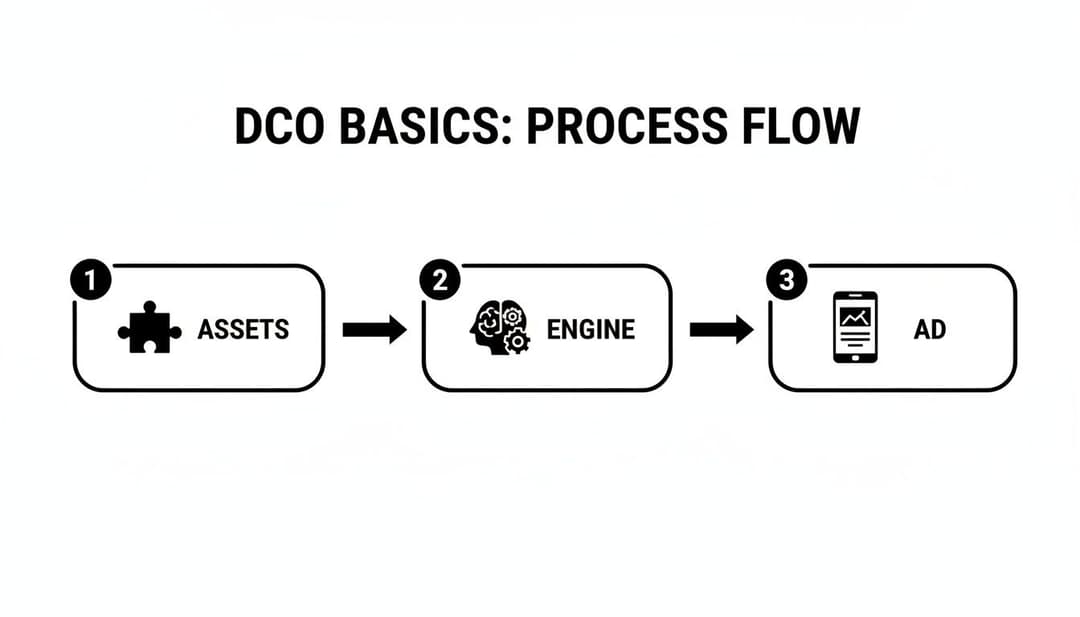
The key takeaway here is that DCO doesn't treat ad creation as a one-and-done task. It’s a continuous, data-driven process.
A DCO engine doesn't just build ads; it learns from them. Every click, conversion, and impression is a new data point that refines its decision-making for the next ad it serves, creating a powerful optimization loop.
This dynamic assembly process gets even more powerful when integrated with sophisticated automated UGC ad generation tools, which can feed a steady stream of varied creative components directly into the DCO engine. The system is always learning, figuring out which elements hit home for different audience segments and campaign goals.
As new data flows in, the algorithm gets smarter, gradually shifting your ad spend toward the winningest combinations. Platforms like AdStellar take this a step further by connecting directly to your ad manager, using your historical performance to make smarter decisions right from day one. To see more on how AI fuels this, check out our guide on top AI-driven ad creative generation tools.
The Real-World Benefits of a DCO Strategy
Okay, so we’ve peeked under the hood at the tech behind Dynamic Creative Optimization. It’s a powerful engine, for sure. But the real magic isn’t in the how—it’s in the measurable results it drives for your business. When you switch to a DCO strategy, you’re fundamentally changing the conversation from shouting one message at everyone to having thousands of hyper-relevant, one-on-one chats that actually connect.
This shift isn't just a feel-good marketing concept; it has a direct, tangible impact on your KPIs. By serving up the perfect message at the perfect moment, DCO dramatically boosts user engagement and the odds of someone clicking "buy." The outcome? Consistently higher click-through rates (CTR), a much lower cost-per-acquisition (CPA), and a stronger return on ad spend (ROAS). It's one of the sharpest tools in the shed for getting more out of your media budget.
From Personalization to Profitability
The line between personalization and profitability is shorter than you think.
Picture an e-commerce brand. A shopper spends a few minutes looking at a specific pair of blue running shoes but leaves without buying. An hour later, an ad pops up in their feed featuring those exact shoes, maybe with a little nudge like "Free Shipping Today." That's worlds more effective than hitting them with a generic ad for the brand's entire shoe collection, right?
This same principle works everywhere, from SaaS companies to local retailers. By tailoring your ad creative to someone's known interests, recent website behavior, or even their location, you create an experience that feels less like an ad and more like a helpful suggestion.
DCO moves marketing from a game of averages to a science of specifics. Instead of hoping a single message resonates with a large audience, it ensures thousands of tailored messages find the single individual they were made for, maximizing the value of every impression.
And this isn't just theory. The data consistently shows that smart personalization drives real performance. Market analyses regularly report significant gains, with conversion uplifts often landing somewhere between a few percentage points to over 20%, depending on the industry. When you look at the broader impact of advanced personalization—the very core of DCO—companies that get it right see revenue lifts of 10–15% on average. You can explore more DCO performance benchmarks and insights to see just how powerful this can be.
Driving Efficiency and Growth at Scale
Beyond the immediate performance bumps, one of the biggest wins with DCO is a massive boost in operational efficiency. It completely automates the tedious, soul-crushing process of manual A/B testing. This frees up your team to think about big-picture strategy instead of getting bogged down in endless creative swaps and spreadsheet analysis.
But it’s not just about saving time; it’s about learning smarter and faster.
The DCO engine is always on, constantly crunching performance data to figure out which creative combinations are resonating with different audience segments. Those insights are pure gold, helping you refine your overall marketing message and strategy. Ultimately, DCO helps you optimize ad spend efficiency by automatically funneling your budget toward the creative variations that actually work, driving sustainable growth and making every dollar count.
Practical DCO Use Cases You Can Use Today
Alright, the theory behind dynamic creative optimization is great, but let's be real—seeing it work in the wild is what makes it click. DCO isn't just for Fortune 500 advertisers with massive budgets; it’s a surprisingly flexible tool that brands of all sizes can use to hit very specific, measurable goals. Let's translate the concepts into actual campaign ideas you can start building on platforms like Meta or through programmatic display.
These examples show how DCO bridges the gap between raw data signals and the creative components of your ads, turning a generic broadcast into a one-on-one conversation. At the end of the day, each strategy is about getting the perfect message in front of the right person at the right time, which massively boosts your chances of getting a click, a lead, or a sale.
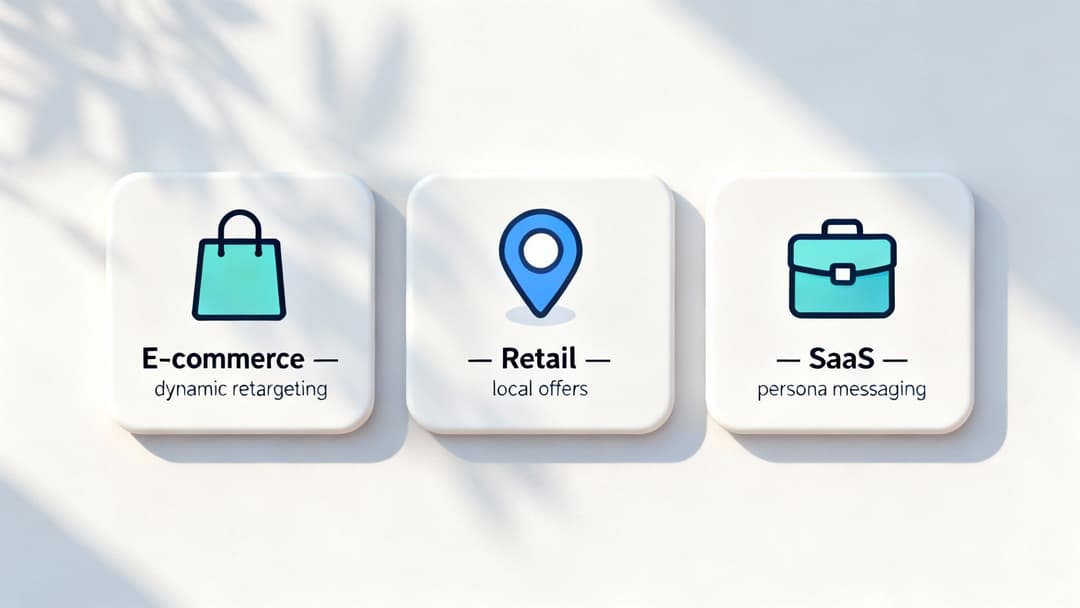
E-commerce Dynamic Retargeting
For any e-commerce store, the absolute killer app for DCO is dynamic product retargeting. It’s simple but incredibly powerful. When a shopper clicks on a few products or, even better, abandons their cart, DCO can automatically serve them an ad featuring those exact items.
- Goal: Win back abandoned carts and close sales with high-intent shoppers.
- Data Signals: Product IDs pulled from your website pixel (products viewed, items added to cart).
- Creative Elements: Product images, titles, and prices pulled directly from a live product feed.
- Expected Outcome: A serious lift in conversion rates and ROAS from your retargeting campaigns. It's often the highest-performing audience segment.
Localized Retail Promotions
If you run a brick-and-mortar business, DCO is your secret weapon for driving foot traffic. Instead of a generic national campaign, you can make your ads hyper-relevant to someone's physical location.
- Goal: Get more people to walk into your stores and make a purchase.
- Data Signals: The user's geolocation, like their city or zip code.
- Creative Elements: Dynamic text that swaps in the local city name, a map image pointing to the nearest store, or even offers that are exclusive to that location.
- Expected Outcome: You’ll see much higher engagement from local audiences and a real, measurable bump in foot traffic.
Persona-Based SaaS Messaging
SaaS companies are almost always selling to different types of users—a marketer, a developer, a CFO—all within the same market. DCO lets you stop using one-size-fits-all messaging and speak directly to each of them.
By creating unique messaging for each professional role, DCO ensures your ad speaks directly to the specific pain points and benefits that matter most to that individual, making your solution feel custom-built for them.
- Goal: Generate higher-quality leads and improve the rate at which those leads become customers.
- Data Signals: Audience data from your CRM (like job titles) or third-party professional data sources.
- Creative Elements: Headlines that call out role-specific benefits, images that look like their work environment, and case studies from their industry.
- Expected Outcome: A lower cost-per-lead (CPL) and a better conversion rate from marketing qualified leads (MQLs) to sales qualified leads (SQLs).
These examples are really just scratching the surface. The core idea is always the same: use data to make your creative smarter and more personal. For anyone looking to put this on the fast track, you can explore how to use AI to launch ads and really speed up your DCO workflows.
How To Launch Your First DCO Campaign
So, you're ready to jump into dynamic creative optimization. It's not as simple as launching a single ad, but the payoff in performance is more than worth the setup. The best way to think about it is that you're building an intelligent system, not just another campaign.
The very first step? Getting crystal-clear on your objectives. You need to give the DCO engine a target to aim for. Are you chasing a lower cost-per-acquisition (CPA), a sky-high return on ad spend (ROAS), or maybe better lead quality? Defining your key performance indicators (KPIs) from the get-go is non-negotiable. Without a clear goal, the algorithm is just flying blind.

Building Your Creative Foundation
Once your goals are locked in, it’s time to build your creative library. This is a mindset shift—you’re not making finished ads. You're producing interchangeable components that the system can mix and match.
Think of them as your essential "Lego bricks":
- Headlines and Copy: Write a bunch of variations. Target different pain points, highlight unique benefits, and speak directly to your key user personas.
- Images and Videos: Collect a diverse set of visuals. The key is that any image or video should be able to work with any of your headlines.
- Calls to Action (CTAs): Don't just stick with one. Create a few distinct CTAs like "Shop Now," "Learn More," or "Get a Demo" to test what really drives action.
This library is the fuel for your DCO engine. The more high-quality, varied assets you feed it, the more powerful its optimization will be.
A successful DCO campaign begins with a "crawl, walk, run" mentality. Start with a controlled test on a specific audience segment. This lets you gather initial data, spot early winning combinations, and fine-tune your strategy before you start scaling up your investment.
Activating Your Data and Technology
With your assets ready, it's time to connect the data that makes the magic happen. This means setting up data feeds—like a product catalog for an e-commerce brand—and making sure your website pixel is tracking user actions correctly. These signals are what tell the DCO platform what each user is actually interested in.
From there, you’ll define your personalization rules. These are the decision trees that tell the system which ad components to show based on specific behaviors or data points. The final piece of the puzzle is choosing the right tech partner. The cost savings here can be massive; automated DCO platforms can slash per-variation production costs by 70–90% compared to doing it all by hand. That's a huge win for any growth team or agency.
Platforms like AdStellar are built specifically to speed up this entire workflow. In fact, features like automated bulk launching can take a setup process that used to take days and condense it down to just a few minutes. If you want to dive deeper, you can read more about these DCO efficiencies for media buyers managing campaigns at scale right here: https://www.adstellar.ai/features/bulk-launching.
Common DCO Mistakes and How to Avoid Them
Even the most powerful engine can sputter with the wrong fuel. Dynamic creative optimization is no different; its success hinges on a smart strategy, not just powerful technology. Many campaigns stumble by making a few common, avoidable mistakes that undermine their potential and waste ad spend.
One of the most frequent errors is feeding the DCO engine with low-quality or mismatched creative assets. If your headlines don't make sense with your images, or your videos are visually inconsistent, the algorithm can't assemble a coherent ad. The result is thousands of disjointed variations that confuse users and harm brand perception.
Another major pitfall is relying on insufficient data. DCO needs a steady stream of performance signals to learn and optimize. Launching a complex campaign with a brand-new pixel and no historical conversion data is like asking a pilot to fly blind. The system simply won’t have enough information to make intelligent decisions.
Overcomplicating the Rules
It’s tempting to build intricate personalization rules for every possible scenario, but this often leads to overly narrow targeting. Creating dozens of complex "if-then" scenarios can segment your audience so much that no single ad variation gets enough impressions to generate statistically significant results. This prevents the algorithm from learning effectively.
The goal of DCO is not to create a perfect rule for every individual but to build a flexible system that learns from broad patterns. Start simple, identify winning elements, and gradually add layers of complexity as you gather more performance data.
Misaligned Measurement and Inconsistent Branding
Finally, two critical mistakes can sink a DCO program: measuring the wrong things and losing brand control.
- Incorrect Measurement: Failing to track the right KPIs is a classic error. If your goal is sales, but you're only optimizing for clicks, you might drive a lot of low-quality traffic without improving your return on ad spend (ROAS).
- Brand Inconsistency: With thousands of ad variations being generated automatically, it's easy to lose control over your brand's look and feel. Without strict templates and brand guidelines, your ads can start to look chaotic and unprofessional.
Avoiding these pitfalls requires a balanced approach. You need enough high-quality creative to give the algorithm options, sufficient data for it to learn, simple rules to start, and a clear measurement framework to guide optimization.
Frequently Asked Questions About DCO
Once you start digging into dynamic creative optimization, a few common questions always seem to come up. Let's tackle them head-on so you have a crystal-clear picture of how this all works and where it fits in your marketing playbook.
What Is the Difference Between DCO and Dynamic Creative?
This is a big one. The terms sound almost identical and get thrown around together, but they’re two very different pieces of the puzzle. The easiest way to think about it is like a high-performance race car and its expert driver.
Dynamic creative is the car itself. It's any ad built with the technical ability to change its components, like swapping out an image or a headline. It's the collection of parts ready to go.
Dynamic Creative Optimization (DCO), on the other hand, is the professional driver behind the wheel. It’s the intelligent, AI-powered brain that doesn't just swap parts but actively tests thousands of combinations in real time. The driver's single-minded goal is to find the absolute best-performing ad for each person and drive a specific result, like maximizing your ROAS.
DCO is the optimization engine making the decisions; dynamic creative is just the vehicle it drives. One is the intelligence, the other is the hardware.
How Much Data Do I Need for DCO to Be Effective?
You don't need a perfectly pristine, massive database to get started, but you can't start from zero, either. A solid foundation is all it takes.
For most advertisers, a good starting point is having consistent conversion data from past campaigns on platforms like Meta. This history gives the DCO algorithm a baseline to learn from right out of the gate, so it's not flying blind.
If you’re stepping into a brand-new channel, it's a smart move to run some standard, non-DCO campaigns first. The goal is to collect that initial performance data. You just need enough information for the algorithm to spot statistically significant patterns it can use to work its magic.
Can DCO Be Used for Brand Awareness Campaigns?
Absolutely. While DCO is a beast for driving direct conversions, it’s just as powerful for upper-funnel goals. Too many marketers think it's only for bottom-funnel performance, but that's a huge missed opportunity.
For awareness campaigns, you can unleash its testing power to figure out which messaging, imagery, or value propositions truly connect with different audience segments.
Instead of optimizing for something like cost-per-acquisition (CPA), you'd simply point the DCO engine toward engagement metrics. These could be things like:
- Video completion rate
- Click-through rate (CTR)
- Ad recall or the results from a brand lift study
This ensures your brand message lands with the biggest possible impact, even when making a sale isn't the immediate finish line.
Ready to stop guessing and start scaling your Meta ads with data-driven precision? AdStellar AI automates the entire DCO workflow, from bulk creative generation to AI-powered optimization, helping you launch winning campaigns 10x faster. Discover how AdStellar can transform your ad performance.