Think about the last time you saw a billboard on the highway. It’s a classic spray-and-pray approach—one generic message blasted at thousands of people, hoping a tiny fraction might care. It’s loud, inefficient, and expensive.
Now, imagine an ad that feels less like a billboard and more like a personal recommendation from a friend. That’s the magic of targeted advertising on social media. It’s a strategy that ditches the megaphone in favor of a quiet, one-on-one conversation with the right person, at the right time.
Instead of showing the same ad to everyone, brands can now deliver highly relevant messages to precise groups of people based on their demographics, interests, and online behaviors. This turns ad spend from a gamble into a calculated investment, which is why it’s the absolute cornerstone of modern performance marketing.
Why Is Targeted Advertising So Effective?

This approach just works because it’s built on relevance. Platforms like Meta and TikTok analyze user data—everything from the pages someone likes to the products they’ve browsed—to serve ads that genuinely align with their interests.
The result is a fundamentally better experience for everyone. The user sees ads for things they actually want, and the advertiser connects with someone who is already leaning in.
From Broadcasting to Conversations
The real power here is shifting from shouting at a crowd to starting a meaningful conversation. Instead of interrupting someone’s scroll with an irrelevant ad, brands can deliver real value the exact moment a potential customer is looking for a solution.
This precision is what drives incredible results.
For advertisers, this means no more wasted budget on uninterested audiences. Every dollar is spent reaching individuals who have already shown signals of intent, leading to higher engagement, better conversion rates, and a much stronger return on ad spend (ROAS).
This is exactly why the model has become essential for direct-to-consumer (DTC) brands and performance marketers. They live and die by predictable, scalable growth, and that’s precisely what well-targeted campaigns deliver. Building these campaigns effectively starts with a solid grasp of the entire Social Media Marketing landscape.
Just Look at the Numbers
The industry's explosive growth tells the whole story. Global social media ad spend is on track to hit a staggering $219 billion by 2026, making up nearly a third of all digital ad budgets.
This isn't happening by accident. It's fueled by the runaway success of hyper-targeted campaigns that turn user data into real, actionable insights. With platforms like Meta capturing a massive share of this market, it's clear where the money—and the attention—is going.
Ultimately, this approach ensures your message doesn't just get seen; it gets seen by the people who are most likely to become your next loyal customers.
The Five Pillars of High-Impact Audience Targeting
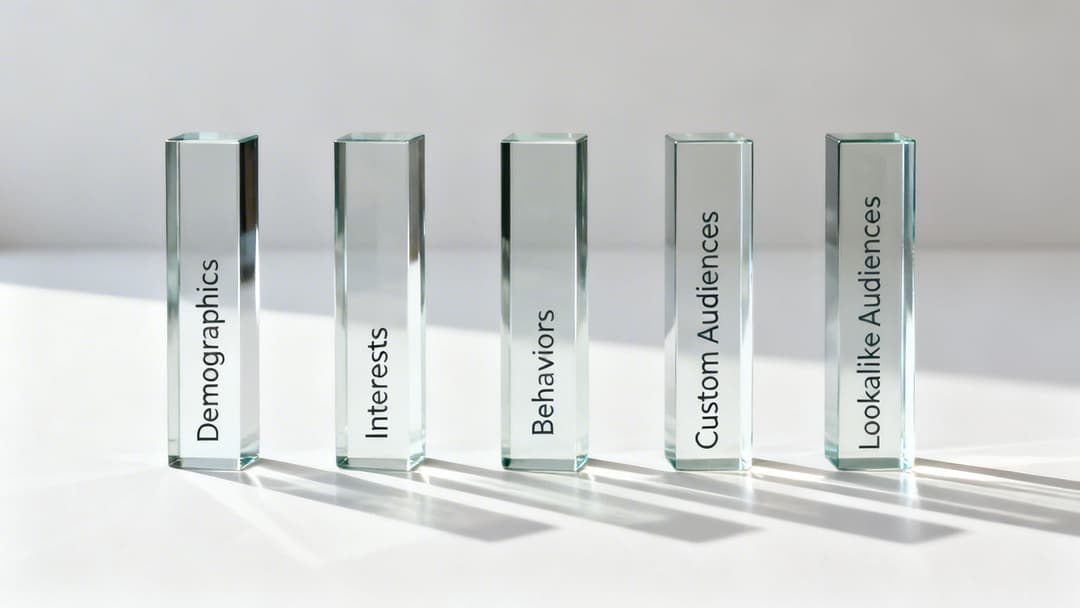
Great social media advertising isn’t about casting the widest net and hoping for the best. It’s about using a high-powered sonar to pinpoint exactly where your ideal customers are swimming. That precision comes from five core targeting methods—the pillars that let you move from broad guesses to sharp, data-backed decisions.
Think of these pillars as different lenses. Each one gives you a new way to see the massive user base on social media. The real magic happens when you start layering these lenses, creating a crystal-clear picture of who you need to reach. Let’s break them down.
Demographic Targeting: The Foundational Layer
This is targeting 101, the bedrock of almost every campaign. It’s all about segmenting people based on objective, factual information about who they are.
- Key Data Points: Age, gender, location (down to the zip code), language, education, job title, and more.
Imagine you run a local coffee shop in Austin, Texas. Showing your ads to someone in New York is just burning money. Demographic targeting lets you draw a 5-mile radius around your shop and show that "2-for-1 Latte" special only to people nearby. It turns a global platform into your neighborhood billboard.
Interest Targeting: What People Love
Once you know who people are, the next step is to understand what they're into. This is where interest targeting shines. Platforms figure this out based on the pages people follow, the posts they engage with, and the groups they join.
This pillar connects you with audiences based on their hobbies and passions. If you sell sustainable yoga mats, you can target users who’ve explicitly shown interest in "yoga," "mindfulness," or even competitor brands like "Lululemon." It’s a direct line to people who have already raised their hand and said, "I care about this stuff."
Interest targeting shifts the focus from who people are to what they care about. It's how you find ready-made communities of engaged potential customers who are already looking for what you offer.
Behavioral Targeting: How People Act
This is where things get really powerful. Behavioral targeting goes beyond interests to focus on what users have actually done—both on and off the platform. We’re talking purchase history, device usage, travel habits, and other digital footprints.
This data screams intent. Someone who just browsed a bunch of travel websites? That’s a perfect person to see an ad from a hotel chain. Platforms can even identify "Engaged Shoppers"—people who frequently click "Shop Now" buttons—making them a goldmine for any e-commerce brand.
Let’s go back to our yoga mat company. They could layer their targeting to show ads not just to people interested in yoga (Interest), but specifically to those who recently bought fitness apparel online (Behavior). That combination is deadly effective because it hits users with both the right passion and a proven habit of buying online. You can dive deeper into combining these tactics in our guide on audience segmentation strategies.
Custom and Lookalike Audiences: Your Most Valuable Assets
The final two pillars are often the most profitable because they’re built from your own data.
Custom Audiences: This is where you upload a list of your existing contacts—like an email list or a customer database—to a platform. The platform matches those contacts to user profiles, letting you serve targeted ads to your warmest audience. It's perfect for re-engaging people who already know and trust you.
Lookalike Audiences: Here’s where the real scaling begins. You take a high-quality Custom Audience (like your best customers) and ask the platform's algorithm to find new people who share similar traits. It crunches thousands of data points to build a fresh, high-potential audience that "looks like" your most valuable buyers. This is hands-down one of the best ways to find new customers.
To help you visualize how these targeting methods stack up, here's a quick breakdown:
Comparison of Social Media Audience Targeting Methods
| Targeting Type | What It Is | Best For | Example |
|---|---|---|---|
| Demographic | Targeting based on objective facts like age, gender, and location. | Reaching a broad but defined group; local businesses. | A local restaurant targets users aged 25-45 within a 10-mile radius. |
| Interest | Targeting based on users' expressed hobbies, passions, and affinities. | Finding new customers who are actively engaged in a specific niche. | A company selling hiking gear targets people interested in "national parks" and "outdoor recreation." |
| Behavioral | Targeting based on past actions, like purchases or website visits. | Reaching users with high purchase intent. | An online retailer shows ads to users identified as "Engaged Shoppers" who have recently bought clothing. |
| Custom | Targeting your existing customers or leads by uploading their data. | Re-engaging past buyers, upselling, and building loyalty. | A software company uploads its email subscriber list to announce a new feature to them on Facebook. |
| Lookalike | Creating a new audience that mirrors the traits of your best customers. | Scaling customer acquisition efficiently and finding new, high-quality prospects. | An e-commerce brand builds a Lookalike Audience from its top 1% of spenders to find similar buyers. |
By mastering these five pillars, you can stop shouting into the void and start having precise, strategic conversations. You can start broad with demographics, get sharper with interests and behaviors, and then scale your success with powerful custom and lookalike audiences. It's a full-funnel strategy that consistently finds and converts the right people.
Choosing the Right Platform for Your Audience
Crafting a brilliant ad is only half the job. If that perfect message lands on a platform where your audience doesn't hang out, it's like setting up a beautiful storefront on a deserted street—a total waste of time and money. The entire game of targeted social media advertising comes down to one simple rule: meet your audience where they already are.
Every social platform is its own little world, complete with a unique culture, user base, and advertising toolkit. The goal isn't just to pick the most popular one; it's to find the strategic sweet spot where your business goals, your product, and your ideal customer all line up. Nail this decision, and you're on your way to turning ad spend into actual results.
Meta (Facebook and Instagram): The E-commerce Powerhouse
For most businesses, especially in e-commerce and direct-to-consumer (DTC), Meta's duo of Facebook and Instagram is still the undisputed champ. With billions of users, these platforms have a treasure trove of data that lets you build incredibly specific audience segments.
Meta’s real magic is its ability to mix demographic, interest, and behavioral data. You can find people who not only fit your customer profile but have also shown they’re ready to buy by clicking "Shop Now" buttons or visiting similar websites.
- Best For: E-commerce brands, local businesses, B2C services, and lead generation for pretty much any industry you can think of.
- Audience Vibe: Incredibly diverse, covering nearly every age and interest. Instagram skews younger and is all about visuals, while Facebook’s crowd is broader and more community-driven.
- Key Advantage: The sheer amount and quality of its user data make its Lookalike Audience feature one of the most powerful tools out there for finding new, high-intent customers.
If your main goal is driving online sales or getting leads from a wide consumer base, Meta’s sophisticated ad system is almost always the right place to start.
TikTok: The Hub of Culture and Discovery
TikTok isn't just another social app; it's a culture engine. Its algorithm is legendary for serving up hyper-relevant content, creating an environment where people are actively looking to discover something new. Advertising here means dropping your brand right into the fast-moving current of trends and entertainment.
The platform is dominated by a younger crowd, especially Gen Z, who value authenticity and creativity way more than slick, corporate ads. The best ads on TikTok don't even feel like ads—they’re native, engaging videos that entertain, teach, or jump on a trending meme.
TikTok's user base is in a constant state of discovery. They aren't just scrolling to see what their friends are up to; they are actively looking for the next cool thing, making it a goldmine for brands with visually appealing products and a creative edge.
This makes it the perfect playground for fashion, beauty, gaming, and entertainment brands trying to build massive awareness and go viral. If you're struggling to decide, our guide on how to select the right ad platform can give you a more detailed framework.
LinkedIn: The Professional's Network
While Meta and TikTok are built for consumers, LinkedIn is the undisputed territory for B2B (business-to-business) advertising. The platform's value is rooted in its unique and reliable professional data, all self-reported by its users. This is where you go to get in front of decision-makers.
LinkedIn lets you target people based on professional details you just can't find anywhere else.
- Job Title: Go straight to the CEOs, Marketing Managers, or Software Engineers you need to reach.
- Company Size: Focus on employees at scrappy startups or Fortune 500 giants.
- Industry: Put your budget into specific sectors like healthcare, finance, or technology.
- Skills and Seniority: Pinpoint individuals with niche expertise or the authority to make a purchase.
This makes it an unbeatable platform for high-ticket B2B sales, SaaS companies, and recruiters. The cost per click might be higher here, but the quality of the audience often delivers a much stronger return for B2B goals.
How to Align Your Creative with Your Target Audience

You’ve absolutely nailed your audience targeting. It’s a huge step, but it's only half the battle. If your perfectly defined audience scrolls right past your ad without a second thought, your entire strategy collapses. This is where creative alignment becomes the critical link in targeted advertising in social media.
Think of it this way: knowing who to talk to is one thing, but knowing what to say and how to say it is what sparks a real connection. Your ad creative—the copy, images, and videos—has to speak the language of the audience segment you’re targeting. Generic, one-size-fits-all creative just doesn't work anymore.
Matching the Message to the Mindset
The secret is to mirror the unique pain points, goals, and communication style of each audience. A message that lands perfectly with one group could completely miss the mark with another, even if they’re both interested in your product. The goal is to make your audience feel like you get them.
Let’s imagine a new fintech app. An ad campaign would need totally different creative approaches for two distinct audiences:
Audience A: Gen Z Students: The creative needs to be visually dynamic, maybe using a trending TikTok format. The copy should be casual, focusing on benefits like "splitting bills with friends" or "saving for that festival ticket." The visuals would show young, relatable people in everyday situations.
Audience B: Established Business Owners: Here, the creative has to be polished and professional. The copy would adopt a more formal tone, highlighting features like "streamlining expense reports" or "securely managing payroll." The imagery needs to project trust and efficiency, maybe featuring a clean dashboard on a laptop.
Same product, but the creative speaks two entirely different languages to solve two very different problems.
The Power of A/B Testing Your Creative
So how do you figure out what actually motivates your audience? You don't guess—you test. A/B testing, also known as split testing, is the process of running multiple versions of an ad to see which one performs best. It’s a fundamental part of optimizing your creative.
Instead of launching just one ad, you can test different elements to learn what drives action. The most effective A/B tests isolate a single variable at a time, so you get crystal-clear results.
An ad is a hypothesis. You believe a certain image, headline, and call-to-action will make your audience convert. A/B testing is the experiment that proves or disproves that hypothesis, giving you the data you need to turn good guesses into winning strategies.
This process strips away subjectivity and lets the data lead, ensuring your budget goes toward creative that actually works.
Scaling Your Creative Testing Efforts
Manually testing every creative element against every audience segment can get overwhelming fast. Imagine trying to test ten different images against five headlines for three separate audiences—that’s 150 ad variations to manage.
This is where modern tools are essential for scaling your efforts. Platforms can automate this entire process, letting you launch hundreds of creative-and-audience pairings at the same time. By analyzing performance data in real time, these systems quickly pinpoint the winning combinations of copy, visuals, and targeting.
This turns a slow, manual chore into a rapid, data-driven optimization cycle. As you discover what resonates, you can create even more effective creative ad campaigns that drive far better results.
Measuring What Matters for Campaign Optimization
Launching a targeted social media campaign without tracking the right metrics is like trying to navigate a ship without a compass. You’re moving, but you have no idea if you’re heading toward your destination or sailing straight into a storm. To get anywhere meaningful, you have to look past vanity metrics like likes and shares and focus on the numbers that actually hit your bottom line.
This means zeroing in on Key Performance Indicators (KPIs) that tell you about profitability and efficiency. These are the metrics that prove your ad spend is generating real value, not just a temporary buzz.
Core Metrics for Profitability
For any campaign where performance is the goal, a few KPIs are simply non-negotiable. They cut through all the noise and give you a crystal-clear picture of financial success.
Return on Ad Spend (ROAS): This is the ultimate report card for profitability. It tells you exactly how much revenue you’re making for every dollar spent on ads. A ROAS of 4:1 means you're bringing in $4 for every $1 you spend. It doesn't get much clearer than that.
Cost Per Acquisition (CPA): This metric pins down the average cost to land one new customer. Keeping a close eye on your CPA is crucial to make sure your growth is sustainable and, most importantly, profitable.
Cost Per Lead (CPL): If your business runs on generating leads, CPL is your go-to metric. It measures how much it costs to get one new potential customer in the door, making it essential for judging how well your top-of-funnel campaigns are working.
If you want to get deeper into tracking and interpreting these numbers, check out our guide to performance marketing metrics. While industry benchmarks can be a helpful guide, the real key is consistently tracking these KPIs to make smart, data-backed decisions for your own business.
The Optimization Loop From Data to Decisions
Just collecting data isn't enough—the magic happens when you use that data to make your campaigns better. This is all done through a continuous cycle known as the optimization loop, a simple but incredibly powerful framework for scaling what works.
Analyze Performance Data: Get into your campaign dashboard regularly. Look for the specific audiences, ad creatives, and messages that are bringing in the best ROAS or the lowest CPA.
Identify the Winners: Pinpoint exactly which combinations are crushing it. Is a certain video ad really clicking with your Lookalike Audience? Is one headline driving all the conversions from your interest-based segments?
Reallocate and Scale: This is where you act. Start shifting your budget away from the stuff that isn't working and double down on your winners. This systematic process makes your ad spend more and more efficient over time, consistently boosting your profitability.
The goal isn't to find one single "perfect" ad. It's to build a system that continuously finds and scales multiple winning combinations, creating an advertising engine that's both resilient and highly profitable.
This cycle is becoming even more critical as AI reshapes the entire industry. An incredible 94% of marketers plan to use AI for content creation by 2026, and platforms like Meta are pushing hard for full ad automation. AI-driven dynamic ads, which now account for 41% of social spend, are already slashing costs and boosting performance. You can find more insights in these social media marketing statistics on apaya.com.
Ultimately, successful targeted advertising hinges on this simple feedback loop: turning raw performance data into actionable insights that fuel real, measurable growth.
Scale Your Social Media Advertising with AdStellar AI
We’ve walked through all the moving parts of a great targeted advertising in social media strategy. From pinpointing the right audiences to getting the creative just right, you know it’s a ton of work. The manual process can be a real grind, eating up time and resources with a whole lot of guesswork.
This is where smart automation becomes a marketer’s secret weapon. Tools like AdStellar AI were built specifically to cut out that manual labor, turning a complicated, time-sucking workflow into a sharp, data-driven operation.
The biggest hurdle for any growth team is always scale. How do you possibly test dozens of headlines, images, and audience segments without getting lost in Ads Manager for days on end? The only way is to automate the creation and testing process so you can spin up hundreds of ad combinations in minutes, not weeks.
From Manual Setup to Automated Scaling
AdStellar AI hooks directly into your Meta Ads Manager and gets to work analyzing your campaign history. It’s looking for the patterns—the specific creative elements and audience segments that have consistently delivered the goods for your most important goals, whether that’s ROAS, CPA, or CPL.
Instead of building every single ad variation by hand, the platform lets you:
- Generate Bulk Ad Variations: Create hundreds of unique creative and audience combos with a few simple clicks.
- Identify Top Performers: Let the AI instantly rank which ads and audiences are crushing it and which are duds.
- Launch with Confidence: Build new campaigns using only the proven, high-performing ingredients from your past wins.
This completely flips the script. You shift your focus from tedious setup to making strategic calls based on what the data is telling you. Less building, more analyzing what works and why.
A Repeatable, Data-Backed Workflow
The real magic here is turning that old guesswork into a repeatable system. When you let AI do the heavy lifting of data analysis and ad creation, you can launch campaigns with a much higher chance of success right out of the gate.
This technology fundamentally changes the campaign launch process. It replaces subjective assumptions with objective data, allowing marketers to launch campaigns up to 10x faster and unlock more revenue with greater efficiency.
The diagram below shows you exactly how this continuous optimization loop fuels campaign growth.
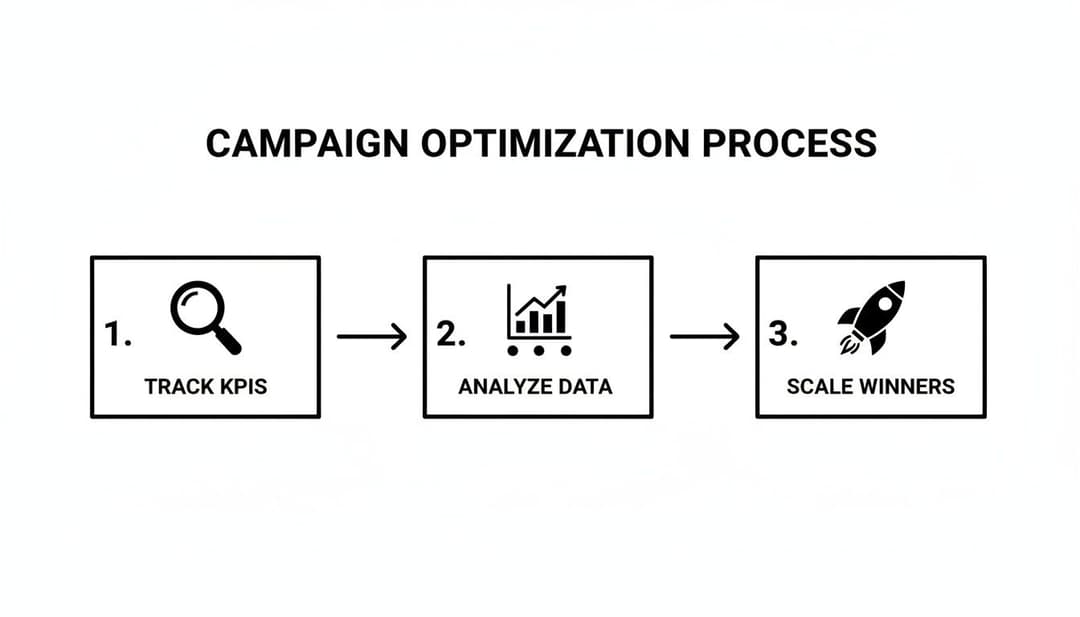
This simple but incredibly powerful framework—track KPIs, analyze data, and scale winners—is the engine of profitable advertising. It's a cycle that AI can put on hyperdrive. The system gets smarter with every bit of new performance data, constantly refining its recommendations to keep your campaigns dialed in. If you're curious, you can learn more about AdStellar’s powerful AI optimization features and see how they can transform your workflow.
By automating the most time-consuming parts of managing campaigns, you free up your team to think bigger. You can focus on high-level strategy, creative direction, and chasing down new growth opportunities. It’s all about working smarter, not harder, to get scalable and predictable results from your social media ads.
Frequently Asked Questions
Jumping into targeted social media ads always brings up a few questions, from "How much is this going to cost?" to "Is this creepy?" Let's clear up some of the most common things marketers wonder about when they're getting started.
How Much Should I Spend on Social Media Ads?
Honestly, there's no magic number here. The right budget is completely tied to your industry, your goals, and which platform you're on.
Instead of pulling a number out of thin air, start with a small test budget you're comfortable losing—maybe a few hundred dollars. The real game-changer is focusing on your Cost Per Acquisition (CPA). Once you figure out exactly what it costs to land a new customer and can see it's profitable, you can start pouring more money in with confidence. This approach means you're scaling based on real results, not just wishful thinking.
Is Targeted Advertising an Invasion of Privacy?
It's a fair question, and one that's definitely on people's minds. While targeted ads do use data, platforms like Meta and TikTok are bound by pretty strict privacy policies and regulations like GDPR.
Here's the key difference: advertisers never see your individual data. We target anonymous, bundled-up groups of people who share certain traits. You can tell the platform to find "women aged 25-34 in Miami who are into yoga," but you'll never see "Jane Doe's" personal profile. It’s a system designed to deliver relevance without crossing the line into personal identity, which is crucial for keeping users' trust.
Which Social Media Platform Is Best for Targeted Ads?
The "best" platform is simply wherever your audience hangs out. If you're selling B2B software, you'll probably get crickets on TikTok but find a goldmine on LinkedIn. On the flip side, a fashion brand trying to reach Gen Z would be wasting their money anywhere but TikTok and Instagram.
Think of it strategically:
- Meta (Facebook & Instagram): A powerhouse for e-commerce and just about any B2C business, thanks to its massive and incredibly diverse user base.
- TikTok: The go-to for brands with visual, trend-driven products targeting a younger crowd.
- LinkedIn: The undisputed champ for B2B marketers who need to zero in on people by their job title, industry, or company size.
Ready to stop guessing and start scaling your Meta campaigns? AdStellar AI handles the heavy lifting of ad creation, using AI to pinpoint your best-performing creative and audience combos. It helps you get winning campaigns live in minutes. See how it works at https://www.adstellar.ai.