Creative ad campaigns aren't just about flashy ideas. They're about using data-backed insights and systematic testing to turn those ideas into real business results, like a better ROAS or a lower CPL. It’s a shift away from one-off concepts toward building a scalable engine for high-performing ads.
Your Blueprint for High-Performing Creative Ad Campaigns
Let's skip the abstract theories and get straight to the playbook that performance marketers use to ship winning ads, fast. This is how you go from a blank slate to a scalable campaign strategy grounded in data—a process that's absolutely essential for consistent growth.
It all boils down to a continuous feedback loop. This simple flowchart breaks down the powerful flow from an initial insight all the way to data-driven iteration.
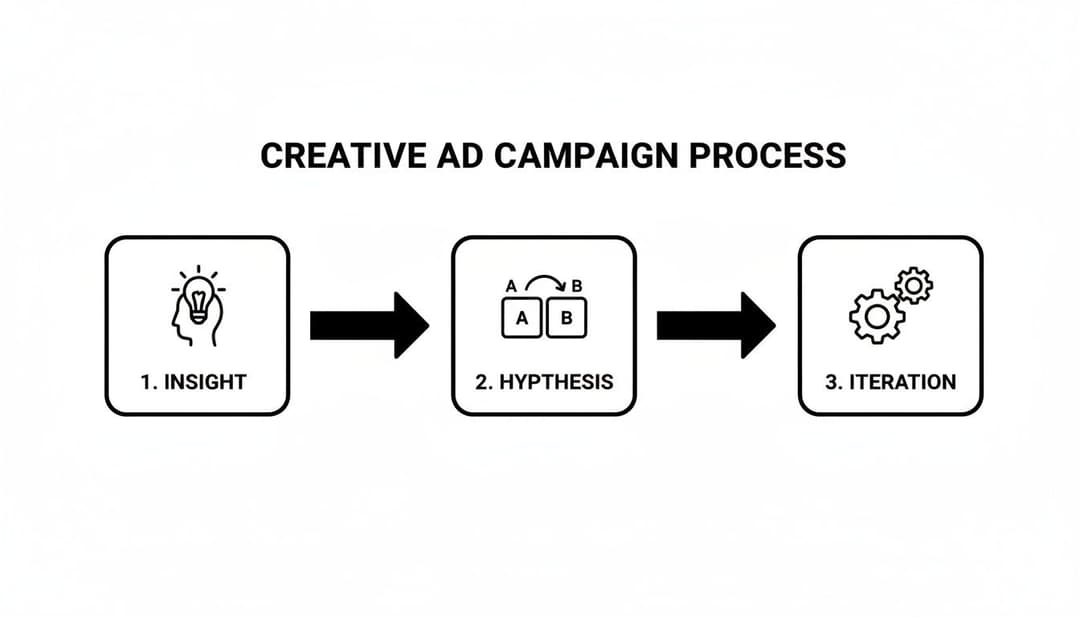
As you can see, a single audience insight sparks a testable hypothesis. That hypothesis then gets refined over and over again through testing, all based on cold, hard performance data.
The Core Components of a Winning Strategy
A truly successful creative strategy is built on repeatable processes, not just random moments of inspiration. It demands that you align your vision with concrete business goals from the very start. To build a stronger foundation, it's worth taking the time to master the fundamentals of creatives in digital marketing.
Here’s a breakdown of the core components that make these campaigns tick.
| The Four Pillars of a Winning Creative Campaign | ||
|---|---|---|
| Pillar | Description | Key Metric |
| Audience Insight | Getting deep into your customer's head—understanding their pain points, desires, and what really makes them click. | Customer Lifetime Value (CLV) |
| Creative Hypothesis | Forming a clear, testable idea about what message, visual, or hook will drive a specific action from your audience. | Click-Through Rate (CTR) |
| Rapid Production | Churning out tons of creative variations quickly so you can test different angles and ideas at scale without losing momentum. | Creative Velocity (Assets/Week) |
| Data-Driven Iteration | Using real performance data to figure out what's working, kill what isn't, and double down on your winners. | Return on Ad Spend (ROAS) |
These four pillars are the bedrock of any campaign that's built to last. By focusing on them, you create a system that consistently delivers.
This entire blueprint ensures every ad you launch is part of a bigger strategy, not just a shot in the dark. It turns your creative process from a guessing game into a predictable system for driving results.
It's no surprise that 85% of marketers using generative AI report a major boost in productivity. Technology is accelerating this process from weeks down to minutes.
For a deeper dive into strategy, you can also explore some great ValueCMO insights on high-performing campaigns. By sticking to these core pillars, you'll be well on your way to producing creatives that don't just grab attention but actually deliver on the numbers that matter.
Mastering Creative Ideation and Briefing
The best ad campaigns feel effortless, but they’re built on a bedrock of killer ideas and rigid strategy. And those ideas don’t just fall out of the sky. They start with a deep, almost obsessive, understanding of what actually makes your audience tick—long before you even think about visuals or copy.
This is where you need to get methodical. Instead of just throwing ideas at a whiteboard and hoping something sticks, lean on proven frameworks to guide your brainstorming.
One of my favorites is the ‘Jobs to Be Done’ framework. It completely reframes how you see your product. Think about it: nobody wants to buy a drill. What they really want is a quarter-inch hole in their wall. By focusing on the "job" your customer is "hiring" your product for, you stop talking about features and start talking about solutions. This tiny shift is a goldmine for powerful messaging.
Another powerhouse technique is ‘Emotional Hook Mapping’. This is all about digging into the core emotions that actually drive your audience to act. Are they motivated by a desire for security? The thrill of convenience? Or maybe a classic case of FOMO? A fintech app, for instance, isn't just selling a budgeting tool; it's selling the feeling of financial peace of mind. Map these emotional triggers, and you’ll craft campaigns that connect on a human level, not just a functional one.
From Idea to Actionable Brief
Okay, so you've landed on a brilliant concept. Now what? The next step is arguably the most critical: translating that idea into a flawless creative brief.
This document is your campaign's single source of truth. It's the map that gets your marketers, copywriters, and designers all heading in the same direction. I’ve seen more promising campaigns get derailed by a vague brief than by anything else. It leads to endless revisions, wasted budget, and a final product that misses the mark entirely.
The whole point of a creative brief is to ruthlessly eliminate ambiguity. It’s not a suggestion box; it’s a set of clear instructions and guardrails that empowers your creative team to hit a home run. If you're looking to sharpen your own skills here, a great place to start is by understanding the fundamentals of writing good ad copy is a great starting point, as the principles are closely linked.
To make sure everyone is on the same page from the get-go, your brief must nail these non-negotiable elements:
- Primary Campaign Goal: What’s the one thing we need the user to do? Get specific. (e.g., "Achieve a Cost Per Acquisition of $50 for new trial sign-ups.")
- Target Audience Persona: Who, exactly, are we talking to? Go beyond basic demographics. What are their pain points? What motivates them? (e.g., "Busy professionals aged 30-45 who are overwhelmed by meal planning and want a healthier, easier option.")
- Key Message: If they remember only one thing from this ad, what should it be? Force yourself to be brutally concise.
- Mandatory Inclusions: Is there a logo, a legal disclaimer, or a specific brand color that has to be in the final creative? List it out.
When your creative brief is crystal clear, it stops being a simple request and becomes a strategic weapon. It’s the tool that ensures every single asset—every image, every headline, every video—is not just creative, but laser-focused on hitting your business goals. This is the behind-the-scenes work that separates forgettable ads from the high-performing campaigns that actually move the needle.
How Bulk Production and Rapid Testing Unlock Growth
Let’s get one thing straight: the days of sinking your entire ad budget into one perfectly polished, high-production ad are long gone. That model is broken.
Winning today is all about building a high-velocity testing engine. It's not about finding a single "perfect" creative—it’s about launching dozens of them to see what sticks. Modern ad success hinges on two things: volume and speed. Get those right, and you’ll learn what your audience actually wants faster than your competitors can even get their next big campaign approved.
This completely flips the old way of thinking on its head. Forget about endless internal debates over which headline is best. You move straight to live-fire testing in the real world. The entire goal is to isolate and test one variable at a time—the headline, the visual, the CTA—to get clean, undeniable data on what drives performance.

A Real-World Testing Scenario
Imagine you’re a DTC brand launching a new energy drink. The traditional playbook would tell you to spend a fortune creating one epic, highly produced video ad.
Instead, a rapid-testing approach means creating several lower-lift variations to test different emotional angles and hooks.
You might structure your initial tests like this:
- Angle 1 (Scarcity): "Limited Edition Flavor - Almost Gone!"
- Angle 2 (Social Proof): "Join the 50,000+ who start their day with us."
- Angle 3 (Benefit-Driven): "Finally, energy without the afternoon crash."
By keeping the visual the same and only changing the headline, you can directly trace any performance difference back to the messaging. The winner of this test becomes your new "control" ad. From there, you start testing the next variable, like the background image or the CTA button color. It’s a systematic process that continuously levels up your campaign’s effectiveness.
The core principle is simple but incredibly powerful: stop guessing what your audience wants and start letting their clicks and conversions tell you. This data-driven approach removes all the guesswork and channels your budget into what is proven to work.
Leveraging Automation for Scale
Okay, so testing dozens of ads sounds great in theory. But manually creating hundreds of variations is a logistical nightmare. This is where automation becomes your secret weapon, allowing you to scale production without your quality taking a nosedive. The latest tools are built to generate a massive number of creative combinations from just a few core assets.
This isn't some new, revolutionary concept. It's just a modern evolution of what the biggest brands have been doing for decades. Think about Nike's 'Just Do It' campaign—it wasn't one ad, but a masterclass in emotional storytelling that skyrocketed their U.S. market share from 18% to 43%.
Today, platforms like AdStellar AI can replicate that same idea at digital speed, automatically generating hundreds of creative variations from your proven winners. This allows marketers to test different emotional hooks at scale to find what truly resonates—and achieve the kind of explosive growth Nike did all those years ago.
By embracing this model, you build a system that perpetually feeds your campaigns with data-backed winners. For a deeper dive, check out our complete guide to bulk ad creation to see how you can get this strategy up and running. This relentless cycle of production, testing, and iteration is the engine that drives scalable growth for the most successful brands today.
Translating Performance Data into Actionable Insights
Launching a battery of tests is just the start. The real magic happens when you can look at the results and turn those raw numbers into fuel for your next round of winning creatives. Forget vanity metrics like likes and shares; we need to get serious about the numbers that actually move the needle on your business.
This means you should be obsessing over a few core metrics.
- Return on Ad Spend (ROAS): This is the bottom line. For every single dollar you put in, how many are you getting back?
- Cost Per Lead (CPL): If you're in B2B or sell services, this is your bread and butter. It tells you exactly what it costs to get a potential customer to raise their hand.
- Cost Per Acquisition (CPA): For anyone in e-commerce or with a direct sales model, this is the true cost of getting a new paying customer through the door.
These are the metrics that cut through the noise. A sky-high click-through rate means absolutely nothing if none of those clicks are turning into customers.

Uncovering the "Why" Behind the Numbers
Analyzing performance isn't just about finding the winning ad. It’s about digging in to understand why it won. This is where you dissect the campaign to pull out clear, actionable insights that can inform your entire creative strategy from here on out.
Let's say you run a test and discover that ads featuring user-generated photos consistently deliver a 20% lower CPA than your polished, professional studio shots. That’s not just a data point; it’s a goldmine. It’s telling you that your audience craves authenticity and trusts their peers more than they trust a slick, corporate ad.
That one insight can completely reshape your visual strategy. Instead of booking another pricey photoshoot, your next move should be building a campaign to get more customers to send in their own content. To make this process work, especially with high-volume tests, you'll need efficient automated data processing to sift through all the results without drowning in spreadsheets.
A Framework for Dissecting Results
When a test wraps up, resist the urge to just crown a winner and move on. You need to dig deeper by asking a series of structured questions that guide your analysis. This is how you turn raw data into a strategic roadmap for your next creative sprint.
For a deeper look at this process, check out our guide on marketing campaign analytics where we lay out some more advanced frameworks.
But for now, here’s a simple framework to get you started:
- Isolate the Variable: What was the one thing that was different between the winning ad and the losers? Was it the headline? The visual? The call-to-action?
- Form a Hypothesis: Based on that winning element, what can you guess about your audience? (e.g., "It seems our audience responds better to benefit-driven headlines than ones that use fear or urgency.")
- Define the Next Action: So, what are you going to do about it? How will this insight directly shape your next batch of creatives? (e.g., "We're going to test three new benefit-focused headlines against our current winner.")
This disciplined approach is what separates the lucky one-hit wonders from the pros who build repeatable systems for success. You stop guessing and chasing trends and start building a library of proven creative principles, all backed by your own performance data.
Scaling Your Winners with AI-Powered Automation
So you’ve found a winning ad creative. That’s a huge win, but it’s really just the starting line. The real challenge? Scaling that success without your performance metrics—like ROAS and CPL—taking a nosedive. This is exactly where AI-powered automation goes from a “nice-to-have” to a mission-critical part of your growth engine.
These platforms plug directly into your ads manager and act as a force multiplier for your best work. We're moving way beyond simple A/B testing here and into the realm of predictive scaling.

From Manual Tweaks to Automated Scaling
Think of AI automation as your always-on campaign manager, one that never sleeps or takes a coffee break. It digs into your historical performance data to pinpoint your top-performing creatives, headlines, and audiences with surgical precision.
Instead of you getting lost in spreadsheets, the AI does the heavy lifting. It identifies the winning combinations that consistently deliver the goods. From there, it can automatically build new campaigns using these proven elements as the foundation, ensuring every new dollar you spend is backed by data, not just a gut feeling.
Real-Time Optimization for Maximum Efficiency
The real magic of AI in advertising is its ability to learn and adapt in real time. Once your new campaigns go live, auto-learning models get to work, constantly monitoring the incoming performance data.
This creates a powerful feedback loop that allows the system to make smart adjustments on the fly. Let's say a new creative variation starts outperforming the original winner. The AI can automatically shift more budget toward it, maximizing your returns without you having to lift a finger. This process ensures your ad spend is always working as hard as it possibly can.
You can take a look at our deep dive into AI marketing automation to see exactly how these systems operate behind the scenes.
The goal is to create a self-optimizing campaign ecosystem. By letting AI manage the budget allocation and scaling decisions, you free up your team to focus on higher-level strategy and developing the next wave of creative concepts.
This isn't just about being more efficient; it's about making a bigger impact. The right message can completely change a brand’s trajectory. A classic example is Dove's 'Real Beauty' campaign—a masterclass in purpose-driven creative that led to a 700% sales surge over ten years and a 3:1 ROI.
Today, platforms like AdStellar AI apply this same principle at scale. They can auto-generate inclusive creative sets from performance data, allowing marketers to test diverse messages against goals like CPL and scale the winners globally. If you want to see more on how top campaigns blend creativity with data, check out the insights from Statista on best-integrated campaign strategies.
This blend of human creativity and machine intelligence isn't just a trend. It's the future of scaling creative ad campaigns.
Common Questions About Creative Ad Campaigns
When you're deep in the trenches of performance marketing, the same questions tend to pop up again and again. Getting clear, practical answers is what separates a stalled campaign from one that's ready to scale.
Let's cut through the noise and tackle some of the most common questions we hear about creating, testing, and scaling ad campaigns that actually perform.
How Many Creative Variations Should I Test at Once?
This is a classic "it depends" question, but the answer really boils down to your budget and how much traffic you can push.
For most brands, a great starting point is testing 3-5 totally distinct creative concepts. Within each of those, try out 2-3 different copy angles. This gives you a manageable test of about 6-15 ad combinations without spreading your budget too thin.
Of course, with AI-powered tools, you can blow that number out of the water and test hundreds of variations at once, digging into granular elements like headlines or CTAs. The trick isn't just about volume; it's about setting up your tests to isolate one variable at a time. That’s how you get clean data and know exactly what’s driving your results.
What Is the Most Important Metric for Creative Ad Campaigns?
There’s no magic bullet metric that works for everyone. The most important metric is the one that lines up directly with your business goals. Everything else is just a supporting character.
- For e-commerce brands, it’s almost always Return on Ad Spend (ROAS). Did you make more money than you spent? Simple as that.
- For B2B or lead generation, the focus shifts to Cost Per Lead (CPL) or Cost Per Acquisition (CPA). How much did it cost to get a qualified person to raise their hand?
Metrics like Click-Through Rate (CTR) and Cost Per Click (CPC) are useful for diagnosing why an ad is working or failing, but they don't pay the bills. Always anchor your success to the metric that measures the final business outcome.
How Does AI Help in the Creative Process?
Think of AI as a massive force multiplier for your entire creative workflow. It takes the manual, repetitive, and time-sucking tasks off your plate so you can focus on strategy.
Instead of guessing what might work, AI analyzes performance data to inform your creative direction. It automates the bulk production of ad variations and streamlines the entire launch and testing process.
Ultimately, it helps you move from subjective decisions to data-backed automation. The AI can analyze results in real-time, spot the winners, and scale them automatically, leaving you to think about the big picture instead of getting lost in the weeds of campaign setup.
AI-powered ads often crush traditional search in relevance. Why? Because AI can process mountains of data to personalize messaging at a scale no human team could ever match.
How Long Should I Run a Creative Test?
The answer here is tied to your ad spend and how quickly you can get conversions. As a general rule of thumb, you want to run a test for at least 3-7 days. This helps smooth out any weird daily spikes or dips in performance (like a slow Monday or a busy Friday).
But time is only half the equation. The real key is waiting until you have enough data to make a confident call. You need a statistically significant number of conversions—often 50-100 per ad set—before you can declare a winner.
If you end a test too early based on a handful of conversions, you're just guessing. You could easily kill a creative that was about to take off. If you want to dive deeper into this topic, you can learn more about A/B testing in marketing.
Ready to stop the guesswork and start scaling your winners? AdStellar AI is the platform built for performance marketers to launch, test, and scale Meta campaigns 10x faster. Automate your creative production, get data-backed insights, and let AI optimize your ad spend for maximum ROAS. https://www.adstellar.ai