In digital marketing, the term creatives refers to the actual ads your audience sees—the images, videos, headlines, and audio clips that carry your brand's message. Think of them as the digital equivalent of a storefront window display. They’re your first, and often only, chance to grab someone's attention and convince them to step inside.
What Are Creatives in Digital Marketing
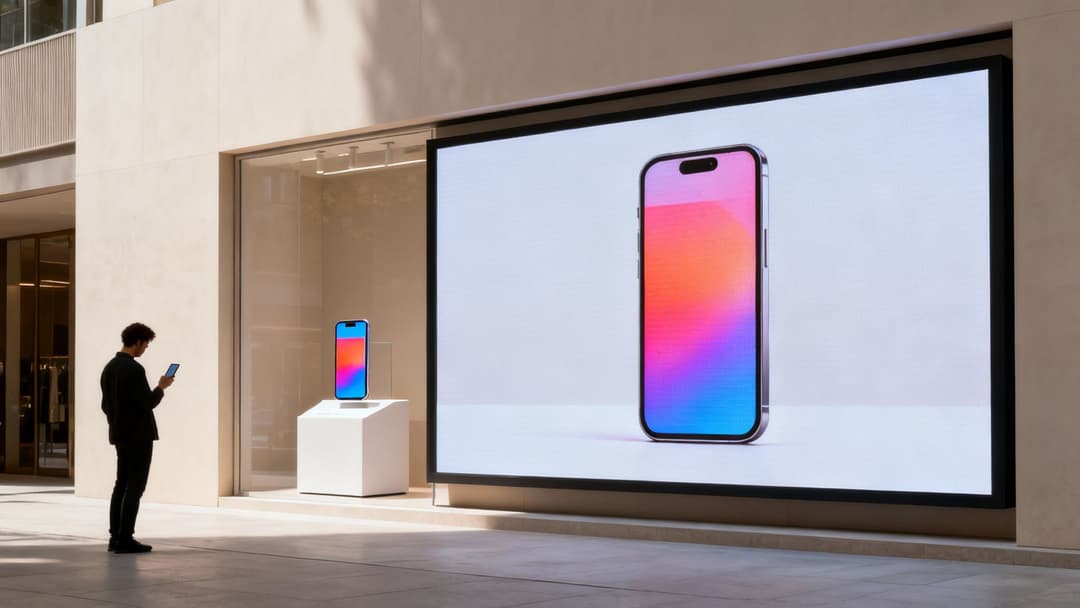
But creatives are so much more than just pretty pictures. In the world of paid advertising, they are the single most powerful lever you can pull to change your campaign results. While your targeting and bidding strategies get your ad in front of the right people, it’s the creative that does the heavy lifting—it’s what actually persuades a person to stop scrolling, pay attention, and take action.
It’s the visual handshake, the emotional connection point between you and a potential customer.
Think about a crowded newspaper. What makes you stop and read a particular story? The headline. In the endless scroll of a social media feed, a compelling creative is your headline. It has to instantly resonate with a user's problem, need, or curiosity to have any chance of success.
The Core Components of a Digital Marketing Creative
Every ad creative that actually works is built from a few key ingredients, all working in harmony to hit a specific goal. Here’s a quick breakdown of what goes into a single creative.
| Component | Function | Example |
|---|---|---|
| Visual | The image, graphic, or video that stops the scroll. | A short demo video of your product in action. |
| Copy | The headline, body text, and description with your message. | "Tired of slow software? Our tool is 3x faster." |
| Call-to-Action | The clear instruction telling the user what's next. | The "Shop Now" or "Get Your Free Trial" button. |
This blend of visual and text is what shapes the user's experience and ultimately determines whether your campaign sinks or swims.
A great creative can make a mediocre offer successful, while a poor creative can cause even the best offer to fail. It’s the primary driver of engagement and conversion.
Why Creative Excellence Matters More Than Ever
Let's be honest: the digital world is noisy. In 2023, the United States was recognized as a global leader in advertising creativity, which tells you just how high the bar is for getting noticed. With social media ad spend alone hitting $226 billion in 2022, the competition for attention is fierce.
As you can see in this Statista report about creative advertising markets, creative quality isn't just a "nice-to-have"—it directly impacts whether someone buys from you or scrolls right past. This is precisely why platforms like AdStellar AI are becoming so crucial. They help marketers break free from slow, manual production and embrace scalable, AI-driven creative generation. You can also learn more about Dynamic Creative Optimization in our article to see how technology is pushing the boundaries of what's possible.
Exploring the Most Effective Ad Creative Formats
Picking the right creative format is a lot like choosing the right tool for a job. You wouldn't use a hammer on a screw, right? In the same way, the format you choose for your creatives in digital marketing has to be a perfect match for your campaign goal, your audience, and the platform you're running on.
Not all formats are created equal. Some are brilliant at grabbing that initial flicker of attention, while others are built to tell a deeper story or push for a direct sale. Let's break down the most powerful formats that seasoned marketers always keep in their toolkit.
Static Image Creatives
Don't let their simplicity fool you. A single, powerful image can stop a user dead in their tracks mid-scroll and get a message across in a split second. They’re the workhorses of the ad world—versatile, quick to produce, and effective on nearly every digital platform, from social feeds to display networks.
The real power of a static image is its ability to deliver an immediate visual punch. It’s all about combining compelling photography or sharp graphic design with short, bold copy to spark an instant emotional connection or highlight a killer product benefit. For top-of-funnel awareness campaigns or direct-response ads with a can't-miss offer, static creatives are still a fundamental—and often unbeatable—choice.
Short-Form Video Creatives
Video is the undisputed king of engagement, and its short-form version absolutely dominates platforms like TikTok, Instagram Reels, and YouTube Shorts. These are quick, dynamic videos made for a mobile-first, sound-on (or off) world, designed to hook a viewer in the first three seconds.
Short-form videos are perfect for things like:
- Product Demos: Showing your product in action in a quick, satisfying way.
- Behind-the-Scenes Content: Giving your brand a human face and building a real connection.
- Educational Snippets: Sharing quick tips or "how-to" content that gives people instant value.
Video lets you tell a more complete story than a static image ever could, making it ideal for guiding customers through the consideration phase. If you want to get into the technical nitty-gritty, you can learn more about optimizing video sizes for Facebook ads in our guide to make sure you're getting the most out of every frame.
A study found that viewers retain 95% of a message when they watch it in a video, compared to just 10% when reading it in text. This makes video an absolute powerhouse for memory and brand recall.
Carousel Creatives
Think of a carousel ad as a mini-story you can swipe through. This interactive format lets you pack multiple images or videos into a single ad unit, which makes it incredibly powerful for a few key jobs.
You can use a carousel to show off different features of one product, display a whole collection of items, or walk someone through a step-by-step guide. This multi-card approach encourages users to engage and lets you share more information without being overwhelming. It's a go-to format for e-commerce and SaaS brands for a reason.
User-Generated Content (UGC)
User-Generated Content isn't so much a format as it is an approach, but its impact is massive. UGC is any content—photos, videos, reviews, testimonials—created by your actual customers, not your brand. It’s the digital version of word-of-mouth, and it’s one of the most powerful forms of social proof out there.
When you weave authentic customer content into your ads, you build instant trust and credibility. Ads that feature UGC just perform better because they feel less like a sales pitch and more like a genuine recommendation from a friend. This authenticity is a huge driver for conversions, as a staggering 79% of people say UGC highly impacts their purchasing decisions.
How to Build a Winning Creative Strategy
Throwing a bunch of beautiful ads into the market without a strategy is like having a race car with no driver—it looks impressive sitting still, but it’s not going to win any races. A real creative strategy is what gets you from hopeful guesses to a data-driven system where every single ad has a purpose, a goal, and a lesson to teach you. It’s about being intentional.
This means you stop the "spray and pray" madness of just launching ads to see what sticks. Instead, you build a roadmap. A strong strategy deliberately maps different creative styles to each stage of the customer's journey, making sure you're always delivering the right message to the right person at exactly the right time. The goal isn't to stumble upon one unicorn ad; it's to build a machine for continuous, measurable improvement.
Aligning Creatives with the Marketing Funnel
A potential customer's mindset is completely different when they first hear about you versus when they're hovering over the "buy now" button. Your creative strategy has to mirror that evolution.
Top of Funnel (Awareness): At this stage, you’re a stranger trying to get a first date. Your job is to grab attention and make a memorable introduction. Think bold, visually arresting, and emotionally resonant creatives. Short-form videos, stunning static images, and anything that makes someone stop scrolling works wonders here. The message is simple: "Here's who we are and why you should care."
Middle of Funnel (Consideration): Okay, you got their attention. Now you have to build trust and show them you're the real deal. This is the time for carousel ads that walk through product features, testimonial videos that provide powerful social proof, or user-generated content (UGC) that shows real people loving what you do. The message gets deeper: "Here’s how we solve your problem better than anyone else."
Bottom of Funnel (Conversion): It’s time to close. Your creatives need to be direct, crystal clear, and compelling. This is where you bring out strong calls-to-action (CTAs), flash sales, limited-time offers, and dynamic ads that retarget users with the exact products they were just looking at. The message is urgent and to the point: "Here’s an irresistible reason to buy right now."
To get a better handle on this, you can think of your ad formats as a toolbox, with different tools for different jobs. This hierarchy shows the main categories that marketers pull from every day.
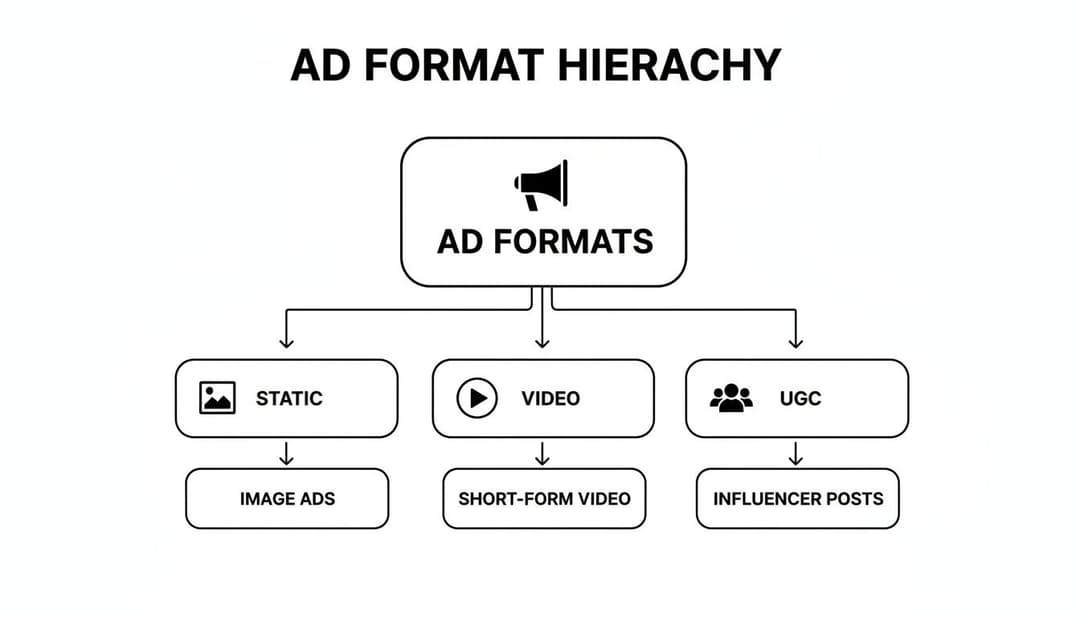
This structure makes it easier to see which creative type—whether it's a static image, a video, or authentic UGC—is the best fit for the message you need to send at each stage of the funnel.
Building a Powerful Creative Testing Culture
A winning strategy is built on a mountain of data, and the only way to get that data is through relentless, systematic testing. This is how you kill your assumptions and replace them with cold, hard facts. The two main frameworks for this are A/B testing and multivariate testing.
First up, A/B testing. Also called split testing, this is the most straightforward method. You pit two versions of a creative against each other (Version A vs. Version B) where you’ve only changed one single thing. Maybe you're testing a red "Shop Now" button against a blue one, or a lifestyle photo against a clean product shot. By isolating just one variable, you know for sure what caused the change in performance.
Then there’s multivariate testing, which is A/B testing on steroids. It lets you test multiple variables all at once to find the ultimate winning combination. For example, you could test two different headlines, three images, and two CTAs simultaneously. The ad platform then mixes and matches these elements, showing different combinations to your audience to pinpoint the absolute highest-performing formula. It’s more complex and needs a lot more traffic to deliver clear results, but it can uncover game-changing insights much faster.
The core principle of a testing culture is this: every ad is a hypothesis. Your goal isn't just to get conversions but to validate that hypothesis and learn what resonates with your audience.
Choosing the right testing framework depends entirely on your goals. One is for big swings, the other for fine-tuning.
A/B Testing vs. Multivariate Testing for Creatives
| Framework | Best For | Key Advantage | Limitation |
|---|---|---|---|
| A/B Testing | Testing big, bold changes, like a completely new offer or a radically different image. | Simple to set up and gives you clear, easy-to-understand results. | It only tests one thing at a time, which can be a slow way to learn. |
| Multivariate Testing | Optimizing an already high-performing creative by tweaking smaller elements. | It identifies the impact of each element and how they work together. | Requires significant traffic and a larger budget to be statistically valid. |
Ultimately, choosing the right method comes down to what you're trying to achieve. Use A/B testing for foundational learnings and multivariate for incremental gains.
By embracing this iterative process, you create a powerful feedback loop. The performance data from today's ads directly fuels the creative brief for tomorrow's. For a deeper dive into the visual side of things, check out our guide on effective advertising banner design. This approach transforms your ad spend from an expense into an investment in learning, guaranteeing your campaigns get smarter and more profitable over time.
Measuring Creative Performance to Find Winners
Launching your creatives is just the starting line. The real work begins when the data starts rolling in, telling you a story about what’s capturing attention and what’s getting ignored.
Without a clear measurement plan, you’re essentially flying blind, burning through your ad budget on assets that don’t deliver. This is where you separate the winners from the ones draining your resources. It’s not about finding one "perfect" ad; it’s about understanding which metrics matter for the job at hand.
Key Metrics for Awareness Campaigns
When your goal is simply to introduce your brand to new people, your key performance indicators (KPIs) are all about reach and attention. You're not looking for immediate sales—you're trying to make a memorable first impression.
- Reach: This is your most basic awareness metric. It tells you the total number of unique people who saw your ad. A high reach means your creative is successfully getting in front of new eyes.
- View-Through Rate (VTR): Especially critical for video, VTR measures the percentage of people who watched your ad to completion (or for a significant chunk of it). A strong VTR is a clear signal that your creative is engaging enough to hold someone's attention.
These metrics tell you if your creative is doing its first job: stopping the scroll and planting the seed of brand recognition.
Key Metrics for Conversion Campaigns
Once your goal shifts from grabbing attention to driving action, your KPIs become much more focused on efficiency and return. This is where you find out if your creative can actually persuade people to take that next step.
Creative performance isn't just about what looks good—it's about what drives profitable action. The ultimate goal is to connect a specific visual or message directly to a measurable business outcome.
Here are the conversion metrics that really matter:
- Click-Through Rate (CTR): This is the percentage of people who saw your ad and clicked on it. A high CTR is a great sign that your visual and headline are compelling enough to make someone curious.
- Cost Per Acquisition (CPA): This is your bottom-line cost to get one new customer or lead. Lowering your CPA is a direct result of effective creatives that convert more efficiently.
- Return on Ad Spend (ROAS): The holy grail for performance marketers. ROAS measures the revenue you generate for every dollar you put into ads. A strong ROAS is the clearest sign that your creative is actually driving business growth. If your campaigns are struggling, learning how to fix your Facebook tracking ads can help you figure out if your creative is the real problem.
The Rise of Creative Intelligence
In today's market, the pressure to perform is immense. Digital ad spending has exploded, jumping 78% from under $375 billion in 2019 to over $667 billion in 2022. Social media ads alone doubled to $226 billion in that same period.
With 89% of senior executives noting a surge in content demands, the need for efficient, data-driven creative has never been more critical.
This is where creative intelligence comes into play. Instead of just glancing at surface-level metrics in a standard ads dashboard, modern platforms dig deeper to find patterns. They can pinpoint exactly which visual elements, headlines, or audience pairings are driving success.
This technology also helps you spot and combat creative fatigue—that moment when a previously winning ad starts to tank because your audience has seen it too many times. By surfacing these insights automatically, creative intelligence platforms take the guesswork out of scaling your best performers and knowing when it's time for a refresh.
You can check out our guide on Facebook Ads reporting software to see how better reporting tools can unlock these kinds of insights.
Using AI to Accelerate Creative Performance

The old way of making creatives in digital marketing has always been a major bottleneck for growth. It’s a slow, manual grind of brainstorming, designing, and then crossing your fingers, hoping your best guess actually connects with the audience.
But artificial intelligence is completely changing the game. Think of it less like a replacement for marketers and more like a powerful co-pilot.
AI tools are built to shatter the old limits of manual creative production and analysis. Imagine generating hundreds of distinct ad variations in the time it once took a team to build just one. You could test countless combinations of images, headlines, and audience segments. This isn't just about moving faster; it’s about unlocking a level of learning that was simply out of reach before.
How AI Transforms Creative Production
Platforms like AdStellar AI are a perfect example of this shift. Instead of starting from a blank page, these systems plug directly into your historical ad data. The AI engine then gets to work, analyzing every campaign you've ever run to find the hidden patterns behind your biggest wins.
It learns which visuals consistently stop the scroll, what kind of language actually drives clicks, and which audience segments respond best to certain messages. This intelligence becomes the blueprint for new creatives that are statistically primed to perform well right out of the gate. Suddenly, creative development moves from an art of guesswork to a science of prediction.
AI doesn't remove the need for human strategy; it automates the tedious execution, freeing up marketers to focus on high-level insights and bigger creative ideas. It handles the how so you can focus on the what and why.
For instance, a feature like AdStellar AI's 'AI Launch' acts like a smart assistant for building new campaigns. It automatically assembles campaigns using only your proven top-performers—the best images, the most compelling copy, and the highest-converting audiences. This ensures every new dollar of ad spend is backed by data, drastically cutting waste and speeding up your path to profitability.
Centralizing Workflows for Data-Backed Decisions
The digital agency world is booming, with the U.S. market expanding by 54% between 2018 and 2023. As demand skyrockets and 89% of executives face content shortages, the old, chaotic workflows just can’t keep up.
AI-powered platforms bring order to this complexity. They centralize campaign management, media libraries, and performance data into one cohesive system. This centralized hub replaces scattered spreadsheets and disjointed tools with a single source of truth.
Marketers can see exactly what’s working at a glance, double down on winners with a single click, and achieve far better ROAS and CPA. For a deeper dive into the tech making this happen, check out our guide on creative automation tools.
As you think about how AI can boost your creative performance, it's also worth exploring the ongoing discussion around AI vs. real photography, as these technologies continue to redefine what’s possible in visual advertising.
Ultimately, AI gives marketers the power to test at scale, learn faster, and make smarter, data-backed decisions that drive real business results.
Your Top Ad Creative Questions, Answered
Even with a killer strategy, questions always pop up when you're in the trenches. Let's tackle some of the most common ones we hear from performance marketers and agency teams, cutting through the noise to give you direct, actionable answers.
How Often Should I Refresh My Ad Creatives?
There's no magic number here, but your ads will tell you when they're getting stale. You're looking for signs of creative fatigue, which almost always shows up as a declining Click-Through Rate (CTR) and a rising Cost Per Acquisition (CPA) for an ad that was crushing it just last week.
For high-volume, big-spend campaigns, this can happen in a matter of weeks. For smaller accounts, you might get months out of a winner. The best approach is proactive: aim to inject new creative concepts into your testing rotation every two to four weeks. This keeps you ahead of performance dips and constantly surfaces new top performers.
What’s More Important: The Visual or The Copy?
They're a team, but let's be honest: the visual is what stops the scroll. A killer image or video earns you the right to have your copy read in the first place. The visual grabs the attention, and the copy closes the deal by persuading the user and driving them to act.
Think about your A/B tests. More often than not, swapping out the visual creates a much bigger swing in performance than tweaking a headline. That said, a weak call-to-action or a confusing hook can absolutely sink a brilliant image. The only way to know for sure is to test variations of both to find that perfect, money-making combination.
Can I Still Win with Static Images, or Is Video a Must?
Absolutely. While video is an incredibly powerful format, don't sleep on high-quality static images. They are still wildly effective, especially on platforms like Facebook and Instagram where users are scrolling at lightning speed.
A static ad with strong graphic design, compelling photography, and a crystal-clear message can often outperform a mediocre video. The real key is testing both formats to see what your specific audience actually responds to.
Most top-tier brands rely on a healthy mix of creative types, using each for what it does best:
- Static Images: Perfect for clear, direct offers and stunning product shots that get straight to the point.
- Carousels: Great for showcasing multiple product features, telling a short story, or walking through a simple process.
- Videos: Unbeatable for product demos, powerful testimonials, and the kind of brand storytelling that builds a real connection.
How Many Creatives Should I Test at Once?
This all comes down to your budget. To get statistically significant results, every single creative needs enough ad spend behind it to gather meaningful data. If you stretch a small budget across too many variations, you'll end up with a bunch of inconclusive data and no real learnings.
If you’re working with a smaller budget (think $50-$100 per day), stick to testing two to four distinct creative concepts at a time. Got more to spend? You can test more. The goal isn't to throw hundreds of random variations at the wall; it's about testing a few strategic hypotheses. Frame your tests around real questions, like, "Does a lifestyle image beat a clean product-on-white shot?" or "Does a short, punchy headline outperform a longer, more descriptive one?"
Ready to stop the guesswork and start launching winning campaigns faster? AdStellar AI uses artificial intelligence to generate hundreds of ad variations, analyze performance data, and help you scale your best creatives with confidence. Learn how AdStellar AI can 10x your campaign output.