Let's be honest, trying to manage a modern paid media campaign can feel like you're captaining a massive ship in a storm, frantically trying to adjust a thousand different sails and ropes to catch the wind just right. It's a constant, exhausting battle against countless variables.
Now, imagine an advanced navigation system that does it all for you, automatically optimizing every single sail for maximum speed without you ever touching a rope. That’s AI marketing automation in a nutshell. It’s not just about getting tasks done faster; it’s about making smarter, data-driven decisions at a scale no human team could ever hope to match.
This shift isn't just a "nice-to-have"—it's becoming essential. Marketers are getting crushed by creative burnout and skyrocketing ad costs on platforms like Meta. The old playbook of launching a handful of ads and just hoping for the best simply doesn't cut it anymore. AI automation is the logical next step for scaling campaigns without getting buried under a mountain of tedious, manual work.
Your Strategic Marketing Co-Pilot
The best way to think about AI automation is as your strategic partner, not just another tool in your tech stack. It’s designed to handle the grueling, data-heavy lifting, freeing you up to focus on the big-picture strategy and creative direction where you add the most value.
This partnership brings a few game-changing advantages to the table:
- Intelligent Execution: Forget rigid, old-school "if-this-then-that" rules. True AI learns directly from your performance data to make predictive adjustments that actually move the needle.
- Proactive Optimization: It automatically sniffs out your winning ads, audiences, and creative elements, then intelligently reallocates your budget to them in real-time. No more waiting for end-of-week reports to make a change.
- Creative Scalability: Need to test hundreds of ad variations to find that perfect message? AI lets you generate and launch them in minutes, a job that would take a human team days to pull off. This means you can explore far more creative angles and find what truly resonates with your audience.
AI marketing automation creates a powerful, self-improving feedback loop. It generates creatives, targets audiences, optimizes your spend, and then uses the results from that cycle to get even smarter for the next one.
The market’s explosive growth tells the whole story. The global marketing automation space, supercharged by AI, was valued at $6.65 billion and is on track to hit a massive $15.58 billion by 2030. This isn't just hype; businesses that properly integrate AI are seeing an average ROI of 544%, turning every $1 spent into $5.44.
A key feature of genuine AI marketing automation is the move toward autonomous workflows. This is a huge leap from simply looking at dashboards to having systems that proactively make decisions for you. It's the core difference between basic automation and truly intelligent automation.
To see what this looks like in the real world, check out our guide on the best AI tools for marketing. This technology isn't some far-off concept—it's the engine driving real revenue for advertisers in today's high-cost, privacy-first world.
Before we go deeper, let's quickly break down the difference between the old way of doing things and the new, AI-powered approach.
Manual vs AI-Powered Campaign Management
The table below gives a quick snapshot of how AI automation transforms day-to-day campaign tasks.
| Task | Manual Approach (The Old Way) | AI Automation Approach (The New Way) |
|---|---|---|
| Creative Testing | Manually creating 5-10 ad variations. | Generating and testing 100s of variations automatically. |
| Audience Targeting | Building broad segments based on assumptions. | Identifying niche, high-intent micro-audiences with predictive analytics. |
| Bid Management | Setting fixed bids and checking them daily/weekly. | Adjusting bids in real-time based on conversion probability. |
| Budget Allocation | Shifting budget between campaigns based on weekly reports. | Reallocating spend to top performers instantly, 24/7. |
| Reporting | Pulling data into spreadsheets to find insights. | Getting proactive alerts and automated performance summaries. |
| Time to Launch | Days or even weeks for a multi-variant campaign. | Hours or even minutes from concept to live ads. |
As you can see, the contrast is stark. The manual approach is reactive and slow, while the AI approach is proactive, fast, and built for scale. It's about shifting from being a campaign operator to a campaign strategist.
The Three Pillars of Paid Ads Automation
To really get what makes AI marketing automation tick, you have to look under the hood. It’s not some single, mysterious black box. Instead, think of it as a system built on three interconnected pillars. Each one handles a critical piece of a paid ad campaign, turning slow, manual work into lightning-fast, intelligent operations.
This is the basic journey: moving from manual grunt work to scaled growth, with AI as the engine.
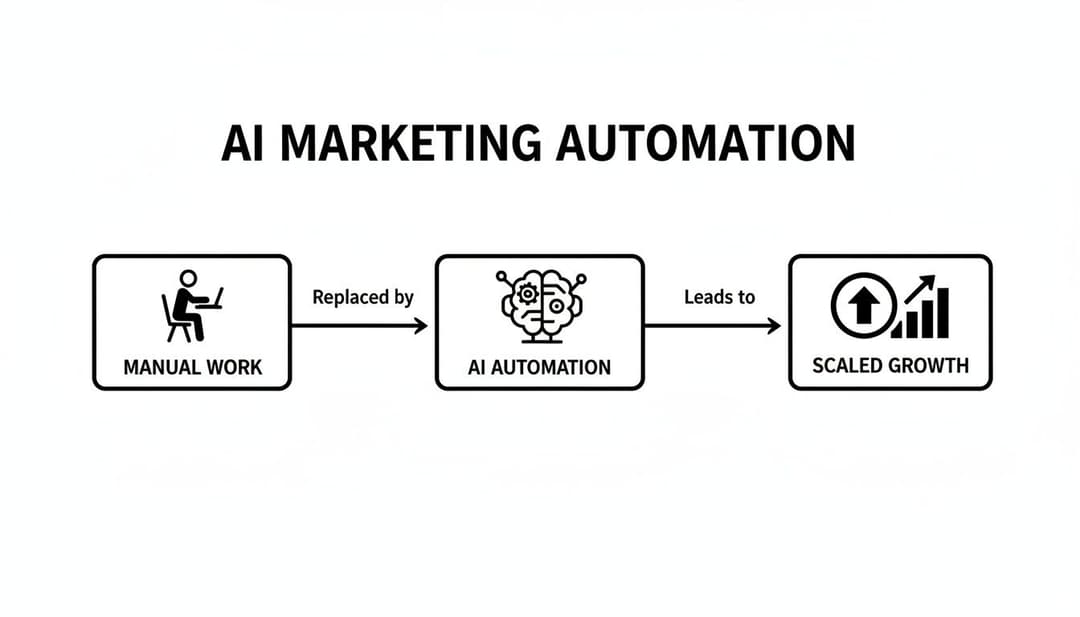
The big idea here is that AI bridges the gap between human effort and exponential results. It automates all the repetitive stuff that holds you back from truly scaling up.
Creative and Copy Automation
The first pillar is basically your tireless, 24/7 creative team. Creative and copy automation smashes one of the biggest bottlenecks in advertising: coming up with enough ad variations to find a real winner. Instead of a designer manually banging out ten different ads, you just feed the AI your core assets—a few images, some videos, headlines, and descriptions.
The system then goes to work, mixing and matching these elements to spit out hundreds of unique ad combinations in minutes. This lets you test a massive volume of creative angles without burning out your team or your budget. It’s how you discover that one perfect image-and-headline combo that just clicks with your audience.
If you want to dig deeper into using AI for ads, check out this complete marketing guide on creating AI video ads that convert.
Audience and Targeting Automation
Next up, the second pillar acts as your brilliant data scientist. Audience and targeting automation goes way beyond broad, assumption-based segments. It’s constantly analyzing your campaign data, picking out patterns and traits of your highest-converting customers.
Based on what it learns, the AI can:
- Build Lookalike Audiences: It finds new people who share characteristics with your best customers, expanding your reach to high-potential groups.
- Discover Hidden Niches: The system might uncover something you’d never spot manually—like users who engage with a certain type of content late at night have a 30% higher conversion rate. Bam, new micro-audience.
- Refine Existing Segments: It’s always tweaking your targeting parameters based on real-time feedback, making sure your ads stay in front of the most receptive people.
This pillar is all about swapping guesswork for data-driven precision. It ensures your awesome creative work actually gets in front of the right eyeballs. To see the tangible results, you can learn more about the benefits of automated ad campaigns.
Bidding and Budget Optimization
Finally, the third pillar is like having an expert financial trader for your ad spend. Bidding and budget optimization handles the complex, second-by-second decisions of where your money will make the biggest impact. No more manually checking bids or shifting budgets at the end of the day—the AI does it instantly.
It monitors performance across every single ad and audience, around the clock. The moment it spots a high-performing ad, it pushes more budget its way. On the flip side, if an ad is tanking and driving up your costs, it pulls back or cuts the spend entirely. This real-time shuffle means not a single dollar gets wasted.
These three pillars don't work in isolation; they create a powerful and continuous feedback loop. The AI generates diverse creatives, targets them to data-defined audiences, and optimizes spend based on results. It then feeds those performance insights back into the system to inform the next cycle of creative generation and audience targeting, becoming smarter with every dollar spent.
Putting AI Automation into Practice
Okay, so we've talked about the theory behind AI marketing automation. But understanding the moving parts is one thing—seeing them come together to launch a real campaign is where it all clicks. Let's step away from the abstract and walk through a real-world scenario to see how this stuff actually works on a platform like Meta.
Think about the old workflow for a performance marketer at an e-commerce brand. It was a grind. Days were spent brainstorming ad concepts, briefing designers, writing endless copy variations, and then painstakingly building dozens of ad sets in Ads Manager. It was slow, tedious, and you could only test as many ideas as you had hours in the day.
With a proper AI automation platform, that entire process gets turned on its head.
From Manual Grind to Automated Launch
The marketer’s new workflow is radically simpler. Instead of building every single ad by hand, they start by feeding the AI a few core ingredients.
These initial inputs are pretty straightforward:
- A handful of high-quality product images or short video clips.
- The core value propositions or key messages they want to test.
- A few compelling headlines and primary text options.
- The main campaign goal, like maximizing Return on Ad Spend (ROAS) or hitting a specific Cost Per Acquisition (CPA).
With these basic assets, the AI gets to work. Think of it as a super-powered creative strategist that systematically combines every image, headline, and message into unique ad variations. In just a few minutes, it can generate well over a hundred distinct ad combinations, each one designed to test a specific creative hypothesis.
But it doesn't stop with the creative. The system also builds out multiple audience segments to test against, from broad interest groups to hyper-specific lookalike audiences based on past customers. The marketer just has to review the AI-generated campaign structure and, with a single click, push everything live to Meta. What used to take a full week is now done in less than an hour.
To give you a better idea of what this looks like, the dashboard below shows an AI platform analyzing live campaign data and flagging the top performers.

This kind of immediate feedback turns a mountain of complex data into simple, actionable insights about which creative and audiences are actually making you money.
Real-Time Optimization in the First 24 Hours
This is where the magic really happens. Once those hundreds of ad variations are live, the AI marketing automation platform starts its most important job: autonomous optimization. It doesn't need a human to log in and crunch the numbers; it analyzes performance data as it comes in.
Within the first 24 hours, the system has already collected enough early signals to start making smart moves. It's constantly monitoring metrics like click-through rates, conversion events, and cost per result for every single ad.
The platform automatically identifies the winning ads—often the top 5% that are crushing the campaign's main goal, like CPA. It then intelligently reallocates the budget, pulling spend from the duds and pouring it onto the proven winners.
This kind of rapid feedback loop is just not possible to do manually. A human media buyer might check in once or twice a day, but the AI is on the job 24/7, making sure not a single dollar is wasted on creative that isn't pulling its weight. This is a complete game-changer for campaign efficiency. You can dive deeper into this streamlined process by exploring how to use AI to launch ads.
This workflow isn't just about saving time—it’s about a fundamental shift in the marketer's role. For teams managing big campaigns or multiple clients, it moves them from being manual operators to strategic overseers. They're free from the repetitive grind of ad creation and budget pacing, giving them the space to focus on what really matters: high-level strategy, creative direction, and making sense of the powerful insights the AI uncovers.
How to Bring AI Automation Into Your Workflow
Bringing AI marketing automation into your team is a lot more than just plugging in a new piece of software. Think of it as a strategic upgrade to your entire marketing engine. It’s a shift in how you operate, not just a technical tweak. Following a clear roadmap here is key—it takes the guesswork out of the process and sets you up for a win right from the start.
The journey doesn't kick off with technology. It starts with an honest look at your current operations. Where are the real hang-ups? Pinpointing the most tedious, time-sucking tasks is the first and most critical step. It tells you exactly where AI can make the biggest difference.
Start with a Workflow Audit
Before you can automate anything, you need a painfully clear picture of how things get done right now. Take a hard look at your team's day-to-day grind and identify the biggest drains on their time and your resources.
Where do the bottlenecks usually hide?
- Manual Ad Creation: How many hours are burned building dozens of nearly identical ad variations inside Ads Manager?
- Daily Budget Pacing: Who’s stuck checking performance dashboards and manually shifting dollars between campaigns every single day?
- Mind-Numbing Reporting: Is your team spending more time pulling data into spreadsheets than actually figuring out what it means?
- Glacially Slow Testing: How long does it take to get from a new creative idea to data that tells you if it actually worked?
Nailing down these pain points gives you a specific problem to solve. This makes your search for the right tool much more focused and effective.
Define Your Goals and Get Your Assets in Order
With your bottlenecks mapped out, you can set real, tangible goals. We’re not talking about fuzzy ambitions like "get better at marketing." Your goals need to be concrete outcomes you can actually track and measure.
Here's what strong goals look like:
- Slash campaign launch time from three days to just three hours.
- Boost creative testing volume by 500% in the first quarter.
- Lift account-wide ROAS by 15% in the next six months.
- Automatically move budget from the bottom 20% of ads to the top performers every single day.
Once your goals are locked in, it’s time to get your house in order. AI systems are only as smart as the data you feed them, so quality is non-negotiable. Make sure your Meta Pixel tracking is rock-solid, conversion events are firing correctly, and your creative library isn't a chaotic mess. A clean foundation is what allows the AI to generate powerful insights and winning campaigns.
If you want to go deeper on this, check out our guide on optimizing your Meta advertising workflow.
Choose the Right Platform and Run a Pilot
Now you're ready to start looking at platforms. Not all AI tools are built the same, so it's vital to find one that lines up with your specific goals and the way your team works. Look for solutions that are experts in the channels you live in, like Meta, and that are designed to crush the specific bottlenecks you identified earlier.
To help with this, we’ve put together a checklist to guide your evaluation process.
AI Automation Platform Evaluation Checklist
Use this checklist to systematically compare different platforms and find the one that truly fits your team's needs.
| Feature/Criteria | What to Look For | Why It Matters |
|---|---|---|
| Core Automation Features | Does it automate the specific tasks you identified as bottlenecks (e.g., creative generation, audience building, budget optimization)? | The tool must solve your actual problems, not just offer a list of generic features. |
| Platform Specialization | Is it built specifically for the ad platforms you use most, like Meta and Google? | A specialized tool will have deeper integrations and more relevant features than a generalist one. |
| Ease of Use | How intuitive is the interface? Can your team learn it quickly without extensive training? | A complex tool won't get used. It needs to simplify workflows, not add another layer of complexity. |
| Data & Tracking Integration | How well does it integrate with your existing data sources, like your Meta Pixel and product catalogs? | Accurate data is the fuel for AI. Poor integration leads to flawed insights and wasted ad spend. |
| Support & Onboarding | What level of support and training is provided during the setup and pilot phase? | Good support ensures you get value from the platform quickly and can troubleshoot issues without delay. |
| Testing & Validation | Does the platform facilitate A/B testing and provide clear, comparative reporting? | The goal is to prove impact. The tool should make it easy to measure its performance against your manual efforts. |
| Scalability | Can the platform grow with your needs? Will it handle more campaigns, bigger budgets, and more users over time? | You're investing for the long term. The platform should support your growth, not hold you back. |
Choosing a platform is a big step, but it’s not the last one. The real proof is in the performance.
A critical part of the evaluation is a controlled pilot campaign. Never go all-in on a new platform without validating its impact first. A pilot allows you to learn the system and measure its performance against your existing methods in a low-risk environment.
Run a small, focused campaign using the AI platform for a few weeks. Pit it directly against a campaign you run the old-fashioned way. Compare the hard numbers—CPA, ROAS, launch speed. This head-to-head showdown will give you the undeniable data you need to prove the tool’s value and get your whole team bought in before you roll it out everywhere.
The Metrics That Truly Measure Success
Adopting AI marketing automation is exciting, but how do you actually prove it's working? Success isn't just about launching more ads; it's about seeing real, tangible improvements in your efficiency, performance, and strategic firepower. To measure the true impact, you have to look past the vanity metrics and focus on the KPIs that prove you're getting serious business value.
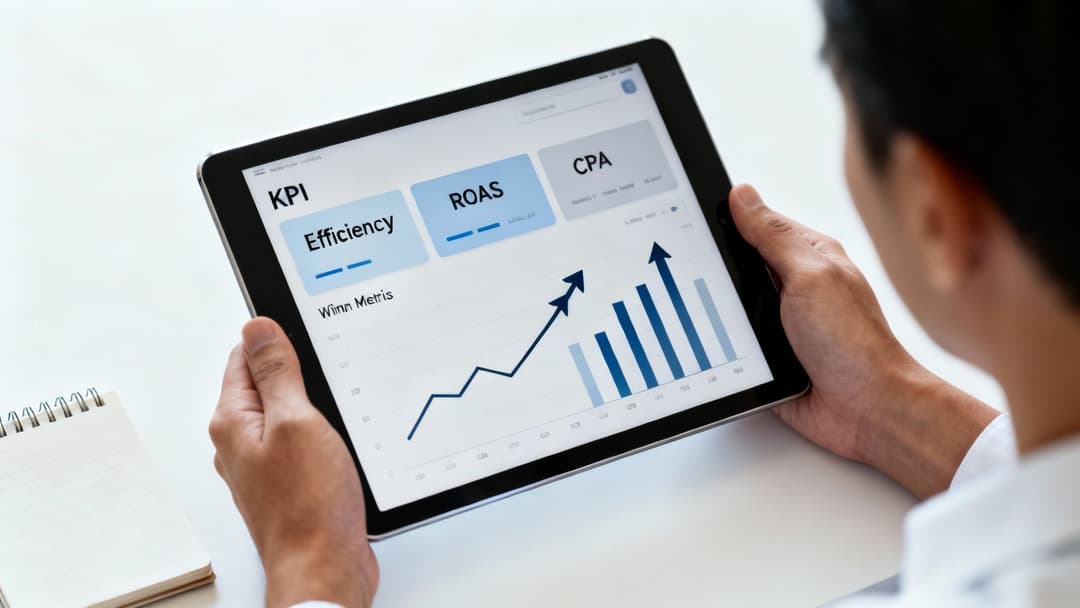
It’s time to shift your focus. Forget the surface-level numbers and drill down into the metrics that directly connect AI-driven actions to your bottom line. Let's break down how to measure success across three critical areas.
Gauging Your Efficiency Gains
The first—and most immediate—win you'll see from AI automation is getting back your most valuable resource: time. Manual campaign setup is a notorious bottleneck, and this is where you'll feel the impact almost overnight. You need to start tracking the hours your team gets back.
Key efficiency metrics to watch:
- Campaign Launch Time: How long does it take to get a campaign from a brief to being live? A process that used to drag on for days can shrink to just a few hours. You need to quantify that.
- Hours Spent on Manual Adjustments: Track the daily time suck of tasks like budget pacing and bid management. An AI handles this 24/7, freeing up your team for the strategic work they were hired to do.
- Creative Iteration Speed: Just look at how fast you can test new creative concepts. With AI, you can generate and deploy hundreds of variations in the time it used to take to create a handful.
Tracking Critical Performance Uplift
Efficiency is fantastic, but it has to lead to better results. This is where you connect AI automation directly to your core business goals. The objective here is to prove that the system isn't just faster—it's smarter and more effective at driving growth.
The ultimate test of an AI marketing automation platform is its ability to consistently improve your key financial metrics. It should be making every dollar of your ad spend work harder, leading to more profitable customer acquisition.
Focus on these essential performance indicators:
- Return on Ad Spend (ROAS): This is the gold standard. A successful AI implementation will deliver a measurable increase in ROAS as the system learns and shifts your budget toward the top-performing ads.
- Cost Per Acquisition (CPA): You should see your CPA trend downward over time. As the AI gets smarter about targeting and creative, it finds more efficient paths to conversion, which naturally lowers your acquisition costs.
- Conversion Rate (CVR): Better targeting and more personalized ad creative will inevitably lead to higher conversion rates. You're simply reaching a more relevant and receptive audience.
Assessing Your Strategic Impact
Finally, the most advanced way to measure success is to look at how AI automation elevates your team's strategic capacity. This is less about specific numbers and more about what your team is now capable of doing. This newfound agility is a massive competitive advantage.
You can learn more about how to monitor these KPIs by checking out our deep dive on essential performance marketing metrics. An effective dashboard should clearly connect the dots between an AI-driven action, like identifying a winning creative, and the direct impact on your business goals. True success is when AI not only improves your numbers but also transforms your team from reactive operators into proactive strategists.
Of course. Here is the rewritten section, crafted to sound completely human-written, following the style and tone of the provided examples.
Common Traps to Sidestep with AI Automation
Jumping into AI marketing automation feels like a massive step forward, but even the slickest systems can trip up if you aren't careful. To make sure your move to AI is a win, you need to know about the common mistakes that can sink an otherwise solid strategy. Getting ahead of these challenges is how you’ll actually see a return on your investment.
The first—and biggest—stumbling block is the quality of the data you feed the machine. There's an old saying in computing that’s truer than ever here: "garbage in, garbage out." If your AI is learning from data that's inaccurate, incomplete, or just plain messy, its output is going to be just as flawed.
An AI platform isn't a miracle worker; it can't spin gold from straw. Before you even think about flipping the switch, you have to get your house in order. That means making sure your tracking pixels, conversion events, and product catalogs are squeaky clean and reliable. A solid data foundation isn't just nice to have—it's non-negotiable.
Resisting the "Set It and Forget It" Mindset
A mistake I see all too often is treating AI automation like a magic button you press once and then walk away from. This "set it and forget it" mentality completely misses the point. AI is your co-pilot, not the autopilot. It's an unbelievably powerful tool, but it still needs you to provide the strategy and expertise.
Think of it this way: you tell the AI the destination (your business goals), and it figures out the most efficient route to get there. But without that destination, it’s just driving in circles.
AI crushes it at execution and optimization, but it has zero understanding of your brand's soul, its long-term vision, or the subtle quirks of your market. Your job shifts from being a manual operator to a strategic overseer—interpreting the insights and making the final call on the creative direction.
This partnership is where the magic really happens. The AI handles the tactical grind, which frees you up to focus on the bigger picture and actually steer the ship.
Neglecting Continuous Learning and Testing
Another classic pitfall is failing to build a culture of constant testing. An AI system's real power comes from its ability to learn and get better over time, but it can only do that if you keep feeding it new ideas and variables to play with. You can't just launch one campaign and expect the AI to optimize it into infinity. That's not how this works.
Your job is to keep the creative pipeline flowing:
- New Angles: Don't get stuck in a rut. Regularly introduce fresh messaging and different ways of talking about your product's value.
- Fresh Creatives: Keep supplying the system with new images, videos, and ad formats to test.
- Hypothesis-Driven Tests: You have strategic assumptions about what resonates with your audience. Use the AI's speed to validate them, fast.
The more you test, the faster the AI learns, and the better your results get. Stagnation is the enemy of great AI automation; constant experimentation is the fuel it runs on.
Overlooking Privacy and Data Security
Finally, in an age where data privacy is everything, ignoring compliance is a rookie mistake with serious consequences. When you’re looking at any AI marketing automation platform, you have to verify that it plays by the rules—think GDPR and secure data connections.
Building and keeping customer trust is everything. Make sure whatever tool you choose is transparent about how it handles data and puts security first. This isn't just about avoiding legal trouble; it’s about showing your customers you respect them. And that’s a cornerstone of any marketing strategy built to last.
Frequently Asked Questions
Jumping into AI marketing automation always brings up a few practical questions. Let's tackle some of the most common ones we hear from marketers who are thinking about making the switch.
Does AI Marketing Automation Replace Human Media Buyers?
Not at all—it supercharges them. Think of AI automation as a powerful co-pilot, not a replacement for the pilot. It’s built to handle the soul-crushing, repetitive tasks: churning out hundreds of ad variations, constantly sifting through data, and making thousands of tiny bid adjustments that no human could ever keep up with.
This frees up your team to focus on what really matters. They can pour their energy into high-level strategy, creative direction, and interpreting the insights the AI uncovers. The real magic happens when you combine the strategic mind of a human with the raw speed and data-crunching power of a machine.
How Much Data Do I Need for AI to Be Effective?
You don't need a mountain of historical data to get started. While more is always nice, a few solid months of consistent campaign performance is a great launchpad. The key is having clean, reliable metrics like conversions, CPA, or ROAS for the AI to learn from.
An AI platform starts learning from that initial dataset and just gets smarter as new campaign data rolls in. What's most important isn't the quantity of data, but the quality. Making sure your tracking and conversion events are buttoned up from day one is absolutely essential for the system to learn the right lessons.
The real power of AI marketing automation isn't a one-time trick. It's in its ability to learn and get better over time. Even a small but clean dataset gives the AI a strong foundation to start spotting patterns and optimizing your campaigns.
Can I Use AI Automation for More Than Just Meta Ads?
Absolutely. The core ideas behind AI marketing automation—finding patterns, optimizing bids, scaling creative—apply to pretty much any ad platform, whether it’s Google Ads, TikTok, or programmatic display.
However, the best tools are usually the ones that go deep on a single platform. Why? Because they’re purpose-built to integrate with that platform's specific APIs and data sources.
A tool designed from the ground up for Meta, for instance, will have much deeper hooks into Ads Manager. This allows it to do far more sophisticated things with creative, audiences, and budget management that a general-purpose tool just can’t match. When you're looking at different platforms, make sure the one you choose is an expert on the channels where you spend most of your time and money.
Ready to stop the manual grind and launch winning Meta campaigns faster? AdStellar AI gives you the power to generate, test, and scale hundreds of ads in minutes, not days. See how our platform can unlock your team's strategic potential and boost your ROAS. Discover AdStellar AI today.