The pace of modern marketing is relentless. Teams are constantly balancing high-level creative strategy with the repetitive, data-heavy execution required to launch, manage, and optimize campaigns. This relentless cycle often leaves little room for the strategic thinking that actually drives growth. Artificial intelligence is no longer a futuristic concept; it's the practical toolkit successful teams are using to reclaim their time and scale operations efficiently. The challenge has shifted from understanding what AI is to knowing which AI tool to deploy for maximum impact.
This guide is designed to cut through the noise. We've compiled a definitive, comparative list of the best AI tools for marketing, organized by critical functions: ad creative, campaign automation, audience generation, advanced analytics, and customer personalization. Instead of generic feature lists, you will find a strategic breakdown of what each platform does best, its ideal user, and practical implementation tips. We provide screenshots, direct links, and concise pros and cons to help you make a fast, informed decision for your specific needs.
Whether you're automating ad production or seeking deeper audience insights, the right tool is essential. The platforms covered here will help you streamline workflows and focus on what truly matters. For teams looking to enhance engagement with highly shareable content, even niche tools like an AI meme generator can offer a surprising competitive edge by producing viral content in minutes. This resource is your roadmap to selecting the right technology to not just keep up, but to get ahead.
1. AdStellar AI
Best For: Rapidly scaling Meta ad campaigns with data-backed creative testing.
AdStellar AI secures its position as a top-tier choice among the best AI tools for marketing by directly addressing one of the biggest bottlenecks for performance teams: the slow, manual process of creating, testing, and scaling ad variations on Meta platforms. It’s an AI-first platform engineered to transform campaign management from a tedious, repetitive task into a streamlined, strategic operation. By automating bulk ad creation, it empowers marketers to launch hundreds of creative, copy, and audience combinations in minutes, not days.
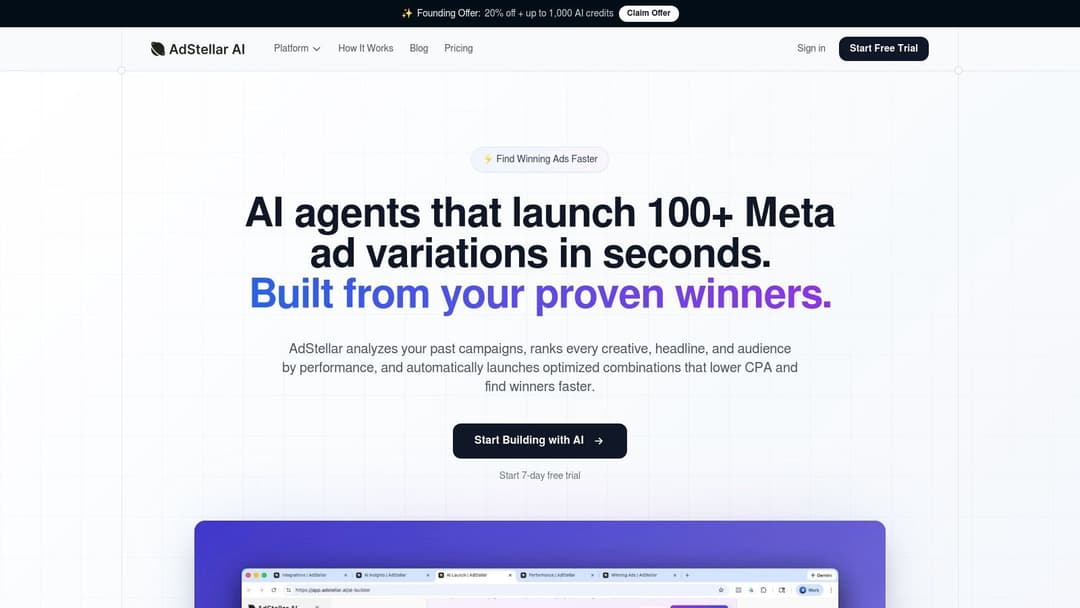
The platform's core strength lies in its ability to connect creative velocity with intelligent optimization. After a secure one-time connection to your Meta Ads Manager, AdStellar AI ingests historical performance data. Its AI then continuously learns from new results, ranking every ad variant against your primary goal, whether that’s ROAS, CPL, or CPA. This eliminates guesswork and provides a clear, data-driven path to scaling your top-performing assets.
Key Features & Use Cases
- Bulk Ad Generation: Generate and publish hundreds of creative variations directly to Meta with a single click. This is ideal for A/B testing creative concepts, headlines, and audience segments at a scale that is impossible to achieve manually.
- AI-Powered Insights: The platform’s models analyze your ad account’s history to identify winning patterns. The AI Launch feature can then automatically assemble new campaigns using these proven combinations of creative, copy, and audience targeting.
- Continuous Optimization: AdStellar’s system doesn't just launch campaigns; it monitors them. It identifies high-performing ads as new data comes in and provides clear signals on where to allocate more budget. To see how this works in detail, you can read more about its AI optimization features.
- Centralized Workspace: Manage your media library, audiences, campaigns, and performance reports from a single, unified interface, which dramatically improves workflow efficiency and team collaboration.
Pricing & Onboarding
AdStellar AI does not publicly list pricing tiers on its website. Access requires scheduling a demo with their sales team, who can provide customized quotes based on your team's size and ad spend. This is also the best route to request case studies and customer testimonials relevant to your industry.
| Pros | Cons |
|---|---|
| Massive speed increase in campaign creation and testing cycles. | Meta-only focus, which may not suit teams managing large, multi-platform advertising strategies. |
| Data-driven optimization that ranks ad components based on core business metrics (ROAS/CPA/CPL). | Lack of public pricing requires direct sales contact, which can slow down the initial evaluation process. |
| Secure and simple integration via Meta's official OAuth flow. | Performance depends on historical data; newer ad accounts may see less immediate value from the AI models. |
Bottom Line: For agencies, e-commerce brands, and growth teams heavily invested in the Meta ecosystem, AdStellar AI is a powerful force multiplier. It replaces manual drudgery with automated intelligence, enabling teams to test more, learn faster, and unlock significant performance gains.
2. G2
While not an AI tool itself, G2 is an indispensable starting point for any marketer’s search. It's the largest B2B software marketplace and review platform, making it one of the best places to research, compare, and shortlist the best AI tools for marketing based on unfiltered, real-world user feedback. Its true value lies in cutting through marketing jargon to reveal how these tools actually perform.
What It's Best For
G2 excels at comparative analysis. Instead of relying on vendor-supplied feature lists, you can leverage detailed comparison grids and "Best Of" reports, which are backed by verified user reviews. This allows you to see how different AI solutions stack up in specific categories like ad creative generation or campaign automation, helping you make a data-informed decision.
Key Features & How to Use Them
- Verified User Reviews: Filter reviews by company size, industry, and role to find feedback from peers with similar needs. Look for reviews that detail specific implementation challenges or unexpected wins.
- Comparison Grids: Use the side-by-side comparison feature to directly evaluate up to four tools at once on key attributes like "Ease of Use," "Quality of Support," and specific feature ratings.
- Educational Content: G2 provides articles and reports that help clarify complex topics, such as the top benefits of using artificial intelligence in your campaigns, giving you a stronger foundation for your research.
Pros & Cons
| Pros | Cons |
|---|---|
| Huge volume of real-user feedback | Sponsored placements can appear above organic results |
| Strong filtering by company size & industry | Pricing info often requires clicking through to the vendor |
| Comprehensive comparison tools | Review quality can vary; look for detailed feedback |
Website: https://www.g2.com
3. Capterra
Similar to G2, Capterra is a leading software directory that serves as an essential research hub for marketers vetting technology. It specializes in helping small and mid-sized businesses navigate the software landscape, offering curated guides and comparison tools. For those just beginning their search, Capterra provides a structured and less overwhelming way to discover and compare the best AI tools for marketing, often presenting clear starting prices and feature sets upfront.
What It's Best For
Capterra shines in its accessibility for small to mid-market teams. Its curated roundups and category-specific pages (like "AI Marketing Software") are perfect for initial discovery. The platform simplifies the vendor selection process by breaking down complex software options into digestible, consistently formatted listings, making it easy to create a preliminary shortlist of potential tools without getting bogged down in technical jargon.
Key Features & How to Use Them
- Curated "Best Of" Roundups: Start with Capterra's pre-made lists and guides. These often highlight top-rated tools based on user reviews and functionality, giving you a strong starting point.
- Granular Filtering: Use the filters on the left-hand sidebar to narrow down options by specific features (e.g., "predictive analytics"), business size, and pricing models. This helps you quickly eliminate tools that don't fit your budget or operational needs.
- Consistent Listing Templates: Each tool's page follows a standard layout, showing screenshots, key features, pricing, and reviews. This uniformity allows for quick, scannable comparisons between different vendors.
Pros & Cons
| Pros | Cons |
|---|---|
| Widely used and trusted by SMBs | Some listings are sponsored and may appear more prominent |
| Often shows starting prices & clear features | Latest pricing should always be verified on vendor sites |
| Strong filtering for core business needs | User review depth can sometimes be less than on G2 |
Website: https://www.capterra.com
4. GetApp
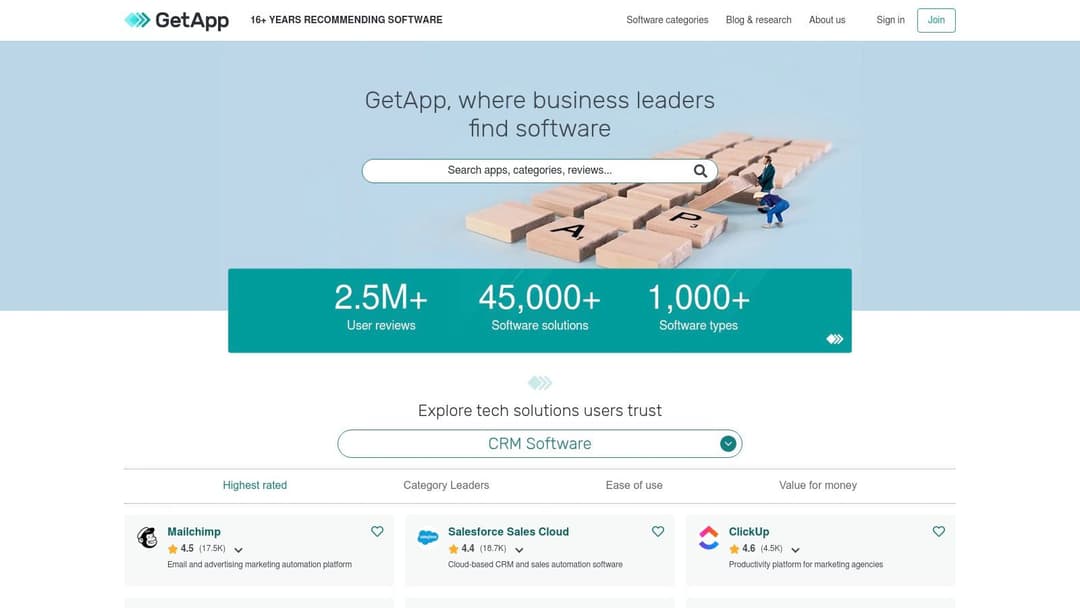
Like its sister site Capterra, GetApp is a premier B2B software directory designed to help marketers navigate the complex landscape of digital tools. It specializes in data-driven comparisons and curated collections, making it a highly efficient resource for finding and vetting the best AI tools for marketing. Its strength lies in its intuitive filtering and dedicated category pages that surface user sentiment and key feature scores, helping you quickly move from broad research to a focused shortlist.
What It's Best For
GetApp is ideal for rapid, side-by-side tool evaluation. If you have a clear idea of the features you need, its robust filtering system allows you to zero in on solutions that match your exact criteria. The platform's dedicated collections for AI Marketing, Generative AI, and AI Chatbots provide a curated starting point, saving you the effort of sifting through irrelevant software categories.
Key Features & How to Use Them
- Dedicated AI Collections: Start your search in pre-built categories like "AI Marketing Tools" or "Generative AI" to see top-rated software based on thousands of user reviews. This is much faster than a general search.
- Side-by-Side Comparison: Use the comparison tool to evaluate up to four products simultaneously on criteria like features, pricing, and user ratings. Pay close attention to the "Likelihood to Recommend" score.
- Review Sentiment Scoring: Look at the sentiment analysis on each product page, which breaks down review feedback into positive and negative themes, offering a quick snapshot of common user experiences.
Pros & Cons
| Pros | Cons |
|---|---|
| Up-to-date category pages with extensive reviews | Sponsored placements appear and require attention to labels |
| Easy vendor click-throughs for trials & demos | Feature details can be high-level |
| Strong comparison and filtering tools | User interface can feel busy with data |
Website: https://www.getapp.com
5. Product Hunt
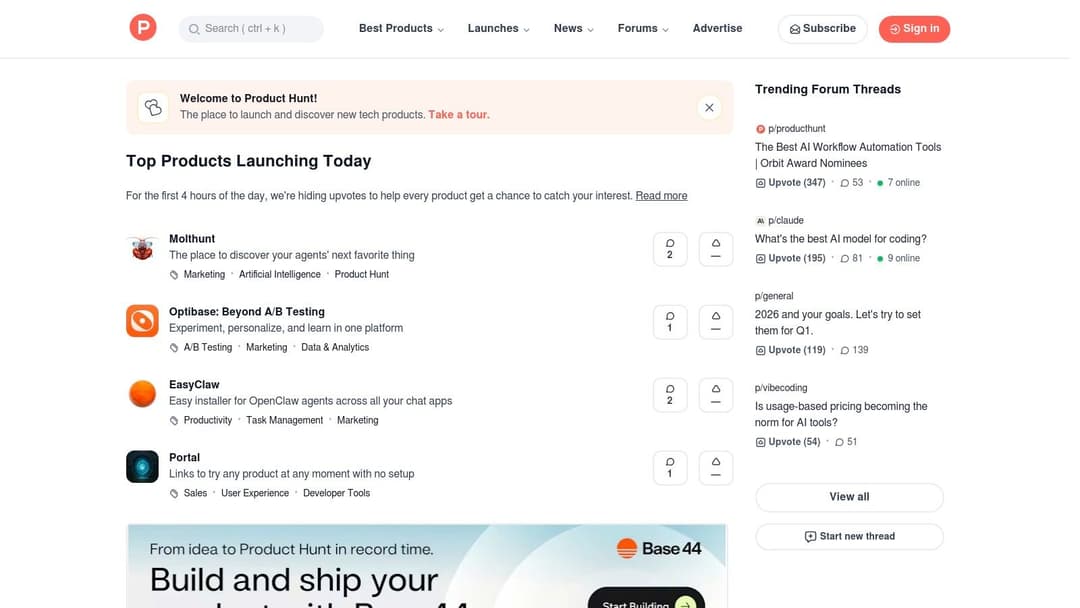
While not a single tool, Product Hunt is an essential daily destination for discovering emerging technology. It’s a community-driven launchpad where makers debut new products, including a constant stream of innovative AI tools for marketing. Its primary value for marketers is the ability to spot niche solutions and cutting-edge platforms before they become mainstream, offering a significant competitive advantage.
What It's Best For
Product Hunt excels at early discovery. It's the best place to find brand-new AI tools designed to solve very specific marketing problems, from generating personalized outreach emails to creating AI-powered landing pages. The community discussion around each launch provides immediate, unfiltered feedback on a tool's potential use cases, strengths, and initial weaknesses.
Key Features & How to Use Them
- Daily Launch Pages: Check the homepage daily to see what's new. Pay attention to the "Upvote" count and the comment section, where founders often answer questions directly, giving you insights into the product roadmap.
- Community Discussions: The comment threads are a goldmine. Look for feedback from other marketers sharing how they envision using the tool, which can spark ideas for your own campaigns.
- Curated Collections: Search for collections like "AI for Marketers" or "Marketing Automation." These are user-curated lists that group together top-rated tools for a specific purpose, saving you research time.
Pros & Cons
| Pros | Cons |
|---|---|
| Fast discovery of emerging AI tools | Launch popularity can be influenced by promotion |
| Direct interaction with founders | Not all products are mature or enterprise-ready |
| Community feedback provides real-world use cases | Quality and long-term viability of tools can vary significantly |
Website: https://www.producthunt.com
6. AppSumo
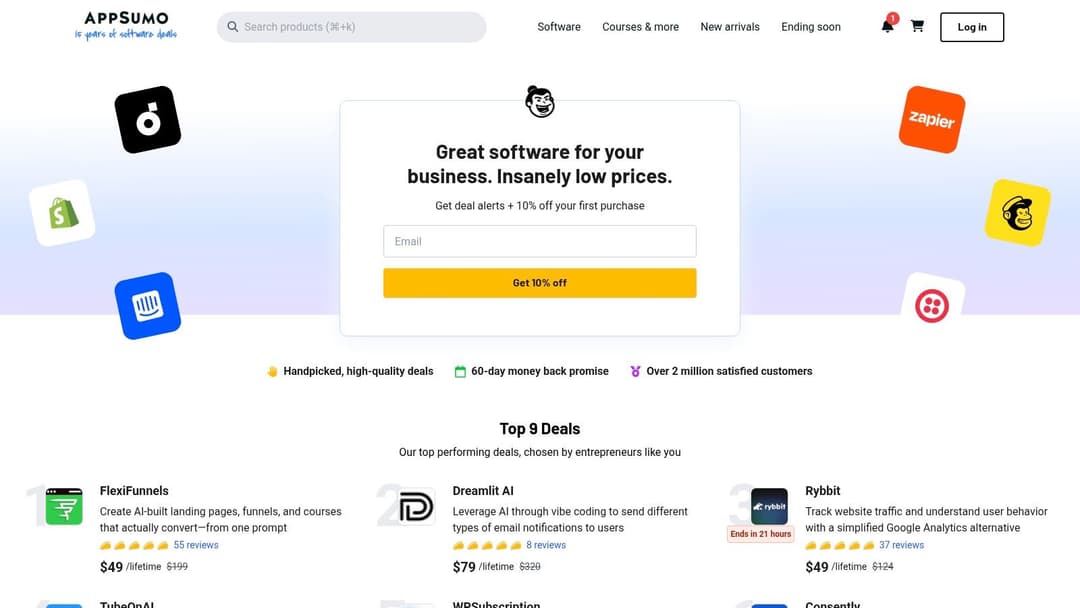
While not a singular AI tool, AppSumo is a crucial marketplace for marketers looking to experiment with emerging technology on a budget. It's a platform offering deep discounts and lifetime deals (LTDs) on a rotating catalog of software, including many of the best AI tools for marketing. Its value lies in providing affordable access to innovative AI copywriters, automation platforms, and analytics tools, allowing teams to test new capabilities without committing to expensive annual subscriptions.
What It's Best For
AppSumo is best for cost-effective experimentation and tool discovery. Marketers can acquire powerful AI solutions for a one-time fee, making it ideal for startups, freelancers, or teams wanting to test a specific function, like AI-powered content generation or social media scheduling, before adopting a more established, high-cost platform. It lowers the financial barrier to entry for adopting advanced marketing technology.
Key Features & How to Use Them
- Lifetime Deals (LTDs): Pay once to own the software forever. Before purchasing, carefully read the deal terms to understand usage limits (e.g., number of users, monthly credits) and check the tool's development roadmap.
- Community Reviews & Questions: Each deal page has an active Q&A section with the founder and a review section from other buyers. Use this to vet the product's stability, support quality, and real-world performance.
- Generous Refund Windows: Most deals come with a 60-day money-back guarantee. This creates a risk-free period to thoroughly test if a tool fits your marketing workflow and delivers on its promises.
Pros & Cons
| Pros | Cons |
|---|---|
| Budget-friendly access to powerful tools | LTD tools can be early-stage with variable support |
| Encourages experimentation with new tech | Longevity of the software company is not guaranteed |
| Active community for vetting deals | Requires careful research before committing to a tool |
Website: https://appsumo.com
7. HubSpot App Marketplace
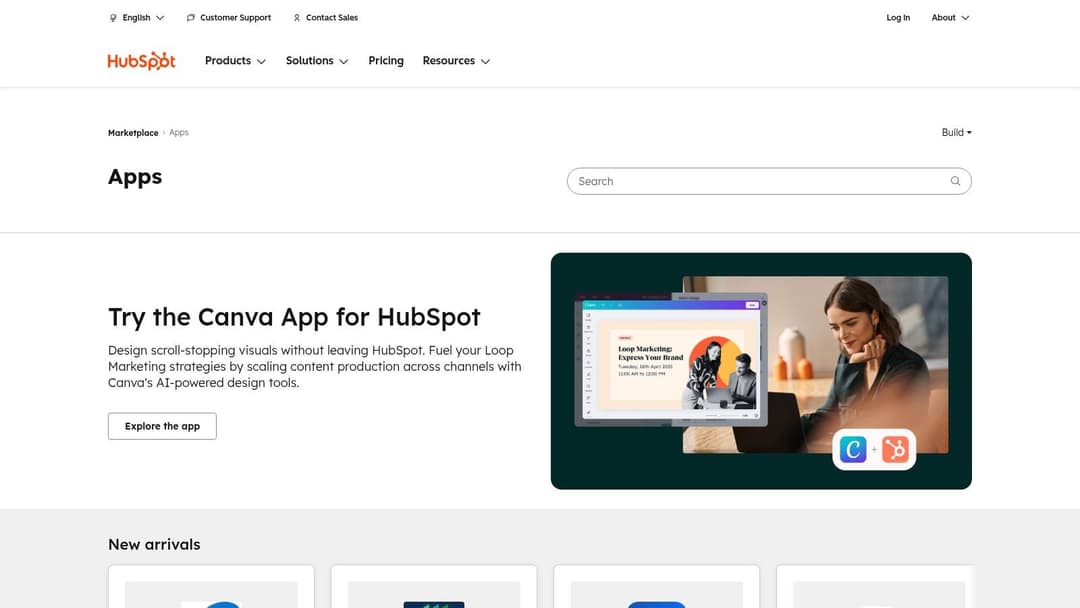
For marketing teams already invested in the HubSpot ecosystem, the HubSpot App Marketplace is the most logical place to start your search. It’s not an AI tool itself, but rather a curated directory of installable apps and AI extensions that plug directly into your HubSpot Marketing or Content Hub. This platform streamlines the discovery and integration of the best AI tools for marketing, ensuring they work seamlessly within your existing workflows.
What It's Best For
The Marketplace is best for enhancing your current HubSpot setup without introducing data silos or complex integrations. It excels at providing pre-vetted AI solutions for specific tasks like content creation, personalization, and video marketing that directly leverage your CRM data. This tight integration means you can deploy AI-powered features with confidence, knowing the data and user experience will remain consistent.
Key Features & How to Use Them
- One-Click Installs: Browse apps and install them directly into your HubSpot portal with a single click. Start by exploring the "Collections" to find apps curated by HubSpot for specific use cases, such as "AI-Powered Apps."
- Consolidated Billing: Many apps offer the ability to consolidate billing through your existing HubSpot account, simplifying your team’s subscription management.
- Integrated AI Extensions: Discover tools for AI writing, video creation, and analytics that are built to work with HubSpot's CRM and content objects. For example, you can find apps that generate blog posts based on your CRM data or create personalized videos for contact lists.
Pros & Cons
| Pros | Cons |
|---|---|
| Tight CRM and content integration | Primarily beneficial for teams already using HubSpot |
| Marketplace vetting improves trust | Requires a HubSpot account to install and use the apps |
| Simplifies tech stack management | App quality and support can vary between third-party vendors |
Website: https://ecosystem.hubspot.com/marketplace/apps
8. Shopify App Store
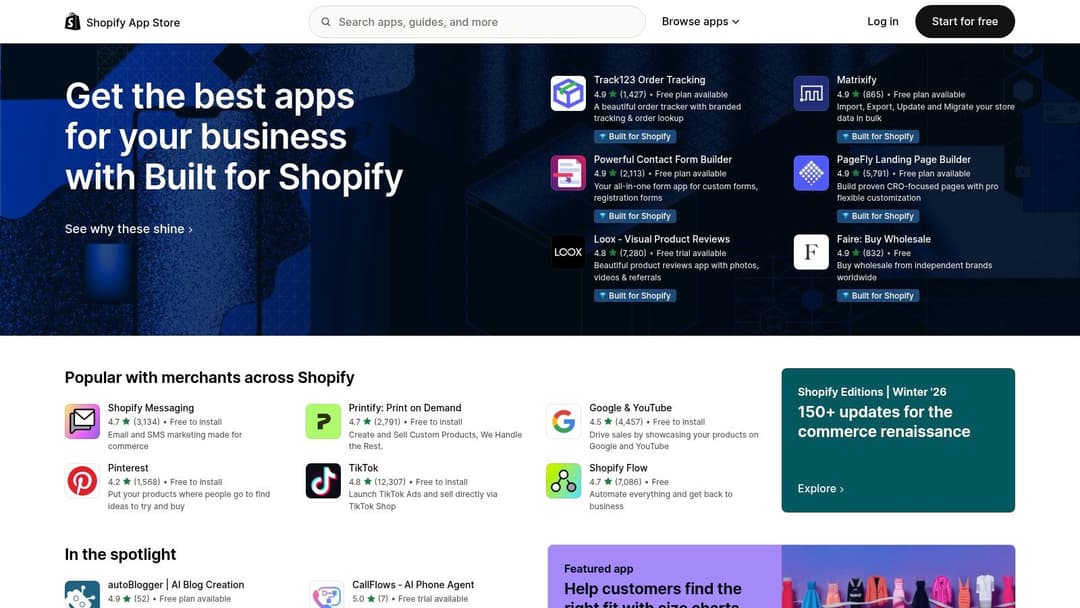
For e-commerce merchants, the Shopify App Store is a crucial ecosystem for discovering and deploying powerful marketing tools directly into their stores. While not a single tool, it’s a curated marketplace featuring hundreds of AI-driven applications designed to solve specific e-commerce challenges. This makes it an essential destination for finding the best AI tools for marketing that offer seamless, one-click integration and immediate utility for online retailers.
What It's Best For
The Shopify App Store excels at providing accessible, plug-and-play AI solutions for store owners who need results without complex setups. It’s ideal for quickly piloting tools for SEO optimization, personalized product recommendations, automated email campaigns, and ad creative generation. The direct integration allows apps to pull product data and customer behavior, enabling highly relevant and automated marketing actions.
Key Features & How to Use Them
- Store-Level Integration: Apps install directly into your Shopify backend, gaining immediate access to your product catalog and customer data. Use this to power AI-driven upsells, cross-sells, and personalized email flows.
- Ratings and Reviews: Leverage community feedback to vet applications before installing. Focus on recent reviews and look for comments about customer support quality and impact on key metrics like conversion rate.
- Free Tiers and Trials: Many apps offer a free plan or trial period. This is perfect for testing a tool’s effectiveness on a small scale before committing to a paid subscription. For example, test an ad creative app by seeing how it applies dynamic creative optimization to your top products.
Pros & Cons
| Pros | Cons |
|---|---|
| Direct, store-level integration enables quick pilots | Best suited for Shopify merchants; limited utility for other sites |
| Many apps have free plans or trials for low-risk testing | App quality and support can vary significantly between developers |
| Transparent pricing and user reviews simplify decision-making | Overloading a store with apps can potentially slow down site speed |
Website: https://apps.shopify.com
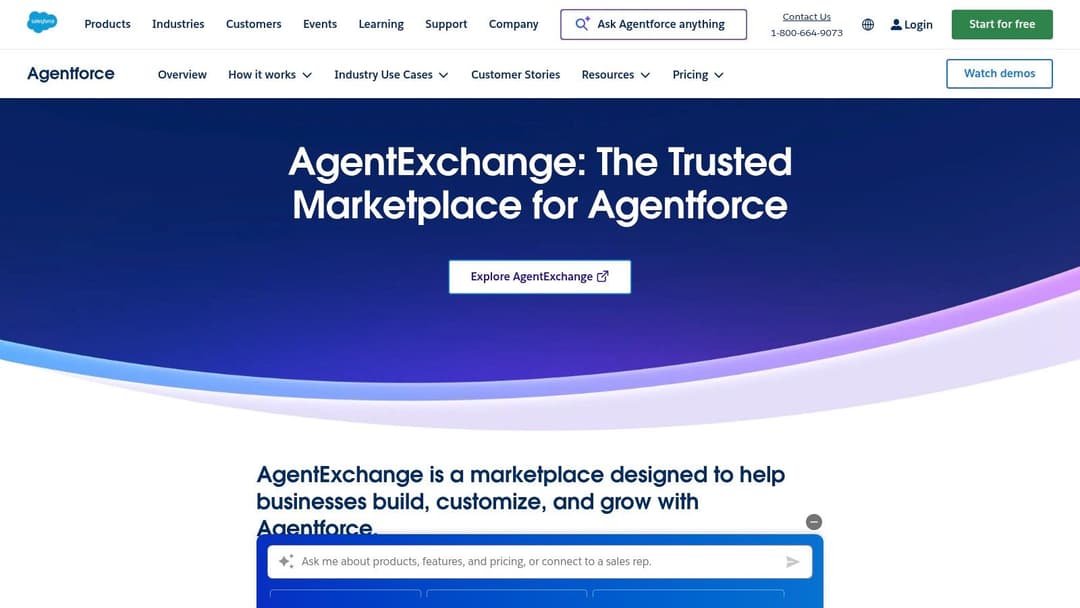
9. Salesforce AgentExchange
For enterprise teams already embedded in the Salesforce ecosystem, AgentExchange is a marketplace specifically for AI agents and partner solutions that operate within the platform. Rather than a standalone tool, it offers a secure environment to discover and deploy pre-built marketing agents that can automate complex tasks like generating campaigns, segmenting audiences, and creating customer journeys directly within your existing Salesforce instance.
What It's Best For
AgentExchange excels at providing enterprise-grade, governed AI solutions that seamlessly integrate with Salesforce data. Its primary strength lies in offering a secure and compliant way for large organizations to pilot and scale marketing automation. Instead of building from scratch, teams can leverage vetted agents to accelerate their marketing operations while maintaining strict data governance through the Einstein Trust Layer.
Key Features & How to Use Them
- Curated AI Agents: Browse the marketplace for security-vetted agents designed for specific marketing functions. You can find solutions for campaign creation, audience segmentation, and journey building that connect directly to your CRM data.
- Einstein Trust Layer: This built-in governance layer ensures all AI interactions are secure and compliant, a critical feature for enterprises handling sensitive customer information. This provides peace of mind when deploying new AI capabilities.
- Agent Templates: Use pre-built agent templates to quickly launch pilot programs for marketing automation. These templates offer a starting point for tasks like creating an AI agent for Facebook Ads, significantly reducing development time.
Pros & Cons
| Pros | Cons |
|---|---|
| Enterprise-grade security and compliance | Requires being on the Salesforce stack |
| Seamless integration with Salesforce data | Pricing and offerings are commonly enterprise-oriented |
| Agent templates speed up pilot projects | Less flexibility than building custom, external AI tools |
Website: https://www.salesforce.com/agentforce/agentexchange/
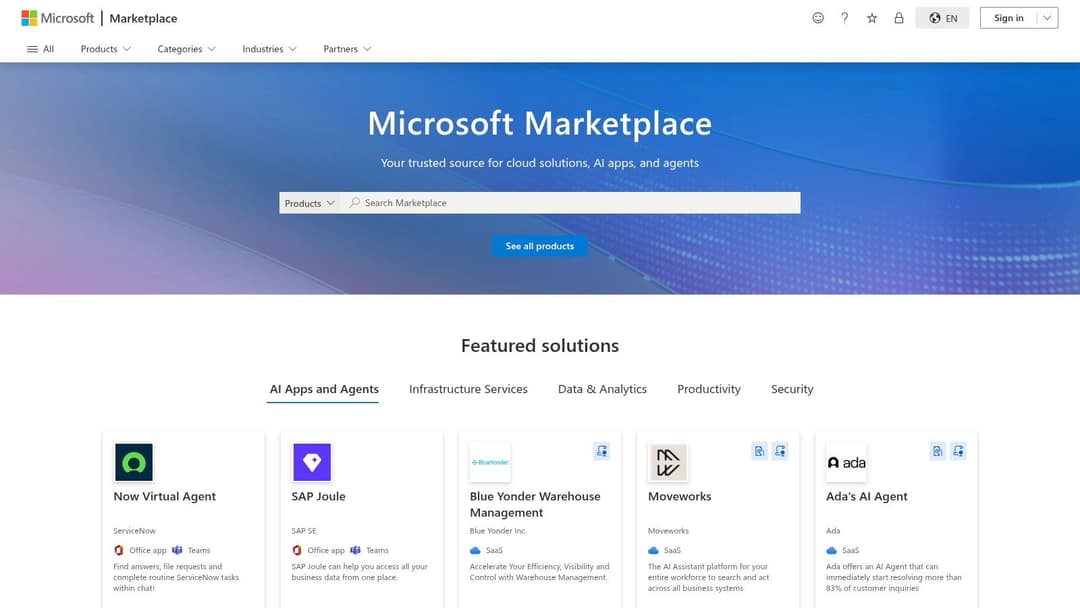
10. Microsoft Marketplace
For teams already embedded in the Microsoft ecosystem, the Microsoft Marketplace is a powerful, integrated starting point. It combines AppSource and the Azure Marketplace into a unified hub where you can find, try, and deploy AI-driven marketing solutions that are pre-vetted for security and compatibility with tools like Azure, Dynamics 365, and Microsoft 365. Its primary value is simplifying procurement and ensuring technical alignment for enterprises.
What It's Best For
Microsoft Marketplace excels at enterprise-level procurement and integration. Rather than vetting new vendors from scratch, marketing and IT teams can discover some of the best AI tools for marketing that plug directly into their existing Microsoft infrastructure. This streamlines the security review, billing, and deployment process, making it ideal for large organizations looking to enhance their marketing stack with minimal friction.
Key Features & How to Use Them
- Integrated Search & Filtering: Use the unified search to look for marketing-specific AI applications. Filter results by product type (like "AI + Machine Learning" or "SaaS"), pricing model, and specific Microsoft product integrations (e.g., Teams, Copilot, Dynamics 365).
- One-Click Deployment: Many apps, especially those built on Azure, can be provisioned directly into your cloud environment with just a few clicks, drastically reducing setup time.
- Flexible Procurement: Leverage existing enterprise agreements or Microsoft Azure Consumption Commitment (MACC) benefits to purchase solutions. This centralizes billing and often provides cost advantages.
Pros & Cons
| Pros | Cons |
|---|---|
| Enterprise procurement and security built-in | Catalog breadth is very large; filtering to specifics can be slow |
| Seamless integration with Microsoft 365/Copilot/Azure | Niche or startup AI tools may not be listed |
| Centralized billing and license management | User interface can feel more IT-focused than marketer-focused |
Website: https://marketplace.microsoft.com
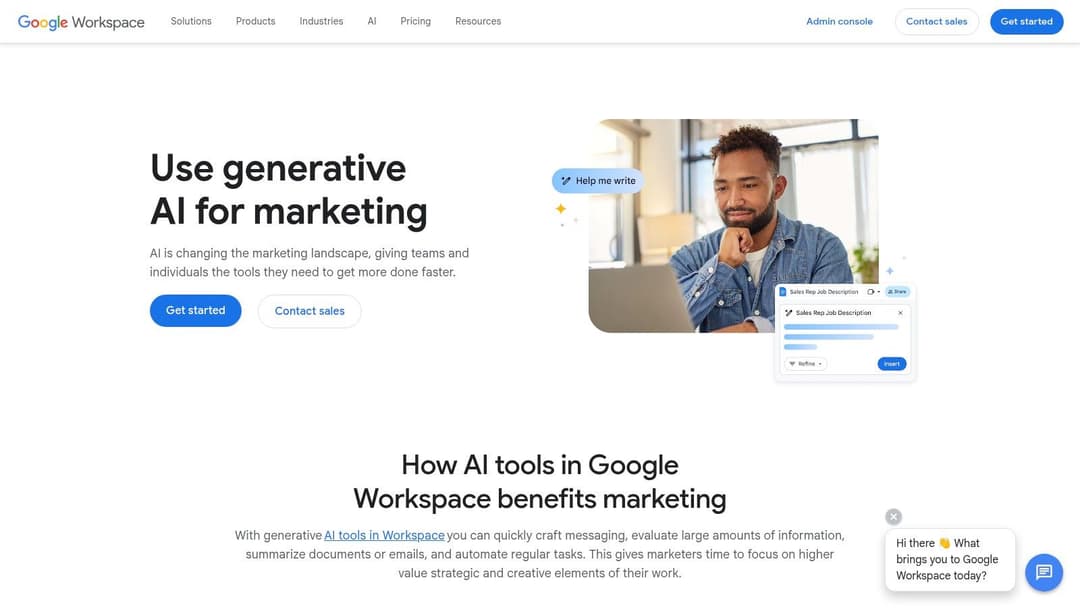
11. Google Workspace & Google Cloud (Gemini for Marketing + agent marketplace)
Google's suite of AI tools brings generative capabilities directly into the daily applications marketers already use, like Docs, Gmail, and Sheets. Instead of context-switching to a separate platform, teams can leverage Gemini to accelerate content creation, organize campaign data, and visualize ideas natively within their workflow. This integration makes it one of the best AI tools for marketing for teams seeking to enhance productivity without overhauling their existing tech stack.
What It's Best For
The combination of Google Workspace and Cloud excels at embedding AI assistance into foundational marketing tasks. It’s ideal for drafting ad copy in Docs, generating presentation outlines in Slides, or summarizing long email threads in Gmail. For larger organizations, the Google Cloud agent platform provides a governed, enterprise-grade path to deploy custom AI agents for more complex marketing automation challenges.
Key Features & How to Use Them
- Embedded Gemini Features: Use prompts directly within Workspace apps to generate first drafts of blog posts, social media updates, and email campaigns. For example, in Sheets, you can ask Gemini to help organize keyword research or create a content calendar template.
- Customizable 'Gems': Create and save custom prompts (Gems) in the Gemini side-panel for recurring tasks, such as generating UTM parameters or writing ad headlines that adhere to specific character limits. This is especially useful for maintaining consistency across campaigns, much like you would when using AI for Facebook Ads.
- Google Cloud Agent Marketplace: For enterprise needs, browse and deploy pre-built marketing agents from Google's partners. These can automate workflows like lead scoring, customer data analysis, or market trend reporting, integrating directly with your company's data.
Pros & Cons
| Pros | Cons |
|---|---|
| Native AI inside daily tools accelerates routine work | Advanced AI features require paid Workspace or Gemini add-ons |
| Enterprise path to deploy governed agents integrated with Workspace | Google Cloud agent solutions are typically paid via Cloud billing |
| Reduces friction by keeping tasks within the Google ecosystem | Can be less specialized than dedicated, single-purpose AI platforms |
Website: https://workspace.google.com/solutions/ai/marketing/
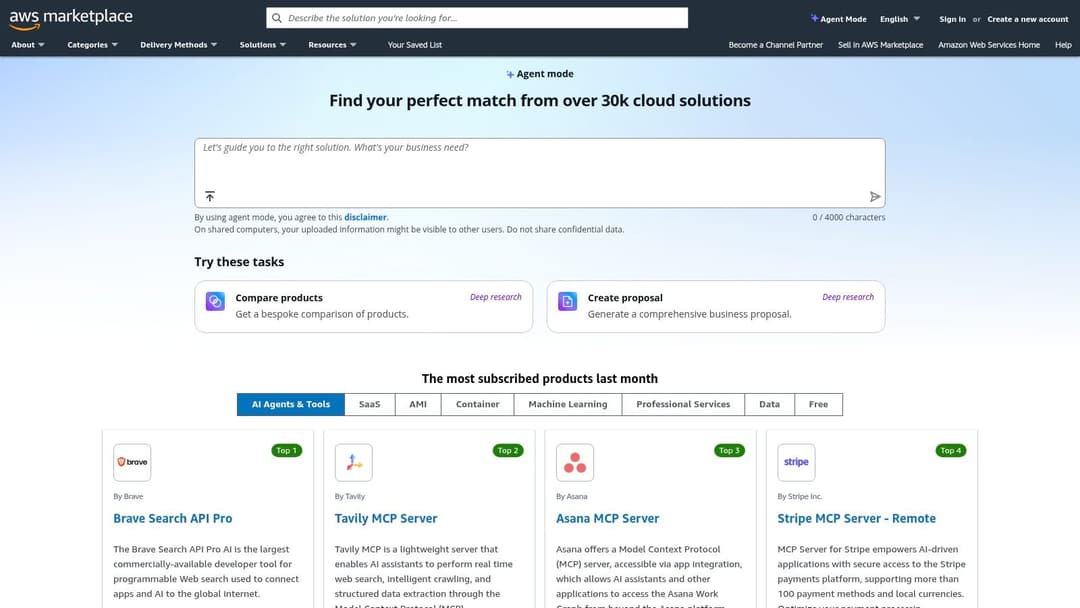
12. AWS Marketplace
For marketing teams already operating within the Amazon Web Services ecosystem, the AWS Marketplace is a powerful procurement hub. It's a digital catalog where you can find, buy, and deploy thousands of software listings from independent vendors. This makes it an essential resource for discovering some of the best AI tools for marketing that are pre-configured to run on AWS, ensuring enterprise-grade security and simplified billing.
What It's Best For
AWS Marketplace excels at streamlining the procurement and deployment of sophisticated AI marketing solutions for technically proficient teams. Its value is in providing a secure, centralized environment to purchase tools for everything from audience insights and conversational commerce to advanced content generation, all while consolidating billing through an existing AWS account.
Key Features & How to Use Them
- AI Agents & Tools Category: Browse this dedicated section to find marketing-specific agentic tools and other AI solutions that are ready to deploy. Evaluate offerings based on their direct integration with core AWS services.
- Private Offers & Enterprise Billing: Engage with vendors to negotiate custom pricing and terms directly within the platform. Leverage consolidated billing to have software charges appear on your monthly AWS invoice.
- AWS Service Integration: Look for tools that integrate natively with services like Amazon Bedrock for generative AI, AWS Lambda for serverless computing, and Amazon Pinpoint for customer engagement, creating a powerful, interconnected marketing stack.
Pros & Cons
| Pros | Cons |
|---|---|
| Enterprise governance and security | Geared toward teams with existing AWS expertise or partners |
| Broad catalog of content, SEO, and personalization tools | Not always plug-and-play for non-technical marketing teams |
| Centralized procurement simplifies billing and vendor management | Deployment and configuration can be complex |
Website: https://aws.amazon.com/marketplace
Top 12 AI Marketing Resources Comparison
| Platform | Core focus | Key features | Target audience | Value / USP | Pricing & access |
|---|---|---|---|---|---|
| AdStellar AI | Meta ad campaign automation & scaling | Bulk creative + copy + audience generation, AI insights, one‑click publish, auto‑scaling | Media buyers, growth teams, agencies, e‑commerce/DTC | Rapid 10× ad velocity, goal-driven ranking (ROAS/CPL/CPA), centralized workflow — Recommended | Contact sales; connects via Meta OAuth |
| G2 | B2B software reviews & shortlisting | Verified user reviews, side‑by‑side comparisons, "Best Of" reports | Buyers researching vendors, marketers | Huge volume of real-user feedback, strong filters | Free to browse; vendor links, sponsored placements possible |
| Capterra | Software directory & buyer guides | Category pages, granular filters, screenshots | SMB and mid-market buyers | Curated roundups, often shows starting prices | Free; vendor click-throughs for trials/pricing |
| GetApp | Comparison site for business apps | Collections, side‑by‑side comparison, sentiment & scoring | SMBs comparing tools | Robust filters, up‑to‑date review counts | Free; direct vendor links for trials/purchase |
| Product Hunt | Product launches & discovery | Daily launch pages, community discussions, collections | Early adopters, founders, marketers | Fast discovery of emerging niche tools | Free; quality/maturity varies by launch |
| AppSumo | Discounted SaaS marketplace | Frequent deals, lifetime deals (LTD), refund windows | Budget-conscious teams, testers | Low-cost experimentation with tools | Paid deals and LTDs; limited-time offers |
| HubSpot App Marketplace | HubSpot-integrated apps & extensions | One‑click installs, consolidated billing, CRM integrations | Teams on HubSpot | Tight CRM/workflow integration, vetted marketplace | Free listings; requires HubSpot account to install |
| Shopify App Store | Store-level marketing & commerce apps | Ratings, reviews, transparent pricing, store integration | Shopify merchants | Quick pilots, measurable store impact, free trials | Apps often free/paid; installs to Shopify stores |
| Salesforce AgentExchange | Salesforce AI agents & templates | Security‑vetted agents, Einstein trust layer, agent templates | Enterprise Salesforce customers | Enterprise governance, admin controls, pilot templates | Enterprise-oriented pricing; requires Salesforce |
| Microsoft Marketplace | AppSource + Azure marketplace for apps | Copilot/Teams integrations, rapid provisioning, enterprise billing | Microsoft 365/Azure customers | Enterprise procurement, security, native integrations | Free to browse; paid apps, partner procurement |
| Google Workspace & Cloud | Gemini in Workspace + Cloud agents | Gemini in Docs/Gmail/Slides, templates, agent marketplace | Workspace users, enterprises | Native AI in daily tools, enterprise agent path | Some features paid; Cloud billing for agents |
| AWS Marketplace | Deployable AI marketing solutions on AWS | AI agents, private offers, integration with Bedrock/Lambda | AWS-centric teams, enterprises | Enterprise procurement, deep AWS service integrations | Paid; deploy into AWS with enterprise billing |
From Tools to Strategy: Making AI Work for Your Marketing Goals
Navigating the expansive landscape of AI marketing tools can feel overwhelming. We've explored a diverse range, from specialized creative automation platforms like AdStellar AI to vast marketplaces like G2 and Capterra, and even the powerful, integrated ecosystems offered by giants such as Google, Salesforce, and AWS. The sheer volume of options underscores a critical truth: the goal isn't just to adopt AI, but to strategically implement it to solve specific, measurable business challenges.
The ultimate takeaway is that the "best AI tool for marketing" is a relative term. The most effective tool for your organization will be the one that directly addresses a bottleneck in your workflow, aligns with your budget, and seamlessly integrates into your existing technology stack. What works for a large enterprise managing complex Salesforce integrations will differ vastly from the needs of a nimble DTC brand seeking to accelerate ad creative testing on social media. Your unique goals must be the compass that guides your selection process.
Your Actionable Framework for Choosing the Right AI Tool
Instead of getting lost in a sea of features, use a structured approach to find the perfect solution. This simple, four-step framework can help you cut through the noise and make a data-informed decision that delivers real value.
- Define Your Primary Problem: Start with a clear, specific pain point. Is it that your team can't test ad creatives fast enough to keep up with platform demands? Are you struggling to personalize customer journeys at scale? Or is your analytics team drowning in data they can't effectively interpret? A well-defined problem like, "We need to reduce campaign setup time by 50%," is far more actionable than a vague goal like "We want to use AI."
- Shortlist Specialized Solutions: Once you've defined the problem, focus your search. If creative fatigue is your main issue, explore tools in the ad creative automation category. If you're looking for broader solutions to augment an existing CRM, dive into the HubSpot or Salesforce marketplaces. This focused approach prevents you from evaluating irrelevant options.
- Run a Small-Scale Pilot with Clear Metrics: Never commit to a platform without a trial run. Identify a small, controlled project and define what success looks like before you begin. Success metrics could include "increase ad click-through rate by 15% on our test campaigns" or "generate 10 high-quality audience segments in one week." This pilot phase provides concrete evidence of the tool's ROI and its fit within your team's workflow. Remember, many of the most effective tools also help you generate the assets for these tests. To truly leverage AI for your marketing objectives, explore resources like these that detail the most effective Top 12 AI Content Creation Tools for Marketers.
- Prioritize Integration and Adoption: A powerful tool is useless if it doesn't work with your current systems or if your team won't use it. During your evaluation, confirm that the tool integrates smoothly with your core platforms like your CRM, ad networks, and analytics software. Consider the learning curve and the level of training required. The best tools are not only powerful but also intuitive, encouraging widespread adoption across your team.
The Future is an AI-Powered Marketing Stack
The era of AI as a niche, experimental technology is over. It is rapidly becoming a foundational layer of the modern marketing stack, an indispensable partner for driving efficiency, unlocking creativity, and delivering superior customer experiences. The platforms we've discussed are not just tools; they represent a fundamental shift in how marketing is planned, executed, and measured.
For performance marketers, growth teams, and e-commerce brands, the message is clear: the time to start experimenting is now. By beginning your journey with a focused, problem-oriented approach, you can build a significant competitive advantage. Start small, measure your results, and scale your successes. The future of marketing belongs to those who learn to effectively partner with AI to achieve their goals.
Ready to eliminate creative bottlenecks and scale your paid campaigns with data-driven precision? AdStellar AI empowers performance marketers to automate ad creative production, testing, and optimization, so you can focus on strategy, not manual tasks. Discover how our platform can supercharge your campaign performance by visiting us at AdStellar AI.