Using AI for Facebook ads is like giving your Meta campaigns a superpowered co-pilot—one that pores over millions of data points, whips up winning ad creatives, and optimizes your budget around the clock. This isn't just basic automation; it's a strategic partner that gets you better results with way less manual grunt work.
The New Era of Advertising: AI for Facebook Ads Explained
Remember trying to find the perfect radio station by twisting the dial one tiny millimeter at a time? That’s what old-school ad management feels like—slow, tedious, and mostly based on guesswork.
Now, imagine a system that instantly scans every station, analyzes listener data in real-time, and locks onto the one playing your audience's absolute favorite song. That's the reality of using AI for Facebook ads.

This shift isn't just about speed; it's about being smarter. Artificial intelligence acts as a force multiplier for marketers, turning complicated, time-sucking tasks into smooth, automated workflows. It lets you and your team graduate from pushing pixels and wrestling with spreadsheets to focusing on big-picture strategy and creative direction.
At its core, AI for advertising is a decision-making engine. It crunches historical campaign data, market trends, and user behavior to predict what will work best, long before you spend a single dollar on a new campaign.
Core Pillars of AI in Facebook Advertising
This new approach completely changes how we build and manage campaigns. The biggest impact is felt across three key pillars that work together to drive performance. Getting a handle on these is crucial to understanding how AI gives marketers a serious competitive edge. You can see just how different this is from older methods in our comparison of AI vs. traditional advertising methods.
This new age of advertising is fueled by tools that automate critical functions, leading to better customer interactions. This is detailed in guides explaining how to use chatbots in Facebook to automate sales, support, and marketing, which touches on a complementary piece of AI-driven communication.
The main areas where AI really makes a difference are:
- Creative and Copy Generation: AI platforms can spit out hundreds of ad variations—images, headlines, and body copy—in minutes. They look at your best-performing ads and generate fresh combinations designed to click with specific audience segments.
- Intelligent Audience Discovery: Forget building audiences based on assumptions. AI algorithms sift through your conversion data to find hidden, high-intent customer groups you never knew existed. It pinpoints profitable pockets of users you would have otherwise missed completely.
- Predictive Performance Analysis: AI tools can forecast campaign outcomes, like ROAS or CPA, before you even launch. This lets you be much more strategic with your budget and helps you sidestep campaigns that are destined to fail.
How AI Rebuilds the Pillars of Advertising
To really get what AI for Facebook ads means, you have to look past the buzzwords and see how it changes the day-to-day grind of a media buyer. It’s not about one magical button. Instead, AI delivers a series of powerful upgrades across the entire campaign workflow, turning gut feelings and guesswork into a data-driven science.
Think of it like building a race car. You can't just slap on a new spoiler and expect to win. You need to upgrade the engine, the suspension, the brakes, and the aerodynamics. In the same way, AI strengthens five core pillars of advertising, with each improvement making the next one even more powerful.
H3: AI Creative and Copy Generation
The first and most obvious change AI brings is to the creative process itself. For years, creating ad variations was a slow, manual chore for designers and copywriters. If you were lucky, you’d end up with a handful of different versions to test.
AI completely rewrites that playbook. By feeding it your best-performing ads—the images, headlines, and CTAs that actually drove sales—AI can spit out hundreds of new, ready-to-test variations in minutes. It's not about replacing your creative team; it's about giving them superpowers. The AI handles the grunt work of mixing and matching, freeing up your team to brainstorm the big, game-changing ideas. To see how this works in practice, you might want to check out some of the leading AI content generation tools.
H3: AI-Powered Audience Discovery
Let's be honest, finding the right audience on Facebook has often felt like throwing darts in a dark room. You build Lookalike audiences, you layer on a few interests, and you cross your fingers. The problem is, this whole approach is boxed in by your own assumptions and almost certainly misses huge pockets of potential customers.
AI-powered audience discovery is like having a heat-seeking missile for buyers. Instead of you telling the algorithm who to find, the AI dives into your pixel data and customer lists, identifying the hidden patterns shared by your most valuable customers. It then goes out and finds new audiences that mirror these complex, often invisible, behaviors.
This process uncovers high-intent customer segments you would never dream of building on your own. For instance, an AI might discover that your best customers don’t just like "hiking"—they also follow three specific gear review blogs, only shop online after 9 PM, and respond to a certain color palette. That’s a level of detail you simply can't guess.
We dive much deeper into this in our complete guide to AI-based customer targeting solutions.
H3: Automated Bidding and Budget Optimization
Juggling bids and budgets across dozens of ad sets is a constant headache. You're always trying to shift money from the losers to the winners, but it requires nonstop monitoring and manual tweaks. It's inefficient and way too easy to make a costly mistake.
AI automates this entire balancing act with machine-like precision. It crunches real-time performance data and makes thousands of tiny adjustments to your bids and budget allocation every single day.
- Predictive Bidding: The AI predicts how likely a specific user is to convert and adjusts the bid in real time. This stops you from overpaying for low-value clicks and lets you bid aggressively for high-value ones.
- Dynamic Budget Allocation: It automatically funnels your budget toward the ad sets, creatives, and audiences that are delivering the best Return on Ad Spend (ROAS), starving the underperformers.
This ensures every dollar you spend is working as hard as it possibly can, maximizing your results without you having to live inside Ads Manager.
H3: Intelligent A/B Testing at Scale
Good A/B testing is the bedrock of any successful campaign, but the old way of doing it is painfully slow and limited. Testing one headline against another, or one image against a second, takes forever and you can only really test a couple of variables at once.
AI introduces what you could call hyper-testing. It can run tests on thousands of combinations of creatives, copy, audiences, and placements all at the same time. The system rapidly learns what's working, kills the losers, and pours fuel on the emerging winners. This iterative cycle finds the perfect ad formula exponentially faster than any human could.
H3: Predictive Performance Analytics
Finally, AI brings the power of forecasting to your ad account. Instead of launching a campaign and just hoping it works, AI can analyze your inputs and historical data to predict how it's likely to perform before you spend a single dollar. This allows for much smarter, proactive strategic decisions.
Meta itself has gone all-in on this, and the numbers are staggering. Meta AI shot up to over 700 million monthly active users, a boom that directly supercharged its ad tools. More than 4 million advertisers have jumped on its generative AI features. This led to a massive 70% year-over-year surge in Advantage+ and shopping campaigns, which now pull in an annual revenue of over $20 billion.
Below is a table that breaks down how these AI-driven changes stack up against the old-school, manual way of managing Facebook ads.
Traditional vs AI-Powered Facebook Ad Management
| Campaign Task | Traditional Method (Manual) | AI-Powered Method (Automated) |
|---|---|---|
| Creative Generation | Small batch of ad variations created by hand over days. | Hundreds of variations generated in minutes from top performers. |
| Audience Targeting | Building audiences based on assumptions and broad interests. | Discovering hidden, high-intent audiences via data analysis. |
| Bidding & Budgeting | Manual, periodic adjustments based on past performance. | Real-time, predictive micro-adjustments to maximize ROAS. |
| A/B Testing | Slow, limited tests of one or two variables at a time. | Massive, simultaneous testing of thousands of combinations. |
| Performance Analysis | Reactive analysis of historical data to see what happened. | Predictive forecasting to estimate campaign success upfront. |
As you can see, the shift isn't just about doing things faster. It's about fundamentally changing the strategic approach from being reactive to proactive, and from being based on guesswork to being driven by predictive data.
Putting AI to Work in Your Facebook Ad Campaigns
Knowing the theory behind AI for Facebook ads is one thing. Actually putting it into practice is where you’ll see the game-changing results. But let's be clear: integrating AI into your workflow doesn't mean you have to burn down your current process and start over.
Think of it more like teaching a machine to think like your very best media buyer. You're taking abstract data and turning it into a powerful, automated advertising engine. Here’s a simple roadmap to get you started.
Connect Your Ad Accounts Securely
First things first, the AI platform needs access to your historical data. This is almost always done through a secure OAuth connection—the same industry-standard method you use to link other apps to your Meta account without ever handing over your password.
Once you’re connected, the AI gets to work, absorbing all your past campaign data. It’s looking at what worked, what flopped, which audiences actually converted, and which creatives drove the best returns. This history is the foundation for every prediction and decision it will make. Without it, the AI is just guessing.
After getting access, an AI zeroes in on the core pillars of any successful campaign.
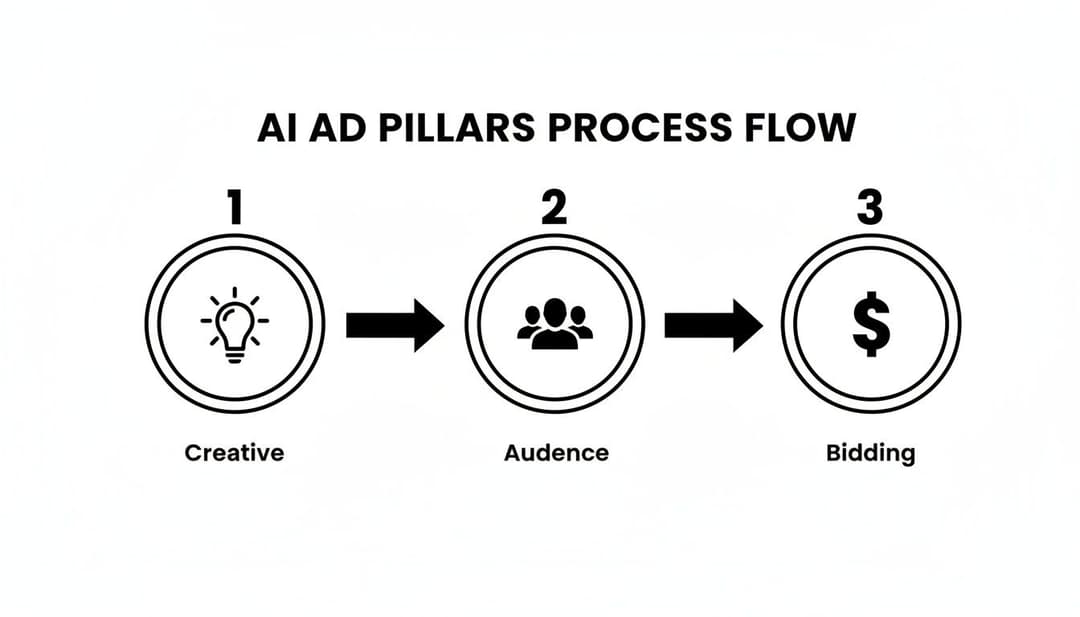
As you can see, the process is systematic. It tackles creative, audience, and bidding to build a smart, cohesive campaign structure from the ground up.
Establish Your Source of Truth
Next, you need to show the AI what "good" looks like for your brand. This step is often called establishing a "source of truth." You’re essentially pointing the platform to your greatest hits and saying, "More of this, please."
This means uploading your top-performing creatives, your most compelling ad copy, and the audience segments that have consistently delivered. By feeding the AI your winners, you give it a clear and powerful starting point for generating new ideas. It learns your visual style, your brand's tone, and the customer profiles that have driven real results in the past.
Think of this as giving a master chef your best family recipes. The chef can then use their expertise to create countless new dishes that retain the core flavors everyone loves, but with exciting new twists.
This phase is non-negotiable. It’s what ensures the AI's output is aligned with your brand and performance goals right from the start.
Launch Your First AI-Powered Campaign
With that foundation set, you're ready to launch. This is where the magic of automation really kicks in. Instead of painstakingly building out a handful of ad variations by hand, you can now generate and deploy hundreds with just a few clicks.
For example, platforms like AdStellar AI let you mix and match your best assets at an incredible scale.
- Select Your Ingredients: Grab 5 of your top images, 5 winning headlines, and 3 high-performing ad copy variations.
- Define Your Audiences: Pick a few of your most reliable custom or lookalike audiences.
- Launch with One Click: The AI platform automatically builds every single possible combination—in this case, 75 unique ads (5 x 5 x 3)—and launches them into perfectly structured A/B tests.
This systematic approach makes sure every element is tested against the others, quickly surfacing the most powerful combinations. For a closer look at this process, check out our detailed guide that explains how to use AI to launch ads.
Leverage AI Insights for Optimization
Once your campaigns are live, the AI’s job switches from creation to analysis. It’s constantly monitoring performance data, crunching the numbers faster and deeper than any human could ever hope to.
The insights are usually laid out in a clean, easy-to-read dashboard. Instead of getting buried in the endless columns of Meta Ads Manager, you get a simple, ranked list of your top-performing elements. You can immediately see which specific image, headline, or audience is bringing in the lowest Cost Per Acquisition (CPA) or the highest Return on Ad Spend (ROAS).
Scale Your Winners with Confidence
The final step is to act on those insights and scale what’s working. Modern AI tools make this incredibly simple. With the data clearly pointing to your winning ad combinations, you can confidently shift your budget to give them more fuel.
Many platforms even offer automated scaling rules. For example, you can set a rule to automatically bump the budget for any ad set that hits a ROAS above a certain threshold for more than 48 hours. This ensures you’re capitalizing on every opportunity in real-time without having to babysit your campaigns, completing the full circle from data connection to automated growth.
Measuring Success with AI-Driven Campaigns
So, you’ve brought AI into your Facebook ad strategy. That's a great first step. But how do you actually know if it's working? The real proof isn't just about launching campaigns faster; it’s about connecting that speed and intelligence to real business outcomes. We need to move past the vanity metrics and zero in on the Key Performance Indicators (KPIs) that actually hit your bottom line.
When AI is truly dialed in, you'll see the impact on the numbers that matter. Forget just looking at clicks or impressions. You should start seeing tangible improvements in your efficiency and, most importantly, your profitability. This is where the magic happens—where automation translates directly into financial returns.
Core KPIs for AI-Powered Advertising
To really get a feel for how your AI is performing, you have to track the right metrics. The good news is, AI directly impacts the numbers that your clients and stakeholders care about most, making it much easier to show its value.
Here are the big three KPIs to keep a close eye on:
- Return on Ad Spend (ROAS): This is the ultimate report card for profitability. AI is a ROAS machine. It automatically funnels your budget toward the best-performing creative and audience combinations, making sure every dollar you spend is working as hard as it possibly can.
- Cost Per Acquisition (CPA): How much does it really cost to land a new customer? AI works to drive this number down by rapidly spotting and scaling your most efficient ads, while simultaneously cutting the dead weight from ads that just aren't converting.
- Creative Fatigue Rate: We've all seen it—ad blindness sets in and performance tanks. AI is your best defense. By constantly generating fresh creative ideas and variations, it keeps your campaigns from going stale, holds audience attention, and breathes new life into your top concepts.
If you want to get a better handle on how these fit into the bigger financial picture, check out our deep dive on how to calculate marketing ROI.
Setting Realistic Performance Goals
Knowing what to expect is half the battle. Industry benchmarks are a fantastic starting point for setting your own goals. For example, the latest Facebook ads benchmarks from Wordstream show some interesting trends advertisers are navigating right now.
While traffic campaigns have gotten more efficient—with click-through rates climbing and the average cost per click (CPC) dropping to $0.70—acquisition costs in other areas are on the rise. Shopping ads did even better, with a CPC of just $0.34. But on the flip side, lead generation campaigns saw a 20% jump in cost per lead (CPL), even though their conversion rate held steady at 7.72%.
These numbers are exactly why AI is no longer a "nice-to-have." For advertisers trying to beat rising costs and get an edge, it's become essential.
An AI platform isn't just a reporting tool; it’s an optimization engine. It doesn’t just show you the data—it actively uses that data to make better decisions in real time, turning insights into immediate action.
Translating AI Data into a Compelling Story
One of the toughest jobs for any marketer is explaining performance to people who don't spend their days in Meta Ads Manager. This is where a good AI platform really shines. It helps you cut through the noise and present data in a clear, outcome-focused way. You can ditch the overwhelming spreadsheets and tell a simple, powerful story instead.
Your performance narrative should pull from both your AI tool and Meta's native reports. Here’s how you do it:
- Start with the AI Insights: Kick things off with your AI platform’s dashboard. Pinpoint the top-performing elements it found. Show exactly which image, headline, or audience segment delivered the best ROAS. This isn't just what happened; it's why the campaign worked.
- Validate with Meta's Data: Now, back it up. Cross-reference those insights with the overall campaign metrics inside Ads Manager. Draw a direct line: "Our AI flagged this creative as a winner, and as you can see, the campaign's overall CPA dropped by 15% right after we scaled it."
- Focus on Business Impact: Finally, frame everything in terms of business goals. Don't just say, "Our CTR went up." Instead, say something like, "By using AI to find better audiences, we generated 30% more qualified leads for the sales team with the same budget."
This approach transforms a pile of data into a clear story of success. It's how you prove that your investment in AI for Facebook ads is delivering a return you can take to the bank.
Real-World Victories with AI for Facebook Ads
Theory is great, but seeing AI for Facebook ads in the wild is where the lightbulb really goes on. Vague concepts like "optimization" and "efficiency" suddenly click when you can tie them to actual business growth. Let's walk through a few stories of how real companies used AI to crack tough advertising puzzles and drive some seriously impressive results.

These aren't just one-off wins. They're common headaches that AI is perfectly built to solve, turning campaign bottlenecks into breakthroughs. Each story gives you a practical look at how an AI-driven strategy leads to success you can actually measure.
Case Study: DTC Brand Scales Holiday Sales
A direct-to-consumer (DTC) apparel brand was staring down the barrel of the classic holiday dilemma: how to pour money into their Black Friday campaigns without their ads getting stale and their costs spiraling. Their small team just couldn't churn out enough ad variations by hand to stay fresh in a hyper-competitive feed.
The Challenge: Creative fatigue was hitting hard, and their Return on Ad Spend (ROAS) was dipping right when they needed to be scaling up.
The AI-Driven Strategy:
- They plugged their best-performing holiday images and promo copy into an AI platform.
- The AI went to work, generating over 200 distinct ad variations by mixing and matching visuals with different headlines and calls-to-action.
- It then automatically tested these combinations, found the winners in real time, and intelligently shifted the budget to the top performers.
The Impact: The brand cut through the holiday clutter and locked in a 40% jump in ROAS compared to the previous year’s manual grind. They spent far less time in Ads Manager and more time using the AI’s insights to plan their next creative drop.
Case Study: B2B SaaS Discovers New Lead Segments
A B2B SaaS company selling project management software was stuck. They were struggling to find new, high-intent audiences. Their Lookalike audiences had been tapped out, and targeting by job title was getting expensive—fast.
The Challenge: Their Cost Per Lead (CPL) was creeping up, and the sales team started complaining that lead quality was taking a nosedive.
AI audience discovery works by finding patterns in your existing customer data that are invisible to the human eye. It moves beyond simple demographics to identify complex behavioral signals that define your best buyers.
The AI-Driven Strategy:
They connected their CRM and Meta ad account to an AI tool. The platform dug into the attributes of their most valuable customers—the ones with the highest lifetime value—and built entirely new audience profiles based on hundreds of hidden data points.
The Impact: By aiming their ads at these new AI-discovered segments, the company tapped into a rich vein of high-intent prospects they never knew existed. This move slashed their CPL by over a third and sent much better-quality leads over to the sales team.
Case Study: Agency Reclaims Hundreds of Hours
Finally, a digital marketing agency was practically drowning in manual tasks. Juggling dozens of client accounts meant endless hours spent on campaign setup, A/B testing, and pulling weekly performance reports. This operational drag was killing their ability to grow and focus on big-picture strategy.
This isn't just their problem; it reflects the entire industry's shift. Meta itself is pushing hard for AI, with its Advantage+ campaigns growing 70% YoY. Their full AI ad suite exploded from a $20 billion to a $60 billion run rate, showing just how central AI has become. You can get more details on Meta's strategy and revenue growth at Marketing Dive.
The Challenge: Repetitive, low-value work was eating up the majority of their account managers' days.
The AI-Driven Strategy:
The agency integrated an AI platform like AdStellar AI directly into its workflow. They used its bulk creation tools to launch campaigns for multiple clients at once and automated their reporting with AI-generated performance summaries.
The Impact: The agency clawed back hundreds of billable hours every single month. This efficiency boost allowed them to take on more clients without adding headcount. More importantly, it freed up their team to act as true strategic partners, which strengthened client relationships and improved retention.
Common AI Implementation Pitfalls to Avoid
Bringing an AI-driven workflow into your Facebook ads can be a massive win, but it’s not plug-and-play. Diving in without a clear strategy is a fast track to wasted ad spend and a whole lot of frustration. To make sure your transition is a smooth one, you'll want to steer clear of the most common mistakes marketers make.
One of the most dangerous traps is the "set it and forget it" mindset. It’s easy to assume the AI will just handle everything, but that's not how this works. While the machine automates the heavy lifting and execution, it absolutely does not replace your strategic oversight. The system needs a skilled marketer to interpret its findings, feed it high-quality creative direction, and tweak the overall strategy based on what the performance data is saying. Your expertise guides the machine, not the other way around.
The Garbage In, Garbage Out Problem
Another major pitfall is ignoring the quality of your inputs. An AI is only as smart as the data it learns from.
If you feed it a bunch of low-quality, poorly performing creatives or messy, undefined audience data, it's going to learn all the wrong lessons. It will dutifully optimize for mediocre results. This is the classic "garbage in, garbage out" scenario in action.
To get ahead of this, always start by giving the AI your proven winners.
- Top Creatives: Don't start with experiments. Upload the images, videos, and ad copy that have historically driven your best ROAS.
- High-Value Audiences: Use customer lists or pixel data from your most profitable segments as the machine's starting point.
- Clear Goals: Define your objective from the very beginning, whether that’s a specific CPA or a target ROAS.
This approach gives the AI a strong foundation to build upon, making sure its output is grounded in what actually works for your brand.
AI is a powerful tool designed to empower expert marketers, not replace them. The most successful campaigns blend machine-speed execution with human intuition and strategic direction.
Finally, don’t ever completely ignore your own marketing intuition just because the data says so. AI is fantastic at spotting patterns that humans might miss, but you understand the nuance of your brand and your market on a deeper level. If an AI-generated ad just feels completely off-brand or tone-deaf, it’s okay to step in and veto it. These systems are incredibly powerful, but they still need a human touch to navigate the many unique challenges faced by advertisers today.
Frequently Asked Questions
Jumping into AI for your Facebook ads is a big step, and it’s natural to have a few questions. Let’s clear up some of the most common ones so you can feel confident moving forward.
Will AI Replace My Job as a Marketer?
Not a chance. Think of AI as your new secret weapon, not your replacement. It’s built to handle the tedious, time-consuming stuff—like churning out hundreds of ad variations, constantly checking budgets, and digging through spreadsheets of performance data.
By automating the grunt work, AI frees you up to do what you do best: think strategically. Your expertise in creative direction, understanding the customer, and shaping the overall campaign vision becomes more valuable than ever. AI is the co-pilot handling the manual controls, letting you focus on being a better strategist.
How Much Data Do I Need for AI Tools to Be Effective?
You probably have enough to get started right now. While a long history of campaign data is great, modern AI platforms are designed to start delivering insights with even a modest amount of performance history. They plug right into your Meta Ads Manager and immediately start learning from your past campaigns.
All you really need is a record of what’s worked and what hasn’t. From there, the AI learns and gets smarter with every new click and conversion, so you’ll see it start paying off surprisingly fast. You don't need years of data to begin.
The best AI systems don't just look at old data; they learn from your live campaigns in real time. This means their predictions get sharper with every dollar you spend, creating a powerful feedback loop that constantly improves your results.
Is It Difficult to Integrate an AI Platform with Meta Ads?
Not at all. Getting an AI platform connected to your Meta Ads account is designed to be incredibly simple and secure. Most tools use a secure OAuth (Open Authorization) connection, which is the same standard used by major tech companies.
This just means you grant the platform access to your ad account with a few clicks, without ever having to share your password. Once you authorize the connection, the platform can start analyzing your data and getting ready to launch campaigns. No coding, no developers, no headaches.
Ready to stop guessing and start scaling? AdStellar AI is the AI-powered platform that helps you launch, test, and optimize Meta campaigns 10x faster. Discover how AdStellar AI can transform your workflow and boost your ROAS.