To get a handle on your marketing ROI, you really only need one core formula: (Sales Growth – Marketing Cost) / Marketing Cost. This simple equation cuts through the noise and tells you exactly how much revenue you're generating for every dollar you put in. It's the clearest measure of profitability you've got.
Your Quick Guide to Calculating Marketing ROI
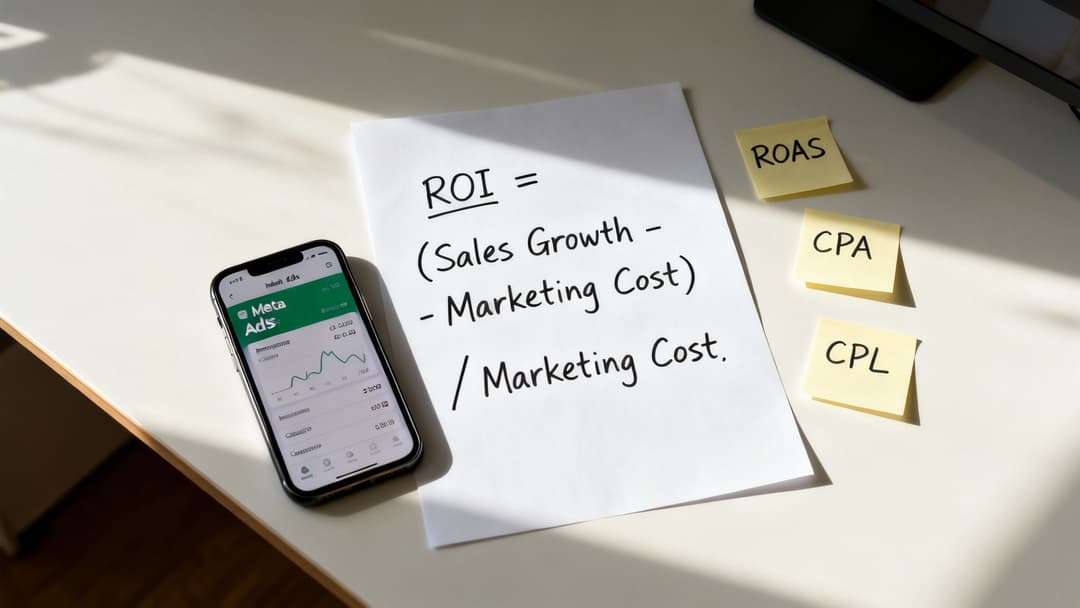
Knowing the return on your marketing spend isn't just a "nice to have"—it's the line between guessing and growing. It's how you turn expenses into smart investments. The basic ROI formula has been the gold standard for performance marketers forever, and for good reason. It works.
You’ll usually see this expressed as a percentage, which just means multiplying the result by 100. Let's say you run a Meta ad campaign and spend $1,000, which brings in $5,000 in new sales. The math gives you a 400% ROI. In plain English, every dollar you spent brought back four dollars in profit.
Sounds simple, right? Yet surprisingly, studies show that only about 50% of marketers feel confident they can actually track their marketing ROI. If you can master this, you're already ahead of half the competition.
Expanding Your Toolkit Beyond Basic ROI
While ROI is your ultimate measure of profitability, it doesn't operate in a vacuum. To get the full story of your performance, you need to look at a few other key metrics. Think of them as the diagnostic tools that tell you why your ROI is what it is.
These complementary metrics give you a more granular view of what's happening:
- Return on Ad Spend (ROAS): This one is all about gross revenue from your ads. It's your go-to for a quick pulse check on an ad campaign's efficiency.
- Cost Per Acquisition (CPA): This tells you exactly what it costs to land a new customer. It's fundamental for knowing if your acquisition strategy is actually sustainable.
- Cost Per Lead (CPL): Focused on the top of your funnel, this tracks the cost to generate a single lead. It's a must-watch metric for B2B companies or anyone with a longer sales cycle.
Each metric provides a different lens. An e-commerce store might live and die by ROAS for daily tweaks, while a B2B SaaS company will be laser-focused on CPL and the long game of converting that lead into a sale.
Understanding when to lean on each metric is what separates good marketers from great ones.
Essential Marketing Metrics at a Glance
To make it even clearer, here’s a quick breakdown of these core metrics. Use this table as a cheat sheet to decide which one to prioritize based on your specific goals.
| Metric | What It Measures | Formula | Best For |
|---|---|---|---|
| ROI | Overall profitability of a marketing investment. | (Sales Growth - Marketing Cost) / Marketing Cost | Assessing the long-term financial health and success of your entire marketing strategy. |
| ROAS | Gross revenue generated for every dollar spent on ads. | Revenue from Ad Campaign / Cost of Ad Campaign | Quick, high-level evaluation of ad campaign performance, especially for e-commerce. |
| CPA | The total cost to acquire a single paying customer. | Total Marketing Spend / Number of New Customers | Understanding the sustainability of customer acquisition and optimizing for profitable growth. |
| CPL | The cost to generate one new lead for your sales pipeline. | Total Marketing Spend / Number of New Leads | Evaluating top-of-funnel campaign effectiveness, particularly for B2B or service-based businesses. |
Having a solid grasp of these four metrics gives you a powerful dashboard for steering your marketing efforts.
Getting these calculations right is the first step. For a deeper dive into turning this data into action, you can explore our guide on https://www.adstellar.ai/blog/how-to-achieve-roi-in-advertising. Additionally, LinkJolt offers an excellent, comprehensive resource on How to Calculate Marketing ROI and Prove Its Value.
Going Beyond the Basics: Advanced ROI Formulas for Deeper Insights
Once you've got the basic ROI formula down, it's time to dig a whole lot deeper. The standard calculation is a fantastic starting point, but let's be honest—it often gives marketing credit for sales that were going to happen anyway. To get a true sense of your impact, you have to isolate the growth that your campaigns generated all on their own.
This is where more advanced ROI models come into play. They help you move past vanity metrics and start making genuinely smarter, more profitable decisions about where your budget is going. Nailing these methods gives you a serious competitive edge, one built on a real understanding of what's moving the needle.
Isolating True Marketing Impact
Imagine your e-commerce store naturally grows by about $5,000 a month. This is your organic baseline. This month, you decide to run a $10,000 ad campaign and your total sales growth hits $35,000.
Using the simple ROI formula, your calculation looks like this: ($35,000 - $10,000) / $10,000 = 250% ROI.
That number looks incredible on a report, but it’s not the whole story. You were already on track to make $5,000 of that growth without spending a cent on this campaign. To find your actual ROI, you have to subtract that organic growth.
The more accurate formula is: (Sales Growth – Organic Growth – Marketing Cost) / Marketing Cost.
Let’s plug in our numbers: ($35,000 - $5,000 - $10,000) / $10,000 = 200% ROI.
This adjusted figure gives you a much more realistic picture of your campaign's performance. It stops you from over-investing in a channel that isn't pulling its weight and ensures your budget flows to the activities that genuinely create new, incremental revenue.
Shifting Focus to Customer Lifetime Value
For so many businesses, especially subscription services or direct-to-consumer (DTC) brands, the first sale is just the opening act. The real value is unlocked through repeat purchases over months or even years. If you only calculate ROI based on that initial transaction, you're missing the big picture.
This is exactly why Customer Lifetime Value (CLV)-based ROI is such a game-changer. It reframes the entire discussion around the total, long-term value a customer brings, not just their first order. A campaign that looks just "okay" on day one could actually be a massive home run when you look at it through the lens of CLV.
This approach is a major strategic shift. The formula looks like this: (Customer Lifetime Value × New Customers – Marketing Investment) / Marketing Investment.
For example, say a campaign costs you $20,000 and brings in 50 new customers. If your average CLV is $2,000, the math becomes ($2,000 × 50 – $20,000) / $20,000 = 4, which translates to a 400% ROI. For every dollar you invested, you're getting five dollars back over the lifetime of those customers. It’s a powerful perspective that shows how a campaign with so-so initial returns can deliver exceptional long-term results, a crucial insight for any brand built on customer relationships. You can find more great insights on using CLV for ROI at Sprinklr.com.
This shift from short-term wins to long-term value is critical. It encourages you to invest in acquiring high-quality customers who will stick around, fundamentally changing your marketing strategy for the better.
Finding the LTV to CAC Gold Standard
A metric that goes hand-in-hand with CLV is the LTV to CAC ratio. It's simple but powerful: it compares the Lifetime Value (LTV) of a customer to the Cost to Acquire that Customer (CAC). This single number is one of the best indicators of your business model's health and potential to scale.
While every industry is a bit different, a widely accepted benchmark for a healthy, scalable business is a ratio of 3:1. This means that for every dollar you spend to bring in a new customer, you can expect to get three dollars back in lifetime value.
Here’s a quick breakdown of what different ratios signal:
- 1:1 Ratio: You're in the danger zone. Once you factor in the cost of goods and operations, you're losing money on every new customer.
- 3:1 Ratio: This is the sweet spot. Your business model is solid, profitable, and ready for growth.
- 5:1 Ratio or Higher: Your customer acquisition is incredibly efficient. This might even be a sign that you're underinvesting in growth and could be more aggressive to capture market share.
Tracking your LTV to CAC ratio is like a regular health check for your marketing engine. It elevates the conversation from simple campaign ROI to sustainable, long-term business growth. Getting clear on these advanced metrics is a core function of robust performance analytics for ads, which helps you finally see how different channels contribute to lasting value.
Setting Up Your Data for Accurate ROI Tracking
You can't calculate marketing ROI without clean, reliable data. Think of it like trying to build a house on a shaky foundation—everything you put on top of it will eventually crumble. If you're serious about understanding what's really working, building a trustworthy data collection system is non-negotiable.
This all starts with your core tracking stack. Tools like Google Analytics, the Meta Pixel, and your CRM aren't just plug-and-play. They need to be configured to talk to each other, capturing every meaningful action a person takes on their journey to becoming a customer.
This visual shows how to level up from basic metrics to a more advanced, CLV-focused approach to ROI.
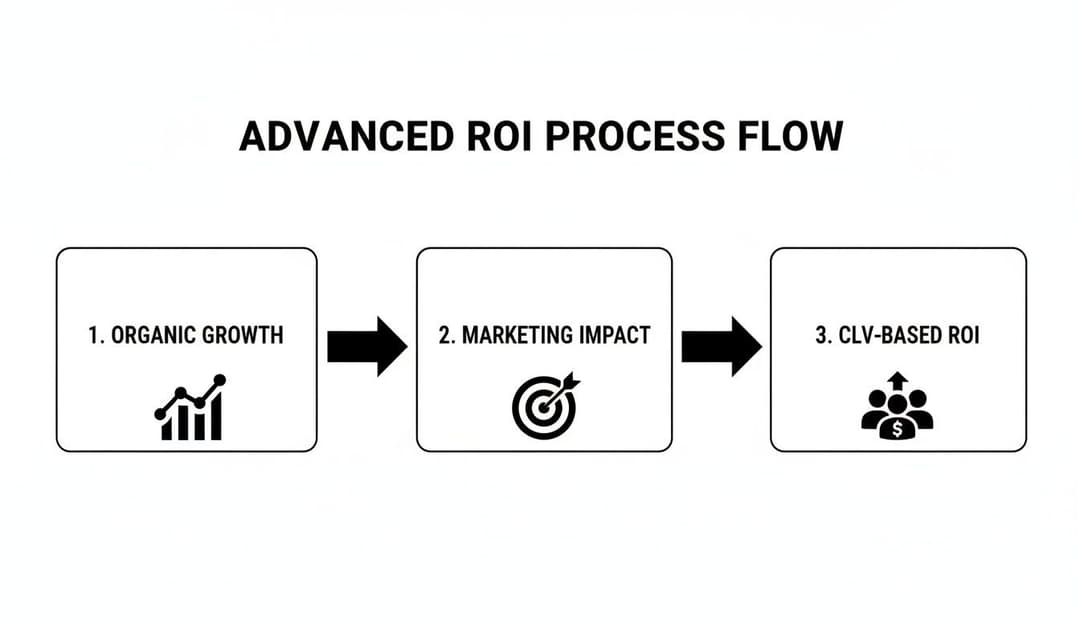
The flow here is key: it’s about moving past just measuring site traffic and instead isolating marketing’s true impact, ultimately calculating ROI based on what a customer is worth over their entire lifetime.
Creating a Single Source of Truth
The goal is to get a seamless flow of information from one platform to the next. When a user clicks a Meta ad, the Meta Pixel should fire. When they land on your site, Google Analytics should pick up the session and track their behavior. If they fill out a form or buy something, that data needs to flow right into your CRM to build out a complete customer profile.
Without this integration, you're stuck with data silos. These are just fragmented pockets of information that make an accurate ROI calculation completely impossible. It’s a common headache, but it's fixable. The first step is simply knowing where to find ad performance data across all your different platforms so you can start pulling it together.
The most common mistake I see is teams treating their analytics tools as separate entities. Your CRM, ad platforms, and website analytics should function as a single, cohesive system that tells a unified story about your customer.
To connect those dots, you need a way to trace every customer's path back to where it started. This is where UTM parameters become your best friend.
Mastering UTM Parameters for Clean Data
UTM parameters are simple tags you add to your URLs that tell analytics platforms exactly where your traffic is coming from. They are the absolute backbone of precise channel tracking. Without them, all your paid and organic efforts get lumped into vague, unhelpful categories like "Direct" or "Referral."
A consistent naming convention is crucial here. If one person on your team tags a Facebook campaign as "facebook_cpc" and another uses "Meta-Paid," your data becomes a mess. You need to establish a clear, documented system that everyone on the team follows.
- utm_source: The platform sending the traffic (e.g.,
google,meta,linkedin). - utm_medium: The marketing channel (e.g.,
cpc,email,social). - utm_campaign: The specific campaign name (e.g.,
black-friday-2024). - utm_term: The paid keyword you're targeting (mostly for search ads).
- utm_content: Used to tell apart ads or links pointing to the same URL (e.g.,
blue-button-advs.red-button-ad).
Consistent UTMs ensure every click gets attributed correctly, giving you the clean data you need to calculate ROI for each specific channel and campaign.
Choosing the Right Attribution Model
Once you're tracking all these touchpoints, the next question is: who gets the credit for a conversion? This is the job of an attribution model. The model you choose will have a direct—and significant—impact on how your marketing ROI shakes out. For platforms like social media, this is especially important, and understanding engagement metrics is part of the puzzle. A TikTok Engagement Rate Calculator can be a handy resource for that.
There are several common models, and each one tells a slightly different story:
- Last-Touch Attribution: This model gives 100% of the credit to the final touchpoint before a conversion. It's simple, but it almost always overvalues your bottom-of-funnel channels while completely ignoring the channels that first introduced a customer to your brand.
- First-Touch Attribution: This one does the opposite, assigning 100% of the credit to the very first interaction. It’s great for understanding which channels are best at generating initial awareness.
- Multi-Touch Attribution (e.g., Linear, Time-Decay): This approach is much more balanced. It spreads the credit across multiple touchpoints in the customer journey, acknowledging that it often takes several interactions to secure a conversion.
So, which one is right? It really depends on your business. If you have a short sales cycle where customers decide quickly, last-touch might be good enough. But for most businesses with longer consideration periods, a multi-touch model will give you a far more accurate picture of which channels are contributing value. This prevents you from mistakenly cutting the budget from a crucial top-of-funnel activity that’s quietly feeding your entire pipeline.
How to Calculate ROI for Different Marketing Channels

Here’s a hard truth: treating every marketing channel the same is a recipe for disaster in your ROI calculations. A paid social ad driving an immediate sale lives in a completely different universe than a blog post that quietly builds authority over six months. If you want to truly understand performance, you have to get granular and adapt your approach to each channel's unique DNA.
This all comes down to identifying the right inputs for your "Sales Growth" and "Marketing Cost." It's never just about ad spend. You've got to account for the hidden costs—creative production, software tools, and even the salaries of the people doing the work. Nailing this is the first step toward an honest, useful ROI assessment.
Calculating ROI for Paid Social Media
With paid channels like Meta or LinkedIn ads, the line between spend and revenue is often the clearest. That's why Return on Ad Spend (ROAS) is your go-to metric for day-to-day pulse checks. It tells you, right now, if your campaigns are bringing in more cash than they're costing.
But a real ROI calculation has to go deeper. Your Marketing Cost isn't just the number you see in Ads Manager.
It must also include:
- Creative Production: The dollars spent designing images, shooting videos, or writing compelling ad copy.
- Agency or Freelancer Fees: If you've got pros managing your campaigns, their fees are a direct cost of the channel.
- Software Subscriptions: Think of any tools you use for ad creation, management, or reporting. They count.
For your Sales Growth, pull the conversion data directly from the ad platform, but—and this is critical—always cross-reference it with your CRM or e-commerce platform. That's your source of truth. By factoring in these extra costs, you move beyond vanity metrics and get a realistic picture of profitability. This detailed view is crucial for understanding how to measure ad effectiveness in a way that actually impacts your bottom line.
A Nuanced Approach to Content Marketing ROI
Content marketing is the definition of a long game, and its ROI is notoriously tough to pin down. A blog post or whitepaper almost never leads to an immediate sale. Instead, its value is sprinkled across the entire customer journey, influencing dozens of touchpoints over time.
Because of this, trying to measure content with a short-term, last-click model will always make it look like a failure. You need patience and a more holistic view.
To really calculate content marketing ROI, you have to track a much broader set of metrics:
- Organic Traffic Growth: How much new, relevant traffic is this content bringing to your site over months, or even years?
- Lead Generation: Of the people who read that blog post, how many eventually signed up for your newsletter or requested a demo?
- Assisted Conversions: Get your multi-touch attribution model fired up. How often did this piece of content play a supporting role in a final sale?
Your Marketing Cost here includes writer salaries or freelance fees, graphic design work, and any SEO tools you use for research and tracking. The Sales Growth is often calculated by assigning a dollar value to the leads you generate or by tracking revenue from customers who first found you through your content.
Don't you dare judge a blog post's ROI after 30 days. Give it at least six to twelve months to start ranking, pulling in traffic, and nurturing leads. Its value compounds over time, unlike a paid ad that dies the second you stop funding it.
Measuring the Impact of Email Marketing
Email marketing consistently delivers one of the highest ROIs out there, simply because sending a message to your existing list is incredibly cost-effective. The calculation here is pretty direct, but you can approach it in a few powerful ways.
The most straightforward method is to calculate ROI on a per-campaign basis: ROI = (Revenue from Campaign - Campaign Cost) / Campaign Cost.
Here, the Campaign Cost includes the labor for writing and designing the email, plus a slice of your email service provider's (ESP) monthly fee. The Revenue is easily tracked in your e-commerce platform by following the purchases made by people who clicked through from that specific email.
For a more strategic view, calculate ROI based on the lifetime value of subscribers acquired through different channels. For instance, what's the long-term ROI of leads who came in from a specific lead magnet versus another? This connects your email efforts to genuine, long-term business value, not just the quick hit from a single promotional blast.
To make this even clearer, here's a quick-reference guide for how to think about ROI across these different channels.
Channel-Specific ROI Calculation Guide
This table breaks down the key components you'll need to consider for an accurate ROI calculation, channel by channel.
| Channel | Primary Success Metric | Costs to Include | Calculation Nuance |
|---|---|---|---|
| Paid Social | ROAS (short-term), CPA | Ad spend, creative production, agency/freelancer fees, software tools. | Most direct revenue attribution, but true ROI must account for all associated operational costs, not just ad spend. |
| Content Marketing | Organic Traffic, Leads Generated, Assisted Conversions | Salaries/freelance fees for writers & designers, SEO software, content promotion spend. | Requires a long-term view (6-12+ months) and multi-touch attribution models to capture its full value across the funnel. |
| Email Marketing | Revenue per Email, Conversion Rate, Subscriber LTV | ESP platform fees, labor costs for content and design, list acquisition costs. | Can be measured per-campaign for immediate results or by subscriber LTV for a more strategic, long-term assessment. |
Ultimately, adapting your ROI formula to the specific channel you're measuring is non-negotiable. It’s the difference between making informed, strategic decisions and just guessing.
Common Mistakes to Avoid When Calculating Marketing ROI
Even the sharpest marketers can stumble when it comes to figuring out their return on investment. Getting your ROI calculation right is so much more than a math problem—it’s the foundation of every sound business decision you make. A simple error can trick you into cutting a winning channel or, even worse, doubling down on a campaign that's quietly bleeding money.
These mistakes aren't just theoretical. I've seen them play out with real-world consequences, impacting everything from quarterly budgets to long-term growth. Understanding these pitfalls is the first step toward building a measurement framework you can actually trust.
Forgetting About Organic Growth
One of the most common blunders I see is failing to account for your baseline organic growth. It’s tempting to credit a shiny new ad campaign for all the sales growth you see, but what if your business was already on an upward trend?
Ignoring this momentum seriously inflates your ROI, making your marketing efforts look way more effective than they really are. This oversight leads to terrible budgeting. You might pour more money into a campaign that’s only delivering marginal returns, thinking it’s a star performer when it's just riding the wave. The key is to isolate the true impact of your marketing spend.
To do this, you need to subtract your average organic sales growth from the total growth before you calculate anything. A more accurate formula looks like this: ROI = (Sales Growth – Average Organic Sales Growth – Marketing Cost) / Marketing Cost.
Let's say your sales jumped by $10,000 during a campaign, but your business typically grows by $3,000 organically each month. That means your marketing-driven growth is only $7,000. Ignoring this detail can turn a seemingly fantastic 400% ROI into a more sober (and accurate) 250%. You can learn more about how experts establish these baselines from this in-depth guide on performance marketing ROI.
Ignoring Customer Lifetime Value
Focusing only on the first purchase is a massive mistake, especially for businesses built on repeat customers. A campaign might look weak with a low initial ROI, but if it acquires customers who stick around and buy again and again, its long-term value could be huge.
When you ignore Customer Lifetime Value (CLV), you risk underfunding the very channels that bring you your most loyal—and most profitable—customers.
Imagine a subscription box company running two campaigns:
- Campaign A: Acquires customers with a high first-purchase value but terrible retention. The immediate ROI looks amazing.
- Campaign B: Acquires customers with a smaller first purchase, but they remain subscribers for two years. The initial ROI is just okay.
Without considering CLV, Campaign A looks like the clear winner. But over the long haul, Campaign B generates far more revenue and is the much smarter investment. This is one of the biggest challenges faced by advertisers—balancing short-term metrics with long-term value.
Relying on Flawed Attribution
Attribution is all about giving credit where credit is due. A classic pitfall is using a simplistic last-click attribution model, which hands 100% of the credit for a sale to the very last touchpoint a customer had before converting.
This model is simple, yes, but it's also dangerously misleading.
A customer journey is rarely that linear. They might see a Meta ad, read three of your blog posts, get an email, and then finally click a branded search ad to make their purchase. With last-click attribution, that search ad gets all the glory, while every other touchpoint that built awareness and trust gets completely ignored.
If you only credit the last click, you'll inevitably defund your top-of-funnel activities. You'll cut the budget for the very blog posts and social ads that introduce new customers to your brand, eventually starving your entire marketing pipeline.
Overlooking Hidden Costs
Finally, one of the easiest ways to get a falsely optimistic ROI is by forgetting to include all your costs. So many marketers only account for the direct ad spend, but that’s just one piece of a much larger puzzle.
A truly accurate ROI calculation has to be comprehensive.
Think about all the resources that really go into a campaign:
- Agency or freelancer fees
- Software subscriptions for design, analytics, or automation
- Creative production costs (think video shoots or graphic design)
- Team salaries for the hours spent planning and managing the campaign
A campaign might seem profitable when you only look at ad spend. But once you factor in these other essential costs, it could easily slip into the red. Being brutally honest about your total investment is the only way to know if your marketing is truly a financial success.
Your Burning Questions About Marketing ROI, Answered
Even with all the right formulas and a clean dataset, putting ROI into practice always brings up a few tricky questions. It's one thing to know the theory, but it's another thing entirely to apply it to the messy reality of your own business. Let's dig into some of the most common hurdles marketers face.
Getting these details right is what separates a vanity metric from a truly useful one. The goal is to make sure your ROI calculations actually lead to smarter, more profitable decisions.
What Is a Good Marketing ROI?
This is the million-dollar question, isn't it? The most honest answer is: it depends. There's no single magic number that works for everyone, but a widely accepted benchmark for a "good" marketing ROI is a 5:1 ratio. That means you're making $5 in revenue for every $1 you spend.
Many marketers would agree that an exceptional return starts to look more like 10:1 or higher.
But these are just rules of thumb. What really matters is what's "good" for your business, which is shaped by a couple of key factors:
- Industry and Profit Margins: A SaaS company with high margins might be perfectly happy with a 3:1 ROI. On the other hand, a low-margin e-commerce store might need to hit a 10:1 ratio just to stay profitable after factoring in the cost of goods sold.
- Business Goals: Are you in a hyper-growth phase trying to grab market share, or are you focused on maximizing profit from every dollar spent? Your immediate goals will change what an acceptable ROI looks like.
The most important benchmark isn't what some blog post says; it's your own. Is your ROI profitable for your business model? And more importantly, is it getting better over time? That's the real metric for success.
How Is ROI Different from ROAS?
It’s incredibly easy to mix up ROI (Return on Investment) and ROAS (Return on Ad Spend), but they tell you two completely different stories about your performance. Confusing them can lead to some expensive mistakes down the road.
ROAS is a pretty straightforward metric. It just measures the gross revenue you generated for every dollar you put into an ad platform. The formula is simple: Revenue from Ad Campaign / Cost of Ad Campaign. Think of it as a quick, top-line pulse check on an ad's efficiency.
ROI, however, gets to the heart of profitability. It takes things a step further by subtracting all the other costs associated with that sale—like the cost of your products, software fees, agency retainers, and creative production—from the revenue generated.
Simply put, ROAS tells you about revenue, while ROI tells you about profit. You can easily have a campaign with a fantastic ROAS that's actually losing you money because your profit margins are razor-thin.
How Often Should I Calculate Marketing ROI?
The right cadence for calculating your marketing ROI really depends on the channel you're looking at and how long your sales cycle is. A one-size-fits-all schedule just doesn't work here.
For fast-moving e-commerce channels like Meta or Google Ads, you'll probably want to check in on ROAS daily to make quick tweaks and optimizations. Then, you can zoom out and do a more thorough ROI calculation weekly or bi-weekly to make sure you're still profitable.
But for long-game strategies like content marketing or SEO, the results take a lot more time to show up. Measuring ROI on a monthly or even quarterly basis is far more realistic for these channels. If you try to measure their impact too soon, you'll almost always convince yourself they're failing.
The key is to set a consistent reporting schedule that makes sense for your business and gives your campaigns enough time to mature. Don't pull the plug on a potentially great campaign just because you got impatient.
Ready to stop guessing and start scaling? AdStellar AI ingests your historical ad performance to surface ROI-driven insights, helping you launch, test, and scale winning Meta campaigns 10x faster. Learn more about AdStellar AI.