The objectives of the campaign are the specific, measurable goals you’re aiming for. Think of them as the destination you plug into your GPS before a road trip. They give the platform's algorithm a crystal-clear picture of what success looks like, guiding every single decision from audience targeting to how your budget gets spent.
Your Campaign's GPS: Navigating Meta Ads Objectives
Defining your campaign objective is hands down the most critical decision you'll make when setting up a campaign on Meta. It's the first and most important instruction you give to its powerful algorithm, telling it exactly what you want to accomplish. This one choice sets your entire strategy in motion.
Are you trying to get a new product in front of as many eyes as possible? Or maybe you need to capture qualified leads for your sales team? Perhaps the goal is simple: drive online sales, right now. Selecting the right objective aligns your specific business goals with Meta's targeting system, making sure every dollar you spend is pushing toward a real, measurable outcome.
Why This First Step Is So Important
This isn't just some setting to click past. It’s a powerful lever that dictates everything—from who sees your ads to what creative they're served. When you get it right, the algorithm becomes your most valuable partner in growth. Get it wrong, and you're just burning through your budget with little to show for it.
Your campaign objective is the language you use to communicate with the Meta algorithm. Choosing 'Sales' tells it to find shoppers, while choosing 'Engagement' tells it to find people who like and comment. They are not the same audience.
Choosing the right objective can make or break your performance. Misalignment is a surefire way to waste money, especially in a competitive market. In the Philippines alone, ad spend hit US$1.95 billion to reach nearly 87 million users. You can't afford to get it wrong.
To simplify this, Meta offers six broad objectives: Awareness, Traffic, Engagement, Leads, App Promotion, and Sales. Each one tells the algorithm what a "win" looks like for you.
This guide will walk you through making this crucial decision. We'll start with how a clear goal fits into your broader paid social media strategy, then dive deep into mapping your business goals to specific Meta objectives and sidestepping common mistakes along the way.
Understanding the Three Stages of Your Customer Journey
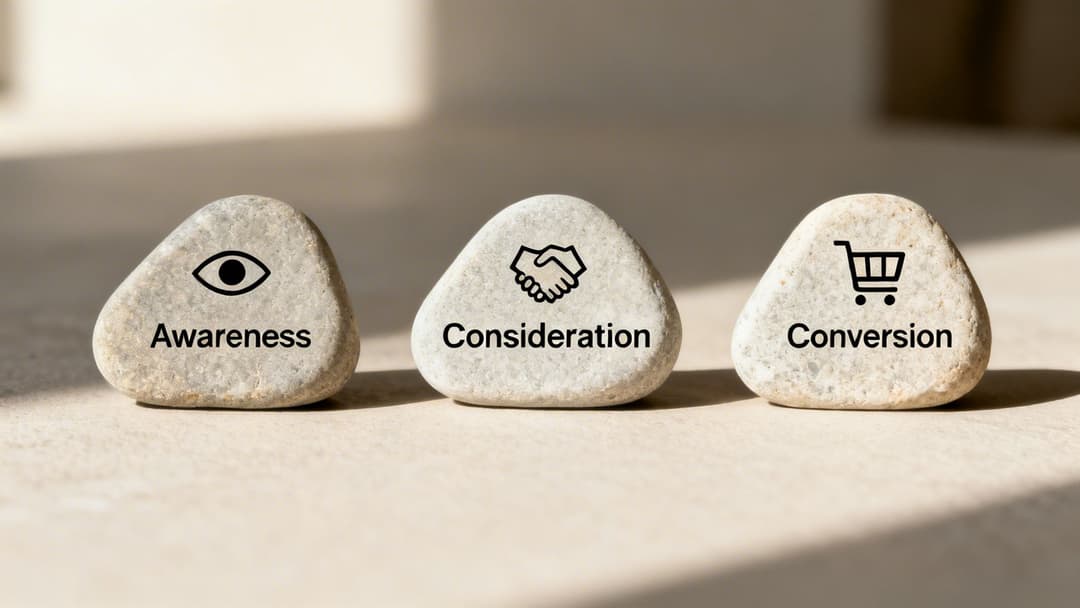
Before you can even think about picking an objective in Meta Ads Manager, you have to get inside your customer's head. Think about it like building any relationship. You wouldn't ask someone to marry you on the first date, right? In the same way, you can't just ask for a sale the very first time someone stumbles across your brand.
This whole process is easiest to picture as a classic marketing funnel, broken down into three simple stages: Awareness, Consideration, and Conversion. Every single effective ad strategy is built to guide people through these phases, one step at a time. It’s the secret sauce that explains why some ads just click with certain audiences while others completely miss the mark.
Stage 1: Awareness (Top of Funnel)
This is your grand entrance. The only goal here is to get your brand in front of people who have absolutely no idea you exist. You’re not selling anything yet—you’re just trying to get on their radar and make a memorable first impression.
The focus is all about grabbing attention and planting a seed. Your campaign objectives are broad, aiming for maximum reach and making sure people remember your name later.
- Goal: Introduce your brand to a fresh, cold audience.
- Message: "Hey, we're here! This is who we are and what we do."
- Audience: Total strangers who've never interacted with your brand.
Getting this first touchpoint right builds the foundation for everything that follows. If you want to get more granular on building these audiences, our guide on what audience segmentation is and why it matters is a great place to start.
Stage 2: Consideration (Middle of Funnel)
Okay, so they know you exist. Now what? The next step is to get them interested and build a little trust. This is the "getting to know you" phase of the relationship. You need to provide real value, answer their unspoken questions, and show them exactly why your product is the solution they've been looking for.
Campaigns at this stage are all about driving interaction—getting people to click, watch your videos, read your blog posts, or sign up for your newsletter.
The Consideration stage is where you turn passive scrollers into an engaged audience. Your job is to give them a compelling reason to lean in and learn more, transforming that initial spark of curiosity into genuine interest.
Stage 3: Conversion (Bottom of Funnel)
This is it—the moment of truth. You're finally ready to ask for the sale, the sign-up, or the appointment. By now, your audience is "warm." They recognize your brand, they've seen your content, and they trust you enough to actually consider pulling out their credit card.
Your campaign objectives here are laser-focused on actions that directly impact your bottom line, like purchases or lead form submissions. You're targeting people who are showing strong signals of intent—like visiting a product page multiple times or, the holy grail, adding an item to their cart. This is the final push to turn an interested prospect into a happy customer.
Matching Your Goals to Meta's Campaign Objectives
Once you have a solid grasp of your customer journey, the next step is to translate your business goals into a language Meta’s algorithm can actually understand. This is where the rubber meets the road. Each of Meta's six campaign objectives is a direct order you give the ad delivery system, telling it precisely what a "win" looks like for you.
Think of choosing an objective like hiring a specialist. You wouldn't call a plumber to fix your car's transmission, right? In the same way, you shouldn’t run a "Traffic" campaign if your real goal is to get online sales. The algorithm is incredibly smart, but it can only execute the command you give it.
Translating Your Funnel into Meta Objectives
Let's break down how each stage of your marketing funnel maps directly to Meta's official objectives. Each choice you make here fine-tunes your campaign to hunt for a specific type of user behavior.
For the Awareness Stage (Top of Funnel)
At this stage, your one and only job is to make a great first impression. You need to get your brand in front of as many new, relevant eyeballs as possible.
- Meta's 'Awareness' Objective: This tells the algorithm to show your ads to the maximum number of unique people (Reach) or to show them multiple times (Impressions). It's the perfect tool for brand introductions, announcing a new product, or just staying top-of-mind.
Awareness objectives lay the groundwork, prioritizing visibility in a world where ad revenue recently jumped 21% thanks to better AI targeting and more impressions. In major markets, you can expect cost-per-mille (CPM) benchmarks to hover around $10–$15 for broad national campaigns. To get a better sense of where objectives fit in the grand scheme, check out our complete guide to what Facebook Ads Manager is and how to use it.
For the Consideration Stage (Middle of Funnel)
Here, you're moving past just being seen. The goal is to get people to actively engage, learn more about what you offer, and start building some trust.
- 'Traffic' Objective: Use this to send people off-platform to a specific destination, like a blog post, a detailed landing page, or your product catalog. The algorithm will hunt for people who love to click links.
- 'Engagement' Objective: This optimizes for social interactions—likes, comments, shares, video views, and event responses. It’s fantastic for building social proof and fostering a community.
- 'Leads' Objective: This one is perfect for capturing contact information, like email addresses or phone numbers, using an instant form that doesn't require users to leave the app.
- 'App Promotion' Objective: Just like it sounds, this is purpose-built to drive app installs and encourage specific in-app events.
Picking the right consideration objective comes down to defining what an "interaction" really means to your business. Is it a click? A 15-second video view? An email signup? Get specific, because Meta will find exactly that type of person for you.
For the Conversion Stage (Bottom of Funnel)
This is it—the moment you ask for the sale. The objectives here are laser-focused on actions that directly impact your bottom line.
- 'Sales' Objective: For most e-commerce brands, this is the holy grail. It instructs Meta to find people who are not just likely to click, but who are statistically most likely to complete a purchase, add an item to their cart, or perform another high-value action on your website.
To make this crystal clear, here’s a simple table that connects your business goals directly to the right Meta objective and the key metrics you’ll use to track success.
Matching Marketing Goals to Meta Objectives and KPIs
| Customer Journey Stage | Primary Business Goal | Corresponding Meta Objective | Key Performance Indicators (KPIs) |
|---|---|---|---|
| Awareness | Introduce the brand, increase reach | Awareness | Reach, Impressions, Cost Per 1,000 Impressions (CPM) |
| Consideration | Drive engagement, clicks, or leads | Traffic, Engagement, Leads, App Promotion | Link Clicks, Cost Per Click (CPC), Video Views, Cost Per Lead (CPL) |
| Conversion | Generate direct sales or actions | Sales | Purchases, Return on Ad Spend (ROAS), Cost Per Acquisition (CPA) |
This table acts as your cheat sheet. When you know your core business goal, you can quickly identify the right objective and KPI to focus on, ensuring your ad spend is working as hard as possible to get you the results you need.
A Practical Framework for Choosing Your Objective
All the theory in the world doesn't mean much until you put it into practice. It’s easy to get bogged down in marketing jargon, so let's cut through the noise with a simple "If-Then" framework to make this decision practical and repeatable.
This approach takes the guesswork out of the equation. It connects what you actually want to achieve for your business directly to a specific campaign objective in Meta Ads Manager. Think of it like a simple recipe: start with your business goal (the "if"), and it gives you the exact setting to use (the "then").
Common Scenarios for E-commerce Brands
For any e-commerce store, the finish line is almost always a sale. But the path you take to get there completely depends on who you're talking to. Are they brand new to your world or a loyal fan?
IF you want to sell a specific product to a warm audience that has already visited your site, THEN your objective is Sales, optimized for the "Purchase" conversion event. This tells Meta to stop looking for window shoppers and start finding people who are ready to pull out their credit cards.
IF you're launching a new collection and just want to create a ton of buzz with a broad, new audience, THEN your objective is Awareness, optimized for "Reach." The goal here isn't an immediate sale; it's about getting as many eyeballs on your new products as possible.
IF you need to re-engage people who added products to their cart but got distracted, THEN your objective is Sales, but you'll target a custom audience of everyone who triggered an "Add to Cart" event in the last 7-14 days.
Decision Rules for B2B and Service Businesses
When you're selling high-ticket services or B2B products, the customer journey is much longer. Your first goal isn't to close a deal on the spot; it's to start a meaningful conversation.
For B2B marketers, a 'lead' is the new 'purchase.' The objective isn't to get a credit card number but to earn the right to have a conversation. Your campaign objective must reflect this value exchange.
Here’s how the If-Then model works in this context:
IF you're promoting a new e-book or webinar to capture email addresses, THEN choose the Leads objective. This is fine-tuned to find people who are most likely to fill out a form right there on the platform.
IF your goal is to drive potential clients to a detailed case study or a services page on your website, THEN use the Traffic objective. You're prioritizing educating your audience and warming them up before you ask for a bigger commitment.
IF you want to book consultations or demos with qualified prospects who already know who you are, THEN use the Sales objective (and optimize for a custom conversion like "Schedule" or "Lead" on your site). This targets high-intent actions from people further down the funnel. A well-structured Meta advertising campaign planning process is crucial for mapping out these multi-step strategies.
Scenarios for Local Businesses
If you have a brick-and-mortar store or offer local services, your goals are all about driving foot traffic and building local buzz.
IF you want to promote an in-store special to people within a 5-mile radius of your shop, THEN use the Awareness objective optimized for "Reach," but with very tight location targeting.
IF you want customers to call your business right from the ad, THEN use the Engagement objective. Select the "on your ad" placement and use a call-to-action that encourages phone calls.
At the end of the day, this framework forces you to be honest about what you're actually trying to accomplish. And if you're thinking about getting some outside help, asking potential partners these key questions when selecting a marketing agency will quickly tell you if they think with the same goal-first clarity.
Common Mistakes in Objective Selection and How to Avoid Them
Picking the wrong campaign objective is like giving your delivery driver the wrong address—no matter how great their driving is, they’ll never get to the right destination. This single mistake can be one of the most expensive you make in paid social, torching your ad spend and delivering nothing but disappointment.
Getting a handle on these common pitfalls is the first step to building a smarter, more effective ad strategy.
So many marketers fall into the classic trap of running a "Traffic" campaign while secretly hoping for sales. And what happens? You get exactly what you asked for: a ton of clicks from people who are happy to browse but have zero intention of buying. Meta's algorithm is painfully literal. If you ask for "clickers," it will find you the best clickers on the platform, not the best buyers.
This is why nailing your objectives of the campaign is so important. It syncs your actual business goal with the algorithm’s powerful optimization engine, making sure you’re driving profitable action, not just meaningless activity.
This decision tree gives you a simple way to connect your main goal, whether it's sales or leads, directly to the right Meta objective.
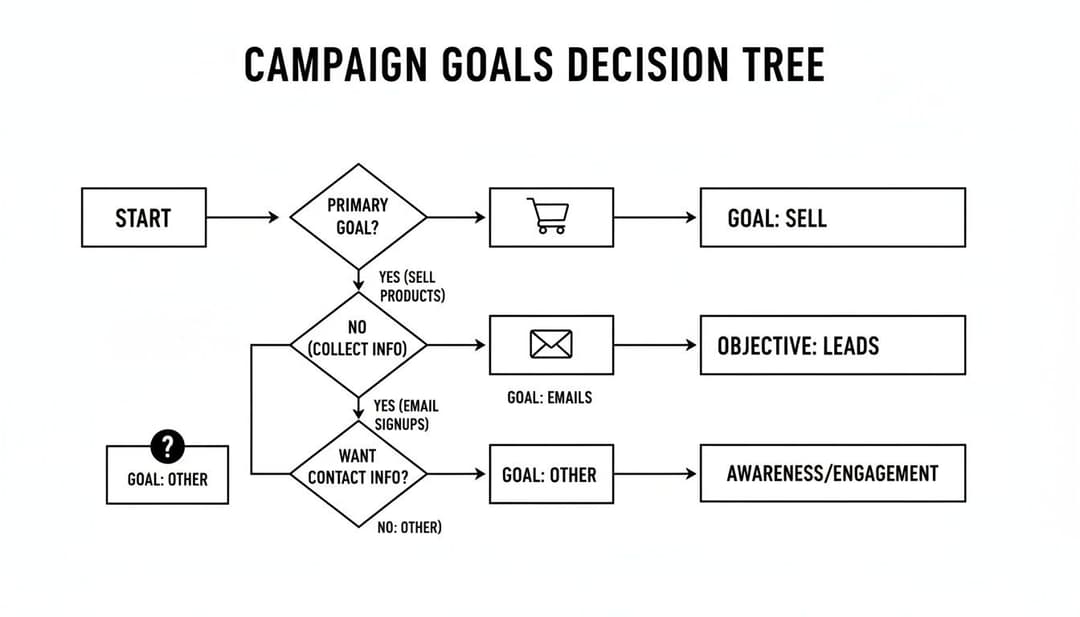
The flowchart drives home a core principle: your ultimate business outcome needs to be the foundation of your campaign setup from day one.
Forgetting About the Funnel
Another huge misstep is going all-in on bottom-of-funnel conversion campaigns. A "Sales" objective is incredibly powerful, but it needs a steady flow of warm, engaged people to work its magic. If you only run conversion ads, your audience will burn out fast, sending your costs through the roof and your returns into the ground.
Neglecting top-of-funnel awareness is like trying to harvest a crop without ever planting any seeds. You need a full-funnel strategy to continuously bring new prospects from discovery to purchase.
Running awareness and consideration campaigns isn't just an extra cost; it's a critical investment in your future sales pipeline.
Not Giving the Algorithm Enough Data
On the other side of the coin, picking a "Sales" objective without enough data is a surefire way to fail. The algorithm needs a consistent stream of conversions to learn who your ideal customer is. If you aren't getting at least 50 purchases per ad set each week, the system can't optimize effectively.
This is what’s known as the Facebook Ads learning phase, and getting stuck there will drain your budget in a hurry.
Here’s how to avoid that trap:
- Start Higher in the Funnel: If you can't get 50 purchases, optimize for a more frequent action like "Add to Cart" or "Initiate Checkout."
- Consolidate Your Budget: Don't spread your spend thin across dozens of ad sets. Focus it on just a few to give them a real chance of hitting that conversion threshold.
When they’re fed with enough data, conversion-focused campaigns are absolute workhorses. In fact, lead-gen campaigns can hit an average conversion rate of 7.72% when they’re backed by great creative. For any B2B or DTC marketer, this data-first approach is the key to mastering your ROAS or CPL.
Your Top Campaign Objective Questions, Answered
Even with the best strategy on paper, things get messy inside Ads Manager. It's completely normal to second-guess yourself when choosing an objective, especially since that single choice has such a massive impact on your campaign's performance.
Let's clear up some of the most common questions that pop up when you're in the trenches.
When on Earth Should I Use the Traffic Objective Instead of Sales?
This is a classic. You should only use the Traffic objective when your main goal is to get eyeballs on a piece of content where you don't expect an immediate sale. Think about sending people to a brand new blog post, a long-form guide, or an article you were featured in. It’s perfect for top-of-funnel plays where you're educating your audience, not asking for their credit card.
On the other hand, you should only choose the Sales objective when you want someone to take a specific, valuable action, like making a purchase. When you select Sales, you’re telling Meta’s algorithm to hunt for people who don’t just click—they have a history of actually buying things. Getting this right is absolutely critical for hitting a positive return on ad spend (ROAS).
How Much Data Does Meta Actually Need for a Sales Campaign to Work?
Meta's algorithm isn't magic; it's a machine that needs to be fed a steady diet of data to do its job. The golden rule you’ll hear everywhere is to aim for at least 50 conversion events per ad set, per week. That’s the number you need to hit to get out of the dreaded "learning phase," where the algorithm is just trying to figure out who your best customers are.
If hitting 50 purchases a week sounds like a pipe dream right now, don't sweat it. You just need to work your way up.
- Start with "Add to Cart": This happens way more often than a purchase.
- Then move to "Initiate Checkout": This gets you one step closer to the final sale.
Once you’re consistently getting 50 of these higher-funnel events each week, you can confidently switch your optimization goal to "Purchase." This strategy gives the algorithm a much stronger signal to work with right from the get-go.
Think of it like leaving a breadcrumb trail for the algorithm. An "Add to Cart" is a small crumb, but 50 of them create a clear path that leads straight to the "Purchase."
Can I Run Campaigns with Different Objectives at the Same Time?
Yes—and you absolutely should. This is the secret sauce behind every great full-funnel strategy. A truly sophisticated approach means running multiple campaigns at the same time, each with a different objective aimed at a specific audience segment, depending on where they are in their journey with your brand.
This layered approach is how you nurture people from being total strangers into raving fans, squeezing the most value out of every stage.
Here’s what a powerful, yet common, setup looks like:
- Awareness Campaign: Use this to get your name in front of a broad, cold audience that has no idea who you are.
- Engagement Campaign: Retarget people who’ve watched your videos or engaged with your posts to build that all-important trust and familiarity.
- Sales Campaign: Go for the kill by showing specific product ads to your hottest prospects—think recent website visitors or cart abandoners.
When you run these campaigns in parallel, you create a seamless system that turns strangers into customers.
Ready to stop the guesswork and scale your campaigns faster? AdStellar AI automates bulk ad creation, tests hundreds of variations in minutes, and uses AI to identify your top-performing creatives and audiences. See how our platform helps you launch, test, and scale Meta campaigns 10x faster. Discover AdStellar AI today.