A paid social media strategy is your architectural blueprint for advertising. It goes way beyond just boosting a few posts here and there. Think of it as a comprehensive plan that dictates exactly who you target, what you say, how you spend your budget, and ultimately, how you measure what’s working.
In a world where organic reach on social media is a shadow of its former self, this blueprint is what turns your ad spend from a wild gamble into a calculated investment.
Why You Need a Paid Social Media Strategy

Running paid social ads without a strategy is like setting sail without a map or a destination. Sure, you’re moving, but you have no idea if you'll end up anywhere you actually want to be. A documented strategy brings much-needed structure, clarity, and direction to turn your advertising efforts into a predictable growth engine for your business.
It’s the single biggest difference between campaigns that just burn through cash with nothing to show for it and those that drive scalable, repeatable results. When you have a clear plan, every dollar has a purpose, every ad has a defined audience, and every outcome is measured against a specific goal. This intentional approach is absolutely critical for cutting through the noise in today’s competitive social ad space.
The Core Pillars of an Effective Strategy
A truly robust paid social strategy is built on a few interconnected pillars. Each one informs the next, creating a solid framework that guides every decision you make, from the first creative concept to the final performance analysis.
- Clear Goals: You have to define what success looks like before you spend a dime. Are you trying to build brand awareness, generate leads, or drive direct sales?
- Precise Audience Targeting: This is about identifying and truly understanding your ideal customer. It means moving beyond broad demographics to pinpoint specific behaviors, interests, and purchase intent.
- Relentless Creative Testing: You need a system for testing everything—ad copy, visuals, offers—to discover what genuinely resonates with your audience and gets them to take action.
- Insightful Measurement: This involves digging into the performance data to understand what's working, what's not, and how to shift your budget for maximum impact.
The market backs this up. Global social media ad spend is on track to hit $247.3 billion in 2025, which is an 11.6% jump from 2024. That massive investment shows just how essential a cohesive plan is for any business trying to compete.
A great strategy ensures you're not just participating in paid social, but mastering it. It turns your ad account from a chaotic collection of ads into a fine-tuned machine designed to achieve specific business objectives.
Ultimately, a paid social strategy provides the discipline you need for long-term success. It forces you to think critically about every single piece of your advertising puzzle, from high-level objectives down to the nitty-gritty of a single headline. For a deeper dive into platform specifics, check out these Facebook Ads best practices to boost ROAS. This structured approach is what allows performance marketers to scale campaigns with confidence and deliver predictable growth.
Setting Goals and KPIs That Actually Matter
Jumping into paid social without clear goals is like driving cross-country without a map—you’ll burn a lot of fuel (and cash), but you probably won’t end up anywhere you want to be. Real success isn't about vanity metrics like likes and shares. It's defined by tangible results that actually grow your business, like hitting revenue targets or acquiring high-value customers.
The trick is to understand the hierarchy of your metrics. Think of your big-picture business goals—like Return on Ad Spend (ROAS) or Customer Lifetime Value (LTV)—as your final destination. The daily in-platform KPIs you're watching, such as Click-Through Rate (CTR) or Cost Per Acquisition (CPA), are just the turn-by-turn directions guiding your optimizations along the way.
Getting this distinction right is critical. A high CTR feels good, but it’s just a leading indicator. It means nothing if those clicks aren't turning into sales or qualified leads. Your strategy has to draw a straight line from every ad dollar you spend to a meaningful business outcome.
Translating Business Objectives into Actionable KPIs
The first step is mapping your specific business goals to the paid social KPIs you need to obsess over. This framework makes sure you're not just collecting data for the sake of it, but using it to make smarter decisions that actually move the needle. A solid connection between your company's ambitions and your campaign's metrics is the bedrock of any winning paid social strategy.
Let's look at a few common scenarios:
- E-commerce Sales: If you’re selling products online, your world revolves around profitability. You need to know, without a doubt, if your ad spend is bringing in more money than it costs.
- B2B Lead Generation: For a B2B company, the immediate goal isn't a sale; it's getting quality leads into the hands of your sales team. Here, the cost and quality of each lead are what matter most.
- Brand Awareness: Sometimes, you just need to get your brand in front of as many relevant eyeballs as possible. Success is measured by how many people you reach and how memorable your ads are.
A classic mistake is getting fixated on top-of-funnel metrics like impressions and clicks. While they're useful for diagnosing problems, they don't tell the whole story. You always have to tie your daily performance back to bottom-line results like revenue or customer acquisition cost.
Making this connection requires rock-solid tracking. To measure conversions accurately and optimize your campaigns effectively, you absolutely must understand how to set up the Facebook Pixel correctly. It’s the tool that bridges the gap between what happens on an ad and what happens on your website.
Your Goal-to-KPI Mapping Framework
To put this into practice, let’s break down how different business goals translate into specific primary and secondary KPIs. Using a framework like this helps you choose the right campaign objective on platforms like Meta and keeps your team focused on what really drives results.
Here’s a simple table to help you align your efforts and track the right numbers.
Mapping Business Goals to Paid Social KPIs
| Business Goal | Primary KPI | Secondary KPIs | Campaign Objective |
|---|---|---|---|
| Increase Online Sales | ROAS | CPA, Conversion Rate | Sales, Conversions |
| Generate B2B Leads | Cost Per Lead (CPL) | Lead Quality Score, CTR | Leads |
| Boost Brand Awareness | Reach & Impressions | Ad Recall Lift, Video Views | Awareness, Reach |
| Drive App Installs | Cost Per Install (CPI) | Install-to-Action Rate | App Promotion |
By defining these connections before you spend a single dollar, your paid social strategy gains a clear sense of purpose. Every optimization you make—from tweaking an audience to testing new creative—is guided by a sharp understanding of what success actually looks like for your business. This disciplined approach makes every dollar accountable and ensures it's working toward a measurable goal.
Mastering Audience Targeting for Your Funnel
Great advertising isn't about shouting your message at the biggest crowd you can find. It’s about whispering it to the right person at the perfect moment. A truly effective paid social media strategy is built on this very idea, turning your ad spend from a wild guess into a calculated investment in connecting with your ideal customers.

This process is called audience segmentation, and it’s the art of slicing up your potential market into distinct, meaningful groups. When you do this, you can tailor your messaging, creative, and offers to hit home with each segment's unique needs and behaviors, smoothly guiding them through your funnel.
The Three Essential Audience Types
To build a full-funnel strategy that actually works, you need to get a handle on the three main audience types available on platforms like Meta. Think of it like a fishing trip: you need different gear and tactics for finding new spots, attracting the fish that are already swimming nearby, and finally, reeling in the ones that have taken a nibble.
Core Audiences (Casting a Wide Net): This is your top-of-funnel workhorse. You're defining a group of people based on their demographics, interests, and behaviors. It’s like picking a promising fishing spot based on good intel—you know the right kind of fish hang out there, but you haven't actually met them yet.
Custom Audiences (Speaking to Warm Leads): These are folks who have already engaged with your brand in some capacity. Maybe they visited your website, watched a video, or liked an Instagram post. This is like talking directly to the fish that have already nibbled on your bait—they know you, and they're much closer to biting again.
Lookalike Audiences (Finding More of Your Best Customers): This is where the real magic happens. You take a source audience, like your best customers from a Custom Audience, and the platform’s algorithm goes out and finds new people who share similar traits. It's like discovering brand-new fishing spots that are packed with the exact same type of fish you've already had a ton of success with.
The real power isn't in using just one of these audience types—it's in how you layer them. You use broad Core audiences to introduce your brand to new people, retarget them with Custom Audiences to build that relationship, and constantly refill your funnel with high-potential prospects using Lookalikes.
Building a Full-Funnel Audience Strategy
A killer paid social strategy maps these audience types to the different stages of the customer journey. You can't just blast a first-time visitor with an aggressive "Buy Now!" ad you'd show someone who abandoned their cart five minutes ago. Your message has to match their level of awareness and intent.
Top of Funnel (Awareness & Discovery)
At this stage, the goal is simple: introduce your brand to cold audiences who have no idea who you are. The key is to cast a wide but intelligent net.
- Audience: Use broad Core Audiences based on key interests and demographics. Lookalike Audiences built from your existing customer list are also incredibly powerful here.
- Message: Your creative needs to be educational or entertaining. Focus on grabbing attention and introducing a problem your product solves.
Middle of Funnel (Consideration & Engagement)
Here, you're nurturing the interest of people who know you exist but aren't quite ready to pull the trigger. This is your chance to build trust and show off your value.
- Audience: Use Custom Audiences to retarget website visitors, video viewers, and people who've engaged with your social profiles.
- Message: Go a little deeper. Offer customer testimonials, case studies, or product demos. You need to show them why you're the best solution out there.
Bottom of Funnel (Conversion)
This is the final push. You're targeting your warmest leads—the ones who have shown strong intent to buy. The messaging here needs to be direct and compelling.
- Audience: Get hyper-specific with Custom Audiences. Target people who added items to their cart or visited a pricing page.
- Message: Create a sense of urgency with a limited-time offer, a discount code, or a friendly reminder about the items they left behind.
By segmenting your approach like this, you guide potential customers on a logical journey from total stranger to loyal fan. To dive deeper into one of the most powerful targeting methods, check out our complete guide to Facebook Lookalike Audiences and learn how to find more of your best customers at scale.
Building Your Creative Testing Engine
In the thumb-stopping, fast-scrolling world of social media, your creative is the single most powerful lever you can pull. You can have the most sophisticated audience targeting in the world, but if the ad itself doesn't stop someone mid-scroll and make them pay attention, it's all for nothing. A truly effective paid social media strategy moves past random guesses and builds a systematic engine for creative testing.
This isn’t about waiting for a lightning bolt of inspiration. It’s about turning creative development into a predictable science. By building a proper testing engine, you create a continuous feedback loop where learnings from one test directly inform the next creative sprint. This methodical approach is the secret to unlocking scalable, repeatable growth.
The Foundation of Creative Testing
Think of your ad creative like a science experiment. To get a clean result, you can't just throw a bunch of different chemicals into a beaker and see what happens. If you test a new headline, a new image, and a new call-to-action all in the same ad, you’ll have no idea which element was actually responsible for the change in performance.
The core principle here is to isolate variables. You test one thing at a time to definitively understand its impact. It’s a disciplined process, but it’s how you identify winning concepts faster, fight off creative fatigue, and discover what genuinely resonates with your audience.
Here are the key variables you should be testing systematically:
- The Hook (First 3 Seconds): For video ads, the opening is everything. Test different initial scenes, bold on-screen text, or provocative questions to see what grabs the most attention right away.
- The Core Creative: This is your main visual. Pit different formats against each other—static images versus user-generated content (UGC), slick professionally shot videos versus scrappy animated graphics.
- The Headline and Copy: Test different angles and emotional triggers. Does your audience respond better to a headline that agitates a pain point, or one that highlights a key benefit?
- The Call-to-Action (CTA): Even a small tweak here can make a difference. Test direct commands like "Shop Now" against softer, more intriguing CTAs like "Find Your Perfect Fit."
The goal of a testing engine isn't just to find one "perfect" ad. It's to build a library of proven elements—winning headlines, top-performing image styles, and effective hooks—that you can combine to consistently produce high-performing creative.
Structuring Your Tests for Clear Results
A structured approach is what makes your test results clean and actionable. Instead of just throwing random ideas at the wall, you form a clear hypothesis for each test. For example: "We believe a headline that highlights our product's durability will achieve a lower Cost Per Purchase than a headline focused on style."
This is where you can use different testing methodologies to get the answers you need. For a more advanced approach that lets you test multiple variables at once in a structured way, you can learn more about what is multivariate testing in our detailed guide. It's a technique that can seriously accelerate your learning process.
To keep your visual pipeline full and fresh, it’s worth exploring innovations in AI image generation for social media. These tools can help you produce a diverse range of visual content quickly and at scale.
Platforms like AdStellar are designed to speed up this entire process, letting you create and launch hundreds of ad variations in minutes, not hours.
By automating the tedious work of creating different ad combinations, you can shift your focus from manual setup to what really matters: analyzing the results and scaling the winners. This turns creative testing from a slow, manual chore into the rapid, data-driven engine that fuels your entire paid social strategy.
Structuring Campaigns for Scalability and Control
A profitable paid social strategy is built on a rock-solid foundation: a well-structured ad account. Think of it like organizing a massive warehouse. If you just toss products everywhere, you’ll never find what you need, track your inventory, or figure out what’s actually selling. A chaotic ad account is no different—it burns cash, hides valuable insights, and makes it impossible to scale your winners.
Building a clear, logical structure for your campaigns, ad sets, and ads is what gives you the clarity to make smart decisions. It ensures every dollar is spent with purpose, your messaging hits the right audience, and you can instantly spot what’s driving performance. This disciplined approach transforms your account from a confusing mess into a high-performance growth engine.
One of the most battle-tested architectures every performance marketer should live by is the clean separation of prospecting and retargeting campaigns.
Prospecting Campaigns: This is all about finding new customers. The goal here is broad reach and efficient acquisition, targeting cold audiences who’ve never heard of you.
Retargeting Campaigns: Here, you're zeroing in on warm audiences—people who have visited your site, engaged with your content, or even abandoned a cart. The goal is simple: close the deal.
Splitting them up lets you tailor your messaging and budget with surgical precision. After all, you wouldn't talk to a total stranger the same way you’d talk to someone who was one click away from buying yesterday. Your ad account needs to reflect that same logic.
Choosing Your Budgeting Strategy
Once your campaigns are separated, you have to decide how you’re going to spend your money. On platforms like Meta, this really boils down to two options: Campaign Budget Optimization (CBO) and Ad Set Budgeting (ABO).
Campaign Budget Optimization (CBO): With CBO, you set one central budget at the campaign level. Meta’s algorithm then automatically pushes that money to the ad sets it thinks will perform best. This is your go-to when you trust the algorithm to find the most efficient pockets of opportunity and you're cool with giving up some manual control for better performance.
Ad Set Budgeting (ABO): Using ABO, you manually set a specific budget for each individual ad set. This gives you direct, granular control over how much you spend on each audience. It's perfect when you need to guarantee a certain amount of spend on a specific audience—for instance, making sure your bottom-of-funnel retargeting audience always gets a dedicated budget, no matter its size.
A common and incredibly effective approach is to run CBO for your broad prospecting campaigns to let the algorithm hunt for new customers, while using ABO for retargeting to maintain tight control over spend on your highest-intent audiences.
Smart Budget Allocation Rules
How you split your budget between finding new customers and converting your existing pipeline is critical for sustainable growth. A proven rule of thumb is the 80/20 split.
This means you dedicate about 80% of your total ad spend to prospecting campaigns that are focused on reaching new people. The other 20% is reserved for your retargeting campaigns, designed to re-engage and convert those warm leads. This aggressive focus on acquisition keeps your funnel full and prevents your campaigns from going stale.
While the campaign structure provides the skeleton, the creative you fill it with is what brings it to life. This means having a systematic process for testing.
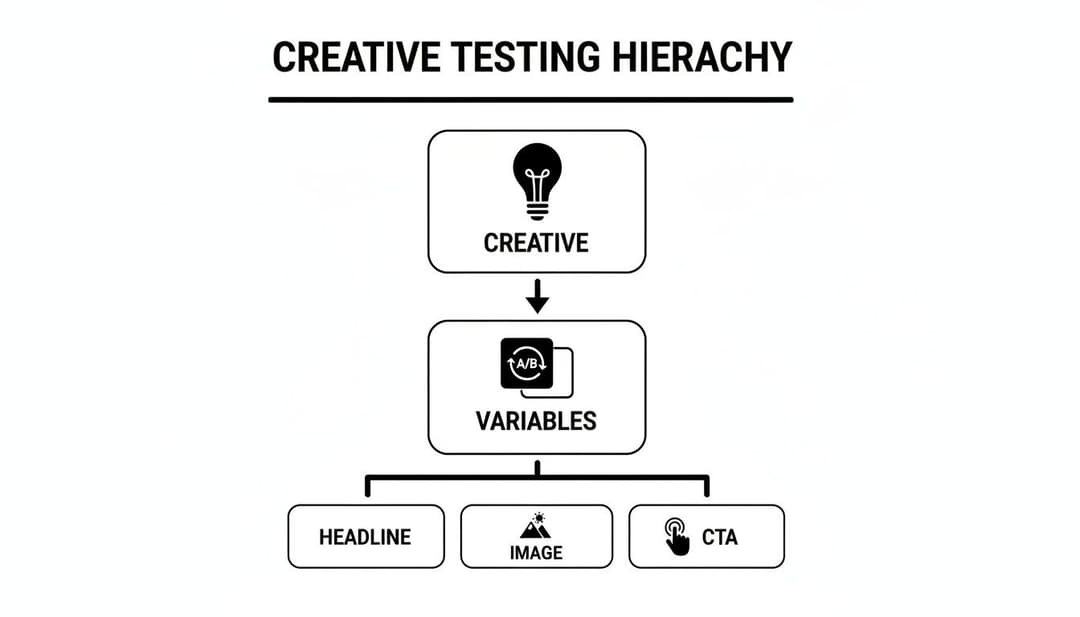
This hierarchy shows how a single creative concept can be broken down into multiple testable elements like the headline, image, and call-to-action. Platforms can even automate much of this testing for you. To see how that works, you can learn more about what is Dynamic Creative Optimization in our detailed guide. It’s a powerful tool that works hand-in-hand with a solid campaign structure to squeeze every last drop of performance out of your budget.
Analyzing Performance and Scaling Your Winners
Getting your campaigns live is just the first step. The real money is made when you turn raw performance data into a clear plan for growth. A winning paid social media strategy isn’t about just celebrating the wins; it’s about digging into the numbers to figure out why certain ads, audiences, or messages are hitting the mark. This is your roadmap for scaling.
You have to look past the surface-level reports and start spotting trends. Is your Cost Per Acquisition (CPA) slowly inching up? That’s a classic sign of ad fatigue—your audience has seen your creative one too many times, and it’s starting to lose its punch. Keeping an eye on metrics like frequency is absolutely critical for catching these problems before they burn through your budget.
Data without insight is just noise. Your job is to translate those numbers into a story about what’s actually resonating with your customers.
Diagnosing Campaign Health
Before you even think about scaling, you need to make sure your foundation is rock-solid. Performance analysis is as much about spotting weaknesses as it is about finding winners. Think of yourself as a campaign doctor, checking the vitals to make sure everything is running as it should.
Here are a few diagnostic questions I always ask:
- Is performance consistent? Look at your daily and weekly trends. Any sudden dips or spikes could signal a problem with tracking, a platform update, or audience saturation.
- Where are people dropping off? Dive into your funnel metrics. A great Click-Through Rate (CTR) paired with a low conversion rate often means there's a disconnect between your ad's promise and what people find on your landing page.
- Are your costs spiraling? Keep a hawk's eye on your CPA or Cost Per Lead (CPL). If it starts climbing, it's time to investigate. Is it creative fatigue, audience exhaustion, or just more competition?
The most common mistake I see is scaling way too fast based on a couple of good days. You have to give your campaigns time to gather enough data. Be patient and you’ll avoid dumping money into what might just be a short-term fluke.
Once you've confirmed that an ad set or campaign is a steady, profitable performer, it's time to pour some gas on the fire. This is where having a clear scaling playbook is crucial, so you can increase your spend without shocking the algorithm and resetting its learning phase. For a refresher on the fundamentals that make a campaign scalable in the first place, check out these Facebook advertising best practices.
The Two Methods for Scaling Your Winners
Scaling isn't as simple as just cranking up the budget. There are two core methods for growing your successful campaigns, and the best marketers know how to use both.
1. Vertical Scaling: More Budget
This is the most direct approach. You find your best-performing ad sets and simply give them more money to spend. The key here is to do it gradually.
- How it works: You're essentially giving a proven winner more fuel to reach more people within its existing, successful audience.
- Best practice: Don't make huge, sudden budget jumps. A 50% or more increase can easily knock the ad set right back into the learning phase, wrecking its performance. Instead, stick to small, steady increases of 15-20% every 24-48 hours, but only if performance holds up.
2. Horizontal Scaling: New Audiences
With this method, you duplicate your winning ad set but point it at new, similar audiences. You’re taking what works and expanding its reach into fresh territory.
- How it works: You clone a successful ad set—keeping the same winning ads and creative—but change the targeting to a new Lookalike Audience, a different interest group, or another demographic.
- Best practice: Build your new Lookalike audiences from high-intent customer actions, like "Purchasers" or "Top 25% Website Visitors." By showing your proven creative to new, highly relevant audiences, you can scale your reach without burning out your original winning segment.
Answering Your Burning Questions
Even the sharpest performance marketers hit a wall now and then when trying to nail down their paid social media strategy. Let's clear up a few of the most common questions that come up.
How Much Should I Spend on My Paid Social Strategy?
There’s no magic number here. Your budget should be a direct reflection of your goals, plain and simple. The best way to figure it out is to work backward from what you want to achieve.
Let's say your target Cost Per Acquisition (CPA) is $50, and you're aiming for 100 new customers. Just do the math: your starting budget is $5,000.
A solid rule of thumb when you're testing new ad sets is to give each one a daily budget that's at least equal to your target CPA. This gives the platform's algorithm enough data to chew on. The key is to start with a budget you're comfortable learning with, prove your return on ad spend (ROAS), and then step on the gas.
How Long Does It Take to See Results From Paid Social?
You’ll see surface-level data like impressions and clicks almost immediately—within hours, even. But the results that actually matter to your business? Those take a bit more time.
Platforms like Meta have a critical "learning phase" for every new ad set. This is where the algorithm figures out who to show your ads to. It typically needs around 50 conversions to exit this phase, which can take anywhere from 3-7 days. It's absolutely crucial to let this process finish before you start tweaking things.
True campaign impact—the kind measured by bottom-line metrics like ROAS—needs to be evaluated over a longer window, like 30 days. This gives you a much more accurate picture by accounting for delayed conversions and the full customer journey.
What Is the Most Common Mistake in Paid Social?
The single biggest—and most expensive—mistake we see is the lack of a structured testing system. Too many advertisers throw a few ads out there, pick an early "winner" based on a gut feeling, and then just cross their fingers.
A winning strategy treats every single element—the creative, the audience, the copy, the offer—as a hypothesis that needs to be proven. When you build a continuous, methodical testing framework, you stop guessing and start building a predictable system for finding what works.
Without one, your campaigns are guaranteed to suffer from creative fatigue, sky-high costs, and an inability to scale.
Ready to stop the guesswork and scale your campaigns faster? AdStellar AI automates bulk ad creation and uses AI to identify your top-performing creative, audiences, and copy so you can double down on what works. Launch, test, and scale your Meta ads 10x faster at https://www.adstellar.ai.