Running Facebook ads for your dropshipping store is the engine that really turns a cool product into a profitable business. But here's the secret: the pros move past guesswork.They build a solid, data-driven foundation that sets them up for predictable growth right from the start. This initial setup is honestly where most newcomers stumble, but getting it right gives you a massive head start.
Building Your Foundation for Profitable Campaigns
Before you even think about spending a single dollar on ads, you need to know that the most successful campaigns are won in the prep phase. This isn't just about ticking off technical boxes; it's about getting crystal clear on your strategy. You need to validate your product, know your ideal customer inside and out, and make sure your tracking is absolutely perfect. Skipping this groundwork is like building a house on sand—it’s just not going to hold up.
I see it all the time. Dropshippers get hyped about a trending product and rush to launch ads, only to watch their budget disappear with nothing to show for it. Why? Usually, it's because the product doesn't actually have a solid market fit, or the ads are being shown to completely the wrong people. Real product validation is way more than just seeing a competitor's ad go viral.
Validating Your Product and Defining Your Customer
First things first: you need proof that real people will actually open their wallets for what you're selling. Look for signs of an existing, passionate community that revolves around the problem your product solves. Is there a buzzing subreddit? A bunch of active Facebook groups? Popular influencers in the niche? These are all green lights pointing to a hungry market.
At the same time, you've got to build a razor-sharp customer avatar. Don't just stop at basic demographics. You need to dig into the psychographics:
- What are their biggest daily frustrations? What do they aspire to?
- What kind of content are they binge-watching or reading online?
- What's the real, emotional reason they would buy a product like yours?
This detailed profile is your North Star. It guides every piece of ad copy you write and every targeting option you select, helping you connect on a much deeper level. And before you launch anything, make sure your supply chain is solid. There are great guides out there on finding high-quality, affordable dropshippers that can help lock this down.
Technical Setup and Account Structure
Okay, so you have a validated product and a clear picture of your customer. Now it’s time to get your Meta Business Manager ready for action.
The single most critical piece of this puzzle is the Meta Pixel. Think of it as the brain of your entire advertising operation. It collects data on every single action a visitor takes, from viewing a page to making a purchase. A correctly installed pixel is completely non-negotiable if you want to track results, retarget visitors, or build powerful custom audiences. To sidestep the common pitfalls, check out our detailed guide on how to set up the Facebook Pixel correctly.
Let's be real: data shows that around 68% of dropshipping stores depend on Meta ads for most of their traffic. These ads drive huge revenue, but you need smart tools and clean data to scale effectively. Without accurate pixel data, you're flying blind. You can't make smart decisions to optimize your campaigns or pour more money into what’s working.
Finally, establish a logical ad account structure from day one. Seriously, this will save you so many headaches later. Use a consistent naming convention for your campaigns, ad sets, and ads (something like "Campaign_Objective_Product"). This simple habit makes analysis a breeze, allowing you to instantly see which strategies are winners and which are bleeding cash. It lets you react fast and protect your ad spend.
Before you hit that "Publish" button, a quick pre-flight check ensures you haven't missed any of the small-but-critical setup details. Running through a checklist like this can be the difference between a smooth launch and a frustrating waste of money.
Dropshipping Campaign Pre-Launch Checklist
| Component | Key Action | Why It's Critical |
|---|---|---|
| Meta Business Manager | Verify your business and domain. | Builds trust with Meta and unlocks essential features, reducing the risk of account issues. |
| Meta Pixel | Install on your store and verify it's firing correctly for all key events (ViewContent, AddToCart, Purchase). | This is your data lifeline. Without it, you can't track ROI, optimize for conversions, or retarget effectively. |
| Conversion API (CAPI) | Set up CAPI alongside the Pixel. | Provides a more reliable server-to-server data connection that bypasses browser-based tracking blockers. |
| Product Catalog | Create and upload your product catalog to Meta Commerce Manager. | Enables powerful Dynamic Product Ads (DPA) for retargeting, showing people items they've already viewed. |
| Ad Account Structure | Decide on a clear and consistent naming convention for your campaigns, ad sets, and ads. | Keeps your account organized, making it easy to analyze performance and scale winners without confusion. |
| Payment Method | Add and verify a primary and backup payment method. | Prevents your ads from being paused unexpectedly due to a payment failure, which can kill campaign momentum. |
Taking the time to nail down these fundamentals ensures your account is primed for success. It allows Meta's algorithm to get the clean data it needs to find your customers, and it gives you the clear insights required to scale profitably.
Creating Ads That Actually Stop the Scroll
Let's be real: the social media feed is an endless river of noise. Your ad is just one tiny drop in that ocean. If you want to succeed with fb ads for dropshipping, your creative isn't just a piece of the puzzle—it's everything. A generic, corporate-looking ad gets scrolled past in less than a second. Your ad spend? Wasted. Your only real edge is crafting something that feels native to the feed, authentic, and immediately interesting to the person on the other side of the screen.
This means you have to ditch the sterile stock photos and create visuals that connect with an actual human. The mission is to interrupt their mindless scrolling with something that feels personal and genuine, not like a pushy sales pitch. Think less like a massive corporation and more like a friend sharing a genuinely cool find.
The Power of Authentic Visuals
Right now, the undisputed champion of dropshipping ad creative is User-Generated Content (UGC). We're talking about videos and images that look like they were made by real customers, not a professional marketing team in a studio.
Why does UGC work so well? It’s all about instant social proof and trust. When a potential buyer sees someone who looks just like them using and loving your product, it feels more like a trusted recommendation than an ad. This raw, often lo-fi aesthetic consistently outperforms slick, highly-produced videos.
Here’s what makes for powerful UGC-style creative:
- Real-World Scenarios: Show the product being used where it's actually used. Selling a portable blender? Film someone making a smoothie in their slightly messy kitchen, not a pristine white studio.
- Direct-to-Camera Honesty: Nothing beats a simple video of a happy customer speaking directly to the camera, sharing their genuine experience. It’s relatable and immediately breaks down the brand-consumer barrier.
- The Problem-Solution Demo: A quick "before and after" or a simple demonstration of how your product solves a common, nagging problem is a classic for a reason. It visually screams "value" in just a few seconds.
And don't worry if you don't have a big budget for creators. You can start by making this content yourself. Grab your smartphone, find some good natural light, and focus on showing off the product in a realistic and helpful way.
Crafting Copy That Connects
Once your visual has done its job and stopped the scroll, your copy has to close the deal. The secret is to talk directly to your customer's pain points and dreams. A great framework for this is the Problem-Agitate-Solution (PAS) model, but the trick is making it sound human, not like you’re reading from a marketing textbook.
First, call out the problem they're dealing with. Then, twist the knife a little—agitate that problem by reminding them how frustrating it is. Finally, swoop in and present your product as the hero, the perfect solution.
Pro Tip: Write your ad copy like you're talking to one person, not broadcasting to a crowd. Using words like "you" and "your" makes the message feel incredibly personal. Instead of saying, "Our customers love this," try, "You'll love how this solves..." It’s a tiny shift that makes a massive difference.
Your copy also needs to be incredibly easy to scan. Nobody on social media has the patience to read a wall of text.
- The Hook (Your First Line): This is the most critical part. Ask a provocative question, make a bold claim, or call out your audience directly. Think: "Tired of those messy kitchen counters?"
- The Headline: Make it clear and focused on the benefit. A headline like "50% Off Today Only" creates urgency, while something like "The Last Portable Charger You'll Ever Need" sells the ultimate solution.
- The Call-to-Action (CTA): Be direct. Tell people exactly what to do next. "Shop Now," "Learn More," or "Get Yours Here" are clear, simple, and effective.
If you're looking for more inspiration on blending killer visuals with magnetic copy, it’s always a good idea to check out examples of truly creative ad campaigns to see how the top brands grab attention. Seeing what works for others can spark some brilliant ideas for your own ads.
Ultimately, making ads that actually convert is a mix of art and science. It's about understanding a bit of human psychology, keeping up with visual trends, and writing copy that is crystal clear and persuasive. By focusing on authenticity and a direct problem-solution approach, you can transform your ads from forgettable interruptions into compelling offers that drive real sales.
Structuring Your Campaigns and Targeting Strategy
Alright, you've got some killer creative ready to go. Now, it's time to build the machine that gets it in front of the right people. This is where the rubber meets the road.
How you structure your campaigns and pick your audiences is the difference between burning cash and printing it. A messy setup is a recipe for disaster—you'll have no idea what's actually working. A clean, strategic approach, on the other hand, gives you clear signals to guide every decision you make.
The goal isn't to build some insanely complex web of campaigns from day one. Forget that. We want a lean, mean framework built for one thing: rapid learning. You need to figure out which audiences and creatives are hitting the mark without wasting your entire budget on guesswork.
Advantage+ vs. Manual Campaigns
These days, Meta gives us two main paths to go down: the AI-powered Advantage+ Shopping Campaign (ASC) or the old-school manual setup.
For most dropshippers, especially if you're just starting out, Advantage+ Shopping Campaigns are the way to go. Seriously. ASC basically automates the targeting for you, letting Meta's machine learning loose to find the most likely buyers across its entire user base. You just feed it your creatives and budget, and the algorithm does the heavy lifting.
But that doesn't mean manual campaigns are dead. Not at all. They still have a place for surgical, controlled tests. You might spin up a manual campaign to:
- Test hyper-niche audiences you have a hunch about, ones that ASC might just gloss over.
- Isolate a brand-new creative angle with a specific demographic to see how it lands before you toss it into your main ASC.
- Run dedicated retargeting campaigns with custom messaging for people at different stages of your funnel.
A really solid strategy is to use ASC as your main "always-on" engine for driving sales. Then, you supplement it with smaller, tightly controlled manual campaigns for your experiments. For a deeper dive on this, check out our guide on designing a modern campaign structure for Meta ads.
The Art of Audience Testing
Even with ASC running the show, you still need to understand your audiences. This is non-negotiable for scaling and for when things inevitably go sideways. Your testing should be all about finding those little pockets of high-intent customers.
The biggest mistake I see people make is over-segmenting right out of the gate. They create dozens of tiny, hyper-specific ad sets. This starves Meta's algorithm of the data it needs to learn and optimize. Don't do it. Start broader and let the data tell you where to zoom in. You have to give the AI some breathing room to work its magic.
Think of your ad as a simple, three-part system designed to stop the scroll and get the click.
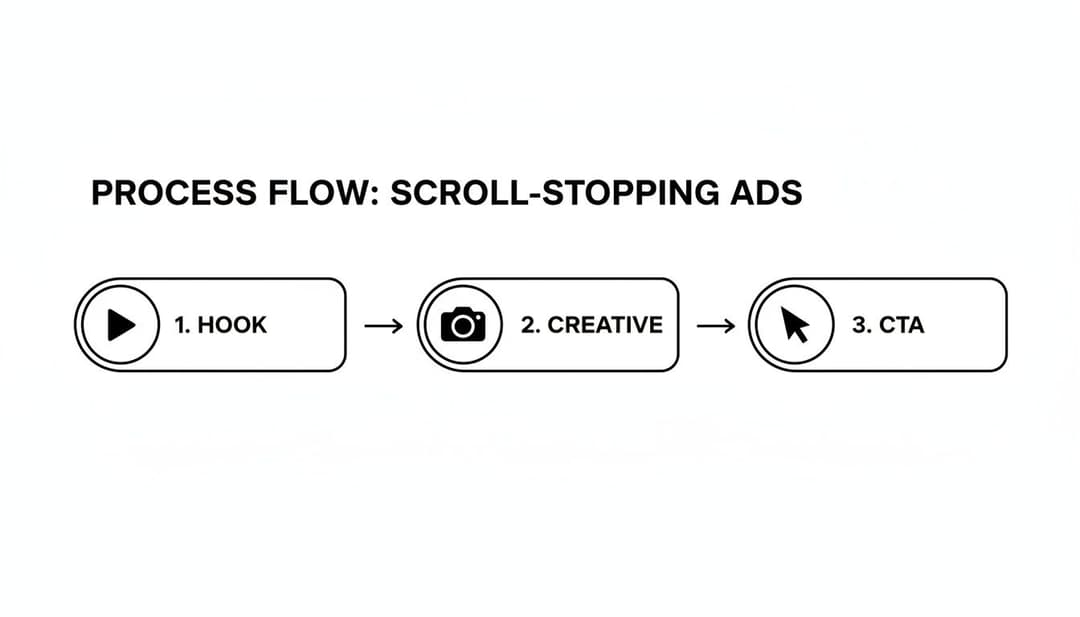
From the initial hook that grabs them to the final CTA that pushes them to your site, every piece has to work together.
Crafting High-Intent Audiences
Let’s get past the generic stuff. Your goal is to find people who are signaling they're ready to buy, not just casually scrolling. This is where you get an edge.
Lookalike Audiences: Once your Meta Pixel has some real data to work with (you want at least 100 purchase events), you can start building Lookalikes. These are audiences Meta creates by finding users who are incredibly similar to your existing customers. A 1% Lookalike of your purchasers is usually pure gold—it's often the most powerful audience you can have.
Interest Stacking: Don't just target a single broad interest like "Skincare." That's amateur hour. Instead, stack related interests to home in on a much more qualified audience. For example, target people interested in "Skincare" AND "Sephora" AND "Drunk Elephant." This layering helps you find the true enthusiasts, not just the window shoppers.
Getting your targeting right is more critical than ever. Facebook ad costs are soaring—the average CPM is now $8.77, and CPC has shot up 63% since 2020. Bad targeting will drain your bank account faster than you can say "unprofitable." As margins shrink, smart targeting isn't just a nice-to-have; it's a matter of survival.
By blending the raw power of Advantage+ with strategic, thoughtful audience testing, you create a system that works. You let Meta's AI handle the broad customer acquisition while you focus on what you do best: feeding it amazing creative and uncovering new, high-intent audiences to fuel your growth.
How to Analyze and Optimize Your Live Campaigns
Once your ads are live, the real work starts. Getting a campaign launched is just the entry ticket; the money is made in the day-to-day grind of analyzing the data and making smart, calculated moves.
This isn't about nervously refreshing Ads Manager every five minutes. It’s about building a disciplined routine to read what the numbers are telling you. The goal is to stop making decisions based on gut feelings and start acting like a data-driven pro. You need to know when to be patient, when to kill an ad that's burning cash, and when to pour gasoline on a winner.
Decoding Your Key Performance Indicators
Your Ads Manager is packed with dozens of metrics, but for dropshipping, only a handful truly matter. Everything comes down to one simple question: are you profitable?
These are the core metrics that should drive every single decision you make on your fb ads for dropshipping:
- Cost Per Purchase (CPP or CPA): This is your north star. It's the exact amount you're paying to get one customer. If your CPP is higher than your profit margin on a product, you’re literally paying to give your stuff away.
- Return on Ad Spend (ROAS): This is the ultimate scorecard. It shows the total revenue you've made for every dollar you put into ads. A 3.0 ROAS means for every $1 you spent, you got $3 back. Simple as that.
- Click-Through Rate (CTR): This is your first clue. It shows the percentage of people who saw your ad and were interested enough to click. A plummeting CTR is usually the first sign your creative or copy just isn't hitting the mark.
Sure, you can look at things like Cost Per Click (CPC) or Cost Per Mille (CPM), and they can be useful for diagnosing specific problems. But don't get lost in the weeds. A high CPC doesn't matter one bit if your ROAS is incredible. Always bring it back to profitability.
Here’s a quick breakdown of the most critical metrics, what they mean for your dropshipping store, and what to do about them.
Key Dropshipping Ad Metrics and What They Mean
| Metric (KPI) | What It Measures | Good Benchmark | Actionable Insight |
|---|---|---|---|
| Cost Per Purchase (CPP) | The average cost to acquire one customer. | Below your product's break-even point. | If too high: Kill the ad set. The audience, creative, or offer is not working. |
| Return on Ad Spend (ROAS) | Total revenue generated per dollar of ad spend. | 2.5x or higher. | If below 2.0x: You're likely losing money. Time to cut it or troubleshoot. |
| Click-Through Rate (CTR) | Percentage of impressions that resulted in a click. | 1% or higher (varies by placement). | If below 1%: Your ad creative or copy is weak. Test a new hook or visual. |
| Cost Per Click (CPC) | The average cost for a single click to your website. | Under $1.50 (highly variable). | If too high: Could signal low ad relevance or a very competitive audience. Check CTR first. |
Ultimately, these numbers tell a story. Learning to read that story is what separates the seven-figure stores from the ones that shut down after a month.
Establishing Your Performance Benchmarks
So, what do "good" numbers actually look like in the wild? This can shift based on your niche and product margins, but there are some solid goalposts to aim for.
For most dropshipping stores, a ROAS of 2.5 to 3.0 is the sweet spot. This range usually means you're covering your ad spend, cost of goods, and transaction fees, with a healthy profit left over. If you’re consistently sitting below a 2.0 ROAS, you're probably either breaking even or losing money.
Before you even launch, you should know your break-even ROAS. It gives you a clear line in the sand. If a product costs you $20 to source and ship and you sell it for $60, your break-even ROAS is 3.0. Any ad set that's running below that after it's out of the learning phase is on the chopping block.
For a deeper dive into profitable ad strategies, our complete guide to Facebook ad optimization is a great next read.
When to Kill Ads and When to Be Patient
Killing an ad set that isn't working is one of the most important skills you can develop. It’s tough, but it protects your budget from getting drained. Here's a simple, data-backed rule I stick to.
Let an ad set spend at least 1.5x your target CPP before you even think about touching it. If your goal is to acquire customers for $20, let that ad set spend $30. If it has zero purchases by that point? Kill it. No emotion, no second-guessing. This gives the algorithm just enough rope to find a buyer without letting a dud burn a hole in your wallet.
On the flip side, don't get trigger-happy with scaling. An ad set that bags a few cheap sales on day one can feel like a lottery win, but resist the urge to immediately 2x the budget. Big, sudden budget changes can throw the algorithm for a loop, resetting the learning phase and often killing the very performance that got you excited.
A much safer—and more sustainable—way to scale is with small, incremental budget increases of 15-20% every 24-48 hours. This approach lets you ride the wave of a winner without knocking the algorithm off balance.
Scaling Your Winning Ads Without Breaking Them
You’ve done it. After all the testing, you’ve finally found a winning ad set—one that’s consistently bringing in profitable sales. This is the moment every dropshipper works for, but it’s also one of the most dangerous.
Scaling too fast or too recklessly is the quickest way to kill a profitable campaign. I’ve seen it happen countless times. A golden goose turns into a dud overnight because someone got too greedy, too quickly.
The secret isn’t just about cranking up your ad spend. It's about doing it intelligently, respecting Meta's algorithm, and expanding your reach without torching your performance. You need to transform that small, successful test into a stable, consistent revenue engine for your store.
Let's break down the two core methods for doing this: vertical and horizontal scaling.
Vertical Scaling: Increasing Your Budget Safely
Vertical scaling is the most straightforward approach: you take a winning ad set and carefully increase its daily budget. The key word here is carefully. The biggest mistake you can make is doubling or tripling the budget in one go.
A sudden, dramatic budget spike can shock the algorithm, forcing it right back into the learning phase. This often resets all the optimization progress and can cause your performance to completely tank. Instead, think of it as gently feeding the machine more fuel.
A proven and safe method is to increase the budget by 15-20% every 24 to 48 hours. This gradual increase allows the algorithm to adjust smoothly, find more customers at a similar cost, and maintain its efficiency. If the ad set’s performance holds steady (or improves) after an increase, you can repeat the process.
Pro Tip: Never edit a winning ad set to change the creative or audience. Doing so will reset the learning phase and destroy the social proof (likes, comments, shares) you've built. If you want to test new variables, duplicate the ad set and make your changes in the new version.
Horizontal Scaling: Finding New Pockets of Customers
While you’re vertically scaling your best performers, you should also be scaling horizontally. This involves taking your winning ad creative and copy and launching it to new, similar audiences. You’re essentially cloning your success and expanding its reach.
This strategy is powerful because it diversifies your campaigns and reduces your reliance on a single audience. If one ad set starts to fatigue, you have others ready to carry the weight.
Here are some prime targets for horizontal scaling:
- New Lookalike Audiences: If a 1% Lookalike of your purchasers is working well, test a 1-3% and a 3-5% Lookalike. These broader audiences can unlock massive scale.
- Different Interest Stacks: Take your winning ad and test it against a completely new combination of related interests that you haven't tried before.
- Broader Demographics: If your winner was targeted at a specific age group, try expanding that range or testing it in new countries.
By combining both vertical and horizontal methods, you create a robust scaling system. You maximize the potential of your current winners while constantly seeking out new opportunities for growth. To explore this topic in more detail, our guide on how to scale Facebook ads offers an even deeper look into advanced techniques.
Advanced Retargeting: The Final Piece of the Puzzle
As you scale your cold traffic campaigns, your website traffic will explode. This is where a sophisticated retargeting strategy becomes absolutely essential to maximize your overall profitability. You're leaving a huge amount of money on the table if you’re not actively re-engaging these warm visitors.
Go beyond a simple "visited website" audience. Segment your retargeting efforts to deliver hyper-relevant messages based on user behavior:
- Viewed Content (VC): Show these users ads featuring testimonials or different benefits of the product they viewed.
- Added to Cart (ATC): This audience is high-intent. Hit them with ads that address common objections, mention a limited-time offer, or use dynamic product ads to show them the exact item they left behind.
- Initiated Checkout (IC): These users were one step away from buying. Remind them of your store's trust signals, like secure checkout or fast shipping, to get them over the finish line.
This full-funnel approach ensures you capture as much value as possible from every click you pay for. It turns one-time visitors into buyers and buyers into repeat customers, fueling a sustainable growth loop for your dropshipping business.
Common Questions About FB Ads for Dropshipping
Running Facebook ads for a dropshipping store can feel like navigating a maze. Everyone has an opinion, and a lot of the advice you hear is contradictory. Let's cut through the noise and tackle some of the biggest questions I hear all the time.
How Much Should I Spend on Facebook Ads When Starting Dropshipping?
There's no single magic number here, but a smart, safe starting point is $20-$50 per day.
This gives you just enough budget to test two to four different ad sets with a couple of creative variations. The goal isn't to get rich overnight; it's to gather meaningful data without burning through your cash.
Think of your first week's ad spend as an investment in your education, not an immediate path to profit. You should plan for a total initial testing budget of at least $500-$1,000. This provides a realistic runway to find that winning product-and-ad combo before your funds dry up.
My Ads Are Getting Clicks but No Sales. What Should I Do?
This is the classic dropshipping dilemma, and it almost always points to a breakdown between your ad and your actual store experience. The problem usually isn't the ad itself, but what happens after someone clicks.
You need to put on your detective hat and audit your product page with a brutally honest eye:
- Is your page painfully slow? If it takes more than three seconds to load, you're losing people. Simple as that.
- Are there nasty surprises at checkout? Suddenly revealing a high shipping cost is the number one killer of conversions. Be upfront.
- Does your store look legit? A lack of reviews, no secure payment badges, or a hard-to-find return policy will scare away even interested buyers.
Also, make sure the promise in your ad matches the reality of your product page. If your ad screams "50% OFF!" but that discount is buried or hard to find on your site, people will feel tricked and bounce immediately.
This is precisely where profits leak out. You've already paid for the click, so your job is to make the path to purchase as smooth and trustworthy as possible. It's about more than just your ads; optimizing your entire operation is what leads to real profitability. For instance, many dropshippers leak margin on logistics without realizing it. Taking the time for finding the cheapest courier service can seriously boost your bottom line.
When Should I Kill an Ad Set That Is Not Performing Well?
Deciding when to kill an ad set should be based on cold, hard data, not a gut feeling. A great rule of thumb is the "break-even ROAS" method. Before anything, you need to know the return on ad spend you need to actually be profitable.
Here's a simple process: Let a new ad set spend at least 1.5x your target Cost Per Purchase (CPA) before you make a call.
For example, if your break-even CPA is $20, you need to let that ad set spend at least $30. If it's hit that $30 mark without a single sale, it's a very strong signal that it's a dud and it's time to turn it off. The key is to avoid knee-jerk reactions. Always give Meta's algorithm a solid 48-72 hours to work its magic and optimize delivery before you pull the plug.
Should I Use Advantage+ Shopping Campaigns or Manual Campaigns?
For almost every dropshipper starting out today, the answer is clear: begin with an Advantage+ Shopping Campaign (ASC).
ASC is Meta's powerful AI doing the heavy lifting for you. It automates the targeting and delivery, which is incredibly efficient for e-commerce and simplifies the whole setup process. It's often much faster at finding customers who are ready to buy than a manual campaign could ever be.
That said, manual campaigns still have a role to play. They're perfect for surgical testing. Use them when you want to try out a brand-new creative angle or target a super-niche audience that ASC might otherwise ignore. A solid strategy is to use ASC as your main sales driver and run smaller, tightly controlled manual campaigns on the side to feed it new ideas.
Ready to stop guessing and start scaling? AdStellar AI is the platform built to launch, test, and scale your Meta ad campaigns 10x faster. Automate your ad creation, uncover AI-driven insights, and turn your winning ads into repeatable revenue engines. See how top media buyers are saving hours and boosting ROAS at https://www.adstellar.ai.