Scaling your Facebook ads isn't about just throwing more money at the problem and hoping for the best. That’s a rookie mistake. True scaling is a deliberate process of amplifying what's already proven to work. It’s about being systematic: you verify consistent performance, pinpoint your winning ads and audiences, and make sure your Meta Pixel is smart enough to find more of the right people.
Trying to scale a campaign before it’s truly ready is the fastest way I’ve seen people burn through their ad budget and end up with nothing but frustration and diminishing returns.
Build a Strong Foundation Before Scaling Your Ads
Thinking you can fix a struggling campaign by just cranking up the budget is one of the most common—and costly—mistakes in this game. Scaling isn’t a magic wand; it's more like adding fuel to a fire.
If you have a steady, controlled flame, more fuel creates a bigger, more powerful fire. Perfect. But if you pour gasoline on a few scattered, sputtering embers, you just get a smoky mess and waste your fuel.
Before you even think about touching that budget slider, you need to be certain your campaign is built on solid ground. This means having a clear track record of predictable, profitable results.
Audit Your Campaigns for Scaling Readiness
So, what does "ready to scale" actually look like? It's all about stability and profitability over a meaningful period. I always recommend looking at the last 7 to 14 days of performance data. This window is long enough to iron out any weird daily spikes or dips but recent enough to be a true reflection of what’s happening right now.
Here are the key health indicators I look for in a scalable campaign:
- Stable Cost Per Result (CPA): Is your cost per purchase or lead staying within an acceptable, predictable range day in and day out? Wild swings are a red flag.
- Positive Return on Ad Spend (ROAS): This one’s simple. Is the campaign consistently making you more money than you’re spending on it?
- Sufficient Conversion Volume: Meta's algorithm is powerful, but it needs data to learn. A good rule of thumb is to have at least 25-50 conversions per ad set, per week. Anything less, and the algorithm is basically flying blind when you ask it to find more customers.
- Low Ad Frequency: Take a peek at your frequency metric. If it’s already creeping up (say, above 3.0 in a prospecting campaign), your audience might be getting tired of seeing your ads. Trying to scale here will only accelerate ad fatigue and drive your costs through the roof.
I've put together a quick checklist to help you make the call on whether your campaign is ready for the big leagues.
Scaling Readiness Checklist
Before you increase your budget, run through this checklist. If you can't confidently check off these boxes, it's better to pause and optimize rather than scale and waste money.
| Metric | What to Look For | Why It Matters |
|---|---|---|
| CPA/Cost Per Result | Consistent and stable over the last 7-14 days. | Volatile costs indicate the campaign isn't predictable enough to handle a bigger budget. |
| ROAS/Return on Ad Spend | Consistently above your break-even point. | You should only scale what's already profitable. Scaling an unprofitable campaign just loses money faster. |
| Weekly Conversions | 25-50+ per ad set. | This provides the algorithm with enough data to effectively find new customers when you scale. |
| Ad Frequency | Below 3.0 for prospecting campaigns. | High frequency suggests audience saturation; spending more will lead to ad fatigue and higher costs. |
| Creative Performance | At least 1-2 clear "winning" ads. | You need proven creative to put your increased budget behind. Don't scale a mix of good and bad ads. |
If everything on this list looks solid, you're in a great position to start scaling. If not, your priority should be optimizing these areas first.
The Role of Data and Winning Creatives
Your Meta Pixel is the brain of your entire advertising operation. Scaling without clean, accurate data is just expensive guesswork. You have to be sure your pixel is firing correctly and tracking all the conversion events that matter to your business.
If you're not 100% confident in your setup, take a step back and review our guide on how to set up the Facebook Pixel. Getting this right is non-negotiable.
Just as important is identifying your "winning" ad creatives. These are the specific images, videos, and copy that truly connect with your audience and drive the best results. Don't make the mistake of scaling an entire campaign that has mediocre ads mixed in with your stars. Your job is to isolate your top 1-3 ads and focus the increased budget entirely on them.
Performance can vary wildly by industry, which makes this initial testing phase so critical. For instance, recent benchmarks show e-commerce shopping ads are seeing a massive 146% surge in CTR to 4.13%, with CPCs hitting an all-time low of $0.34. In stark contrast, real estate campaigns saw their CTRs drop by 36%. This proves that trying to scale without proven, industry-relevant performance is a massive gamble. You have to know your numbers before you make your move.
Choosing Your Scaling Method: Vertical vs. Horizontal
Alright, you’ve got campaigns humming along nicely, built on a solid foundation. Now for the million-dollar question: how do you actually scale? Here’s a hard truth many marketers learn the expensive way: just cranking up your budget isn’t a strategy. It’s a gamble.
How you increase that spend is everything. It all boils down to two core methods that every seasoned media buyer has mastered: vertical and horizontal scaling.

Think of it this way. Vertical scaling is digging deeper where you’ve already struck gold. Horizontal scaling is taking your proven map and tools to find new gold mines. Which path you take depends entirely on what your business needs right now.
Understanding Vertical Scaling
Vertical scaling is the most direct approach you can take. You find a winning ad set—one that's consistently crushing your ROAS target—and you carefully feed it more budget. The goal is simple: spend more on what’s working to get more of the same great results.
But this requires a steady hand. The classic rookie mistake is seeing a high-performing ad set, getting excited, and doubling the budget overnight. This sends a shockwave through Meta's algorithm, often resetting the dreaded "learning phase" and throwing performance completely off a cliff.
The golden rule for vertical scaling is the 20% rule. To keep things stable, you should only increase the budget on a proven ad set by a maximum of 20% every 48-72 hours. This gradual bump gives the algorithm time to adjust smoothly and find more customers without freaking out.
So, if you have an ad set killing it at $100/day, your first increase is just to $120/day. Let that run for two or three days. If performance holds steady, you can bump it again by another 20% to $144/day. This methodical patience is what separates the pros from the people who burn through cash.
Diving into Horizontal Scaling
While vertical scaling goes deep, horizontal scaling goes wide. This method is all about duplicating your best ad set and aiming it at entirely new audiences. You're taking your champion creative and copy combo and seeing how it performs with a fresh set of eyes.
This is how you find untapped pockets of growth and, just as importantly, avoid audience fatigue. If you only ever scale vertically, you'll eventually saturate your core audience. Ad frequency will skyrocket, and your returns will start to plummet.
A few classic horizontal scaling plays include:
- Testing New Lookalike Audiences: Is your 1% purchaser lookalike performing well? Great. Duplicate that ad set and test a 3% or even a 5% lookalike to broaden your reach.
- Exploring New Interest Groups: If you found a winner targeting "Yoga Enthusiasts," try duplicating the ad set to target related interests like "Meditation" or "Wellness."
- Expanding to Different Placements: Is your ad a star in the Facebook Feed? Duplicate it and create a version specifically for Instagram Reels or Stories, making sure to adapt the creative for a vertical format.
This entire approach is about expansion and testing. With ad costs jumping by as much as 80% in some markets since 2020, manually building out all these variations has become a massive time-sink. That's why many teams now lean on AI-powered platforms to automate the creation of hundreds of creative, copy, and audience combinations. These tools analyze historical data to spot new winners fast, letting you scale much more efficiently.
When to Use Each Scaling Method
Choosing between vertical and horizontal isn't an either/or dilemma. It’s about knowing which tool to pull out of the toolbox for the job at hand.
And if you want to get really granular on managing your ad spend as you scale, our guide on how to optimize ad budget allocation is a must-read. It digs deeper into making every dollar work harder.
Scenario 1: An E-commerce Brand Prepping for Black Friday
- Goal: Maximize sales volume, and fast.
- Best Approach: A mix of both. In the weeks before the sale, you'd want to get aggressive with vertical scaling on your all-time best-performing evergreen campaigns. At the same time, you'd use horizontal scaling to test brand new holiday-themed creatives and audiences, like people interested in "Black Friday deals."
Scenario 2: A B2B SaaS Company Seeking Steady Leads
- Goal: A consistent, predictable flow of qualified leads without wild budget fluctuations.
- Best Approach: Primarily horizontal scaling. The name of the game here is sustainable, long-term growth. The marketing team should constantly be duplicating their best lead-gen ad sets to test new lookalikes (maybe from a list of high-LTV customers) or new professional interest targets (like different job titles or industries). This keeps their niche audience from getting stale. Vertical scaling would be used much more cautiously, and only after a new audience has proven its worth over several weeks.
Advanced Audience and Creative Expansion Tactics
Even your most reliable audiences and best-performing ads will eventually run out of steam. It’s just the nature of the game. Audience saturation is a given, and creative fatigue will absolutely murder your ROAS if you let it. If you're serious about learning how to scale Facebook ads for the long haul, you have to get past the basics and build a system for continuous expansion.
This is where the real craft of media buying shines. It’s not about finding one magic bullet ad; it's about building a pipeline of future winners so you're never caught flat-footed.

Graduating Beyond Basic Lookalikes
The standard 1% Lookalike Audience is a great place to start, but that's all it is—a starting point. Lean on it too heavily, and you're just setting yourself up for stagnation. To maintain momentum, you need to feed Meta’s algorithm richer, higher-quality signals from more sophisticated audience sources.
- Value-Based Lookalikes: Don't just ask Meta to find people like your past customers. Ask it to find people like your best customers. When you upload a customer list that includes Lifetime Value (LTV) data, you're creating a much more powerful source audience. The algorithm gets smarter, prioritizing users who share traits with your high-spenders, not just the one-and-done buyers.
- "Super Lookalikes": This is a killer technique where you stack multiple high-intent audiences into one. For example, you could combine your top 10% of LTV customers, people who have purchased 3+ times, and your most engaged website visitors (highest time-on-site) into a single custom audience. A Lookalike built from this "super" source is often pure gold.
Looking for a deeper dive on this? Our https://www.adstellar.ai/blog/facebook-lookalike-audiences breaks down the entire process. It's a must-read if you're serious about leveling up your audience game.
Rethinking Broad Targeting in a Post-iOS World
For years, the playbook was all about hyper-specific targeting. But as Meta's AI has become ridiculously powerful, a totally counterintuitive strategy has emerged as a scaling champion: broad targeting. This means you go after huge, open audiences with minimal demographic or interest layers and just let the algorithm do its thing.
This shift was definitely sped up by all the privacy changes. Post-iOS 14.5, broad targeting has been a monster, with some studies showing it delivers a 49% higher ROAS (113% vs 76%) and a 45% lower CPM than Lookalikes. That makes it an absolutely critical tool for scaling campaigns right now.
Building a Systematic Creative Iteration Framework
Guesswork is the enemy of scale. You can't just throw random ideas at the wall and hope something sticks. You need a system for creative development that’s built on what’s already working. This is all about data-informed iteration, not some random brainstorming session.
Think of your winning ad as a collection of parts: a killer hook, a compelling visual, and a solid call-to-action. Your job is to pull those parts apart and iterate on each one.
Key Takeaway: Stop trying to reinvent the wheel with every new ad. Instead, identify the individual elements of your top-performing creative and test variations of each. This is how you find your next big winner without starting from scratch.
A Practical Framework for Creative Expansion
Here’s a simple structure you can steal to systematically build out your creative library and keep your campaigns alive and profitable.
1. Isolate the Winning Angle
First, figure out why your best ad is crushing it. Is it hitting a specific pain point? Highlighting a unique benefit? Tapping into social proof? Once you know the core marketing angle, you can come up with new ways to say the same thing.
2. Test New Hooks
Those first three seconds are everything. Take your winning ad and just swap out the opening hook.
- Video Example: If your best ad starts with a product demo, test a version that opens with a customer testimonial or a bold, text-on-screen question.
- Static Example: If your top-performing ad is a lifestyle image, try a version with a bold headline overlay that asks a provocative question.
3. Iterate on Formats
A winning concept shouldn't be trapped in a single format. Repurpose it across different mediums to grab more eyeballs.
- Static to Video: Turn your best static image into a simple animated slideshow or a quick, user-generated-content-style video.
- Long-form to Short-form: Chop up your best long-form video. Pull out the most compelling 15-second clip and test it as a standalone Reel or Story ad.
This iterative process builds a sustainable pipeline of high-potential ads. To stay ahead, you need to know how to create AI video that captivates and converts to keep your creative fresh and effective. By constantly testing and evolving, you’ll always have another ad ready to deploy, heading off performance dips before they even start.
Smart Budget Management And Bidding For Growth
Trying to scale your ad budget without a solid strategy is a recipe for disaster. It’s like flooring it in a supercar with your eyes shut—you’ll go fast, but you're heading straight for a crash. Pouring more cash into your campaigns demands a whole new level of precision. The way you manage a $500/day budget just won't cut it when you’re pushing $5,000/day.
This is the point where you stop just setting a daily spend and start actively steering Meta's algorithm. Getting this right is what separates a flash-in-the-pan success from sustainable, profitable growth.
CBO vs. ABO: The Great Debate
When it comes to your budget, you've got two main tools in the toolbox: Campaign Budget Optimization (CBO) and Ad Set Budget Optimization (ABO). They each have their place, but they serve very different masters, especially when scaling is the goal.
Ad Set Budget Optimization (ABO): Think of this as your control panel for testing. With ABO, you dictate the exact budget for every single ad set. It’s perfect when you're in the early stages and need to force a specific amount of spend toward a new audience or creative, just to make sure each one gets a fair shake.
Campaign Budget Optimization (CBO): This is your engine for scale. With CBO, you set one budget for the whole campaign and let Meta’s AI figure out where to spend it. The algorithm automatically funnels money to the best-performing ad sets in real-time, hunting down the cheapest and most efficient conversions it can find.
For aggressive scaling, CBO is almost always the way to go. You’re basically letting the algorithm do what it was built for: finding the most efficient path to your goal. If one ad set suddenly hits a goldmine of converting users, CBO can instantly flood it with budget—something you’d have to spot and do manually with ABO.
Structuring CBO Campaigns For Maximum Impact
To really let CBO work its magic, you have to set the stage properly. Don't just chuck all your ad sets into one giant CBO campaign and hope for the best. You need to structure them logically so you're giving the algorithm clear, clean signals.
A really effective approach is to group similar ad sets together. For instance, you could have one CBO campaign dedicated to all your prospecting Lookalike audiences (e.g., 1%, 3%, and 5% purchasers) and a totally separate CBO campaign for your interest-based targeting. This setup prevents a rockstar Lookalike from sucking up all the budget before a promising interest audience even has a chance to learn.
Pro Tip: When you're scaling a CBO campaign, a good rule of thumb is to have at least 3-5 ad sets running inside it. This gives the algorithm enough distinct options to test and allocate spend effectively, rather than just having one or two ad sets dominate by default.
Demystifying Advanced Bidding Strategies
As you crank up the spend, just sticking with the default "Highest Volume" bid strategy can get you into trouble with unpredictable costs. To protect your profitability, you need to take more control. This is where options like Cost Cap and Bid Cap come into play.
Cost Cap: This is you telling Meta the average cost per conversion you’re willing to stomach. It's a fantastic tool for keeping your CPA stable as you scale. If your target CPA is $50, you set a $50 Cost Cap. Meta's algorithm will then bid whatever it takes to win auctions that are likely to convert at or below that average cost.
Bid Cap: This is a much more hands-on, aggressive tactic. You're setting the absolute maximum bid you'll place in any single auction. It's useful in super competitive niches where you need to make sure you're not getting fleeced for impressions, but be careful—set it too low, and you'll severely limit your reach because you won't win enough auctions.
So, which one do you use? It really boils down to your main objective. If you're laser-focused on maintaining a specific ROAS, Cost Cap is your best friend. If your priority is ensuring you never overpay in a volatile auction, Bid Cap gives you that power. A crucial first step is to how to calculate ROAS so you can set these caps with confidence.
Finally, never forget that outside factors can throw a wrench in your costs. Seasonality is a huge one. For example, CPMs in Q4 often jump by around 6% as holiday competition heats up, with averages hitting $19.64 compared to just $18.50 in Q1. Having a dynamic budget and a smart bidding strategy is the only way to navigate these shifts and scale effectively.
Automating and Safeguarding Your Scaled Campaigns
When you're only managing a handful of ad sets, doing things by hand is manageable. But trying to juggle dozens, or even hundreds, as you scale? That's a recipe for burning through your budget and missing huge opportunities.
Once your daily spend really starts to pick up, manual management quickly becomes your biggest bottleneck. This is the point where automation shifts from a "nice-to-have" to a critical tool for survival and profitable growth.
The goal isn't to set it and forget it. It's to build an intelligent, self-regulating system that shields your budget from sudden performance drops while automatically pushing more spend toward your winners. This frees you up to focus on the big picture—strategy, creative, and expansion—instead of nervously refreshing Ads Manager every hour.
Building Your Automated Safety Net
One of the most powerful, yet surprisingly underused, tools for this is Meta's own Automated Rules. Think of them as your 24/7 campaign watchdogs. They're simple if/then commands that trigger based on performance, saving you from costly mistakes that can pop up overnight or on a weekend.
Here are a few essential rules you can set up today to protect your campaigns as they scale:
- The 'Stop-Loss' Rule: This is your first line of defense against a bleeding ad set. For example, you can create a rule to automatically pause any ad set if its Cost Per Acquisition (CPA) shoots past your target by 30% after spending at least half of its daily budget. No more waking up to a maxed-out ad set with zero conversions.
- The 'Winner's Boost' Rule: On the flip side, you need to feed what's working. Set a rule to automatically bump an ad set's budget by 20% once a day if its Return on Ad Spend (ROAS) is crushing your target (say, > 4.0) and it's brought in at least 5 purchases in the last 24 hours.
- The 'Ad Fatigue' Monitor: Ad fatigue is a silent killer of good campaigns. Create a simple rule that pings you with a notification if an ad set’s frequency metric creeps above 3.0 over a 3-day window. This is your cue to swap in fresh creative before performance nose-dives.
If you're ready to explore beyond Meta's native features, we've broken down all the options in our comprehensive guide to the best Facebook ads automation tools.
Essential Automated Rules for Scaling
Here's a simple template you can use to build a foundation of automated rules. These are designed to protect your ROAS and give your winning ad sets the fuel they need, all without constant manual oversight.
| Rule Name | Condition | Action | Purpose |
|---|---|---|---|
| Stop-Loss CPA | CPA > $X over the last 3 days AND Spend > $Y | Pause Ad Set | Instantly stop overspending on unprofitable ad sets. |
| Winner's Budget Boost | ROAS > X over the last 24 hours AND Purchases > Y | Increase Budget by 20% (daily) | Automatically scale your best performers without delay. |
| Restart Low-Performers | CPA < $X (lifetime) BUT Paused in last 7 days | Turn Ad Set On | Give previously paused ad sets another chance if they were historically profitable. |
| Ad Fatigue Alert | Frequency > 3.0 over the last 3 days | Send Notification | Get a heads-up to refresh your creative before your audience tunes it out. |
Think of this table as your starting playbook. You'll want to adjust the specific numbers (X and Y) to match your own campaign goals and metrics, but the logic remains the same: protect the downside, and amplify the upside.
Creating an Emergency Rollback Plan
Automation is fantastic, but sometimes, things just break. An algorithm update, a sudden surge in competition, or audience saturation can make your performance fall off a cliff. When this happens, panic is your worst enemy. What you need is a calm, pre-defined rollback plan.
A rollback plan is your emergency protocol. It’s a step-by-step process to stop the damage, diagnose the problem, and revert to a last known stable state without making emotional, data-blind decisions.
When performance suddenly tanks by more than 20-25% for over 48 hours, it's time to activate the plan. Here’s what that looks like in practice:
First, stop the bleeding. Immediately pull the budget of the affected campaign back to the level it was at right before the drop. Don't touch anything else just yet. The goal is to stabilize first.
Next, diagnose the cause. Systematically work through the potential culprits. Was it a recent budget change? Did you just launch new creative? Is the frequency skyrocketing? Dive into Ads Manager and check your auction competition and audience saturation metrics.
Then, start a systematic reversal. If you made several changes recently, undo the most recent one first. For example, if you expanded to a new audience and performance immediately cratered, pause that ad set. Give it 24-48 hours to see if things level out.
Finally, re-launch methodically. Once you've found and fixed the problem, don't just crank the budget back up. Re-introduce your scaling strategy gradually. Stick to the 20% rule to ease back into your growth trajectory and ensure the campaign remains stable.
This disciplined approach turns a potential catastrophe into a manageable problem, making your scaling journey more resilient and built for the long haul.
Your Playbook for Sustainable Facebook Ad Growth
Scaling your Facebook ads is a discipline, not a lottery ticket. It’s a continuous cycle of testing, learning, and optimizing that turns reliable campaigns into powerful growth engines. This playbook is built on one core idea: success starts with a rock-solid foundation. You amplify what already works—you don't just spend more blindly.
Making the right call between vertical and horizontal scaling, relentlessly iterating on your creatives, and managing your budget with precision are the core mechanics of getting this right.
With Meta's ad spend hitting $153.76 billion in 2023, the platform is more competitive than ever. And with Reels expected to grab up to 55% of all impressions, mastering scalable strategies with a focus on vertical video isn't just a good idea—it's non-negotiable. If you're curious about the numbers, you can find more insights on Facebook ad benchmarks over at rockingweb.com.au.
This simple automation flow gives you a visual on how to safeguard your ads as you start to push the budget.
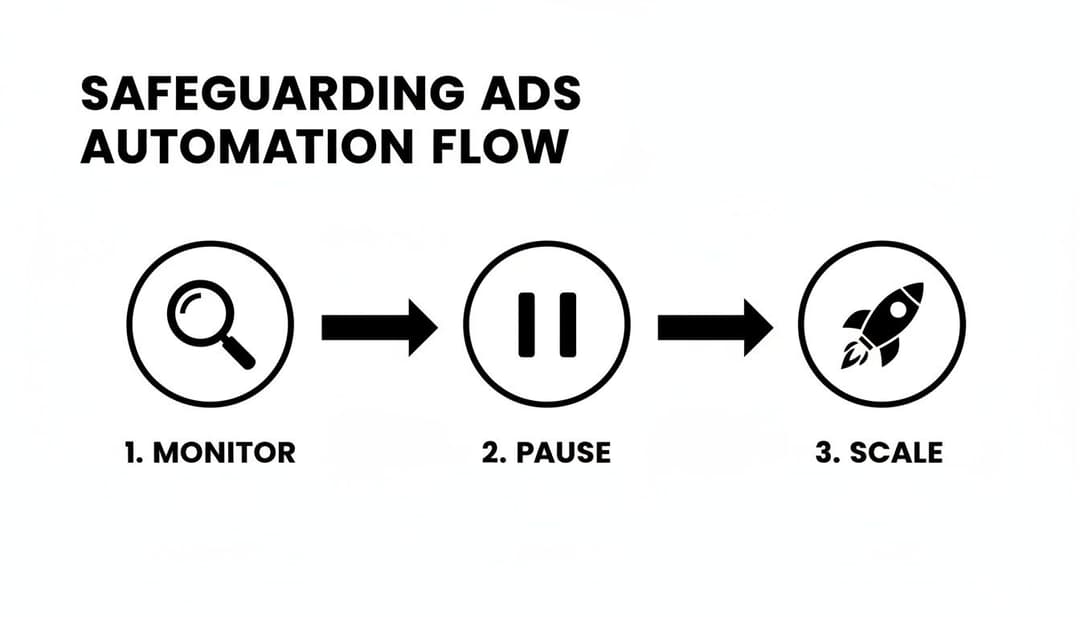
Think of it as a loop: constantly monitor performance, automatically pause the underperformers to protect your budget, and methodically scale the winners. It's that simple, yet incredibly effective.
The ultimate takeaway is that scaling should be a systematic process, never a shot in the dark. Armed with data, smart automation, and a structured approach, you can build a reliable customer acquisition machine.
Got Questions About Scaling? We've Got Answers.
As you start pushing bigger budgets through your Meta campaigns, a whole new set of questions inevitably pops up. It's totally normal. Here are some quick, no-nonsense answers to the most common hurdles I see advertisers hit when they begin to scale.
How Fast Can I Really Increase My Ad Budget?
Look, I know it's tempting to floor it when an ad set is crushing it, but patience is your best friend here. The gold standard is the 20% rule.
Stick to increasing the budget on a hot ad set by no more than 20% every 48 to 72 hours. Any sudden, massive jump can spook the algorithm, potentially kicking you right back into the learning phase and making performance go haywire. Think of it as gently adding fuel, not dumping a whole can on the fire.
If you're running Campaign Budget Optimization (CBO), you can sometimes get away with being a little more aggressive. The algorithm is already doing the heavy lifting of distributing spend, so it's a bit more resilient. Still, slow and steady almost always wins the race.
Help! My ROAS Tanked After I Started Scaling. What Now?
First thing's first: don't panic. A temporary dip in Return on Ad Spend (ROAS) is often part of the process as Meta figures out how to spend your new, larger budget efficiently. Give it a solid 48-72 hours to see if the numbers level out on their own.
If things don't bounce back, it's time to play detective. Pop the hood and check a few things:
- Is Ad Frequency Skyrocketing? If people are seeing your ad too many times, you're likely saturating your audience.
- Where's the Money Going? Dig into your placements. Is a single placement, like Audience Network, suddenly gobbling up your budget for little to no return?
- What Did I Change? Be honest. Did you get greedy and bump the budget too fast? Did you throw a brand new, unproven audience into the mix?
If you spot the problem, just undo that last change. This is exactly why having a rollback plan is non-negotiable—it lets you get back to what was working without having to guess.
CBO vs. ABO: Which Is Better for Scaling?
This is a classic debate, but the answer really depends on your goal and how much you trust the machine.
For pure scaling, Campaign Budget Optimization (CBO) is almost always the way to go. You're essentially handing the keys to Meta's algorithm and letting it find the cheapest conversions by shifting your budget to the best-performing ad sets in real-time. It’s built for efficiency at scale.
So, when do you use Ad Set Budget Optimization (ABO)? ABO is your go-to for the testing phase. It's perfect when you need to force a specific amount of spend to a new creative or a new audience just to see if it has legs, even if its initial performance isn't stellar. You use ABO to gather data, then switch to CBO to scale the winners.
Ready to stop the guesswork and scale your Meta ads with confidence? AdStellar AI is the AI-powered platform that automates ad creation, testing, and optimization, helping you launch and scale campaigns 10x faster. Let our AI identify your winning creatives and audiences so you can double down on what works. Unlock profitable growth today.