Facebook ad optimization isn't a one-and-done task; it's the ongoing process of systematically making your campaigns better to squeeze every drop of value from your budget. It’s a constant loop of auditing performance, testing variables like creative and audiences, and then making smart, data-backed adjustments to boost your return on ad spend (ROAS).
Building Your Foundation for Ad Optimization
Before you can even think about scaling or testing flashy new tactics, you need to make sure your foundation is rock-solid. Real, effective Facebook ad optimization doesn’t start with a bang—launching a bunch of new campaigns. It starts quietly, with a strategic deep-dive into your existing Meta ad account.
The goal is simple: figure out what’s working, what’s a complete dud, and where your money is quietly leaking away. This audit creates a stable launchpad for everything that comes next.
Think of it like building a house. You wouldn’t start framing walls or picking out paint colors on a cracked, uneven foundation. The account audit is your chance to pour the concrete and make sure everything is level before you invest another dollar.
Analyze Historical Campaign Performance
Your ad account’s history is a goldmine. Seriously. The first thing to do is roll up your sleeves and dig into past campaigns to find the patterns and hidden gems. Don’t just glance at the top-level ROAS and call it a day. Go deeper.
Look for trends in your core metrics:
- Cost Per Acquisition (CPA): Which campaigns, ad sets, or even individual ads consistently brought in conversions under your target CPA?
- Click-Through Rate (CTR): What creative styles, hooks, or copy angles got the most clicks? A high CTR is a great signal that your ad is resonating with your audience.
- Conversion Rate (CVR): Of all the people who clicked, which ads or landing pages actually convinced them to become customers?
- Audience Fatigue: Are you seeing performance tank for ad sets that have been running for a while? That’s a classic sign your audience is tired of seeing the same old ads.
By isolating your greatest hits—that top 10% of ads that likely drove 80% of your results—you’re basically creating a blueprint for what works. These winners tell you exactly what your audience wants, giving you a clear starting point for new creative ideas and targeting hypotheses.
Verify Your Technical Health
A killer ad campaign can be completely torpedoed by bad data tracking. If your data is flawed, your optimization decisions will be, too—and so will Meta's. That’s why checking the health of your Meta Pixel and Conversions API (CAPI) is non-negotiable.
This three-step process is a great framework for a thorough audit, moving you from analysis to technical checks to goal-setting.
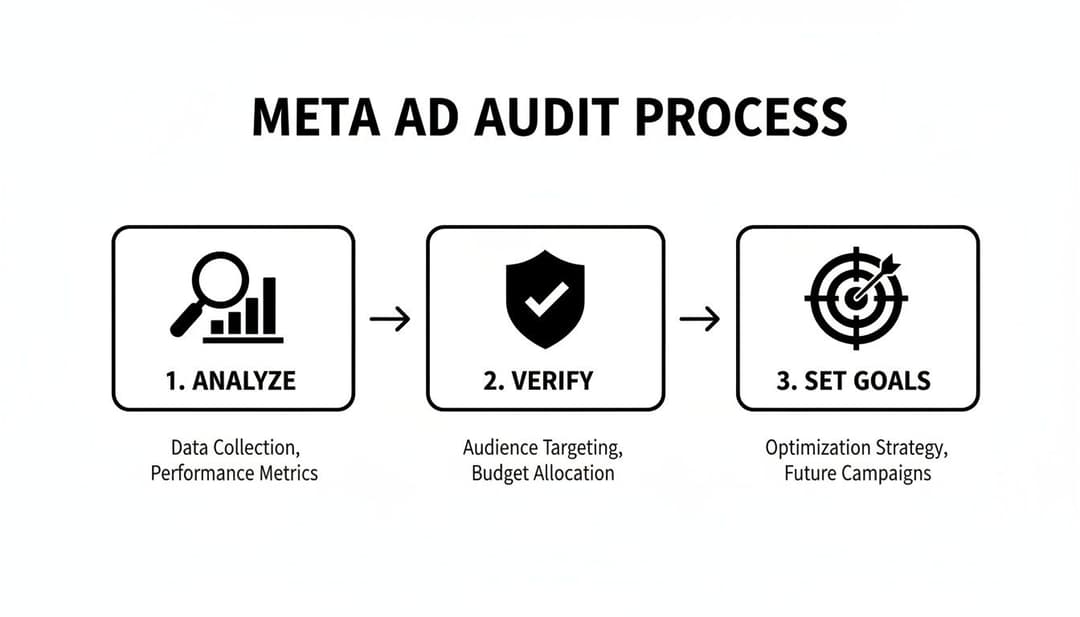
This methodical approach makes sure your account is technically sound and strategically ready before you ramp up the spend. Head over to Meta's Events Manager and check your Event Match Quality score. You want to see a high score, ideally 8.0 or above. This tells you Meta can accurately connect conversions back to your ads, which is what the algorithm needs to find more people like your best customers. Our detailed guide on how to use the Meta Events Manager can walk you through this.
Key Takeaway: If your tracking is broken, you're flying blind. A low Event Match Quality score starves Meta’s algorithm of the data it needs to optimize effectively, leading to higher CPAs and wasted budget. Fixing this is one of the highest-leverage actions you can take.
Pre-Optimization Audit Checklist
Before you move on to launching new tests, run through this checklist. It organizes the key areas of your audit into a simple, actionable format to ensure you've covered all your bases.
| Audit Area | Key Checkpoints | Success Metric |
|---|---|---|
| Performance History | Identify top 5-10% of ads by ROAS/CPA. Analyze common themes in creative, copy, and offers. | A clear "swipe file" of winning ad components and a list of underperformers to avoid repeating. |
| Tracking & Attribution | Check Meta Pixel health in Events Manager. Verify Conversions API setup and Event Match Quality score. | Event Match Quality score of 8.0+. No major diagnostic errors for key conversion events. |
| Audience Strategy | Review performance of saved audiences, custom audiences, and lookalikes. Check for audience overlap. | Identify consistently high-performing audience segments. Pinpoint audiences suffering from fatigue (high frequency). |
| Campaign Structure | Assess account simplification (e.g., are you using CBO effectively?). Check for logical naming conventions. | A clean, understandable campaign structure that aligns with business goals and is easy to analyze. |
| Budget & Bidding | Analyze budget allocation vs. performance. Review bid strategy effectiveness (e.g., Highest Volume vs. Cost Cap). | Confirmation that budget is flowing to top-performing campaigns and ad sets. |
This audit is where the real work begins. By cleaning up your account and setting clear, measurable goals beyond just ROAS—like hitting a specific CPA or lead volume—you build a resilient foundation for growth.
Developing Creative and Copy That Converts
Once your technical foundation is solid, it's time to focus on the biggest lever you can pull for better performance: your creative and copy. Let’s be honest, you can have the most dialed-in audience, a perfect bidding strategy, and an unlimited budget, but none of it matters if your ad doesn't stop the scroll and make someone feel something. This is where the real wins are found.
Success here isn't about getting lucky or stumbling upon a winning ad. It’s about building a systematic, hypothesis-driven testing machine. Forget throwing spaghetti at the wall. We’re talking about intentionally testing specific ideas to figure out what truly resonates with your audience.
The Psychology of a Winning Ad
Every ad that absolutely crushes it starts with one thing: a deep, almost obsessive understanding of the customer. What keeps them up at night? What are their deepest desires? What’s holding them back from buying? Your creative and copy need to tap directly into those emotional triggers.
Most great ads follow a simple but incredibly powerful formula:
- The Hook: The first three seconds are everything. Whether it’s a video or an image, it has to be a thumb-stopper. Your only job is to create enough curiosity to earn a few more seconds of their attention.
- The Problem/Angle: Right away, the copy needs to hit a nerve. Agitate a pain point they know all too well or frame the problem in a surprising new way.
- The Solution: This is your moment. Clearly and simply, present your product as the answer to the problem you just twisted the knife on.
- The Call-to-Action (CTA): Tell them exactly what to do next. Don't be shy. Use a clear, low-friction command like "Shop Now," "Learn More," or "Get Your Free Trial."
Think about it. A DTC brand selling ergonomic office chairs shouldn't just show a static photo of the chair. A much better hook is a quick video clip of someone wincing from back pain at their desk, immediately followed by a shot of them leaning back, relaxed and comfortable, in the new chair. That’s not an ad; it's a relatable story told in three seconds.
Building Your Creative Testing Hypothesis
Random testing is just a way to burn money. Instead, every single creative you launch should be tied to a clear hypothesis—a simple statement you want to prove or disprove. This structure is what turns your ad spend into an investment in market intelligence.
Here’s what that looks like in practice:
- Hypothesis: "We believe that raw, user-generated content (UGC) style videos featuring real customers will outperform our polished, studio-shot videos because they feel more authentic and build more trust."
- Test: Simple. Run an A/B test. Target the exact same audience, but put the UGC videos in one ad set and the studio videos in another.
- Metric: Measure which ad set delivers a lower Cost Per Acquisition (CPA) once you have enough data to call a winner.
This approach flips the script from being reactive to proactive. You’re not just finding winning ads; you’re understanding the psychology behind why they win. That knowledge informs every creative decision you make from that point on. For a deeper look at writing compelling text, check out our guide on what to include in ad copy.
Diagnosing and Combating Creative Fatigue
No matter how great an ad is, it has a shelf life. Creative fatigue is real, and it’s inevitable. It’s that moment when your audience has seen your ad so many times they just tune it out. You'll see your CTR drop and your CPA start to creep up.
The first step is to keep an eye on your ad frequency. If you see it climb above 3-4 in a cold prospecting campaign without a corresponding lift in conversions, the fatigue is setting in. It's time for a refresh.
Pro Tip: Don't wait for your campaign to crash and burn. Be proactive. I recommend swapping in new creative assets every 2-4 weeks, even if a campaign is performing well. This keeps your ads fresh, your audience engaged, and prevents those sudden, sharp performance drops from severe ad fatigue.
To stay ahead of the curve, you need a steady stream of new visuals. Tools like AI Reel generators are fantastic for this. They can help you quickly create a batch of engaging short-form videos to test, letting you fight fatigue without a massive production budget.
By building a structured, hypothesis-driven creative process, you transform your ad account from a money pit into a learning machine. You stop guessing and start building a repeatable system for generating ads that not only grab attention but drive real, measurable results for your business. That, right there, is the core of modern Facebook advertising.
Mastering Advanced Audience and Targeting Strategies
If you're still relying on broad, interest-based audiences, you're probably burning through your ad budget with very little to show for it. True facebook ad optimization is all about sophisticated targeting and segmentation—it’s about finding your ideal customers with surgical precision, not casting a wide net and hoping for the best.
This is where we move beyond guesswork. The foundation of any killer audience strategy is your own first-party data. Your existing customers, email subscribers, and website visitors are goldmines. Meta's algorithm is brilliant, but it needs good data to learn from. Your customer list is the perfect fuel to help it find more people just like your best buyers.
It’s time to stop focusing on generic interests and start targeting based on actions that signal real intent.
Crafting High-Intent Lookalike Audiences
Lookalike Audiences are one of Meta's most powerful tools, but their effectiveness is directly tied to the quality of your source audience. A Lookalike built from a list of all your customers is decent. But a Lookalike built from your absolute best customers? That’s a total game-changer.
This is where you can get a serious competitive edge. Instead of just uploading your entire customer database, get granular and segment it first. Build your seed list from high-value signals:
- Top 5% by Lifetime Value (LTV): These are your VIPs—the ones who buy again and again.
- Recent Purchasers (Last 30-60 Days): This group is a snapshot of who your ideal customer is right now.
- High Average Order Value (AOV): Isolate the customers who consistently spend more per purchase.
When you create a 1% Lookalike Audience from your top LTV customers, you’re basically telling Meta, "Go find me more people who behave exactly like my most profitable buyers." This one tactic is often one of the quickest ways to scale campaigns profitably. For a deeper dive, our complete guide to Facebook Lookalike Audiences is a great resource.
Building Advanced Retargeting Funnels
Let's be real: not all website visitors are created equal. Someone who bounces from your homepage after two seconds is worlds away from someone who added a product to their cart. A smart retargeting strategy segments these users based on their actions and serves them hyper-relevant ads that nudge them toward the finish line.
You need to build a tiered funnel. For instance, you could structure your ad sets like this:
- Low Intent: Users who only visited a blog post or spent minimal time on your site. Don't hit them with a hard sell. Instead, show them top-of-funnel content or social proof to build some brand love.
- Medium Intent: Visitors who checked out a specific product or category page. This is your chance to retarget them with ads showing off that exact product's benefits or maybe a carousel of similar items.
- High Intent: People who initiated checkout or abandoned their cart. This is your hottest audience. Hit them with a compelling offer they can't refuse, like free shipping or a small discount, to seal the deal.
Key Insight: The golden rule of retargeting is to avoid audience overlap. Always use the "Exclude" function. For example, your "Add to Cart" audience should always exclude anyone who has already purchased. This stops you from annoying new customers and wasting money advertising to people who have already converted.
Advantage Plus Versus Detailed Targeting
With Meta’s AI getting smarter every day, a big question is when to use Advantage+ Audiences versus rolling up your sleeves with manual detailed targeting. Advantage+ basically hands the keys to the algorithm, letting it use your Pixel data to find customers, often looking beyond your initial inputs if it spots an opportunity.
Detailed targeting, on the other hand, gives you that granular control over demographics, interests, and behaviors. Knowing when to deploy each is key for effective facebook ad optimization.
As a rule of thumb, let Advantage+ run your broader top-of-funnel campaigns where the goal is just efficient customer acquisition at scale. For niche products or super-specific retargeting segments, manual targeting often gives you the precision you need. The goal is always to beat the benchmarks. Recent data shows an average Facebook ad click-through rate of 1.44%, but top-tier advertisers are often hitting over 2.5% with meticulously tuned campaigns. You can discover more insights about Facebook ad stats to see where you stack up.
Fine-Tuning Your Bids, Budgets, and Campaign Structure

If your ad creative is the engine, then your bidding and budget strategy is the steering wheel. You can have the most powerful, scroll-stopping ad in the world, but without smart management of your spend, it's just not going to deliver profitable results. Truly effective facebook ad optimization comes down to a disciplined approach to how you allocate your money, what you tell Meta to aim for, and how you organize your campaigns for clarity and scale.
This is about much more than just punching in a daily budget and hoping for the best. It's about getting to grips with the powerful levers Meta gives you to control costs and squeeze every last drop of value out of your ad spend. It’s about making every dollar work for you.
Choosing the Right Bid Strategy
Meta gives us a few different bidding strategies, and honestly, picking the right one is completely dependent on your campaign's goal. It’s one of the easiest things to get wrong and one of the quickest ways to torpedo your performance.
So what are your main options?
- Highest Volume (Lowest Cost): This is Meta’s default setting for a reason. You’re essentially telling the algorithm, "Get me the most results you can for this budget." It’s perfect for brand new campaigns where you need to gather data fast or when your main goal is just raw volume over strict cost control.
- Cost Per Result Goal (Cost Cap): This is where you get more specific. You set an average cost you’re willing to pay for each conversion. Meta’s job is then to hit that average—some conversions might cost more, some less, but it’ll aim for your target. This is the strategy you want when you know your target Cost Per Acquisition (CPA) and need to maintain stable, predictable costs.
- ROAS Goal: Built for e-commerce, this one is all about profitability. You tell Meta the minimum Return On Ad Spend you need to hit. To make this work, you need a healthy amount of purchase data flowing through your pixel. It's the go-to for campaigns where profit is the one and only metric that matters.
Don't be afraid to experiment. I've seen accounts switch from Highest Volume to a Cost Per Result Goal and unlock 30% more conversions almost overnight, simply by bringing more stability and predictability to their ad delivery.
When you're weighing your options, a simple decision framework can help you match the strategy to your campaign's objective.
Bidding Strategy Decision Framework
| Bidding Strategy | Best For | Key Consideration |
|---|---|---|
| Highest Volume | New campaigns, maximizing reach, or when you need to gather data quickly. | You're giving Meta full control over the cost per result to maximize volume. |
| Cost Per Result Goal | Campaigns where you have a specific target CPA you need to maintain for profitability. | Requires you to know your numbers. Set the cap too low, and you may not spend your full budget. |
| ROAS Goal | E-commerce campaigns focused purely on achieving a specific return on ad spend. | Needs consistent conversion data to work effectively. Not ideal for lead gen. |
Ultimately, your choice here dictates how Meta's algorithm approaches the auction, so make sure it aligns perfectly with what you're trying to achieve.
Campaign Budget Optimization vs. Ad Set Budgets
One of the first structural decisions you have to make is where you set the budget: at the campaign level or at the ad set level. This choice fundamentally changes how Meta’s algorithm spends your money.
Ad Set Budget Optimization (ABO): This is the manual approach. You set a specific, dedicated budget for each individual ad set. This gives you total control, which is exactly what you need when you're testing new audiences or creatives. It guarantees each variable gets enough spend for you to gather clean, reliable data.
Campaign Budget Optimization (CBO): With CBO, you set one single budget for the entire campaign. Meta’s AI then takes over, automatically distributing that budget to the best-performing ad sets in real time. CBO is built for one thing: scaling. Once you’ve used ABO to find your winning audiences and creatives, you consolidate them into a CBO campaign and let the algorithm do the heavy lifting.
A Practical Framework: Think of it this way: use ABO for testing, CBO for scaling. Start new campaigns with Ad Set Budgets to isolate your variables and find the winners. Once you have ad sets that are proven performers, move them into a CBO campaign to maximize efficiency and let Meta’s algorithm take over.
If you want to go deeper on this, our guide on how to optimize ad budget allocation breaks down exactly how to structure your spend for maximum impact.
How to Scale Budgets Without Resetting the Learning Phase
You’ve struck gold. A campaign is crushing it, and it’s time to pour some fuel on the fire. The single biggest mistake I see advertisers make here is getting too aggressive with the budget. A huge, sudden increase can shock the system, throwing your ad set right back into the dreaded "learning phase" and completely wrecking your performance.
Smart scaling is all about patience and making incremental changes.
- Go Slow and Steady: The golden rule is to increase your budget by no more than 20-30% every 2-3 days. This slow-and-steady approach gives the algorithm time to adjust without sounding the alarms and triggering a reset.
- Duplicate for Big Jumps: If you need to scale faster, don't touch the original. Duplicate the winning ad set and set the new, higher budget on the copy. This leaves your proven performer untouched while letting the new ad set enter the learning phase on its own.
- Watch Your Metrics Like a Hawk: As you scale, keep a close eye on your CPA and frequency. If your CPA starts to creep up or your frequency gets too high, it's a clear signal that you're starting to saturate your audience. That's your cue to start thinking about expanding your targeting.
Mastering these budget and bidding fundamentals is what separates the pros from the amateurs. It creates a stable, predictable system for growth that allows you to test methodically, scale confidently, and ensure your ad spend is always working as hard as possible to hit your goals.
Using AI Automation for Faster Scaling
So, you’ve found a few winning ads. Your creative, copy, and audiences are clicking, and the results are looking good. Now comes the hard part: how do you scale that success without getting completely buried in the tedious, manual work of campaign management?
The honest answer is that you can't, not if you're stuck in the old click-by-click routine of Ads Manager. Trying to scale manually isn't just slow; it’s the bottleneck that chokes your growth. This is where AI-driven platforms come in. They’re not just another tool; they're changing how smart marketers test, learn, and scale.
This isn't about replacing you. It's about giving you superpowers.
From a Full Day's Work to Just a Few Minutes
Let's get practical. Say you've nailed down three killer video ads, four headlines that are getting clicks, and five promising audiences. If you wanted to test every possible combination, you’d be building 60 unique ads (3 x 4 x 5).
Doing that by hand in Ads Manager? That’s an entire day gone, filled with duplicating, tweaking, and checking for errors. It’s mind-numbing work.
AI automation tools completely sidestep this mess. You can:
- Upload all your videos and images in one go.
- Paste in all your different headlines and body copy.
- Select every audience you want to test against.
Then, the platform does the heavy lifting, building out every single ad variation and pushing them live in a matter of minutes. This isn't just about saving time—it’s a massive strategic edge that lets you test at a velocity that’s physically impossible to do manually.
Trading Guesswork for Data-Backed Decisions
The real magic isn't just about building ads faster. It's about understanding what works and why. Modern AI tools plug directly into your ad account, pulling in historical data to see what’s already resonated with your customers.
As new campaigns run, the AI is constantly crunching the numbers in real-time. It’ll show you exactly which creative elements are driving performance. You’ll see the specific video hook that’s delivering the lowest CPA or the one headline that’s crushing CTR across all your audiences. And if you want to streamline the creative part of this process even further, a good AI Facebook ad generator can be a huge help.
The Big Shift: AI doesn't just tell you which ad is winning. It breaks it down to show you why it's winning. You learn which specific image, hook, or call-to-action is the hero, giving you a clear playbook for your next creative sprint.
Your ad account becomes a perpetual learning machine. Instead of getting lost in spreadsheets, you get clear, actionable insights handed to you.
How to Actually Operationalize Your Scaling
With AI, you can finally build a repeatable, systematic process for growth. It’s no longer about one person's heroic manual effort; it's about creating a true operational framework for continuous improvement.
For example, platforms like AdStellar have features that use AI optimization to not only spot your winning assets but to automatically build new campaigns from those proven components.
This creates a powerful, self-improving loop:
- Launch Wide: Use an AI tool to instantly create and launch dozens or hundreds of tests across your best creative and audiences.
- Learn Fast: Let the AI analyze the data and flag the top-performing creative elements and audience segments for you.
- Iterate Smarter: Use those data-backed insights to guide your next round of creative development.
- Scale with Confidence: Relaunch new campaigns automatically built from your proven winning ingredients.
This approach strips the guesswork and emotion out of campaign management. Every dollar you spend isn't just buying a sale; it's buying data that makes your next dollar work even harder. By truly integrating these tools, you build a resilient system that lets you test, learn, and scale faster than ever before.
Your Top Facebook Ad Optimization Questions, Answered
Jumping into Meta advertising can feel like you're trying to hit a moving target, especially with algorithms and features always in flux. To help you put the strategies in this guide to work with confidence, I've pulled together answers to the questions I hear most from performance marketers about Facebook ad optimization. Let's clear things up.
How Often Should I Optimize My Facebook Ads?
This is the big one, and the answer is all about balancing patience with being proactive. The minute you launch a new campaign, it kicks off a "learning phase." For the next 3 to 7 days, Meta's algorithm is just figuring things out—who to show your ads to and how to get you the best results.
If you jump in and start making big changes during this window, you’ll just reset the process and shoot yourself in the foot. You have to let the algorithm get its bearings. Once you're out of the learning phase, a solid rhythm for optimization is every 7-14 days. This gives you enough real data to make smart calls without overreacting to the daily ups and downs.
Why Is My Ad Frequency So High?
Seeing a high ad frequency means you're showing the same ad to the same people over and over again. While a little repetition is great for retargeting, if your frequency creeps above 3-4 in a prospecting campaign, you're likely dealing with audience fatigue. It usually happens when your audience is too small for your budget or an ad has just run its course.
When you notice frequency climbing and your Cost Per Acquisition (CPA) is going up right along with it, that's your cue to act.
- Swap in new creative. Give people something new to look at.
- Widen your audience targeting. It's time to find new pockets of potential customers.
- Exclude recent buyers. Stop spending money on people who've already converted.
What Is a Good CTR for Facebook Ads?
Your Click-Through Rate (CTR) is a huge health indicator. It tells you flat-out if your ad is actually interesting to the people you're targeting. What's "good" can swing wildly from one industry to another, but there are some solid benchmarks. Across the board, the average CTR hovers around 1.44%.
That said, the best advertisers consistently hit a CTR of 2.5% or higher by nailing their targeting and creative. If you're stuck below 1%, it's a massive red flag. Either your creative is missing the mark or your audience is just plain wrong. Your first move should be testing new images, videos, headlines, and hooks to get that number up.
Key Takeaway: A low CTR is almost always the culprit behind a high CPA. The fastest way to bring down your acquisition costs is to make your ads more relevant and appealing.
Should I Use Automatic Placements?
For almost every campaign, the answer is a hard yes. Using Advantage+ Placements (what we used to call Automatic Placements) lets Meta's algorithm do what it does best. It will show your ads across Facebook, Instagram, Messenger, and the Audience Network—wherever it can get you the results you want for the lowest cost.
Giving the algorithm that freedom almost always pays off with better performance than trying to hand-pick placements yourself. The system is just incredibly good at finding cheap inventory in spots you'd probably ignore. The only real exception is if you have hard data showing a specific placement is a total money pit, or if your creative is built for a single format, like an Instagram Story. Otherwise, trust the machine.
Ready to stop the manual grind and scale your Meta ads faster? At AdStellar AI, we've built the platform that automates bulk ad creation, surfaces AI-driven insights, and turns your winning assets into repeatable campaigns. Stop guessing and start growing. Learn how AdStellar can transform your workflow.