Data-driven marketing isn't some complex, futuristic concept. At its core, it's about making decisions based on what you know about your customers, not just what you think you know. It's the simple, powerful idea of swapping out guesswork and gut feelings for cold, hard evidence to build campaigns that are more personal, effective, and—most importantly—profitable.
Moving Beyond Guesswork: What Is Data-Driven Marketing

We’ve all been there. You have a great hunch about a new ad creative or a specific audience you just know will convert. You pour a good chunk of your budget into the campaign, cross your fingers, and… get lackluster results. It’s a classic marketing story, and it highlights the fundamental flaw of old-school, intuition-based strategies: they’re unpredictable and almost impossible to scale reliably.
So, what is data-driven marketing? It's the antidote to that uncertainty.
Instead of relying on those gut feelings, this approach insists that you use real customer information to steer the ship. Every click, every purchase, every interaction on your site is a breadcrumb that tells a story about what your customers actually want. When you start listening to that story, you can make smarter, more strategic choices at every single stage of the funnel.
This shift lets you deliver campaigns that truly connect with people on an individual level. You stop casting a wide, generic net and start making precise, informed moves that lead to much better outcomes.
The Old Way vs. The New Way
The contrast between marketing by intuition and marketing by data couldn't be more stark. One is built on broad assumptions, while the other is fueled by specific, measurable actions. Ditching the guesswork means adopting a data-driven approach to conversion rate optimization to truly understand and improve every step of the customer journey. For any modern growth team trying to get the most out of their budget, this isn't just a good idea—it's essential.
To really nail down this difference, let's put the two approaches head-to-head.
Intuition-Based Marketing vs Data Driven Marketing
This table clearly shows the shift from a more reactive, assumption-led process to a proactive, evidence-based one.
| Aspect | Intuition-Based Marketing | Data Driven Marketing |
|---|---|---|
| Decision-Making | Based on gut feelings, assumptions, and past experiences. | Based on customer data, analytics, and A/B testing results. |
| Personalization | One-size-fits-all messaging sent to broad audience segments. | Highly personalized content tailored to individual behaviors and preferences. |
| Measurement | Relies on vanity metrics like likes or general brand awareness. | Focuses on performance metrics like ROAS, CPA, and Customer Lifetime Value (CLV). |
| Optimization | Campaigns are adjusted infrequently, often after they have ended. | Campaigns are continuously optimized in real-time based on performance data. |
| Outcomes | Inconsistent results, wasted ad spend, and missed opportunities. | Predictable growth, higher ROI, and improved customer loyalty. |
By embracing a data-first mindset, you’re not just boosting campaign performance; you’re building a much deeper, more nuanced understanding of who your customers are and what they care about. Properly analyzing your results is a huge part of this. To go deeper, you can explore our detailed guide on marketing campaign analytics.
Ultimately, this foundational knowledge is what allows you to build a marketing engine that is efficient, scalable, and genuinely customer-centric.
The Three Pillars of Your Data-Driven Strategy
Just having access to data isn’t enough to win. A truly effective data-driven marketing operation is like a high-performance race car, built on three essential parts working in perfect harmony.
Think of it this way: your data is the high-octane fuel. Your analytics are the powerful engine that turns that fuel into raw power. And your activation strategy is the skilled driver who steers that power toward the finish line.
If one of these is missing, you’re just spinning your wheels. Let's break down each of these foundational pillars.
Pillar 1: Data Collection and Integration
First, you need to get the right fuel in the tank. This means gathering valuable information from every customer touchpoint and—this is the crucial part—bringing it all together in one place. Disconnected data locked away in separate silos is one of the biggest roadblocks to success.
Your data sources are hiding in plain sight, everywhere your customers interact with your brand:
- Customer Relationship Management (CRM) Systems: This is a goldmine of information on purchase history, customer service tickets, and lead status.
- Website and App Analytics: Tools like Google Analytics show you who’s visiting your site, what they’re clicking on, and where they’re dropping off.
- Social Media Platforms: Engagement metrics, audience demographics, and ad performance data give you direct feedback on what resonates with your audience.
- Email Marketing Platforms: Open rates, click-through rates, and conversions from email campaigns tell you exactly how effective your content is.
The real magic, though, is integration. All this information needs to flow into a central hub, like a Customer Data Platform (CDP), to create a single, unified view of each customer. This complete profile is the foundation for everything else you do.
A unified customer view eliminates blind spots. It lets you see the entire customer journey, from the first ad they saw to their most recent purchase, enabling truly informed marketing decisions.
Pillar 2: Analytics and Insights
With your fuel tank full and integrated, it’s time to fire up the engine. This is the analytics pillar, where raw, unprocessed data gets turned into actionable intelligence. Collecting data is passive; analyzing it is where you find the "why" behind what your customers are doing.
This process involves using various tools and techniques to spot trends, identify patterns, and answer your most pressing business questions. You might analyze which ad creatives are driving the highest return on ad spend (ROAS), or pinpoint the specific customer segments with the highest lifetime value (CLV).
The goal here is to move from data points to data stories. An insight isn't just knowing that 25% of customers abandoned their carts. It’s discovering that most of them bailed after seeing the shipping costs, which tells you exactly what problem you need to solve.
Pillar 3: Activation and Optimization
Finally, you need a driver to take the wheel. The activation and optimization pillar is where you put your insights into action to execute, measure, and refine your marketing campaigns. This is the hands-on part of the job.
Activation means using what you've learned to deliver highly targeted and personalized experiences. For example:
- Targeting Lapsed Customers: If your analytics flags a segment of high-value customers who haven't bought anything in 90 days, you can activate a specific re-engagement campaign with a personalized offer just for them.
- Personalizing Ad Creative: If you discover a certain demographic responds best to video ads with user-generated content, you can activate campaigns that serve that exact creative to that audience.
Optimization is the continuous feedback loop. As you launch these targeted campaigns, you collect new performance data, which flows right back into your analytics engine. This allows you to constantly learn and improve, making smarter decisions with each iteration. For a comprehensive look at building a winning approach, explore this detailed guide on data driven marketing strategy. This cycle of testing and refining is what separates the good marketers from the great ones.
Focusing on Metrics That Truly Matter for Growth
In the world of data-driven marketing, it’s easy to get lost in a sea of numbers. But not all metrics are created equal. It's tempting to chase flashy figures like social media likes or impressions—often called "vanity metrics"—because they look good on a report. The problem is, they do very little to prove marketing's real impact on the bottom line.
True growth isn’t about looking busy; it’s about results. That means zeroing in on performance metrics that tell a clear story about revenue, efficiency, and customer value.
Think of it like flying a plane. The number of clouds you pass (impressions) is nice, but what really matters are your altitude, fuel level, and speed. Those are the data points that tell you if you're actually going to reach your destination. For marketers, this means tying every metric back to core business goals.
The diagram below shows how a solid data strategy works. It’s a loop: you collect the right data, which fuels your strategy, which in turn drives the actions that create more data to collect.
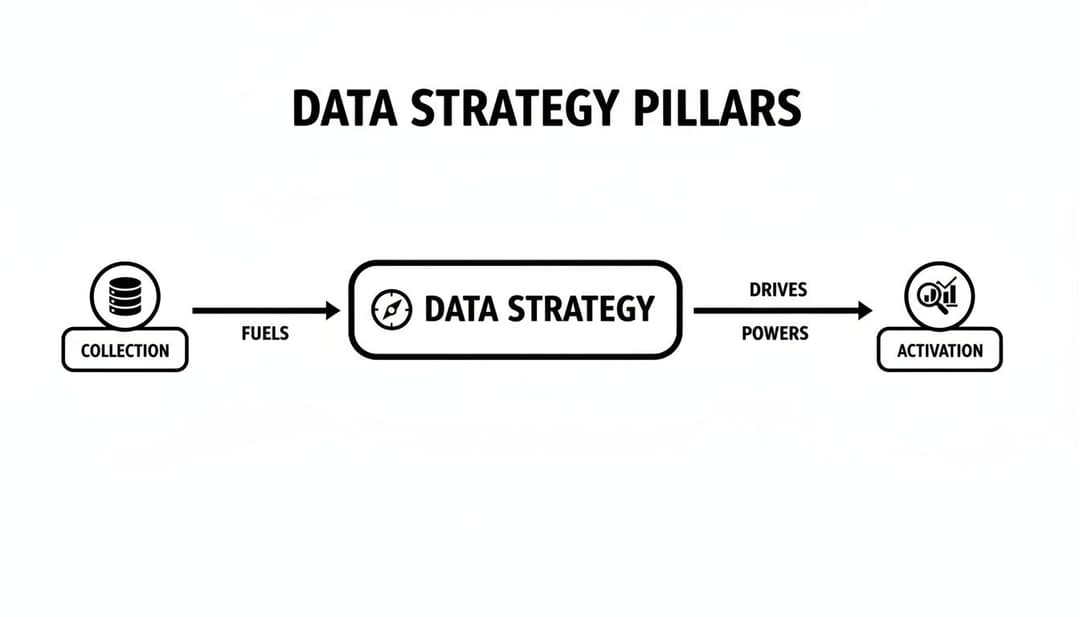
This continuous flow ensures you're always collecting, analyzing, and acting on the information that actually moves the needle.
Key Metrics for Acquisition
Acquisition metrics are all about how effectively you bring in new, paying customers. These are your frontline indicators, telling you if your campaigns and budget are working. Without a firm handle on these numbers, trying to scale your marketing is just a high-stakes guessing game.
- Customer Acquisition Cost (CAC): This is your total cost to land one new customer. A low CAC is great, but it’s meaningless unless you weigh it against the lifetime value of that customer.
- Return on Ad Spend (ROAS): This shows you the gross revenue you get back for every dollar you put into advertising. A high ROAS is the ultimate sign that your campaigns aren't just running—they're profitable.
A healthy ROAS is definitive proof that your creative, targeting, and messaging are hitting the mark. It shifts the conversation from "How much did we spend?" to "How much did we earn?"
Measuring Meaningful Engagement
Once you’ve got a customer, the game shifts to keeping them interested. Engagement metrics help you figure out if you're building a real relationship or just processing a one-time transaction. Strong engagement is a powerful leading indicator of future loyalty and profit.
Key engagement metrics include:
- Conversion Rate: The percentage of people who take a specific action you want, like making a purchase or signing up. It’s a direct measure of how persuasive your marketing really is.
- Customer Lifetime Value (CLV): This is a forecast of the total revenue you can expect from a single customer over their entire relationship with you. CLV is what justifies spending more to acquire high-value customers who will stick around. To go deeper, check out our guide on the most important performance marketing metrics.
Retention: The Engine of Sustainable Growth
Finally, retention metrics show how good you are at keeping the customers you worked so hard to get. High retention is one of the most powerful drivers of long-term growth because keeping a customer is almost always cheaper than finding a new one.
A critical metric here is the Churn Rate—the percentage of customers who leave over a certain period. A high churn rate can silently sink a business, making it a number you have to watch like a hawk.
By tracking these specific metrics, you build a dashboard that gives you clear signals on what to scale, what to fix, and what to cut.
Building Your Data-Driven Marketing Roadmap
Knowing you need data is one thing; actually putting it to work is a whole different ballgame. Moving from gut-feel decisions to an evidence-backed strategy takes more than just buying a few new tools—it requires a clear plan. Think of a data-driven marketing roadmap as your blueprint for turning raw information into predictable growth, making sure every move is intentional and every result is measurable.
This roadmap isn't about flipping a switch and changing everything overnight. It's a structured, four-stage process designed to build momentum. By breaking it down into these steps, you create a clear path for your team, making the transition feel manageable, even if you're just getting started.
Stage 1: Define Clear Business Objectives
Before you dive into a single spreadsheet, you have to know what you’re trying to accomplish. Without a clear goal, data is just noise. Your objectives need to be specific, measurable, and tied directly to real business outcomes—not just fuzzy marketing wishes.
So, instead of saying, "We want more leads," a much stronger objective is, "We need to increase qualified MQLs by 20% in Q3 to hit our sales pipeline targets." That kind of clarity tells you exactly what data you need to collect and analyze.
These goals become your north star. They keep your data efforts focused and prevent you from getting sidetracked by interesting but ultimately useless metrics, keeping everyone aligned on what truly moves the needle.
Stage 2: Unify Your Data Sources
Once your objectives are set, it’s time to gather the fuel for your engine. Customer data is almost always scattered across a dozen disconnected systems—your CRM, Google Analytics, email platform, and various ad accounts. This fragmentation creates massive blind spots, making it impossible to see the complete customer journey.
Your main job here is data unification. The goal is to funnel all that information from its separate silos into one central place. This is how you build a unified customer profile and get a 360-degree view of every single interaction someone has with your brand.
Common data sources you'll want to pull together include:
- Website Analytics: To track user behavior, from the first landing page visit to the final checkout step.
- CRM Data: To consolidate purchase history, customer support tickets, and sales conversations.
- Ad Platform APIs: To pull performance data on clicks, conversions, and costs directly from platforms like Meta.
Bringing this data together is the foundational step. Everything else in your strategy depends on it.
Stage 3: Choose Your Technology Stack
Now that you know your goals and have a plan for your data, it's time to pick the right tools for the job. Your tech stack doesn't need to be overwhelmingly complex or expensive, especially at the beginning. The key is to choose platforms that solve your immediate problems but can also grow with you.
A basic stack might look something like this:
- A Central Hub: A Customer Data Platform (CDP) is the gold standard for unifying data, but even a well-organized CRM can work as a starting point.
- Analytics and Visualization: Tools like Google Analytics or Looker Studio are essential for making sense of your data and building insightful dashboards.
- Activation Channels: This covers your email marketing software, ad platforms, and any other tools you use to actually run your campaigns.
As you get more sophisticated, you can explore more advanced platforms. If you're looking for guidance, our guide on the best data-driven marketing technology can help you sort through the options. Remember, the right technology should make your life easier, not more complicated.
Stage 4: Establish a Test, Measure, Learn Culture
This final stage is the most important one, and it's all about people. A data-driven roadmap isn't a one-and-done project; it’s a continuous cycle of improvement. This requires building a "test, measure, learn" mindset across your entire team, where curiosity is encouraged and so-called "failures" are just seen as valuable learning opportunities.
Data-driven marketing thrives on experimentation. Every campaign is a hypothesis, and every result—good or bad—provides an insight that makes the next one smarter.
This constant feedback loop is where the magic happens. You test a new ad creative, measure its performance against your KPIs, learn why it worked or didn't, and roll that knowledge into the next experiment. This commitment to ongoing optimization is what transforms your marketing from a series of shots in the dark into a sophisticated, ever-improving growth engine.
How AI Supercharges Your Data-Driven Marketing

If a solid data-driven roadmap is the blueprint for growth, think of artificial intelligence as the supercharged construction crew that turns it into a skyscraper. AI doesn’t come in to replace your marketing strategy; it gives you the muscle and intelligence to execute it at a scale that’s flat-out impossible for any human team.
Imagine your marketing efforts are run by a skilled chef. The chef has a great recipe (your strategy) and fresh ingredients (your data). AI is like giving that chef a state-of-the-art kitchen and a team of lightning-fast assistants. They can now prepare a world-class meal faster and more consistently than ever before, because all the tedious prep work is handled for them.
In short, AI bridges that frustrating gap between insight and action, automating the most repetitive parts of running campaigns and spotting patterns in your data that you’d never see otherwise.
Automating Creative Testing at Scale
One of the first places you’ll feel AI’s impact is in creative testing. A truly data-driven approach means testing hundreds of ad variations—different images, headlines, copy, and CTAs—to find that one magic combination. But doing this by hand? It’s a massive bottleneck that grinds even the most dedicated teams to a halt.
AI platforms, like AdStellar AI, completely smash this problem by automating the whole process. You can generate a staggering number of ad variations in minutes, not days. This rapid-fire production means you can test more ideas, learn from the results faster, and unearth high-performing creative you would’ve never had the time to discover.
Artificial intelligence is the engine that allows your data-driven marketing to move at the speed of your customers. It turns a time-consuming manual process into an automated, continuous learning loop.
This isn't just about clawing back a few hours. It’s about radically expanding your capacity to learn. The more you test, the more data you get, and the smarter your next move becomes. It’s a powerful cycle that just keeps driving better results.
Uncovering Hidden Patterns in Your Data
Beyond just doing things faster, AI’s real superpower is its ability to analyze your historical performance data and find connections that even a seasoned analyst would miss. Sure, you can spot the big trends in Meta Ads Manager, but AI models can sift through thousands of data points to identify tiny, subtle correlations between a specific creative element, an audience segment, and a conversion.
Think of your performance data as a giant, complex tapestry. A human can see the main colors and shapes, but an AI can trace every single thread, showing you exactly how they all weave together to create the final picture.
- Creative Intelligence: AI can analyze your best ads and tell you that, for example, ads with bright yellow backgrounds and images of people smiling consistently drive more clicks.
- Audience Optimization: It can uncover a tiny, niche audience segment that delivers an incredible ROAS, even if it's too small to show up in your high-level reports.
- Copy Insights: AI models can figure out which messaging style—whether it’s a direct, urgent tone or a more story-driven approach—resonates best with different customer groups.
This kind of granular insight is a total game-changer. It shifts your strategy from just reacting to what happened last month to proactively building campaigns based on proven, data-backed patterns.
From Intelligent Insight to Automated Action
The final piece of the puzzle is how AI closes the loop. It’s not enough to just know what works; you have to be able to act on that knowledge instantly. This is where AI-powered platforms really shine, turning those insights into immediate campaign optimizations without you lifting a finger.
This powerful integration is why adoption has exploded. Today, 63% of marketers are already using generative AI in their campaigns. The results speak for themselves: 83% of sales teams using AI have seen revenue grow, compared to just 66% of teams who aren't. For advertisers, this means AI can use historical Meta ad data to find winning combinations faster, improving ROAS and driving down CPA. You can dive into the full marketing statistics to see the broader trends.
AI-driven systems can automatically:
- Reallocate Budget: Shift spend in real-time toward the ad sets and campaigns that are absolutely crushing it.
- Scale Winners: Spot campaigns with strong early signals and pump more budget into them before you even have to log in.
- Pause Underperformers: Cut off wasted spend by automatically pausing ads that aren't hitting their KPI targets.
This continuous optimization loop makes sure your budget is always working as hard as possible. If you want to explore more ways to put this tech to work, read our complete guide on AI for ads.
Ultimately, AI isn't here to take over your job. It’s here to make you ridiculously good at it—transforming you from a campaign manager into a true growth strategist.
Common Questions About Data-Driven Marketing
Even with a clear plan and the best tools, diving into data-driven marketing can feel a bit daunting. Practical questions always pop up. It’s one thing to understand the theory, but it’s another to navigate the common hurdles, figure out where to start, and handle the very real complexities of data privacy.
Getting these things right is the difference between a strategy that just works and one that’s effective, responsible, and built to last. Let's clear up some of the most common questions.
What Are the Biggest Challenges in Implementing a Data-Driven Strategy?
Making the switch to a data-first culture is about more than just technology—it's a fundamental shift in how your organization operates. That kind of change almost always runs into a few predictable, but very real, roadblocks. Knowing what they are ahead of time is half the battle.
The most common culprit? Data silos. This is what happens when your customer information is locked away in different, disconnected systems. Your CRM has one piece of the puzzle, your email platform has another, and your analytics tools have a third. You can't see the full customer journey, which leads to disjointed marketing and a confusing customer experience.
Another huge hurdle is a skills gap on the team. Data-driven marketing demands a mix of creative savvy and analytical muscle. Many teams realize they either need to train their current marketers to be more comfortable with data analysis or bring in new people who are already pros at turning raw numbers into smart decisions.
Finally, don't underestimate internal resistance. In companies where gut feelings have always ruled the day, shifting to a culture that demands data can make people uncomfortable. Overcoming this requires solid buy-in from leadership and a genuine willingness to experiment. You have to create an environment where a "failed" test isn't a mistake, but a valuable lesson.
How Can Small Businesses Start with Data-Driven Marketing?
You absolutely do not need a huge budget or a team of data scientists to get started. For small businesses, the trick is to start lean and focus on the information you already have. Keep it simple.
Start with the tools that are probably already in your toolkit:
- Google Analytics: This free platform is an absolute goldmine for understanding your website traffic. You can see which pages people love, how they’re finding you, and where they’re getting stuck.
- Social Media Insights: Every social media platform has its own built-in analytics. Use them. They’ll tell you who your audience is and what kind of content actually gets them to stop scrolling.
- Email Platform Data: Your email tool is giving you direct feedback every time you send a campaign. Open rates, click-throughs, and unsubscribes tell you, in no uncertain terms, if your message is landing.
The whole idea is to start small and build from there. Pick one or two metrics that really matter—like your website's conversion rate. Run a simple A/B test on an ad headline. Try a different color for a call-to-action button. Each small, informed tweak is a step forward, creating a cycle of improvement that pays off over time.
The goal isn’t to be perfect overnight. It's to be a little smarter today than you were yesterday by letting real customer behavior guide your next move.
How Do You Ensure Data Privacy and Compliance?
In a world run on data, customer trust is everything. It's not something you can tack on at the end; privacy has to be baked into your strategy from the very beginning. Getting this wrong doesn't just expose you to massive legal fines—it can destroy your brand's reputation for good.
Your top priority should be collecting first-party data. This is information customers give you directly and willingly, like when they sign up for a newsletter or buy a product. It’s far more sustainable and respectful than buying third-party data.
Be transparent. Your privacy policy needs to be written in plain English, clearly explaining what you collect, why you collect it, and how you use it. You also have to stay on top of major regulations like Europe's GDPR and California's CCPA. That means giving people easy ways to see, change, or delete the information you have on them.
Where possible, use techniques like data anonymization and aggregation to spot trends without peeking into anyone's personal life. And finally, only work with tech partners who take security and compliance as seriously as you do. Protecting customer data isn't just a legal chore—it's how you build a relationship that lasts.
Ready to replace guesswork with a powerful, data-backed approach? AdStellar AI is an AI-powered platform that helps you launch, test, and scale your Meta campaigns 10x faster. It automates creative testing, uncovers winning patterns in your data, and automatically scales your best-performing ads to drive more revenue with less effort. Discover how you can unlock predictable growth by visiting https://www.adstellar.ai.