Multivariate testing, or MVT, is a way to test several changes to a page or an ad all at once to see which combination gets you the best results. While a simpler test might swap out one headline for another, MVT looks at how different headlines, images, and calls-to-action actually work together, helping you find the perfect recipe for higher conversions.
Understanding Multivariate Testing in Practice
Let’s stick with a simple analogy. Say you’re trying to perfect a cake recipe.
An A/B test is like comparing two types of flour to see which one makes a better cake. You’re only changing one thing—the flour. It’s straightforward, and you get a clear answer about that single ingredient.
Multivariate testing, on the other hand, is for the master baker trying to create the ultimate cake from the ground up. Instead of just testing flour, you’re testing everything at the same time:
- Three types of flour (all-purpose, cake, almond)
- Two types of sugar (white, brown)
- Two types of frosting (buttercream, cream cheese)
This method doesn't just tell you which flour is best. It might reveal that almond flour, brown sugar, and cream cheese frosting create an unbelievably good cake—an insight you’d completely miss by testing each ingredient one by one.

Uncovering Deeper Campaign Insights
For performance marketers, this means you can finally stop guessing how your ad elements interact. You can find out for sure if that bold, urgent headline works better with a product-focused image or a lifestyle shot. This is where MVT really shines: it measures the interaction effects between all your variables.
Using this method is a cornerstone of building a holistic conversion optimization strategy and is key to consistently improving metrics like Return on Ad Spend (ROAS) and Cost Per Acquisition (CPA).
MVT isn’t about finding the single "best" element. It’s about discovering the most persuasive system of elements that gets people to act, turning creative optimization from a guessing game into a data-driven science.
Ultimately, MVT gives you a much richer understanding than A/B testing. It doesn't just show you what works, but starts to reveal why it works. This is similar in spirit to dynamic creative optimization, which also focuses on finding and assembling winning ad combinations on the fly. You can learn more about that here: https://www.adstellar.ai/blog/what-is-dynamic-creative-optimization.
The Building Blocks of a Successful Multivariate Test
To get a multivariate test off the ground, you really only need to understand three core pieces: elements, variations, and combinations. Think of them like the ingredients for a recipe you're trying to perfect. Get these right, and you're well on your way to building a smart, effective MVT campaign.
An element is just one part of your ad or landing page that you want to test. This could be your headline, the hero image, or even the text on your call-to-action (CTA) button. The key is to pick elements you suspect have the biggest influence on what your audience does next.
Once you’ve picked an element, you’ll come up with different versions of it. We call these variations. Let's say the element you're testing is the headline. Your variations might look something like this:
- Variation 1: "Save 50% on Summer Styles"
- Variation 2: "Unlock Exclusive Summer Deals"
- Variation 3: "Your New Wardrobe Awaits"
Each one tests a totally different angle—a hard discount, a sense of exclusivity, and an aspirational message. The idea is to find out which emotional trigger actually gets people to click.
The Power of Combinations
Now, here’s where the real magic of multivariate testing comes into play: creating combinations. A combination is a unique version of your ad made by mixing one variation from each of your elements.
Let's build on our example:
- Element 1 (Headline): 3 variations
- Element 2 (Image): 2 variations (maybe a clean product shot vs. a candid lifestyle photo)
- Element 3 (CTA): 2 variations ("Shop Now" vs. "Learn More")
When you test all of these together, you're not just running a few tests—you're running 12 unique ad combinations (3 headlines x 2 images x 2 CTAs). This is the fundamental difference from an A/B test, which only tweaks one thing at a time. MVT lets you see how all these moving parts work together to create the best possible outcome. You can find more great insights on this over at Invespcro.
A multivariate test doesn't just tell you which headline won. It reveals that the "Save 50%" headline works wonders, but only when paired with the lifestyle photo and the "Shop Now" button. That’s a game-changing insight you simply can't get any other way.
There's a catch, though: this approach demands a lot of traffic. Every single one of those 12 combinations needs enough eyeballs to produce statistically significant results. That makes MVT a better fit for high-traffic landing pages or ad campaigns with a serious budget and reach. It also means your tracking has to be flawless. A properly configured setup is non-negotiable for collecting clean data—our guide on how to set up the Facebook Pixel walks you through exactly what that looks like.
Alright, let's get down to business. Moving from theory to actually running a multivariate test is where the magic happens. It might seem daunting at first, but launching your first test is really just a repeatable process that turns creative optimization from a guessing game into a data-driven science. If you follow a structured approach, you'll end up with clear, reliable insights.
The whole thing starts not with design, but with a solid, testable hypothesis. A good hypothesis is specific and measurable. For instance, you might propose: "Using a customer testimonial in the headline combined with a product-in-use video will lower our cost-per-acquisition compared to our current top-performing ad." This simple statement nails down the elements, the variations you'll test, and how you'll measure success.
Defining Your Test Components
Once you have your hypothesis, the next step is to break it down into its core parts. This is where you get really clear on what you're actually testing.
- Select Your Elements: Pick the parts of your ad or landing page that you think will have the biggest impact. For paid social ads, the usual suspects are the headline, primary text, creative (image or video), and the call-to-action (CTA) button.
- Create Your Variations: For each element, come up with a few distinct options. If you're testing headlines, you could try one focused on a discount, another on a key benefit, and maybe a third leveraging social proof.
- Define Success Metrics: How will you know who won? Pinpoint the main key performance indicator (KPI) that directly ties back to your hypothesis. This could be conversion rate, cost-per-acquisition (CPA), return on ad spend (ROAS), or click-through rate (CTR).
This flow—from elements to variations to combinations—is the fundamental building block of any multivariate test.
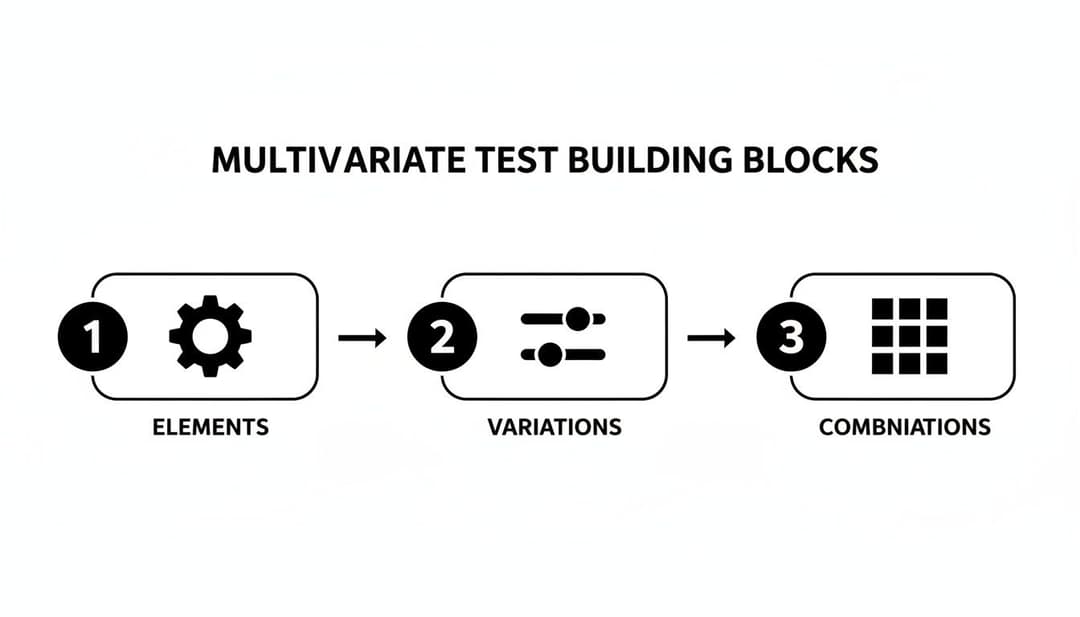
The image above shows exactly how individual elements and their variations multiply out to create all the test combinations. This systematic approach is what lets MVT uncover those subtle interaction effects that simpler tests would completely miss.
Calculating Sample Size and Duration
Now for one of the most critical steps: making sure your test has enough statistical power to actually mean something. A classic mistake is calling a test too early or not having enough traffic to get a clean read in the first place. The sample size you need is directly tied to the number of combinations you're testing.
The more combinations in your test, the more traffic each one needs to reach statistical significance. A test with 12 combinations will require substantially more traffic than a simple two-version A/B test to produce trustworthy results.
Use an online sample size calculator to get a ballpark idea of the traffic and conversions needed for each variation. This will help you estimate how long the test needs to run to give you data you can trust.
When you're dealing with dozens or even hundreds of ad variations, using tools for bulk ad launching is a lifesaver. It prevents countless hours of tedious, manual setup and helps you avoid costly errors. This frees up your team to focus on strategy instead of getting bogged down in implementation, getting your test live faster and more accurately.
Once it's launched, the hard part begins: leave it alone. Let it run without interference until you hit your predetermined sample size or time frame.
Decoding Your Test Results and Interaction Effects

Running the test is the easy part. The real magic happens when you start digging into the results, and it goes way beyond just picking the combination with the highest conversion rate. You need to be sure that the winner actually won fair and square—not just by random luck. This is where statistical significance comes into play.
Think of statistical significance as your data's quality control. It’s a mathematical gut check that tells you how confident you can be that your results are real and repeatable. Most marketers won't act on anything less than a 95% confidence level, which means there's only a 5% chance the outcome was a fluke. Hitting that threshold is what turns a risky guess into a reliable insight.
Understanding Interaction Effects
Here’s where multivariate testing truly shines and leaves A/B testing in the dust: uncovering interaction effects. This is the secret sauce. Interaction effects show you how different elements on your ad or page influence each other, creating a combined impact that's way bigger (or smaller) than the sum of its parts.
Let's say you're testing an ad for a new pair of sneakers. You might find that:
- A playful, high-energy headline performs well on its own.
- A vibrant, colorful product image also does great on its own.
But when you put that playful headline together with the vibrant image, the conversion rate goes through the roof. That extra boost, that synergy, is a classic interaction effect. On the flip side, that same killer headline might completely tank when paired with a formal, black-and-white photo. This is the kind of deep insight MVT is built to deliver.
An interaction effect tells you more than just what worked; it starts to explain why it worked. You're not just finding a winning ad—you're learning a creative principle you can apply to future campaigns.
To really get to the bottom of these results and see those subtle interactions, you need solid data. Using one of the top conversion tracking tools is non-negotiable, as they provide the granular numbers you need to connect the dots.
From Data to Actionable Insights
Once you've found a winning combination with statistical confidence, the job isn't done. The goal is to turn that raw data into a strategic takeaway. Don't just look at the overall winner; analyze the performance of individual elements to see if any trends pop up. Did one type of headline consistently beat the others, no matter which image it was paired with? Our guide on how to analyze ad performance offers a deeper framework for this exact process.
This level of rigor is what separates the pros from the amateurs. It’s how savvy marketers make bold decisions that pay off. By understanding interaction effects, you're building a library of creative knowledge that will inform your strategy long after this one test is over. You're not just guessing anymore—you're building a repeatable system for creating ads that work.
Don't Let These Common Pitfalls Derail Your Multivariate Test
Jumping into a multivariate test is a fantastic way to get serious about data-driven marketing. But a few common missteps can send your results right off the rails. Knowing what to watch out for is the best way to make sure you end up with genuine insights, not just flawed conclusions based on noisy data.
The most frequent mistake? Getting too ambitious, too fast. Marketers get a taste of MVT’s power and immediately want to test a dozen combinations on a page that just doesn't have the visitor count to support it. This spreads your audience way too thin, making it nearly impossible for any single variation to reach statistical significance. You’re left with an inconclusive test that just burned through time and budget.
Key Takeaway: Your test's complexity has to match your traffic. If you're working with a massive audience, go ahead and test more combinations. If not, stick to fewer, more impactful variables to start.
The Danger of Calling It Too Early
Another huge pitfall is ending a test prematurely. It’s tempting, I get it. You see one combination shoot into the lead after a day or two and you're ready to declare it the winner. But early results are often just random noise—fluctuations in user behavior that haven't evened out yet.
Calling a test complete before it hits a 95% statistical confidence level is like making a major business decision on a coin flip. Patience is everything here. You have to let the test run its course to gather enough data for a reliable outcome.
The Sneaky Problem of Scale
It's shockingly easy to underestimate how quickly combinations can multiply. For instance, let's say you want to test six different ad elements, each with four variations. That creates a mind-boggling 4,096 different versions of your ad.
Getting to statistical significance on a test that big could demand millions of impressions and a hefty budget—a reality that often hits teams after the test is already live. You can explore more about these calculations to see just how much traffic a test can require.
To sidestep this, always map out your combinations before you even think about building the test. Use this simple formula:
(Variations of Element A) x (Variations of Element B) x (Variations of Element C) = Total Combinations
This quick gut-check will tell you if your plan is actually realistic for your traffic and budget. If the number looks terrifyingly high, scale it back. Reduce the number of elements or variations until you have a manageable experiment that can produce clean, actionable data.
How AI Is Revolutionizing Creative Testing
While incredibly powerful, traditional multivariate testing has a catch: it demands a massive amount of manual labor and traffic. For any team trying to grow fast on platforms like Meta, the sheer complexity of setting up hundreds of ad combinations and managing budgets across them is a huge operational headache.
This is where modern AI platforms completely change the game.
Instead of having your team manually build every possible ad variation, these systems can automate the creation and launch of thousands of creative combinations in minutes. This isn't just a small step forward; it's a massive leap that allows growth teams to test at a scale that was previously unimaginable.
Smart Budget Allocation and Predictive Insights
Beyond just building the ads, AI fundamentally improves the testing process itself. It intelligently allocates the ad budget in real-time, automatically shifting spend toward the top-performing combinations as soon as the data starts pointing to a clear winner. This means you stop wasting money on underperforming ads much, much faster than any manual analysis would allow.
The real power of AI is its ability to learn. It doesn't just find the current winner; it uses predictive analytics to identify patterns and suggest which new creative elements you should test next, creating a continuous cycle of improvement.
This creates a scalable, always-on learning system that drives revenue and gives you clear creative direction. For example, a landmark test by Hyundai using MVT principles delivered a 62% uplift in conversions. You can learn more about how they did it and see other case studies about multivariate testing.
By automating the tedious setup and optimizing the budget on the fly, AI makes sophisticated testing accessible to more teams. Platforms that offer AI optimization transform creative strategy from a high-effort, one-off project into a seamless, data-driven workflow. This shift empowers marketers to uncover winning ad recipes faster, ensuring every dollar of ad spend is working as hard as possible to generate results.
A Few Common Questions About Multivariate Testing
Getting started with multivariate testing usually brings up a few key questions. Let's tackle the most common ones marketers ask when they're first dipping their toes in.
How Much Traffic Do I Really Need for This?
This is the big one. The honest answer is: it depends. The amount of traffic you need hinges on your current conversion rate and, crucially, how many combinations you’re testing.
Because you’re splitting your audience across so many different variations, MVT is much thirstier for traffic than a simple A/B test. You'll often need tens or even hundreds of thousands of visitors to get results you can actually trust.
Can I Use Multivariate Testing for Social Media Ads?
Absolutely. In fact, it’s a powerhouse for paid social campaigns on platforms like Meta and TikTok. It's the perfect way to test all the little pieces of your ad creative at once—the headline, the main text, the image or video, and the call-to-action button.
This process helps you figure out the single most persuasive combination for your audience, which is the key to unlocking better performance.
The real magic of MVT in paid social is seeing how the elements play off each other. A killer headline might crush it with a product video but completely flop with a static image. That's a golden insight you'd never get otherwise.
What’s the Main Difference Between A/B/n and Multivariate Testing?
It’s all about focus. A/B/n testing compares several completely different versions of one single thing. For instance, you might pit three totally unique landing page designs against one another to see which one wins.
On the other hand, multivariate testing (MVT) juggles multiple elements all at the same time on one page or ad. This approach is all about understanding how different combinations of those elements work together, revealing the specific recipe that drives the best results.
Ready to stop guessing and start scaling your Meta ads with data-backed insights? AdStellar AI automates the entire creative testing process, from bulk ad creation to AI-powered optimization, so you can find winning combinations 10x faster. Discover how AdStellar AI can transform your campaigns today.