The Facebook ads learning phase is that initial, sometimes nail-biting, period where Meta's algorithm is working overtime to figure out the best, most cost-effective way to show your ads. This exploration is absolutely critical if you want to achieve stable, predictable campaign performance and lower costs down the line.
What Is the Facebook Ads Learning Phase, Anyway?
Let's be real, the "learning phase" can feel like a mysterious black box. You launch a new ad set, and for a while, performance is all over the place. What’s actually happening?
In simple terms, it's the period right after you go live where Meta's powerful AI is on a mission. It’s rapidly testing everything—different pockets of your audience, various ad placements, and even times of day—to discover the most efficient path to get you the results you’re paying for.

Think of it like a new chef trying to perfect a signature dish. They'll experiment with different ingredients and cooking times (that’s the algorithm testing your ads) until they find the exact combination that creates a masterpiece (your stable, cost-effective conversions).
This initial period of exploration is the foundation for predictable, long-term performance. Getting your head around it is the first real step to mastering your ad campaigns.
The Goal of the Learning Phase
The main objective is simple: data collection. Meta’s delivery system needs to gather enough performance data to make smart decisions about who is most likely to click, purchase, or sign up. During this time, you should absolutely expect some volatility in your results, including swings in your Cost Per Result (CPR). It’s normal.
This automated process is precisely what makes Meta’s ad platform so powerful. Instead of you having to guess who to target, you’re letting a sophisticated algorithm do the heavy lifting. While this can feel a bit unnerving, especially if you're experiencing a steep Meta ads learning curve (https://www.adstellar.ai/blog/meta-ads-learning-curve-steep), patience is your best friend here.
The Facebook ads learning phase isn't a bug; it's a feature. It's the system's way of investing your initial budget to find the cheapest, most stable conversions for the long run. Resisting the urge to make constant edits is crucial.
This phase is foundational for anyone running paid social campaigns. For a deeper dive into how this fits into the bigger picture, check out this definitive playbook on Facebook Ads for ecommerce. Successfully getting through this period is often what separates the campaigns that fizzle out from the ones that become highly profitable.
Why You Must Master the Learning Phase for Campaign Success
That initial rollercoaster of results isn't just some technical hiccup in Meta's system; it's the bedrock of your entire campaign's profitability. Nail the Facebook ads learning phase, and you’re on your way to stable, predictable performance and lower costs.
But if you mess it up? You’ll likely get stuck in that dreaded 'Learning Limited' status. That’s the fast track to inefficient spending, skyrocketing costs, and a campaign that never truly gets off the ground.
Think of it like building a house. The learning phase is the concrete foundation. Getting it right means everything you build on top of it—your scaling, your ad spend, your profits—is secure. Ignoring it is like building on sand and wondering why everything keeps collapsing.
The Real Cost of Ignoring the Learning Phase
The fallout from a mismanaged learning phase is real, and it hits your wallet directly. When an ad set can't gather enough data to exit this period, you're left with a delivery system that's just guessing. It can't confidently find your ideal customers, which leads straight to wasted ad spend and missed opportunities.
Did you know that this phase, which typically needs about 50 conversions in a week, can make or break your bottom line? When Meta first rolled out this machine-learning approach, many advertisers saw their Return on Ad Spend (ROAS) tank by up to 30-50% during that initial, unstable period. Now, with Meta's ad revenue higher than ever, mastering this is non-negotiable for profitability. You can dig into more of the numbers with these current Facebook ad statistics on ElectroIQ.com.
This upfront investment in data is what separates the campaigns that fly from the ones that just limp along.
From Unpredictable to Profitable
The whole point is to get from chaos to consistency as fast as you can. A campaign that successfully graduates from the learning phase is armed with enough data to deliver results you can count on. This gives you a few massive advantages:
- Lower Cost Per Result: The algorithm knows exactly who to show your ads to, cutting down on wasted impressions and driving down your costs.
- Stable Performance: Your daily results become far more predictable, giving you the confidence to scale your budget without guessing.
- Improved ROAS: When every dollar is spent more efficiently, your return on investment naturally goes up.
Ultimately, mastering the learning phase isn't about trying to avoid the initial volatility—it's about understanding and working with it. By feeding the algorithm the data it craves, you’re turning it into a powerful ally. You're transforming that early uncertainty into a long-term, profitable advertising machine that drives real, sustainable growth.
Understanding The 50 Conversion Rule
So, how does Meta’s algorithm know when it’s finished its homework? The magic number that signals the end of the initial Facebook Ads learning phase is 50.
The algorithm needs to see roughly 50 of your desired optimization events—like a purchase, a lead form submission, or an add-to-cart—within a seven-day window. Think of it as the system collecting enough data points to move from making educated guesses to delivering your ads with confident precision. Hitting this target is your primary goal.
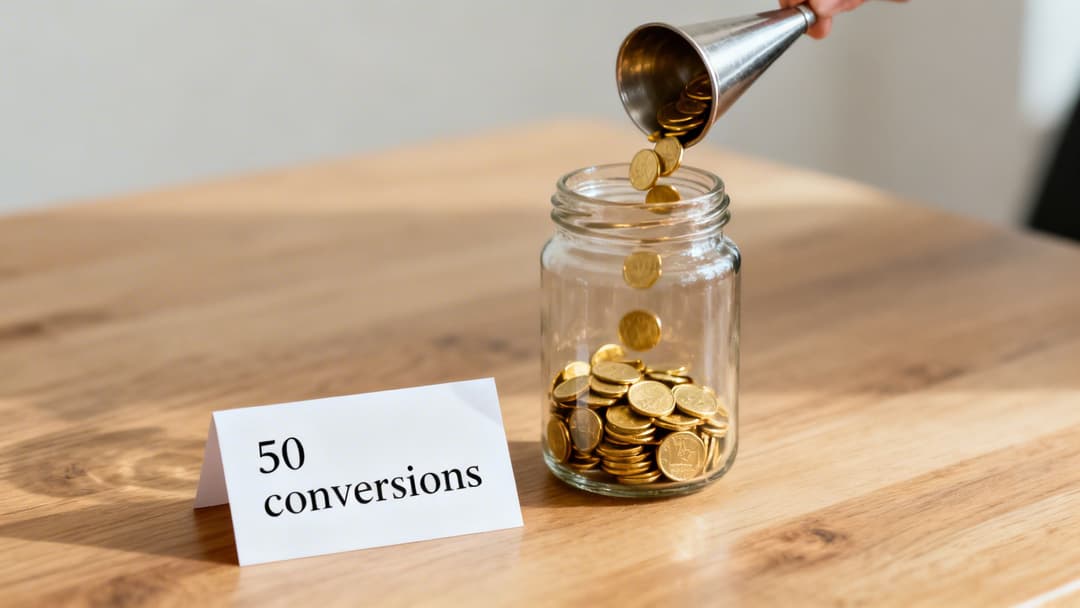
It’s absolutely critical that the event you choose to optimize for aligns directly with your most important business goal. If you need sales, optimizing for link clicks just won't cut it. The algorithm is incredibly literal; it will find you exactly what you ask it to.
Choosing The Right Optimization Event
Your choice of optimization event sets the entire direction for the algorithm's learning. It’s like giving a new chef a specific recipe to perfect. If you want a five-star meal (purchases), don't give them instructions for making toast (link clicks).
Here are the most common optimization events and when they make the most sense:
- Purchases: This is the gold standard for any e-commerce business. It tells Meta to go find users with a history of buying products similar to yours.
- Leads: Ideal for service-based businesses or B2B companies. The algorithm will hunt for users who are most likely to fill out a contact or inquiry form.
- Add to Cart: A solid secondary choice if you can't get 50 purchases a week. This targets users who show high purchase intent, even if they don't complete the checkout.
- Complete Registration: Perfect for apps, webinars, or subscription services where signing up is the main objective.
Properly setting up your conversion events is completely non-negotiable for this process to work. If you need a refresher, our guide on how to set up the Facebook Pixel covers all the essential steps to ensure your tracking is accurate from day one.
The 50-conversion rule isn't just a suggestion; it's the algorithm's graduation requirement. Failing to provide enough conversion data is the number one reason ad sets get stuck in "Learning Limited," leading to higher costs and unstable results.
Monitoring key metrics during this period provides a real-time report card on the algorithm's progress. Think of it as checking the vitals of your campaign as it matures.
Here’s a breakdown of what to watch and what it tells you about your campaign’s health as it works toward exiting the learning phase.
Key Metrics To Monitor During The Learning Phase
| Metric | What It Means During Learning | Ideal Trend Post-Learning |
|---|---|---|
| Cost Per Result (CPR/CPA) | Expect this to be erratic and high. The algorithm is spending to learn who your best customers are. | Should stabilize and ideally decrease as the algorithm finds efficiencies. |
| Conversions (Optimization Events) | This is your primary goal. The number should be steadily climbing toward the 50-event threshold. | A consistent and predictable flow of conversions at a stable cost. |
| Frequency | This shows how many times the same person sees your ad. High frequency early on isn't necessarily bad. | Should settle into a healthy range. If it gets too high, it's a sign of audience fatigue. |
| Click-Through Rate (CTR) | An early indicator of whether your ad creative and messaging are resonating with the initial audience. | Should remain stable or improve slightly. A sharp drop could mean creative fatigue. |
| Amount Spent | Tracks how quickly you are spending your budget. It helps you forecast if you'll hit the conversion goal in time. | Spending becomes more consistent and aligns with the stable results you're achieving. |
Keeping an eye on these numbers doesn’t just tell you if you’re on track; it helps you understand why you might be hitting roadblocks. With these insights, you're better equipped to make smart adjustments and guide your campaign to success.
Common Reasons Your Ads Get Stuck in Learning Limited
Seeing that dreaded “Learning Limited” status is one of the most common frustrations for media buyers, and it’s a big red flag that your campaign is struggling to find its footing. Think of it as the check engine light for your ad set; it means the algorithm can't get the 50 conversions it needs to properly optimize, leaving your performance unstable and your budget at risk.
This status isn't just a harmless label—it's a direct hit to your bottom line. Campaigns stuck in “Learning Limited” often see a 20-40% higher Cost Per Acquisition (CPA) because the algorithm is just guessing instead of making data-backed decisions. For anyone in a competitive market, that’s a budget killer. To get a broader sense of the numbers behind campaign performance, you can discover key Facebook Ad statistics on electroiq.com.
So, what’s really causing this? The culprits are usually pretty straightforward.
Insufficient Budget Allocation
This is the number one reason ads get stuck, hands down. If your daily budget is too low to generate enough conversions within a week, the learning phase will stall out before it even gets started.
Let’s say your average cost per purchase is $25. A daily budget of $10 makes it mathematically impossible for the algorithm to learn. You're asking it to find 50 purchases a week, but you're only giving it enough money to find a few. The system is essentially starved of the data it needs to succeed, forcing it to make decisions based on scraps of information—which almost always leads to wasted spend.
If your ads aren't spending their budget at all, you might be dealing with other delivery problems. Our guide on troubleshooting why Facebook Ads are not delivering can help you diagnose what's going on.
Targeting an Audience That Is Too Small
It feels smart to get hyper-specific with your targeting, but an overly narrow audience can suffocate the learning phase. If your potential reach is only a few thousand people, the algorithm simply doesn't have enough room to explore and find the pockets of users most likely to convert. This is especially true if you've layered on too many interests or behavioral filters.
A tiny audience combined with a low budget is the fastest way to get stuck in "Learning Limited." You're essentially tying the algorithm's hands, preventing it from doing the very job you're paying it to do.
Frequent and Significant Edits
Patience is a virtue, especially during the Facebook ads learning phase. Every time you make a significant edit to your ad set—the budget, creative, or targeting—you reset the learning process. The algorithm has to throw out everything it's learned and start over from scratch.
What counts as a "significant edit"?
- Budget Changes: Any increase or decrease of more than 20-30% at once.
- Creative Swaps: Adding new ads or removing existing ones from the ad set.
- Targeting Adjustments: Changing demographics, interests, or lookalike audiences.
- Optimization Goal: Switching your goal from, say, Purchases to Add to Carts.
Making these changes too often creates a vicious cycle of endless learning. Your campaign never gets a chance to stabilize and achieve the predictable, profitable results you’re after. By avoiding these common mistakes, you can give your campaigns the best shot at exiting the learning phase and unlocking their true potential.
Actionable Strategies to Exit the Learning Phase Faster
Knowing why your ads are stuck is half the battle. The other half is taking decisive action to fix it. Getting your campaigns out of the Facebook ads learning phase isn’t about brute force or just throwing more money at the problem—it’s about being strategic. The goal is simple: feed the algorithm enough good, clean data so it can start making smart decisions for you, fast.
This means you have to stop spreading your budget thin across a dozen different ad sets. Instead, consolidate your spend. Funnel your budget into fewer, stronger ad sets so each one has a real shot at hitting that magic 50-conversion mark within the seven-day window. Give the algorithm the fuel it needs.
This flowchart breaks down the three usual suspects that keep ad sets stuck in a loop of inefficiency.
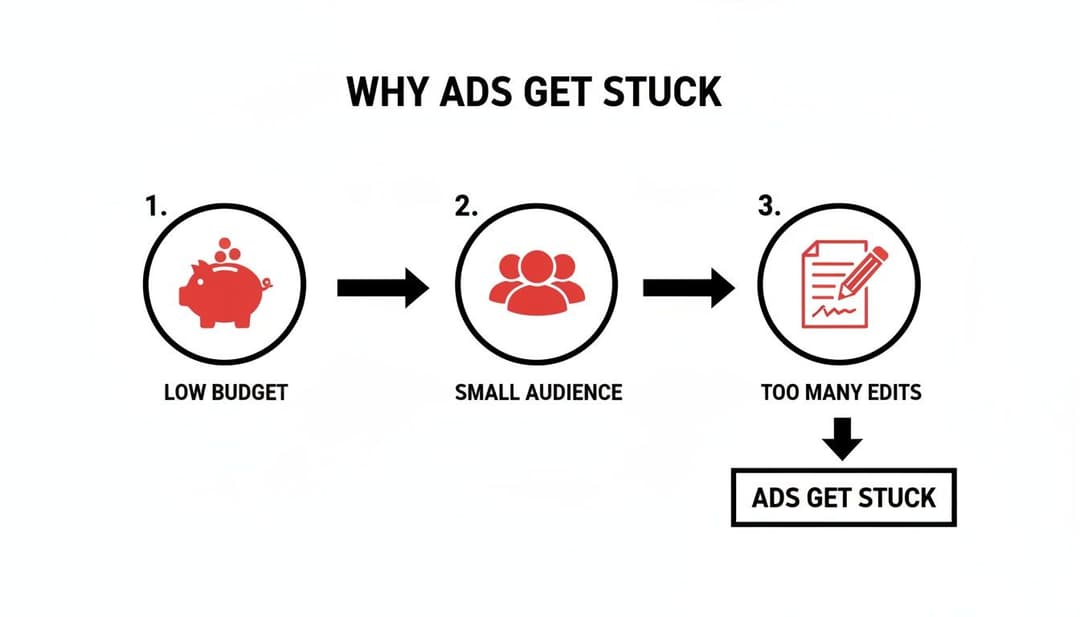
As you can see, the most common roadblocks are almost always the same: not enough budget, an audience that’s way too narrow, or getting impatient and making too many edits. These are the things that prevent your campaigns from stabilizing and hitting their stride.
Build a Strong Foundation for Learning
You can sidestep a lot of the usual headaches by setting your campaign up for success right from the start. A few foundational principles can make all the difference in shortening the learning period.
Broaden Your Audience: Fight the temptation to get hyper-specific with your targeting right away. A broader audience gives Meta’s algorithm more room to explore and find pockets of customers you might not have expected. You can always narrow things down later once you have real performance data to guide you.
Choose the Right Optimization Event: Make sure your campaign is optimizing for an event that can realistically hit 50 conversions a week with your budget. If "Purchase" is too much of a stretch, try optimizing for a higher-funnel goal like "Add to Cart." This will get the data flowing.
Be Patient with Edits: This one is crucial. Once an ad set is live, leave it alone. Don’t touch the budget, creative, or targeting for at least 72 hours. Every time you make a significant change, you reset the learning process and trap your campaign in a cycle of instability.
The learning phase isn’t just some technicality. It’s a high-stakes gatekeeper, and mastering it is the difference between a profitable campaign and a money pit. Ad sets stuck in learning often have 10-20% higher costs. But once they graduate, you’ll typically see click-through and conversion rates improve.
Leverage Automation for Faster Testing
This is where modern automation tools can be a total game-changer. Platforms like AdStellar AI let you generate and test hundreds of creative and audience combinations right from the jump. Instead of guessing, you’re feeding the algorithm a rich, diverse dataset from day one, helping you find the winning formula much faster.
By front-loading the testing process, you're not just speeding up the learning phase; you're making it smarter. You sidestep the manual guesswork and let data guide you toward what works.
This approach helps you quickly pinpoint your top-performing elements. From there, you can build new campaigns based on what’s already proven to work, not just on assumptions. For more deep-dive strategies, check out our guide on how to optimize Facebook ads for maximum performance.
How to Scale Your Campaigns After the Learning Phase
Getting out of the Facebook ads learning phase is a huge milestone, but honestly, it’s just the starting line. Now that your ad set is stable and delivering consistent, predictable results, the real challenge begins: scaling that success without throwing it right back into learning mode.
This is where you shift gears from maintaining a stable campaign to building a high-growth profit engine.
Think of your stable ad set like a finely tuned engine. You wouldn't just slam the pedal to the floor and redline it, right? You’d make gradual, careful adjustments to increase its power over time. The same exact principle applies here. Making sudden, drastic changes will shock the system and undo all the hard work the algorithm just put in.
The 20 Percent Budget Rule
The safest and most proven method for scaling your budget is what we call the 20% rule. It's simple. Once your ad set is performing well, increase its daily budget by no more than 20% every 24-48 hours.
This slow and steady approach gives the algorithm enough breathing room to adjust to the increased spend without freaking out and triggering a full learning phase reset.
So, if you have a winning ad set spending $100 per day, your first bump should be to $120. Let it run for a day or two, keep a close eye on performance, and if the results hold steady, you can increase it again. Patience is everything here. This methodical approach is the secret to sustainable growth.
Duplicating Winning Ad Sets
Another incredibly powerful scaling technique is duplication. Instead of messing with your original, high-performing ad set, you simply duplicate it and point it toward a new, similar audience. This keeps your proven winner completely untouched while you expand your reach.
Here are a couple of ways you can put this into practice:
- Duplicate to a New Lookalike Audience: If a Lookalike audience of your past purchasers is crushing it, try duplicating that ad set and targeting a Lookalike of users who added items to their cart or initiated checkout.
- Duplicate with a Broader Interest: Let's say an ad set targeting a very specific interest is successful. You can duplicate it and target a related, but much broader, interest to see if you can find new pockets of customers.
Duplicating winning ad sets is like cloning your best salesperson. You let the original keep doing their thing while the clone goes out to explore new territories. It minimizes risk and maximizes your potential reach.
By combining careful, incremental budget increases with strategic duplication, you can scale your campaigns effectively without breaking what’s already working. If you're ready for more advanced tactics, you can learn more about how to scale Facebook ads in our deep-dive guide. This is also where AI-powered tools become invaluable, helping you pinpoint the top-performing elements to build out new campaigns based on proven data.
Common Questions About the Learning Phase
When you're in the trenches with your campaigns, theory is one thing, but practical questions always come up. Here are the straight-up answers to the most common things advertisers ask about the learning phase.
What Happens If I Edit My Ad Set During Learning?
Tread carefully here. Making a significant change—like messing with your targeting, swapping out the creative, changing the optimization event, or adjusting your budget by more than 20%—will completely reset the learning process.
When that happens, the algorithm basically throws out everything it's learned and has to start from square one. All that precious data collection goes out the window, and you're back to a period of instability. It's almost always best to keep your hands off until learning is complete.
Should I Use a Broad or Specific Audience?
When in doubt, go broad. It might feel counterintuitive, but giving Meta's algorithm a larger pool to fish in is one of the smartest moves you can make. It gives the system more data and flexibility to hunt down those little pockets of users who are actually going to convert.
Overly narrow audiences are a classic mistake. You can easily choke the algorithm, making it nearly impossible to hit the 50 conversions it needs to learn. This is probably the number one reason ad sets get slapped with the dreaded "Learning Limited" status.
How Long Should I Wait for an Ad Set to Exit Learning?
Patience is a virtue, but don't wait forever. The goal is to hit 50 optimization events within about seven days.
If a full week has gone by and you're nowhere near that magic number, take it as a clear signal that something's off. It could be anything from a budget that's too small to make an impact, a weak offer, or creative that just isn't landing. At that point, it's time to put on your detective hat and diagnose the problem instead of just hoping things will turn around.
Ready to stop guessing and start scaling? AdStellar AI automates the heavy lifting of ad creation and testing, feeding Meta's algorithm exactly what it needs to find winning campaigns in record time. Launch, test, and scale your Meta ads 10x faster with AdStellar AI.