If you want to get serious about optimizing your Meta ads, you need to ditch the guesswork. Real success comes from a repeatable framework—one that’s built on clear goals, methodical testing, and smart scaling. It’s a simple but powerful cycle: define what winning looks like, run tests to find out what actually works, and then put your budget behind those winners.
A Practical Framework for Ad Optimization
Forget the quick "hacks" and silver bullets. In today's ad environment, sustainable growth comes from a systematic process, not a one-off trick. This guide lays out a practical, repeatable framework for performance marketers who need to turn ad spend into predictable revenue. It's about building a reliable engine that consistently finds what works.
Of course, a killer campaign always starts with a strong Facebook content strategy. Once that's in place, we can dive into the core pillars that take campaigns from just okay to truly exceptional.
This entire process can be boiled down to three core stages: setting goals, running tests, and scaling up.
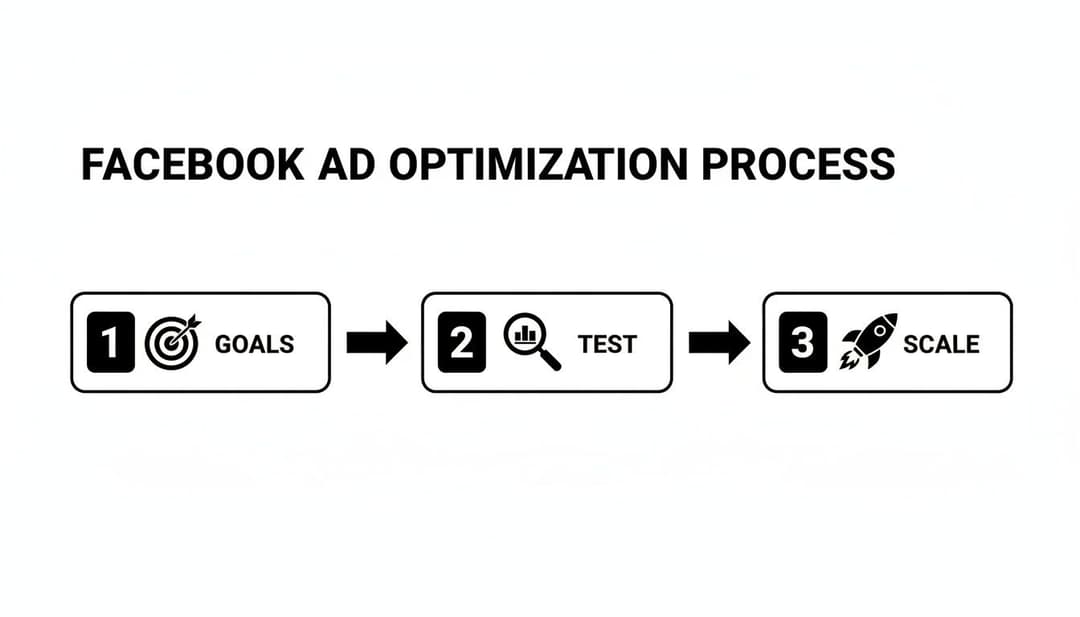
It’s not a one-and-done task. True optimization is a continuous loop of learning and refining based on real data.
Core Pillars of Facebook Ad Optimization
To help you build this optimization engine, we'll walk through the key strategic areas that matter most. Each pillar builds on the last, ensuring you're making smart, data-backed decisions at every step of your campaign.
The table below gives you a high-level look at the framework we'll be breaking down. Think of it as your cheat sheet for building a high-performance ad account.
| Pillar | Objective | Key Action |
|---|---|---|
| Defining Success | Move beyond vanity metrics to track what actually grows the business. | Focus on KPIs like ROAS, CPA, and LTV that tie directly to revenue and profitability. |
| Data-Driven Testing | Eliminate guesswork by finding what truly resonates with your audience. | Systematically test creatives, ad copy, audiences, and landing pages. |
| Smart Budgeting | Use the right budget strategy for the right campaign stage. | Leverage ABO for controlled testing and CBO for efficient scaling of proven winners. |
| Responsible Scaling | Increase spend on winning campaigns without killing their performance. | Gradually increase budgets on high-performers while closely monitoring KPIs. |
This structured approach ensures you're always making informed decisions, from initial testing to full-scale campaigns.
A disciplined process is more critical than ever. With over 90% of marketers using Facebook Ads, you're competing for the attention of three billion monthly users. Meta's ad revenue is on track to blow past $196 billion in 2025, proving just how powerful—and crowded—the platform is.
When you treat optimization like a science—hypothesis, test, analyze, repeat—you take emotion and bias out of the equation. This framework isn't about finding a magic bullet. It's about building a machine that consistently produces results.
Mastering this process is non-negotiable for anyone serious about paid acquisition. As you get more comfortable, you can explore more advanced techniques in our guide on Meta advertising best practices. For now, let’s get into the actionable steps you need to build your own high-performance optimization engine.
Defining What Success Actually Looks Like
Before you even think about optimizing a single ad set, you have to answer a fundamental question: what does a “win” actually look like for your business? So many advertisers pour money into campaigns without clear, measurable goals. It's like driving without a destination—sure, you’re moving, but you have no idea if you’re getting closer to where you want to go.
It’s dangerously easy to get distracted by vanity metrics. Likes, comments, and shares feel good, but they don’t pay the bills. Success isn't about getting the most clicks; it's about getting the right clicks that turn into profitable actions. This means shifting your focus from fuzzy engagement numbers to the key performance indicators (KPIs) that directly impact your bottom line.
Moving Beyond Vanity Metrics to Business KPIs
The KPIs that truly matter are completely tied to your business model. What an e-commerce store obsesses over is going to be worlds apart from what a B2B software company needs to track. The entire goal is to draw a straight line from your ad spend to your revenue.
Here’s how that looks in the real world for different businesses:
E-commerce: The undisputed champion here is Return on Ad Spend (ROAS). If you spend $100 on ads and get $500 back in sales, your ROAS is 5x. Another critical one is Cost Per Acquisition (CPA), which tells you exactly how much you’re paying to land a new customer.
SaaS (Software as a Service): You're likely looking at Cost Per Trial or Cost Per Demo Booked. A more sophisticated approach is to track the Customer Lifetime Value (LTV) to CPA ratio. This ensures you're not just getting sign-ups, but acquiring customers who will be profitable over the long haul.
B2B Lead Generation: The most common starting point is Cost Per Lead (CPL). But let's be honest, not all leads are created equal. A much better KPI is Cost Per Marketing Qualified Lead (MQL) or Cost Per Sales Qualified Lead (SQL). This measures what you're paying for a lead that your sales team actually wants to talk to.
As you start zeroing in on these numbers, using a conversion rate calculator can be a huge help. It’s a simple way to translate raw data into clear benchmarks for your campaigns.
The Bedrock of Optimization: Accurate Tracking
None of these KPIs mean a thing if you can't trust your data. This is where the Meta Pixel and Conversions API (CAPI) come into play, and getting them set up correctly from day one is completely non-negotiable. Think of them as the data pipelines that tell Meta’s algorithm which users are taking the valuable actions you care about on your website.
Without accurate tracking, you're flying blind. The algorithm can't optimize for conversions it can't see, and you can't make informed decisions about which ads to scale and which to kill.
The Pixel has been the standard for a long time, but CAPI provides a much more robust, server-to-server connection. It's less vulnerable to things like browser restrictions and ad blockers that are becoming more common. Using both together gives you the most complete and reliable picture of your campaign performance.
This setup ensures that when someone makes a purchase or fills out a form, Meta receives that signal loud and clear, allowing its algorithm to go out and find more people just like them. For a deeper dive, check out our guide on essential performance marketing metrics.
The data backs this up. Different campaign objectives produce wildly different results, which makes this tracking-first approach so vital. For example, lead-generation ads see an average Click-Through Rate (CTR) of 2.53%, while campaigns optimized for traffic only average 1.57%. More importantly, campaigns properly optimized for conversions can achieve 2–3 times higher ROI, and solid retargeting efforts often produce 10 times better conversion rates than prospecting. To learn more about how ad formats impact performance, discover more insights on Facebook stats for marketers.
Uncovering Wins with Data-Driven Testing
Okay, you’ve defined your goals. That’s the critical first step, but now the real work begins. Optimizing your Meta ads isn’t a one-and-done setup; it's an active process of discovery. It’s about methodically testing your assumptions to find out what actually makes your audience tick, swapping guesswork for hard data.
Too many advertisers fall into the trap of just throwing a dozen different ads into a campaign and hoping one sticks. This "spaghetti on the wall" approach is a fantastic way to burn through your budget without learning a thing. A structured testing methodology, on the other hand, lets you isolate variables and ensures every dollar you spend teaches you something valuable.
Structuring Your A/B Tests for Clarity
The golden rule of effective A/B testing is simple: isolate a single variable. When you change the image, the headline, and the audience all at once, you have no idea which change actually moved the needle. Real learning comes from controlled, methodical experiments.
Here’s a common and highly effective way to structure your tests:
- Creative vs. Creative: Pit two or more different ad creatives (like an image vs. a video) against each other. Keep the ad copy and audience exactly the same. This tells you which visual element grabs more attention.
- Copy vs. Copy: Once you have a winning visual, use it to test different headlines or primary text. This helps you nail down the messaging or value prop that really connects.
- Audience vs. Audience: Take your best-performing ad—your proven creative and copy combo—and test it against different audiences. Maybe a lookalike audience versus an interest-based one.
This disciplined approach gives you clean results and actionable takeaways. You're not just finding a winning ad; you're learning why it wins.
Dynamic Creative for Testing at Scale
Let’s be honest, manually setting up dozens of A/B tests is a massive time sink. This is where Meta’s Dynamic Creative feature becomes your best friend. Instead of creating individual ads one by one, you just upload a bunch of assets—multiple headlines, images, videos, descriptions, and CTAs.
Meta's algorithm then takes over, automatically mixing and matching them to find the highest-performing combinations for different people in your audience.
Dynamic Creative is your shortcut to understanding which ad components drive results. It automates the heavy lifting of testing, freeing you up to focus on interpreting the data and scaling what works.
Using the "Breakdown" feature in Ads Manager, you can see which specific images, headlines, or text variations produced the best ROAS or the lowest CPA. These insights are pure gold and can inform your entire creative strategy. For a deeper dive, check out our guide on the best practices for ad testing.
A Real-World Testing Scenario
Let's walk through a practical example. An e-commerce brand selling sustainable coffee beans wanted to get their ROAS from a shaky 1.5x to over 3x. They were running ads, but had no real clue what was actually driving sales.
So, they put a structured testing framework in place.
First, they ran an Audience Test. They took their current best ad and tested it on three different audiences: a 1% Lookalike of past purchasers, an interest group for "Fair Trade Coffee," and a broad audience with no specific targeting. The Lookalike audience won by a landslide, hitting a 1.9x ROAS.
Next up was the Creative Test. Using that winning Lookalike audience, they tested three creatives: a static image of their coffee bag, a short video of coffee being brewed, and a customer's user-generated photo. The brewing video was the clear winner, pushing their ROAS up to 2.6x.
Finally, they ran a Copy Test. They combined the winning video and audience and tested three different messaging angles:
- Angle 1: Focused on the taste and flavor profile.
- Angle 2: Emphasized ethical sourcing and sustainability.
- Angle 3: Highlighted a limited-time discount.
The ethical sourcing angle resonated most powerfully with their Lookalike audience. That final combination—Lookalike audience, brewing video, and sustainability copy—smashed their goal, hitting a 3.8x ROAS. By isolating one variable at a time, they built a winning ad piece by piece and gained a deep understanding of what their best customers truly care about.
Fine-Tuning Your Spend with Smart Bidding and Budgeting
You can have the most killer creative and a perfectly dialed-in audience, but the wrong bidding and budget strategy will bring a campaign to a screeching halt. How you manage your spend is just as important as what you show and who you show it to. This is your chance to tell Meta’s algorithm what you value most, guiding it to find the right people at the right price.
Choosing the right approach isn’t about finding one "best" option; it's about knowing which tool to use for the job. It means aligning your bidding strategy directly with your campaign goals. A mismatch here is one of the most common ways advertisers unknowingly sabotage their own success.
Choosing the Right Bidding Strategy
Meta gives you a few different bidding options, and knowing the nuances is key when you want to truly optimize Facebook ads for profit.
Here’s a quick rundown of the most common strategies and when they really shine:
Highest Volume (Lowest Cost): This is Meta's default setting for a reason. The algorithm’s only goal is to get you the most results possible (like purchases or leads) within your budget. It’s a great choice for maximizing conversions when you don't have a rigid cost-per-result target.
Cost Per Result Goal: This is for when you know your numbers. You tell Meta the average cost you're willing to pay for a conversion, and the algorithm will aim to hit that average. Some results might cost a bit more, others a bit less, but it keeps you near your target. This is perfect for maintaining a specific Cost Per Acquisition (CPA).
ROAS Goal (Return On Ad Spend): An e-commerce favorite. You set a minimum ROAS target (say, 300%), and Meta’s algorithm will hunt for users most likely to make high-value purchases to meet that goal.
Your bidding strategy is a direct instruction to the algorithm. Choosing "Highest Volume" tells it to prioritize quantity, while "ROAS Goal" tells it to prioritize the monetary value of each conversion.
CBO vs. ABO: The Great Budget Debate
Once you’ve picked a bid strategy, you have to decide where to set your budget: at the campaign level (CBO) or the ad set level (ABO). This choice fundamentally changes how Meta allocates your money and is a critical part of any advanced optimization workflow.
Ad Set Budget Optimization (ABO) is your best friend during the testing phase. With ABO, you manually set a budget for each ad set. This gives you total control, ensuring every audience or creative you’re testing gets a fair shot without a single strong performer gobbling up the entire budget.
Campaign Budget Optimization (CBO), now called Advantage Campaign Budget, is built for scaling. You set one central budget at the campaign level, and Meta’s algorithm automatically funnels it to the top-performing ad sets in real-time. It’s incredibly efficient for maximizing results once you've identified your winners.
A battle-tested workflow is to use ABO to find winning ad combinations, then move those winners into a new CBO campaign to scale them efficiently. For a deeper dive, check out our full guide on Facebook campaign budget allocation.
Smart Budget Management in Practice
Knowing when and how to adjust your budget is more art than science. Tweak it too quickly, and you risk resetting the algorithm's learning phase. Wait too long, and you're just burning cash on ads that aren't working.
One of the biggest mistakes I see is marketers getting too aggressive with a winning ad set. A sudden, massive budget increase can shock the system, kick it back into the learning phase, and completely tank performance.
A safe rule of thumb? Increase the budget by no more than 20% every 24-48 hours.
This gradual increase gives the algorithm time to adapt and find more customers at a similar cost, preserving the performance you worked so hard to achieve. Careful, patient budget management is the final piece of the puzzle to successfully optimize Facebook ads for long-term, profitable growth.
How to Scale Your Winning Ads Responsibly
You’ve done the hard work, run the tests, and finally—you’ve got a winner. An ad that’s hitting your KPIs and bringing in consistent results. Now for the fun part: scaling.
This is also where most advertisers crash and burn.
It’s tempting to get aggressive. You see an ad set humming along, so you double or triple the budget, expecting to double or triple your results. Instead, performance collapses. The algorithm gets shocked, your CPA skyrockets, and your winner suddenly looks like a loser.
Responsible scaling isn’t about hitting the gas; it's a disciplined, methodical process. It’s about carefully increasing your investment without spooking Meta’s algorithm or fatiguing your audience. An ad that’s profitable at $50/day won't automatically be a winner at $500/day without a smart strategy.
The goal here is to grow your spend while protecting the efficiency that made the campaign a success in the first place. You need to shift from a rapid-fire testing mindset to one of steady, incremental growth.
First, Make Sure You Have a True Winner
Before you touch that budget, you need to be absolutely certain you have a scalable ad on your hands. A high click-through rate is nice, but it’s a vanity metric if those clicks aren’t turning into profitable customers.
Here’s my checklist for confirming an ad is truly ready to scale:
- Consistent Performance: Has it maintained a stable CPA or ROAS for at least 3-5 days after exiting the learning phase? One good day is a fluke. A good week is a trend.
- Sufficient Conversion Volume: Has the ad generated a healthy number of conversions? I look for 50+ as a bare minimum. This tells me its success isn't just luck from a tiny data set.
- Low Frequency: For prospecting campaigns, your frequency should be well under 2.0. If it starts creeping up, you’re already on the path to saturating your audience.
A truly scalable ad isn’t just one that works; it’s one that works consistently and has room to grow. Don’t rush to scale an ad that’s had one lucky day. Patience now will save you a lot of wasted ad spend later.
Vertical vs. Horizontal Scaling: Your Two Levers for Growth
Once you've confirmed you have a winner, there are two primary ways to scale. The best advertisers almost always use a combination of both.
Vertical Scaling
This is the most straightforward approach: you gradually increase the budget on your existing, winning ad set. The keyword here is gradually.
Jamming the budget up too fast will almost certainly throw the ad set back into the learning phase, wrecking its performance.
A safe rule of thumb is to increase the budget by no more than 20-30% every 24-48 hours. This gives the algorithm enough time to adjust and find new customers without destabilizing the whole operation.
Horizontal Scaling
Horizontal scaling is about taking your winning ad creative and audience combo and expanding its reach. Instead of putting more money into the same ad set, you duplicate the winner into new, similar ad sets.
This lets you tap into new pockets of customers without disrupting the performance of your original winner.
Great candidates for horizontal scaling include:
- Expanding from a 1% lookalike audience to a 3% or 5% lookalike.
- Targeting new, but related, interest-based audiences.
- Going after broad audiences with minimal targeting, letting the algorithm do the work.
This is where you can really appreciate the platform's sheer size. As of January 2025, Facebook's advertising reach hit 2.28 billion users globally, a 4.3 percent jump from the previous year. That massive user base gives you plenty of new ground to cover with horizontal scaling. You can explore the full report on Facebook's user statistics to see the numbers for yourself.
How a SaaS Company 10x'd Their Spend (Without Breaking Their CPA)
Let's make this real. I worked with a B2B SaaS company trying to scale their lead generation. They were spending $10,000/month to get customers at a target CPA of $250. Their goal was ambitious: get to $100,000/month in spend while keeping their CPA under $300.
Their top performer was a short video testimonial targeting a 1% lookalike of their current customer base. Instead of just cranking up the budget on that single ad set, we built a two-pronged strategy.
First, we started vertically scaling the original ad set, bumping its budget by 20% every two days.
At the same time, we kicked off a horizontal scaling effort. We duplicated that winning video ad and put it in front of new audiences: a 3% lookalike, a 5% lookalike, and an interest-based audience of professionals in their target industry.
This methodical approach let them expand their reach and spend without burning out any single audience. The result? Within three months, they successfully scaled their monthly ad spend to $100,000 while maintaining an average CPA of just $285.
It's a perfect example of how responsible scaling is the key to sustainable growth. If you're looking for more on this, you can read our guide on how to scale Facebook ads efficiently.
Frequently Asked Questions About Facebook Ad Optimization
Even the most seasoned media buyers run into questions when managing Meta ad campaigns. Performance can be unpredictable, and it's easy to get stuck. I've been there. So, I've put together answers to some of the most common questions we get, with practical advice you can use to get your campaigns back on track.
How Often Should I Optimize My Facebook Ad Campaigns?
This is the million-dollar question, and there’s no single right answer. It's a delicate balance. You need to give the algorithm room to breathe and learn, but you can't just let it burn through your budget if things are going sideways.
For any brand-new campaign, my hard-and-fast rule is to leave it alone for at least 72 hours. The learning phase is real, and making changes too early will just reset the algorithm and keep you from ever getting stable results.
Once a campaign is out of the learning phase and running, I recommend checking in daily but only making tweaks every 3-5 days. This cadence stops you from overreacting to the natural daily ups and downs of ad performance.
So, when should you step in? Look for these red flags:
- A major, sustained drop in your main KPI (like ROAS or CPA).
- Your Cost Per Acquisition (CPA) is climbing day after day.
- The frequency on a cold prospecting ad set creeps above 3-4.
If you're managing a massive budget—say, over $1,000 a day—you'll naturally check in more often. But the core principle is universal: make decisions based on trends, not a single day's data.
What Is the Most Important Metric to Focus On?
It’s tempting to obsess over metrics like CTR or CPC, but they’re just diagnostic tools. They don't pay the bills. The only metric that truly matters is the one that's closest to your actual business goal.
For an e-commerce store, that’s almost always Return on Ad Spend (ROAS) or Purchase CPA. If you're running lead gen, it’s Cost Per Lead (CPL)—or even better, Cost Per SQL (Sales Qualified Lead) if you can track it.
Sure, secondary metrics like Click-Through Rate (CTR) and Cost Per Click (CPC) can help you diagnose a problem. A tanking CTR is a clear sign your creative isn't resonating. But a killer CTR with zero conversions is just an expensive way to get clicks.
Always, always optimize for the metric that directly impacts your bottom line. Everything else is just noise.
Why Did My Great Ad Suddenly Stop Working?
Ah, the classic case of ad fatigue. It's incredibly common and frustrating. Your audience has simply seen your ad so many times that they've started to tune it out. Think of it like digital banner blindness.
The first place I look is the 'Frequency' column in Ads Manager. If that number is steadily rising—getting above 3 for a cold audience or 8 for a retargeting audience—you've almost certainly found your culprit.
Here’s how to fix it:
- Refresh Your Creative: This is your best weapon. Test new images, videos, headlines, or copy.
- Broaden Your Audience: Try expanding your targeting. You can also exclude recent purchasers or converters to get in front of fresh eyes.
- Give It a Rest: Sometimes, just pausing the ad set for a few days is enough to hit the reset button on your audience's attention span.
- Try a New Angle: If your message is getting stale, pivot to a completely different benefit or offer.
Proactively managing your creative pipeline and keeping an eye on audience saturation is the key to preventing these sudden performance cliff-dives.
Should I Use CBO or ABO for My Budget?
The whole CBO vs. ABO debate is a bit of a false choice. A smart Meta strategy uses both, just for different things. They're two different tools for two different jobs.
Ad Set Budget Optimization (ABO) is your go-to for the testing phase. It gives you precise, manual control over how much you spend on each ad set. This is critical when you're testing new audiences or creatives because it guarantees each variable gets a fair shot to prove itself with enough data.
Campaign Budget Optimization (CBO)—now called Advantage Campaign Budget—is built for the scaling phase. Once you've used ABO to find your winning ad sets, you group them together in a new CBO campaign. Meta’s algorithm then takes over, automatically pushing more of the budget to the top performers in real-time. It's a powerful way to maximize your overall campaign efficiency.
A battle-tested workflow looks like this: Use ABO to test and identify your winners. Then, move those proven ad sets into a CBO campaign to scale them profitably.
Ready to stop the guesswork and start scaling your Meta ads with confidence? AdStellar AI is the all-in-one platform designed for performance marketers. Automate ad creation, uncover AI-driven insights, and launch high-performing campaigns 10x faster. Discover how AdStellar AI can transform your workflow today.